zkRevoke: Configurable Untraceability for Verifiable Credentials using ZKPs
praveensankar manimaran (Paper author · University of Oslo, Norway), Mayank Raikwar (Paper author · University of Oslo, Norway), Thiago Garrett (Paper author · University of Oslo, Norway), Arlindo F. da Conceição (Paper author · Federal University of São Paulo, Brazil), Leander Jehl (Paper author · University of Stavanger, Norway), Roman Vitenberg (Paper author · University of Oslo, Norway)
Privacy Enhancing Technologies Symposium (PETS) 2026 · Day 3 · Alpaca
Overview
In an increasingly digital world, Verifiable Credentials (VCs) are emerging as a cornerstone of digital trust, enabling individuals to prove claims about themselves without relying on centralized authorities. However, the widespread adoption of VCs in both private and public sectors, such as by India's UIDAI, brings forth critical privacy concerns, particularly regarding the ability of verifiers to continuously track the revocation status of these credentials. The talk "zkRevoke: Configurable Untraceability for Verifiable Credentials using ZKPs" addresses this fundamental challenge by introducing a novel protocol designed to inject configurable untraceability into the VC ecosystem.
Key moments
- 0:00 Introduction to Verifiable Credentials and ecosystem
- 2:00 Problem: Verifiers can continuously track revocation status
- 2:45 ZK Revoke's core mechanism: time-bound tokens
- 4:45 Using Zero-Knowledge Proofs for token verification
- 6:00 Comparison with accumulator-based protocols (Irma)
- 7:00 Performance evaluation: bandwidth and computation costs
- 7:45 Summary of contributions and future extensions
zkRevoke: Configurable Untraceability for Verifiable Credentials using ZKPs
Speakers: praveensankar manimaran (Paper author, University of Oslo, Norway); Mayank Raikwar (Paper author, University of Oslo, Norway); Thiago Garrett (Paper author, University of Oslo, Norway); Arlindo F. da Conceição (Paper author, Federal University of São Paulo, Brazil); Leander Jehl (Paper author, University of Stavanger, Norway); Roman Vitenberg (Paper author, University of Oslo, Norway)
Conference: PETS
YouTube: https://www.youtube.com/watch?v=K_VisjaLt-w
Overview
In an increasingly digital world, Verifiable Credentials (VCs) are emerging as a cornerstone of digital trust, enabling individuals to prove claims about themselves without relying on centralized authorities. However, the widespread adoption of VCs in both private and public sectors, such as by India's UIDAI, brings forth critical privacy concerns, particularly regarding the ability of verifiers to continuously track the revocation status of these credentials. The talk "zkRevoke: Configurable Untraceability for Verifiable Credentials using ZKPs" addresses this fundamental challenge by introducing a novel protocol designed to inject configurable untraceability into the VC ecosystem.
Presented by Praveensankar Manimaran on behalf of a collaborative research team from the University of Oslo, Federal University of São Paulo, and University of Stavanger, zkRevoke proposes a robust solution to a pervasive privacy problem. The core issue lies in existing VC frameworks where a verifier, once granted access to a Verifiable Presentation (VP), can perpetually monitor the underlying VC's revocation status. This capability, while seemingly innocuous, can have significant privacy implications, such as an employer tracking a former employee's job applications or a healthcare provider monitoring a patient's status indefinitely. zkRevoke aims to empower holders with granular control over how long and under what conditions their revocation status can be checked, ensuring privacy without compromising the integrity of the verification process.
The significance of zkRevoke lies in its innovative use of Zero-Knowledge Proofs (ZKPs) combined with time-bound identifiers. This combination allows holders to restrict verifiers to checking revocation status only for a specific, configurable period, enforce one-time sharing of VPs (meaning all necessary verification information is self-contained), and ensure that the verification process remains unobservable by the original issuer. By tackling these issues, zkRevoke not only enhances the privacy posture of VCs but also paves the way for more trustable and user-centric digital identity systems, making it a crucial development for the future of decentralized digital trust.
Background
▶ Watch: Introduction to Verifiable Credentials and ecosystem (0:00)
Verifiable Credentials (VCs) are digital attestations that allow an issuer to make cryptographically verifiable claims about a holder. These claims can range from basic personal information like name and age to more complex attributes such as educational diplomas, professional roles, or passport details. The ecosystem typically involves three primary entities: an Issuer, who issues VCs to a Holder and manages their revocation; a Holder, who receives VCs and creates Verifiable Presentations (VPs) to share specific claims; and a Verifier, who checks the authenticity of the VP and the revocation status of the underlying VC. This architecture forms the basis of many modern digital identity initiatives, including large-scale government deployments like UIDAI.
The conventional flow for VCs involves an issuer assigning a VC to a holder, who then generates a VP containing selected claims and shares it with a verifier. The verifier's role is to validate these claims and, crucially, to ascertain that the VC has not been revoked. For instance, in an employment scenario, an employer (issuer) issues an employment proof (VC) to an employee (holder). When the employee applies for a new job, they present a VP to a recruiter (verifier) to prove current employment. The recruiter then checks the revocation status to confirm the employment.
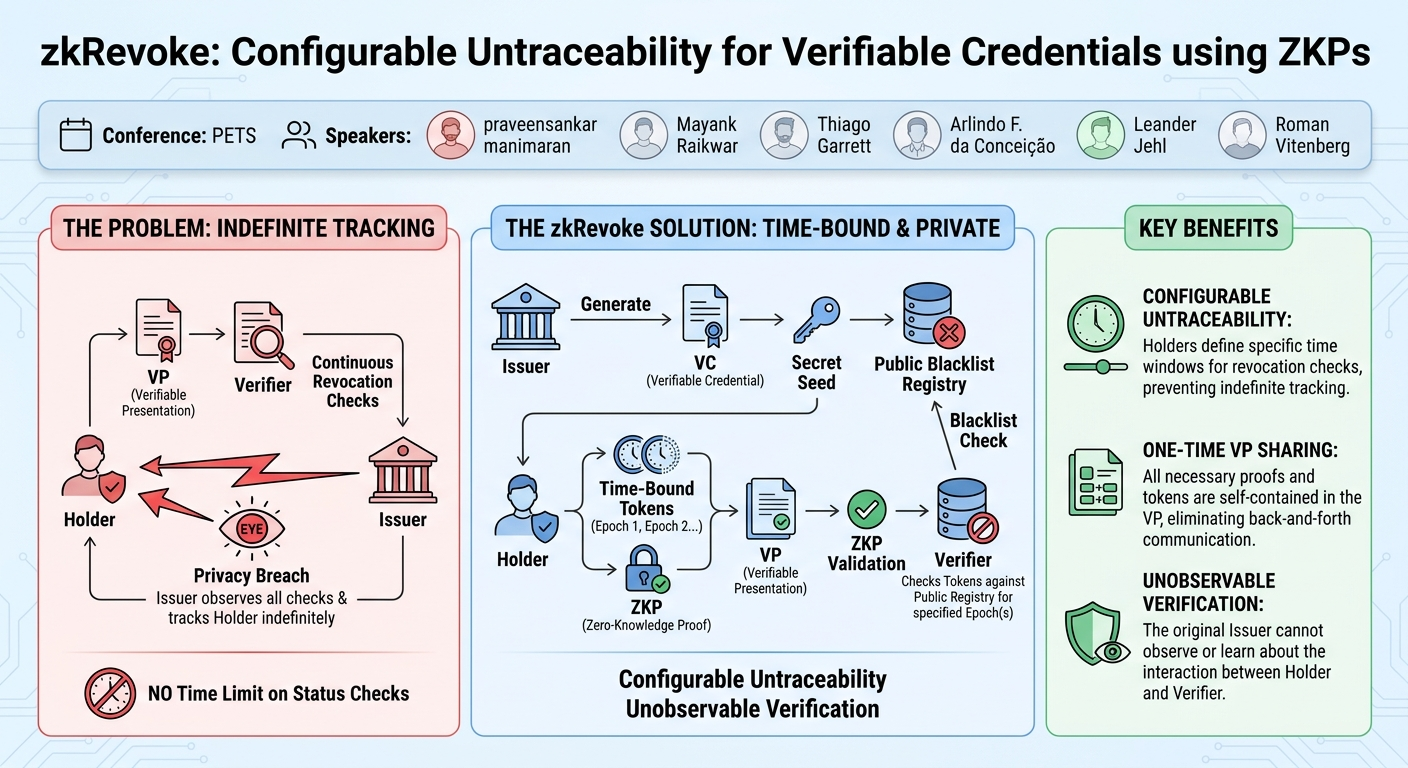
However, a fundamental privacy flaw exists in many current VC implementations: once a verifier obtains a VP, they often gain the capability to continuously track the revocation status of the underlying VC. This means the verifier can query the status of the credential indefinitely, often until its expiration or explicit revocation. In the employment example, this would allow the recruiter to track the applicant's employment status with their previous employer over an extended period. This continuous tracking violates the holder's privacy, as it can reveal sensitive information about their activities or status to entities beyond the initial, intended scope of disclosure. For instance, an employer might learn that an employee is actively seeking other job opportunities, potentially affecting their current working conditions or career trajectory.
To mitigate these profound privacy risks, the zkRevoke protocol sets out to achieve three critical objectives:
- Configurable Period: Holders must be able to restrict verifiers to checking the revocation status only for a specific, limited time period, rather than indefinitely. After this period, the verifier should no longer be able to track the VC's status.
- One-Time VP Sharing: All information necessary for the verifier to check the revocation status, including any time-bound proofs, should be fully contained within the Verifiable Presentation itself. This eliminates the need for further communication between the holder and verifier during the verification process.
- Unobservability of Verification: The original issuer of the VC should not be able to observe or learn about the interaction between the holder and the verifier. This prevents the issuer from inferring sensitive information, such as the holder applying for a job, which could have adverse consequences.
These objectives highlight the need for a paradigm shift in how revocation is handled within the verifiable credentials framework, moving from a continuously monitorable state to a privacy-preserving, time-limited disclosure model.
Key Findings
▶ Watch: ZK Revoke's core mechanism: time-bound tokens (2:45)
The zkRevoke protocol introduces a transformative approach to managing verifiable credential revocation, fundamentally shifting the balance towards enhanced holder privacy. Its key findings and contributions revolve around the innovative integration of time-bound identifiers and Zero-Knowledge Proofs (ZKPs) to achieve configurable untraceability, one-time sharing, and unobservability.
A central innovation is the concept of time-bound identifiers, referred to as tokens. Instead of relying on a permanent, globally unique identifier for a Verifiable Credential (VC) that could be continuously tracked, zkRevoke assigns a unique, permanent seed to each VC, known only to the issuer and holder. From this seed, distinct tokens are generated for each predefined epoch (a sequence of time). This means that for a single VC, there will be a different token for every epoch it remains valid. When a VC is revoked, the issuer stores these time-bound tokens in a registry, operating on a blacklist model for performance reasons. This blacklist is periodically refreshed by the issuer after each epoch, ensuring only relevant, currently revoked tokens are maintained.
Holders play a crucial role by generating tokens for the specific epochs during which they wish to allow revocation status checks. These epoch-specific tokens are then embedded into the Verifiable Presentation (VP). This mechanism directly enables the configurable period property, as the holder dictates the time window for which the verifier can check the status. Furthermore, by including all necessary tokens within the VP, zkRevoke achieves one-time sharing, eliminating the need for back-and-forth communication between the holder and verifier during the verification process.
A significant challenge arises from the holder's ability to generate these tokens: how can a verifier trust that the tokens are correctly derived from a legitimate VC seed and not fabricated? This is where Zero-Knowledge Proofs (ZKPs) become indispensable. zkRevoke mandates that the holder generates a ZKP to cryptographically prove the correctness and ownership of the generated tokens without revealing the underlying seed or any other sensitive information. This ZKP acts as an irrefutable guarantee for the verifier, ensuring the integrity of the tokens without compromising the holder's privacy. The ZKP circuit verifies two critical conditions: the existence of a valid signature on the seed (issued by the original issuer) and the correct computation of the tokens from that seed. All private inputs, such as the seed and the issuer's signature, remain solely with the holder.
Finally, zkRevoke ensures unobservability of verification by the issuer. Since the verifier only interacts with the holder's VP (containing tokens and the ZKP) and the issuer's public blacklist, the issuer is completely uninvolved in the actual verification process. This prevents the issuer from learning about any interactions between the holder and verifiers, thereby protecting the holder's privacy from potential surveillance or inference of activity. The research also presents a detailed evaluation, demonstrating that zkRevoke achieves lower bandwidth compared to accumulator-based protocols like Irma, and for larger numbers of VCs, it also performs better computationally, addressing some of the performance bottlenecks often associated with ZKP-based systems.
Technical Deep Dive
▶ Watch: Using Zero-Knowledge Proofs for token verification (4:45)
The technical architecture of zkRevoke is meticulously designed to achieve its privacy goals by fundamentally altering how revocation status is managed and verified in the Verifiable Credentials (VC) ecosystem. The protocol's efficacy hinges on a synergy between time-bound identifiers, a blacklist revocation model, and the cryptographic power of Zero-Knowledge Proofs (ZKPs).
At the core of zkRevoke is the concept of a seed, a unique, permanent identifier assigned to each VC by the issuer. This seed is a secret shared only between the issuer and the holder, akin to a persistent private key for the credential. To introduce time-bound privacy, time is segmented into discrete units called epochs. For each epoch, a specific token is cryptographically derived from the original seed. This means that a single VC, valid over multiple epochs, will have a distinct token for each epoch. For example, if a VC is valid for epoch_1, epoch_2, and epoch_3, it will yield token_1, token_2, and token_3 respectively, all derived from the same underlying seed. The exact cryptographic primitive for deriving these tokens is not explicitly detailed in the talk, but it would typically involve a secure hash function or a key derivation function, keyed by the seed and the epoch identifier.
The Issuer's role in zkRevoke is twofold. First, they are responsible for assigning the unique seed to each VC during issuance and signing it to attest to its authenticity. Second, when a VC is revoked, the issuer does not revoke the seed itself. Instead, they compute and store the corresponding epoch-specific tokens for the revoked VC in a public registry. This registry functions as a blacklist, meaning it lists all tokens associated with revoked VCs. Crucially, because tokens are time-bound, the issuer must refresh this blacklist after each epoch, removing old tokens that are no longer relevant and adding new ones if VCs are revoked in the current epoch. This dynamic management of the blacklist is essential for maintaining accuracy and preventing indefinite tracking.
The Holder is central to enabling configurable untraceability. When a holder wishes to present a VC to a verifier, they first decide for which specific time period (i.e., which epochs) they want to allow the verifier to check the revocation status. The holder then generates the corresponding tokens for these chosen epochs from their secret seed. These tokens are then included in the Verifiable Presentation (VP). This empowers the holder to define the "configurable period" for revocation checks. For instance, if Bob wants a recruiter to check his employment status only for the next three months, he would include tokens corresponding to those three months' epochs in his VP. This also facilitates one-time VP sharing, as all necessary information for revocation status verification (the tokens) is embedded within the VP itself, eliminating the need for subsequent communication.
However, the verifier needs assurance that the tokens included in the VP are legitimate and correctly derived from a valid VC, rather than being arbitrary, fake tokens generated by the holder. This is where Zero-Knowledge Proofs (ZKPs) become a critical component. The holder generates a ZKP that proves two fundamental properties:
- Correctness of Token Derivation: The ZKP verifies that the included tokens were correctly computed from a valid seed.
- Ownership and Authenticity of Seed: The ZKP proves that the holder possesses a seed that was legitimately signed by the issuer, without revealing the seed itself.
The ZKP circuit designed for zkRevoke encapsulates these conditions. The private inputs to this circuit (known only to the holder) would include the VC's seed and the issuer's signature on that seed. The public inputs would include the derived tokens and potentially the issuer's public key. The ZKP output is a compact proof that the verifier can validate. This mechanism ensures that the verifier can trust the validity of the tokens and, by extension, the revocation status, without gaining access to the sensitive underlying seed that could enable tracking.
The Verifier's role is then straightforward: upon receiving a VP containing epoch-specific tokens and the corresponding ZKP, the verifier first validates the ZKP. If the ZKP is valid, assuring the authenticity and correct derivation of the tokens, the verifier then fetches the relevant blacklist from the public registry for the epoch(s) specified by the holder. Finally, the verifier performs a membership check: if any of the provided tokens are found in the blacklist for the corresponding epoch, the underlying VC is deemed revoked. This entire process occurs without any direct involvement of the issuer, thus ensuring the unobservability of verification.
When comparing zkRevoke to accumulator-based protocols (such as those used in systems like Irma), a significant distinction emerges. Accumulator-based systems often require holders to obtain non-revocation proofs based on future accumulator states, which are updated during revocation events. This necessitates holders fetching new accumulator states and updating their proofs in each epoch, leading to continuous interaction and higher bandwidth usage. zkRevoke circumvents this by embedding all necessary time-bound tokens and the ZKP directly into the VP, enabling true one-time sharing. The evaluation presented indicates that zkRevoke achieves lower bandwidth than Irma due to this self-contained VP construction. Furthermore, for larger numbers of VCs, zkRevoke's computational cost becomes more favorable than that of accumulator-based systems, even though ZKPs generally carry a computational overhead for smaller scales. The protocol's design therefore offers a scalable and privacy-preserving alternative to existing revocation mechanisms.
Demo / Proof of Concept
▶ Watch: Performance evaluation: bandwidth and computation costs (7:00)
The talk primarily focused on the theoretical framework, design, and evaluation results of the zkRevoke protocol. While the authors mention a "proof of correctness in our paper" and "detailed experimental and evaluation" comparing zkRevoke against existing systems like Irma, a live demonstration or specific proof-of-concept implementation was not explicitly detailed during the presentation. The discussion of evaluation results, particularly regarding bandwidth and computation costs, implies that a functional prototype or simulation environment was developed to measure these performance metrics. This evaluation would have involved simulating the issuance, revocation, and verification processes to quantify the protocol's efficiency and validate its practical feasibility, reinforcing the claims made about its superior performance in certain scenarios.
Defensive Implications
▶ Watch: Summary of contributions and future extensions (7:45)
The zkRevoke protocol offers profound implications for defenders across the verifiable credentials ecosystem, providing a clear pathway to enhance privacy and security. Its adoption necessitates a shift in perspective for issuers, holders, and verifiers alike.
For Issuers, the primary implication is the need to integrate robust seed management and token generation mechanisms into their VC issuance platforms. Issuers must be able to securely generate unique seeds for each VC, sign these seeds, and establish a reliable process for deriving epoch-specific tokens upon revocation. The move to a blacklist model for revocation also requires careful consideration regarding storage, refresh cycles, and the public availability of the registry. While a blacklist can offer performance benefits, its management must be meticulous to ensure all revoked tokens are accurately listed and updated across epochs. Issuers should prioritize privacy-by-design principles, understanding that their role shifts from being a potential observer of verification events to solely managing the authenticity and revocation status of the underlying credentials via the public registry.
Holders are arguably the biggest beneficiaries of zkRevoke, gaining unprecedented control over their privacy. Defenders focused on empowering users should advocate for and implement systems that support such configurable untraceability. Holders need intuitive interfaces to specify the desired "configurable period" for revocation checks when creating a Verifiable Presentation (VP). Education is key here, as holders must understand the implications of different disclosure periods and how their privacy is protected through the use of time-bound tokens and Zero-Knowledge Proofs (ZKPs). The ability to share a VP "one-time" without continuous tracking is a significant defensive win for individual privacy against surveillance.
Verifiers must adapt their systems to incorporate ZKP validation and epoch-based revocation checks. This means integrating ZKP verifiers into their existing VC processing pipelines, ensuring they can cryptographically validate the authenticity and correct derivation of tokens without needing to access the holder's private seed. Verifiers must also be prepared to fetch and process epoch-specific blacklists from the public registry, understanding that their ability to check revocation status is limited to the period specified by the holder in the VP. This paradigm shift requires verifiers to respect the holder's privacy boundaries and move away from assumptions of indefinite tracking capabilities. From a defensive standpoint, integrating ZKP verification strengthens the overall security posture by ensuring the integrity of the revocation check itself.
More broadly, zkRevoke underscores the importance of privacy-preserving cryptography in modern digital trust frameworks. It demonstrates how ZKPs can be leveraged not just for anonymous credentials but specifically for enhancing the privacy of revocation mechanisms. Defenders should recognize that the continuous tracking inherent in many current VC systems is a significant privacy vulnerability. Adopting protocols like zkRevoke helps to mitigate this by decoupling the identity of the VC from its revocation status over time and ensuring that verification events do not inadvertently reveal sensitive information to unintended parties (like the issuer). This contributes to building a more resilient, trustworthy, and privacy-respecting digital identity infrastructure.
Key Takeaways
- Verifiable Credentials (VCs) face significant privacy challenges due to existing revocation mechanisms that allow verifiers to continuously track revocation status, potentially exposing sensitive holder information.
- zkRevoke introduces configurable untraceability by employing time-bound identifiers (tokens) derived from a unique VC seed, empowering holders to define how long their revocation status can be checked.
- Zero-Knowledge Proofs (ZKPs) are critical for ensuring the authenticity and correct derivation of these time-bound tokens without revealing the underlying seed, thereby maintaining holder privacy while enabling trusted verification.
- The protocol enables one-time Verifiable Presentation (VP) sharing and unobservable verification by the issuer, as all necessary revocation information is self-contained within the VP, and the issuer is not involved in the real-time verification process.
- zkRevoke offers performance advantages over accumulator-based protocols like Irma, demonstrating lower bandwidth consumption and improved computational efficiency for larger-scale VC deployments.
- The system shifts from persistent, trackable identifiers to dynamic, epoch-specific tokens managed via a refreshed blacklist, fundamentally enhancing privacy in the digital trust ecosystem.
About the Speaker(s)
The talk "zkRevoke: Configurable Untraceability for Verifiable Credentials using ZKPs" was presented by Praveensankar Manimaran, who is listed as a paper author from the University of Oslo, Norway. He represented a team of co-authors who contributed to the research and paper. The full list of authors includes Mayank Raikwar and Thiago Garrett, also affiliated with the University of Oslo, Norway; Arlindo F. da Conceição from the Federal University of São Paulo, Brazil; Leander Jehl from the University of Stavanger, Norway; and Roman Vitenberg, another author from the University of Oslo, Norway. Their collective expertise spans the fields of computer science, security, and privacy, particularly focusing on advanced cryptographic protocols like Zero-Knowledge Proofs and their application in decentralized identity systems.
Reviews
Dr. Zero (Offensive Security Researcher) — SOLID
zkRevoke actually solves a massive privacy leak in the W3C Verifiable Credentials spec where verifiers can perpetually poll revocation endpoints to track users. The math is sound, ditching heavy accumulators for epoch-bound ZKPs and a public blacklist. It's dry academic cryptography, but it's exactly the kind of plumbing we need before governments force mobile IDs on everyone.
Heather Calloway (CISO) — SOLID
Current verifiable credential (VC) architectures carry a massive, unacknowledged privacy liability: they allow verifiers to track a user's credential revocation status indefinitely. This research introduces a cryptographic mechanism to time-box that tracking. It is a required watch for any identity architect or CISO evaluating next-gen IAM platforms.
→ Top-rated talks at Privacy Enhancing Technologies Symposium (PETS) 2026
All talks from Privacy Enhancing Technologies Symposium (PETS) 2026