Revisiting the LiRA Membership Inference Attack Under Realistic Assumptions
Najeeb Jebreel (Paper author · Universitat Rovira i Virgili), Mona Khalil (Paper author · Universitat Rovira i Virgili), David Sánchez (Paper author · Universitat Rovira i Virgili), Josep Domingo-Ferrer (Paper author · Universitat Rovira i Virgili)
Privacy Enhancing Technologies Symposium (PETS) 2026 · Day 3 · Caribou
Overview
This talk, presented by Najeeb Jebreel and his co-authors from Universitat Rovira i Virgili, delves into a critical re-evaluation of the LIRA membership inference attack (MIA), a widely recognized state-of-the-art technique for assessing privacy risks in machine learning models. Membership inference attacks are fundamental to understanding the extent to which a model "remembers" its training data, thus providing a crucial metric for data privacy and the effectiveness of privacy-enhancing technologies like unlearning algorithms. The researchers contend that while LIRA has become a de facto privacy benchmark and even a ground truth for validating other attacks, its reported effectiveness may be significantly overestimated due to several optimistic assumptions commonly made in prior literature.
Key moments
- 0:00 Introduction to LIRA membership inference attack and its importance
- 0:50 Four optimistic assumptions overestimating LIRA's effectiveness
- 2:50 Anti-overfitting dramatically reduces LIRA attack effectiveness
- 3:45 LIRA membership thresholds are unstable at low false positive rates
- 6:00 Vulnerable sets highly sensitive to training stochasticity, change across runs
- 6:40 The 'optimistic paradox': vulnerable models are poorly trained
- 7:20 Key recommendations for realistic LIRA evaluation and mitigation
Revisiting the LiRA Membership Inference Attack Under Realistic Assumptions
Speakers: Najeeb Jebreel (Paper author, Universitat Rovira i Virgili), Mona Khalil (Paper author, Universitat Rovira i Virgili), David Sánchez (Paper author, Universitat Rovira i Virgili), Josep Domingo-Ferrer (Paper author, Universitat Rovira i Virgili)
Conference: PETS
YouTube: https://www.youtube.com/watch?v=wVuf4qv3MvQ
Overview
This talk, presented by Najeeb Jebreel and his co-authors from Universitat Rovira i Virgili, delves into a critical re-evaluation of the LIRA membership inference attack (MIA), a widely recognized state-of-the-art technique for assessing privacy risks in machine learning models. Membership inference attacks are fundamental to understanding the extent to which a model "remembers" its training data, thus providing a crucial metric for data privacy and the effectiveness of privacy-enhancing technologies like unlearning algorithms. The researchers contend that while LIRA has become a de facto privacy benchmark and even a ground truth for validating other attacks, its reported effectiveness may be significantly overestimated due to several optimistic assumptions commonly made in prior literature.
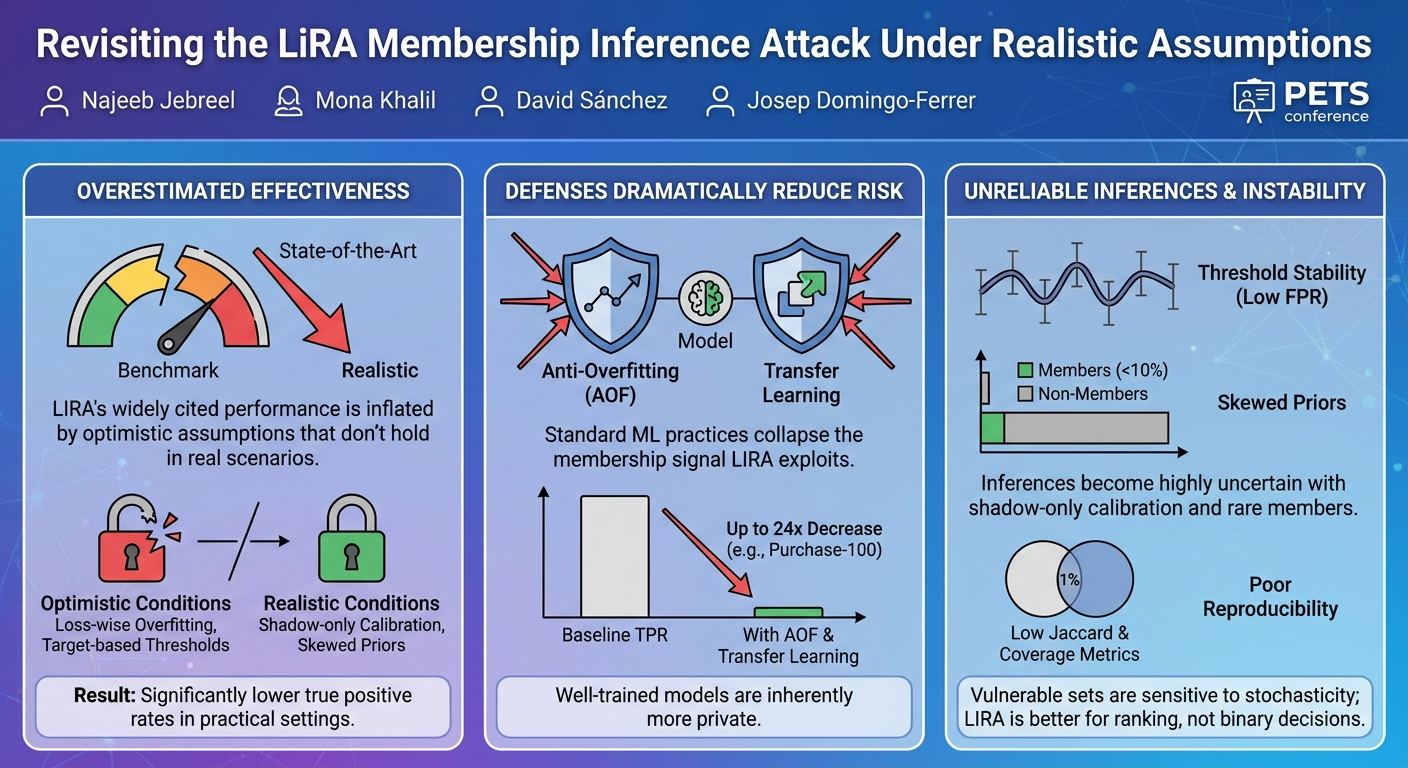
The core of this work is to challenge these optimistic assumptions by subjecting LIRA to a more realistic adversarial and defensive scenario. The authors investigate how LIRA's performance changes when models are trained with anti-overfitting measures and transfer learning, when attackers must calibrate thresholds using only shadow models (not target data), when membership priors are skewed (representing real-world data distributions), and when reproducibility is rigorously tested across multiple runs. Their findings reveal a substantial weakening of LIRA's effectiveness under these more pragmatic conditions, suggesting that current assessments of privacy risks based on LIRA might be unduly pessimistic.
This research is highly significant for both machine learning practitioners and privacy researchers. For practitioners, it offers guidance on how to train and deploy models that are more robust against membership inference, highlighting the importance of proper training methodologies. For researchers, it calls for a recalibration of how MIAs are evaluated, advocating for more stringent and realistic experimental setups to ensure that privacy benchmarks accurately reflect real-world attack capabilities and model vulnerabilities. By scrutinizing a foundational attack method, this paper contributes to a more nuanced and accurate understanding of data privacy in the age of pervasive machine learning.
Background
▶ Watch: Introduction to LIRA membership inference attack and its importance (0:00)
The rapid advancement and widespread deployment of machine learning models have brought unprecedented capabilities but also significant privacy concerns. One of the most prominent concerns is the potential for membership inference attacks (MIAs), where an attacker attempts to determine whether a specific data point was part of a model's training dataset. The success of such an attack directly correlates with the model's ability to "memorize" individual training examples, thereby leaking sensitive information about the individuals whose data contributed to the model's development. Consequently, MIAs serve as a vital tool for measuring the privacy of training data and evaluating the efficacy of unlearning algorithms or other privacy-preserving techniques.
Among the various MIA methodologies, the LIRA (Loss-based Inference Attack) has emerged as a particularly potent and widely adopted approach. LIRA operates by comparing the loss values of a target model on a given data point with the loss values obtained from a collection of "shadow models." These shadow models are trained on datasets similar to the target model's training data, some containing the data point in question and some not. By analyzing the distribution of loss values, LIRA can infer whether the data point was a member of the target model's training set. Its strength lies in its ability to leverage a sufficient number of shadow models, often outperforming even newer attack strategies, which has solidified its status as a state-of-the-art attack. This robust performance has led LIRA to be widely used as a privacy benchmark and even considered a ground truth for validating the effectiveness of cheaper or less sophisticated attacks.
However, the researchers behind this talk identified four critical "optimistic assumptions" that have historically overestimated LIRA's effectiveness in the literature:
- Loss-wise Overfitting: Many models targeted in prior LIRA evaluations were significantly overfitted, meaning they performed exceptionally well on their training data but poorly on unseen data. This overfitting naturally amplifies the signal LIRA exploits, making membership inference easier.
- Target-based Thresholds: Attackers in previous studies often had access to the target model's data for calibrating their inference thresholds. In realistic scenarios, an attacker would not have this privileged information and would need to rely on less precise methods, such as using only shadow model data.
- Balanced Membership Prior: It was often assumed that the proportion of members (data points in the training set) and non-members in the test data was roughly balanced (e.g., 50/50). Real-world scenarios, especially in privacy-critical applications, often involve highly skewed priors, where the likelihood of a given data point being a member is very low.
- Reproducibility Issues: The stability of detected memberships across different runs of the attack or model training was often not rigorously examined. Unstable results undermine the reliability and actionable insights derived from MIA findings.
This research aims to dismantle these optimistic assumptions, providing a more grounded and realistic assessment of LIRA's true capabilities and, by extension, a more accurate understanding of machine learning model privacy.
Key Findings
▶ Watch: Anti-overfitting dramatically reduces LIRA attack effectiveness (2:50)
The research presented in this talk fundamentally challenges the prevailing view of LIRA's potency by evaluating it under a set of more realistic assumptions. The findings consistently demonstrate that LIRA's effectiveness is significantly diminished when these real-world constraints are introduced, leading to a substantial collapse of its ability to reliably infer membership.
Firstly, the most striking finding is the dramatic reduction in LIRA's performance when models are trained with anti-overfitting (AOF) techniques and transfer learning. The researchers observed that the membership signal, which LIRA relies upon to distinguish members from non-members, effectively collapses under these conditions. Quantitatively, the true positive rate (TPR)—the proportion of actual members correctly identified—decreased by an astonishing 16 times relative to the baseline for the CIFAR-10 dataset. For other datasets, the impact was similarly profound, with a 13-fold decrease for CIFAR-100 and an even more significant 24-fold decrease for the Purchase-100 dataset. This highlights the critical role of robust model training in mitigating MIA risks.
Secondly, the study revealed significant instability in LIRA's membership thresholds, particularly when operating at extremely low false positive rates (FPRs), which are desirable in privacy-sensitive contexts to minimize erroneous accusations of membership. The interquartile range for these thresholds was found to be very large, indicating high variability even when using 256 shadow models. This instability persisted even across multiple independent runs, demonstrating that the thresholds LIRA identifies as optimal are highly sensitive to stochasticity in the training process, making reliable threshold selection challenging for an attacker.
Thirdly, the impact of skewed priors on LIRA's inference certainty was substantial. When the proportion of members in the test set was less than 10% (a more realistic scenario than a balanced 50% prior), the membership inferences became highly uncertain. For instance, LIRA's effectiveness on CIFAR-10, which was 94% in the baseline (under optimistic assumptions), plummeted to 49% when AOF and transfer learning were applied alongside skewed priors. This underscores that real-world data distributions significantly impede LIRA's ability to make confident membership judgments.
Fourthly, the research rigorously examined reproducibility across independent runs. The Jaccard metric (measuring similarity between detected member sets) and the coverage metric (measuring the proportion of true members identified) both decreased as the number of runs increased. This indicates that the "vulnerable set" of samples identified as members is highly sensitive to training stochasticity and minor variations in model configuration. Even the top-ranked vulnerable samples, identified with a zero false positive rate, changed substantially across runs. This finding severely undermines the reliability of binary membership decisions made by LIRA.
Finally, the researchers concluded that LIRA is more reliable for ranking the likelihood of a data point being a member rather than making definitive binary decisions. They also identified the loss ratio as a strong proxy for the risk of a true membership inference. Perhaps the most insightful finding is what they termed an "optimistic paradox": the models most vulnerable to LIRA are precisely those that are least suitable for deployment in privacy-critical settings because they are typically more overfit or trained under suboptimal conditions. Conversely, properly trained models with appropriate anti-overfitting measures inherently exhibit lower susceptibility to LIRA.
Technical Deep Dive
▶ Watch: LIRA membership thresholds are unstable at low false positive rates (3:45)
The technical core of this research revolves around systematically dismantling the optimistic assumptions that have historically inflated the perceived effectiveness of the LIRA membership inference attack. The authors designed a realistic evaluation framework by carefully selecting an attacker model, a defender model, and a set of pragmatic experimental conditions.
The attacker considered in this study is strong but constrained. They are capable of utilizing a considerable number of shadow models, up to 256 in the experiments, which is typical for state-of-the-art LIRA implementations. However, critically, this attacker cannot calibrate thresholds using target model data. This simulates a real-world scenario where an adversary does not have privileged access to the victim's private training data. Instead, the attacker is limited to shadow-only threshold calibrations, meaning they must derive their inference thresholds solely from the data available to train their shadow models. This constraint significantly increases the difficulty for the attacker to set accurate decision boundaries.
The defender, on the other hand, is a pragmatic practitioner employing standard, yet effective, machine learning best practices. The primary defensive mechanisms explored are anti-overfitting (AOF) techniques and transfer learning. Anti-overfitting measures, such as regularization, dropout, and early stopping, aim to prevent the model from memorizing individual training examples too closely, thereby reducing the characteristic difference in loss values between members and non-members that LIRA exploits. Transfer learning, where a model is pre-trained on a large, general dataset and then fine-tuned on a smaller, specific dataset, can also implicitly reduce overfitting by leveraging robust, generalized features learned during pre-training. The study evaluates the impact of these techniques on LIRA's ability to extract membership information.
The experimental setup systematically varied the conditions to reflect real-world scenarios:
- Overfitting Mitigation: The researchers explicitly trained target models with anti-overfitting (AOF) and transfer learning. This directly addresses the assumption that attacked models are typically overfitted. The results were stark: the membership signal—the statistical difference in loss distributions between members and non-members—collapsed. For instance, on CIFAR-10, the true positive rate (TPR), which measures the proportion of correctly identified members, decreased by a factor of 16 compared to a baseline without these mitigations. This effect was consistent across various datasets, including CIFAR-100 (13x decrease) and Purchase-100 (24x decrease), demonstrating the universal efficacy of these defensive strategies.
- Realistic Threshold Calibration: Instead of allowing target-based threshold calibration, the experiments strictly enforced shadow-only threshold calibrations. This forced the attacker to rely on less precise information. The study found that LIRA's derived membership thresholds were highly unstable, especially when aiming for extremely low false positive rates (FPRs), such as 10^-5. The interquartile range for these thresholds was substantial, even with 256 shadow models, and this variability increased across multiple independent runs. This instability makes it difficult for an attacker to confidently set a threshold that minimizes false positives while maximizing true positives.
- Skewed Membership Priors: The researchers moved away from the artificial assumption of a balanced 50% membership prior. They introduced skewed priors, where the proportion of members in the test data was less than 10%. This reflects more accurately the scenario in many privacy-critical applications where the vast majority of data points are non-members. Under these conditions, the membership inferences became highly uncertain. For CIFAR-10, the effectiveness dropped from a baseline of 94% to 49% when AOF and transfer learning were combined with skewed priors, indicating that a rare membership signal is much harder to detect reliably.
- Reproducibility Assessment: To address the lack of rigorous reproducibility checks, the study performed multiple independent runs with identical settings. They used the Jaccard metric to quantify the overlap between the sets of identified members across runs and the coverage metric to assess how consistently true members were detected. Both metrics showed a significant decrease as the number of runs increased. This demonstrated that the "vulnerable set" of samples identified by LIRA is highly sensitive to training stochasticity and minor variations in model initialization or data ordering. Even the "top-ranked vulnerable samples" (those with the highest membership scores, often considered with zero FPR) were not consistent across runs, highlighting the unreliability of LIRA for making definitive binary membership decisions.
The authors also observed that the loss ratio—the ratio of a data point's loss on the target model to its loss on shadow models—served as a strong proxy for the risk of a true membership inference. Furthermore, they identified an "optimistic paradox": models that are most vulnerable to LIRA (e.g., highly overfit models) are precisely those that would be considered unsuitable for deployment in privacy-sensitive applications due to their poor generalization and potential for data leakage. Conversely, well-trained models, which are desirable for deployment, are inherently more resistant to LIRA. This suggests that good machine learning practices naturally provide a degree of defense against membership inference.
In summary, the technical deep dive reveals that LIRA's power is heavily contingent on ideal, often unrealistic, conditions. By introducing pragmatic constraints on the attacker and employing standard defensive practices, the researchers demonstrated a significant and consistent reduction in LIRA's effectiveness, urging a re-evaluation of its role as a universal privacy benchmark.
Demo / Proof of Concept
▶ Watch: The 'optimistic paradox': vulnerable models are poorly trained (6:40)
The talk focused on presenting the methodology and empirical results of the research paper rather than showcasing a live demonstration or a specific, interactive proof of concept. The findings were derived from extensive experimental evaluations conducted by the researchers using various datasets and model configurations, as detailed in the technical deep dive. While no live demo was part of the presentation, the quantitative results and statistical analyses presented serve as compelling evidence for their claims regarding LIRA's diminished effectiveness under realistic assumptions.
Defensive Implications
▶ Watch: Key recommendations for realistic LIRA evaluation and mitigation (7:20)
The findings from this research provide crucial, actionable insights for defenders and machine learning practitioners aiming to build and deploy privacy-preserving models. The study effectively translates theoretical attack vulnerabilities into practical defensive strategies, emphasizing that robust ML practices inherently bolster privacy.
Firstly, the most significant defensive implication is the paramount importance of training target models with anti-overfitting (AOF) techniques or transfer learning. The research unequivocally demonstrates that these standard machine learning practices dramatically reduce the membership signal that LIRA exploits. By preventing models from memorizing training data too closely, defenders can make it significantly harder for attackers to distinguish between members and non-members. Implementing techniques such as regularization (L1/L2), dropout, early stopping, and data augmentation should be considered standard procedure, not just for improving generalization but also as a primary defense against membership inference. Leveraging pre-trained models through transfer learning also contributes to this robustness by providing a strong, generalized feature extractor that is less prone to memorizing specific training examples from the fine-tuning dataset.
Secondly, practitioners should be aware that their models' inherent vulnerability to MIAs correlates with their suitability for privacy-critical deployments. The "optimistic paradox" suggests that models most vulnerable to LIRA are often those that are poorly trained or overfit, making them inherently unsuitable for sensitive applications regardless of MIA concerns. Therefore, focusing on building high-quality, well-generalized models is a dual-purpose strategy: it improves model utility and simultaneously enhances privacy against attacks like LIRA.
Thirdly, when assessing the privacy risk of a model, defenders should consider using the lowest loss ratio as a potential indicator. While LIRA is unreliable for binary decisions, the loss ratio itself was identified as a strong proxy for the risk of true membership. Monitoring this metric during model development could provide an early warning system for potential vulnerabilities.
Finally, organizations and researchers evaluating the privacy of machine learning models must adopt more rigorous and realistic methodologies. This means:
- Evaluating with shadow-calibrated thresholds: Do not assume an attacker has access to target data for threshold calibration. Assessments should reflect what an attacker can realistically achieve with only shadow model information.
- Considering skewed priors: Acknowledge that in many real-world scenarios, the proportion of members in the test data is very low. Privacy evaluations should reflect these skewed priors rather than idealized balanced priors, as skewed distributions significantly reduce an attack's effectiveness.
- Checking reproducibility across runs: Before trusting any assessment that a dataset or model is "vulnerable," rigorously test the reproducibility of the findings across multiple independent training and attack runs. If the identified vulnerable sets are highly unstable, the utility of such an assessment for guiding privacy decisions is severely limited.
By adhering to these defensive implications and adopting more realistic evaluation methodologies, defenders can gain a more accurate understanding of their models' privacy posture and deploy systems that are genuinely more resilient to membership inference attacks.
Key Takeaways
- LIRA's effectiveness is significantly overestimated: The widely cited effectiveness of the state-of-the-art LIRA membership inference attack is largely contingent on optimistic assumptions that do not hold in realistic scenarios.
- Anti-overfitting and transfer learning are crucial mitigations: Implementing standard anti-overfitting (AOF) techniques and utilizing transfer learning dramatically reduces LIRA's ability to infer membership, leading to up to a 24-fold decrease in the true positive rate for some datasets.
- Realistic calibration leads to uncertain inferences: When attackers are limited to shadow-only threshold calibrations and face skewed priors (e.g., less than 10% members), LIRA's inferences become highly uncertain and significantly less effective.
- MIA results are highly unstable: The "vulnerable sets" identified by LIRA are extremely sensitive to training stochasticity and model configuration variations, leading to poor reproducibility across independent runs (low Jaccard and coverage metrics).
- LIRA is better for ranking than binary decisions: LIRA is more reliable for ranking the likelihood of a data point being a member than for making definitive binary decisions about membership, which are often unstable and unreliable.
- Well-trained models are inherently more private: Models that are properly trained, well-generalized, and not overfit are inherently more resistant to membership inference attacks, aligning good machine learning practices with enhanced data privacy.
About the Speaker(s)
The talk was presented by Najeeb Jebreel, one of the paper's authors, representing Universitat Rovira i Virgili. He, along with his co-authors Mona Khalil, David Sánchez, and Josep Domingo-Ferrer, are researchers affiliated with Universitat Rovira i Virgili. Their collective work focuses on advancing the understanding of privacy in machine learning, particularly through the rigorous evaluation and re-assessment of established attack methodologies like the LIRA membership inference attack. Their research contributes to developing more robust and realistic privacy benchmarks for the machine learning community.
Reviews
Dr. Zero (Offensive Security Researcher) — MUST SEE
Finally, someone brought a reality check to the ML privacy echo chamber. Jebreel and team took a sledgehammer to the LIRA benchmark, proving that the 'state-of-the-art' membership inference attack completely falls apart the second you step out of a sterile lab environment. If you assess ML privacy risk, you need to read this to understand why our current baseline threat models are largely bullshit.
Heather Calloway (CISO) — STRONG ACCEPT
This research dismantles the hype around the LiRA membership inference attack by proving it fails under real-world conditions. For our risk committee, this is highly actionable news. It proves that standard anti-overfitting practices from our data science teams double as robust privacy controls.
→ Top-rated talks at Privacy Enhancing Technologies Symposium (PETS) 2026
All talks from Privacy Enhancing Technologies Symposium (PETS) 2026