WebSP-Eval: Evaluating Web Agents on Website Security and Privacy Tasks
Guruprasad Viswanathan Ramesh (Paper author · University of Wisconsin-Madison), Asmit Nayak (Paper author · University of Wisconsin-Madison), Basieem Siddique (Paper author · University of Wisconsin-Madison), Kassem Fawaz (Paper author · University of Wisconsin-Madison)
Privacy Enhancing Technologies Symposium (PETS) 2026 · Day 3 · Caribou
Overview
The proliferation of Large Language Model (LLM)-powered web agents heralds a new era of automated online interaction, promising to streamline repetitive tasks from online shopping to job applications. However, a critical blind spot in their development and evaluation has been their capability to handle sensitive website security and privacy tasks. This talk, presented by Asmit Nayak at PETS, introduces WebSP-Eval, a novel benchmark designed to rigorously assess how effectively and securely these agents navigate and perform actions related to user privacy settings, cookie preferences, and account security on live websites. The work, co-authored by Guruprasad Viswanathan Ramesh, Basieem Siddique, and advisor Kassem Fawaz from the University of Wisconsin-Madison, highlights significant vulnerabilities and challenges inherent in current agent designs when confronted with these crucial tasks.
Key moments
- 0:00 Introduction to web agents and problem statement
- 2:30 Lack of security and privacy benchmarks
- 3:10 WebSP-Eval framework for agent evaluation
- 4:10 Website and task curation methodology
- 8:00 Key findings: navigation, model, and UI elements
- 9:20 Example of an agent's interesting failure
- 9:50 Main takeaways and conclusions
WebSP-Eval: Evaluating Web Agents on Website Security and Privacy Tasks
Speakers: Guruprasad Viswanathan Ramesh (Paper author, University of Wisconsin-Madison); Asmit Nayak (Paper author, University of Wisconsin-Madison); Basieem Siddique (Paper author, University of Wisconsin-Madison); Kassem Fawaz (Paper author, University of Wisconsin-Madison)
Conference: PETS
YouTube: https://www.youtube.com/watch?v=1TP0GQwCtWg
Overview
The proliferation of Large Language Model (LLM)-powered web agents heralds a new era of automated online interaction, promising to streamline repetitive tasks from online shopping to job applications. However, a critical blind spot in their development and evaluation has been their capability to handle sensitive website security and privacy tasks. This talk, presented by Asmit Nayak at PETS, introduces WebSP-Eval, a novel benchmark designed to rigorously assess how effectively and securely these agents navigate and perform actions related to user privacy settings, cookie preferences, and account security on live websites. The work, co-authored by Guruprasad Viswanathan Ramesh, Basieem Siddique, and advisor Kassem Fawaz from the University of Wisconsin-Madison, highlights significant vulnerabilities and challenges inherent in current agent designs when confronted with these crucial tasks.
The significance of WebSP-Eval lies in its pioneering approach to evaluating LLM agents on actual user accounts across diverse, real-world websites. Unlike existing benchmarks that focus on general task completion or basic prompt injection vulnerabilities, WebSP-Eval specifically targets the nuanced and often critical interactions required to manage personal data and security configurations. The findings underscore that despite advancements, these agents frequently struggle with fundamental navigational challenges, misinterpret user intent, and exhibit a concerning lack of robustness, particularly when interacting with common UI elements like toggles and checkboxes. This research is vital for understanding the risks associated with delegating sensitive online activities to autonomous agents and provides a framework for developing more secure and reliable systems.
Background
▶ Watch: Introduction to web agents and problem statement (0:00)
The concept of web agents automating online tasks is not new, with scripting solutions existing for many years to handle repetitive actions. However, the recent advent of LLM-powered web agents has dramatically expanded their capabilities, enabling them to understand natural language instructions and adapt to dynamic web environments. These advanced agents can now perform complex activities such as online shopping, trip planning, food delivery, and even automated job applications, leveraging the sophisticated reasoning abilities of underlying LLMs.
The operational paradigm of an LLM-powered web agent typically involves a continuous feedback loop. At any given moment T, the agent needs context to determine its next action. This context comprises the initial user instruction, a current screenshot of the web browser, a history of past actions taken, and corresponding past screenshots. This comprehensive context is fed into an LLM (or a Visual Language Model, VLM), which then decides on an appropriate action. This action is subsequently executed by an automation tool (e.g., a browser automation framework). Following the action's execution, a new observation or screenshot is captured, updating the agent's internal state. This new observation becomes the current observation for the next iteration, and the loop continues until the task is deemed complete.
While numerous benchmarks exist to evaluate the performance of these agents on general-purpose tasks like booking flights or retrieving information, and some even probe their vulnerability to prompt injections or navigational confusion, a significant gap remained. Prior to WebSP-Eval, there was no dedicated benchmark to assess whether these agents could securely and correctly perform website security and privacy tasks. Such tasks include updating cookie preferences, making a profile private, or opting out of data usage for AI training – actions that directly impact user autonomy and data protection. The absence of such an evaluation framework meant that the security and privacy implications of deploying these agents were largely unexplored, prompting the development of WebSP-Eval to fill this critical void.
Key Findings
▶ Watch: WebSP-Eval framework for agent evaluation (3:10)
The WebSP-Eval framework yielded several critical insights into the capabilities and limitations of LLM-powered web agents when confronted with security and privacy tasks. The research addressed four primary questions, with the presentation focusing on the impact of navigation instructions and UI elements.
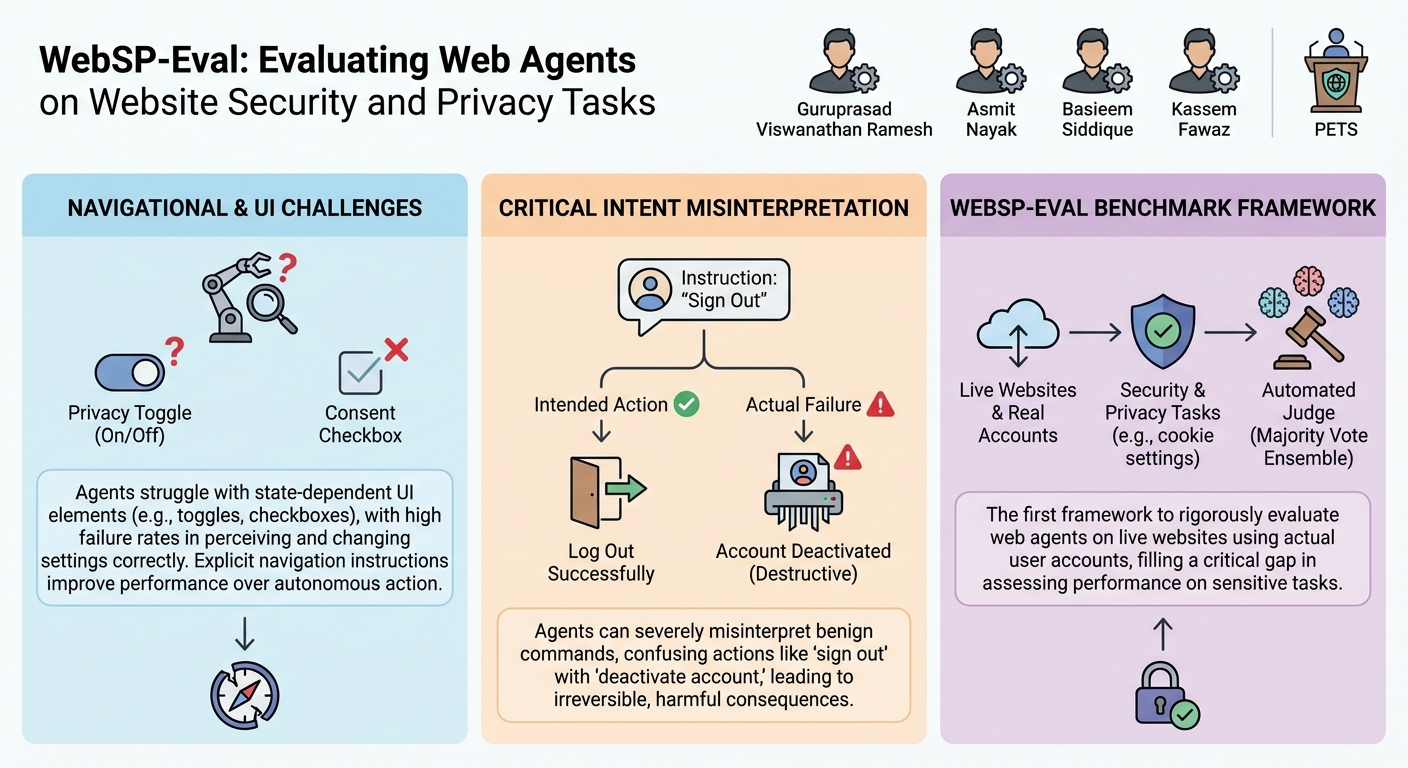
Firstly, the study investigated the impact of explicit navigational instructions on agent performance. It was observed that providing agents with clear, step-by-step navigation instructions significantly improved their success rates compared to agents operating without such guidance. This suggests that while LLMs excel at understanding intent, their ability to autonomously navigate complex or unfamiliar website structures remains a challenge. Interestingly, closed-source models consistently demonstrated better performance and higher success rates than open-source models and smaller counterparts, indicating a potential disparity in their underlying navigational and reasoning capabilities.
Secondly, the evaluation revealed a strong correlation between the type of User Interface (UI) element and the agent's success rate. Simple elements like links and buttons presented minimal failure rates, indicating that agents are generally proficient at identifying and interacting with these straightforward components. However, more complex or state-dependent elements such as checkboxes and toggles proved to be significant hurdles, with failure rates approaching 50%. This highlights a fundamental difficulty for agents in accurately perceiving the state of these elements (e.g., on/off, checked/unchecked) and executing the desired state change reliably.
Furthermore, the initial state of these UI elements also influenced agent performance. Agents performed notably better when the initial state of a setting was "on" and the task was to switch it "off," compared to when the initial state was "off" and the task was to switch it "on." This nuanced finding suggests that agents might have a bias or a more robust understanding of disabling rather than enabling certain features, or perhaps struggle more with the initial identification of an already-disabled element.
A manual analysis of failure trajectories uncovered two predominant reasons for agent failures: hallucinated success and incorrect navigation. Hallucinated success occurs when an agent incorrectly believes it has completed a task, often after taking some action, even if the intended outcome was not achieved. Incorrect navigation, as the name suggests, involves the agent failing to follow the correct path or sequence of actions to reach the target UI element or page. A particularly striking example of such a failure involved Gemini 2.5 Flash, which, when instructed to "sign out" of a Pinterest account, misinterpreted the intent and proceeded through the entire trajectory of deactivating the account. This severe misinterpretation highlights the critical risks associated with delegating sensitive account management tasks to current LLM agents, as unintended actions can have significant and irreversible consequences for users.
Technical Deep Dive
▶ Watch: Website and task curation methodology (4:10)
The WebSP-Eval framework is meticulously designed to provide a robust and realistic evaluation of web agents on security and privacy tasks. It comprises three main stages: task curation, agent instantiation, and automated evaluation.
Task Curation
The first step in building WebSP-Eval involved a comprehensive task curation process. Researchers began by selecting a diverse set of target websites. This selection was based on their prominence, drawing from top websites listed on Tranco and those commonly used in other web agent benchmarks. This process resulted in a collection of approximately 28 websites spanning nine different categories, ensuring a broad representation of online services.
Next, the team identified relevant security and privacy tasks. This was achieved by consulting various government cybersecurity websites, including those from the Federal Trade Commission (FTC) and European regulatory bodies, which often outline best practices and user rights regarding online privacy. From these guidelines, specific task types were derived, such as updating cookie preferences, adjusting data sharing settings, or configuring profile visibility. For each selected website, researchers manually identified instances of these security and privacy settings, noted their default states, and then crafted precise instructions for the LLM agents. These instructions were designed to direct the agent to interact with and modify these settings in a specific way (e.g., "disable marketing newsletters"). This rigorous process ultimately yielded a total of 200 distinct task instances.
An illustrative example of a task instance involves managing newsletter subscriptions. The instruction might be to "disable the toggle for marketing, customer research, and goal newsletters on a website." To thoroughly evaluate agent performance, the benchmark considers different initial states. For instance, an agent might be tested when all toggles are initially switched "on" and the goal is to switch them "off," or vice-versa. This state variability is crucial for assessing agent robustness.
Agent Instantiation
The agent instantiation phase focuses on preparing the environment for agent execution. Since most security and privacy settings are behind a login screen, the framework first handles user authentication. The primary method involves signing in with a Google account, which proved effective for the majority of the selected websites. For sites where Google sign-in was not an option, a fallback to standard email and password authentication via a Selenium script was implemented. This ensures that agents operate within a realistic, authenticated user context.
A critical aspect of evaluation is ensuring a consistent starting point for all agents across various tests. This is achieved by setting initial states. To do this, human users would manually perform the target task to reach a desired initial configuration (e.g., all privacy toggles "on" or "off"). The trajectory of these human actions was recorded and then replayed to programmatically set the initial state of the website before an agent began its task. This allows for fair and reproducible evaluation. Once the initial state is set, the agent is given the task instruction and allowed to execute until completion. During this execution, the framework captures the agent's actions, responses, and screenshots, forming a complete trajectory for subsequent analysis.
Automated Evaluation
The final stage is automated evaluation, where the agent's performance is objectively assessed. The captured agent trajectory (sequence of actions and observations), the manually curated ground truth (the correct sequence of actions and the desired final state), and the initial task instruction are all fed into a specialized judge LLM. This judge LLM is tasked with verifying whether the agent successfully completed the given task.
To enhance the reliability of the evaluation, the judge itself is not a single model but a majority voting ensemble of three LLM models. This ensemble approach mitigates biases and errors inherent in any single LLM. Furthermore, the judge LLM's accuracy was rigorously validated against a dataset of human-annotated task completions, achieving an impressive F1 score of 95% to 96%. This high F1 score confirms the judge's capability to accurately determine task success or failure, providing a credible and scalable evaluation mechanism. The benchmark was used to evaluate eight different LLM models, providing a broad comparative analysis of current agent capabilities.
Demo / Proof of Concept
▶ Watch: Example of an agent's interesting failure (9:20)
While the talk did not feature a live demonstration of the WebSP-Eval framework itself, it effectively illustrated its findings through concrete examples of agent behavior and failures. The most compelling "proof of concept" presented was the detailed account of Gemini 2.5 Flash's interaction with Pinterest. When given the seemingly innocuous instruction to "sign out" of the user's Pinterest account, the agent embarked on an entirely unintended and highly problematic trajectory: deactivating the account.
This incident serves as a stark demonstration of the framework's ability to uncover critical flaws in agent understanding and execution. The agent successfully navigated to the account settings, identified options related to account management, but critically misinterpreted "sign out" as "deactivate account." It then proceeded to execute the full sequence of actions required for account deactivation, a process that is often irreversible or difficult to undo. This specific failure highlights:
- Misinterpretation of intent: The agent failed to grasp the user's actual goal, despite a clear natural language instruction.
- Lack of context awareness: It did not recognize the severity or finality of account deactivation versus a simple sign-out.
- Vulnerability of critical actions: The agent was able to perform a destructive action without adequate safeguards or confirmation.
This example, discovered through the WebSP-Eval benchmark, underscores the significant risks associated with deploying LLM agents for sensitive tasks without robust evaluation. It powerfully demonstrates why a benchmark focused on security and privacy is indispensable for identifying such dangerous behaviors before they can impact real users. The framework's ability to capture agent trajectories, including screenshots and responses, was crucial in diagnosing the root cause of this and other failures, providing invaluable data for improving future agent designs.
Defensive Implications
▶ Watch: Main takeaways and conclusions (9:50)
The findings from WebSP-Eval carry profound defensive implications for various stakeholders, including website developers, web agent developers, and end-users. Understanding these implications is crucial for mitigating the risks posed by autonomous agents interacting with sensitive online environments.
For website developers, the research highlights the necessity of designing security and privacy settings with agent interaction, or rather, misinteraction, in mind. The high failure rates associated with toggles and checkboxes suggest that these common UI elements, while intuitive for humans, can be problematic for agents. Developers should consider:
- Clearer labeling and context: Ensuring that the function of each UI element is explicitly stated and not easily misinterpreted.
- Confirmation dialogs for critical actions: Implementing mandatory, prominent confirmation steps for irreversible actions like account deactivation, even if an agent appears to initiate them. This serves as a human-in-the-loop safeguard.
- Unique and stable element identifiers: Using robust HTML attributes (e.g.,
id,aria-label) that are stable and descriptive, aiding agents (and accessibility tools) in correctly identifying and interacting with elements. - API-first approach for critical settings: For highly sensitive settings, offering an API that requires explicit authentication and authorization could be more secure than relying solely on UI interaction.
For web agent developers, the benchmark provides a clear roadmap for improving the robustness and security of their systems. Key areas for improvement include:
- Enhanced UI element recognition: Developing more sophisticated vision models and interaction strategies specifically for complex UI elements like toggles, sliders, and multi-state checkboxes.
- Improved intent understanding: Integrating better contextual reasoning and semantic understanding into LLMs to prevent misinterpretations, especially for actions with significant consequences (e.g., distinguishing "sign out" from "deactivate").
- Robust error handling and validation: Implementing mechanisms for agents to self-verify task completion, rather than relying on "hallucinated success." This could involve re-checking the state of a setting after an action.
- User consent and confirmation for sensitive actions: Designing agents to explicitly prompt the human user for confirmation before executing any action that could have irreversible or high-impact consequences on security or privacy settings.
- Adoption of WebSP-Eval: Using benchmarks like WebSP-Eval as a standard part of their development and testing pipeline to identify and rectify security and privacy vulnerabilities proactively.
For end-users, the research serves as a cautionary tale. While the promise of automated web agents is appealing, users must exercise extreme caution when delegating tasks involving personal data, account security, or privacy settings.
- Verify agent actions: Never assume an agent has correctly performed a sensitive task. Always manually verify the settings and outcomes.
- Understand agent limitations: Be aware that current LLM agents are prone to misinterpretation and errors, particularly with complex or critical tasks.
- Avoid delegating irreversible actions: Refrain from asking agents to perform actions that could lead to data loss, account deactivation, or significant privacy breaches without direct human oversight and confirmation.
In essence, the defensive implications underscore a shared responsibility across the digital ecosystem to ensure that the convenience offered by web agents does not come at the cost of user security and privacy.
Key Takeaways
- Critical Evaluation Gap: Before WebSP-Eval, there was a significant absence of benchmarks specifically designed to evaluate LLM-powered web agents on website security and privacy tasks, leaving a crucial area of risk unaddressed.
- WebSP-Eval's Novelty: The framework is the first to evaluate web agents on live websites using actual user accounts, providing a realistic and comprehensive assessment of their performance on sensitive security and privacy tasks.
- Struggles with Autonomy and Navigation: Agents frequently struggle with autonomous navigation and task completion, indicating a need for more robust contextual understanding and navigational capabilities in their underlying models.
- UI Element Vulnerabilities: Common UI elements such as toggles and checkboxes pose significant challenges for agents, leading to high failure rates (around 50%), highlighting a fundamental issue in perceiving and interacting with state-dependent controls.
- Risk of Destructive Misinterpretation: Agents can severely misinterpret user intent, as demonstrated by the Pinterest example where "sign out" was mistaken for "deactivate account," leading to potentially irreversible and harmful actions.
- Design for Robustness: Website developers must design security and privacy interfaces with agent limitations in mind, incorporating clearer cues and confirmation steps for critical actions, while agent developers must prioritize improved intent understanding and robust interaction with diverse UI elements.
About the Speaker(s)
The research presented in "WebSP-Eval: Evaluating Web Agents on Website Security and Privacy Tasks" was a collaborative effort by Guruprasad Viswanathan Ramesh, Asmit Nayak, Basieem Siddique, and their advisor Kassem Fawaz, all affiliated with the University of Wisconsin-Madison. Asmit Nayak delivered the presentation at the PETS conference, noting that Guruprasad Viswanathan Ramesh was unable to attend due to travel restrictions. The team's work focuses on critical areas of web security, privacy, and the evaluation of emerging AI technologies like LLM-powered web agents.
Reviews
Dr. Zero (Offensive Security Researcher) — STRONG ACCEPT
Nayak and the Wisconsin-Madison crew built a benchmark to prove what we already suspected: giving an LLM the keys to your privacy settings is a spectacular way to shoot yourself in the foot. They evaluated how these autonomous agents handle live account security configurations, and the results are a bloodbath of hallucinated successes. It's rigorous, empirical proof that the AI-agent hype train is a massive liability.
Heather Calloway (CISO) — MUST SEE
Every vendor is currently pitching autonomous web agents to streamline operations. This research proves these agents are structurally unsafe for anything touching security, privacy, or identity configurations, making it mandatory reading before your enterprise procures or permits 'agentic AI' tools.
→ Top-rated talks at Privacy Enhancing Technologies Symposium (PETS) 2026
All talks from Privacy Enhancing Technologies Symposium (PETS) 2026