LendLocked: Privacy & Transparency for Digital Library Lending
Boya Wang (Paper author · MPI-SP and EPFL), Peter Hall (Paper author · NYU), Sunoo Park (Paper author · NYU)
Privacy Enhancing Technologies Symposium (PETS) 2026 · Day 3 · Moose
Overview
In the digital age, the simple act of borrowing a book from a library has become a complex privacy challenge. The talk "LendLocked: Privacy & Transparency for Digital Library Lending," presented at PETS by Peter Hall, a co-author alongside Boya Wang and Sunoo Park, introduces a groundbreaking protocol designed to restore the privacy norms of physical libraries to their digital counterparts. This research directly confronts the pervasive issue of third-party intermediaries in digital lending platforms, which routinely collect and analyze sensitive user borrowing and reading data.
Key moments
- 0:00 Digital lending's privacy challenges and lawsuit context
- 2:15 Research question: balancing access control and privacy
- 4:00 LendLocked model: removing intermediaries with transparency log
- 5:30 Cryptographic building blocks for the LendLocked protocol
- 6:10 Performance: Full audit for large libraries in days
- 7:10 Key takeaway: library privacy norms inform crypto definitions
- 8:00 Open questions and future work for LendLocked
LendLocked: Privacy & Transparency for Digital Library Lending
Speakers: Boya Wang, Paper author, MPI-SP and EPFL; Peter Hall, Paper author, NYU; Sunoo Park, Paper author, NYU
Conference: PETS
YouTube: https://www.youtube.com/watch?v=hos3H7FdNng
Overview
In the digital age, the simple act of borrowing a book from a library has become a complex privacy challenge. The talk "LendLocked: Privacy & Transparency for Digital Library Lending," presented at PETS by Peter Hall, a co-author alongside Boya Wang and Sunoo Park, introduces a groundbreaking protocol designed to restore the privacy norms of physical libraries to their digital counterparts. This research directly confronts the pervasive issue of third-party intermediaries in digital lending platforms, which routinely collect and analyze sensitive user borrowing and reading data.
The core of LendLocked is its innovative approach to satisfying two seemingly conflicting requirements: the robust access control demanded by publishers to prevent copyright infringement, and the stringent privacy expectations of library patrons. By eliminating the need for a central, trusted intermediary that tracks user activities, LendLocked proposes a system where libraries can lend digital ebooks transparently and accountably, while individual user privacy remains fully protected. This work is not merely a technical exercise but is deeply informed by an interview study with librarians and activists, ensuring its design aligns with long-held professional ethics around patron privacy.
The significance of LendLocked extends beyond theoretical cryptography. It offers a practical framework for Controlled Digital Lending (CDL) that could reshape the legal and operational landscape of digital libraries. By demonstrating that privacy and transparency are not mutually exclusive in digital lending, the authors provide a pathway for libraries to uphold their foundational values in an increasingly digitized world, offering a much-needed alternative to surveillance-prone commercial platforms.
Background
▶ Watch: Digital lending's privacy challenges and lawsuit context (0:00)
Traditional physical book lending has historically operated under clear, privacy-preserving principles. Rooted in the First Sale Doctrine, a library that purchases a physical copy of a book is free to lend it out, provided only one copy is in circulation at a time. The library knows who borrows a book, but this information is typically kept private and is not shared with third parties, nor are reading habits tracked. This model inherently protects patron privacy, a cornerstone of library ethics.
However, the transition to digital lending introduces significant complexities. Unlike physical books, digital files can be copied infinitely at virtually no cost, making robust access control a paramount concern for publishers and distributors. To address this, the prevailing model for digital ebook lending relies heavily on intermediary platforms such as OverDrive (used by Libby), Adobe Digital Editions, or even general-purpose cloud storage like Google Drive. These platforms manage licenses, track the number of copies in circulation, and enforce lending periods.
The critical drawback of this intermediary-centric model is its inherent privacy compromise. These platforms, by design, gain visibility into users' borrowing patterns and, in many cases, even their reading patterns. This centralized collection of sensitive data fundamentally contradicts the privacy norms established by physical libraries. Users are forced to trade their privacy for access to digital content, a Faustian bargain that libraries and privacy advocates find unacceptable. The issue gained widespread attention during the COVID-19 pandemic with the Internet Archive's "Emergency Library," which faced a lawsuit from publishers (Hachette vs. Internet Archive) that questioned the legality and copyright compliance of Controlled Digital Lending (CDL) itself. This legal challenge highlighted the urgent need for technical solutions that could enable CDL while satisfying both copyright holders' need for access control and patrons' right to privacy.
Recognizing this critical gap, the authors embarked on an interview study involving 11 participants, including library staff and activists. The rationale was to understand the problem from the perspective of those most impacted by the privacy erosion – the libraries and their patrons – given that distributors generally accept the status quo. This qualitative research revealed eight overarching themes, with five directly informing the design of the LendLocked protocol, many of which revolved around issues commonly found in SaaS (Software as a Service) environments. The findings underscored that the "gold standard" for digital lending should closely mirror the privacy and transparency of physical lending, without infringing on copyright.
Key Findings
▶ Watch: LendLocked model: removing intermediaries with transparency log (4:00)
The research presented in "LendLocked" culminates in several key findings that collectively propose a paradigm shift for digital library lending.
Firstly, the interview study with 11 library staff and activists proved instrumental. By focusing on the perspectives of those directly engaged with patrons and their privacy, the researchers gained invaluable insights into the practical and ethical considerations surrounding digital lending. This qualitative data, though non-technical, directly informed the technical design, highlighting the importance of bridging the gap between user needs and cryptographic solutions. Eight overall themes emerged, with five being directly incorporated into the system design, many of which touched upon the inherent privacy and control issues associated with third-party Software-as-a-Service (SaaS) providers.
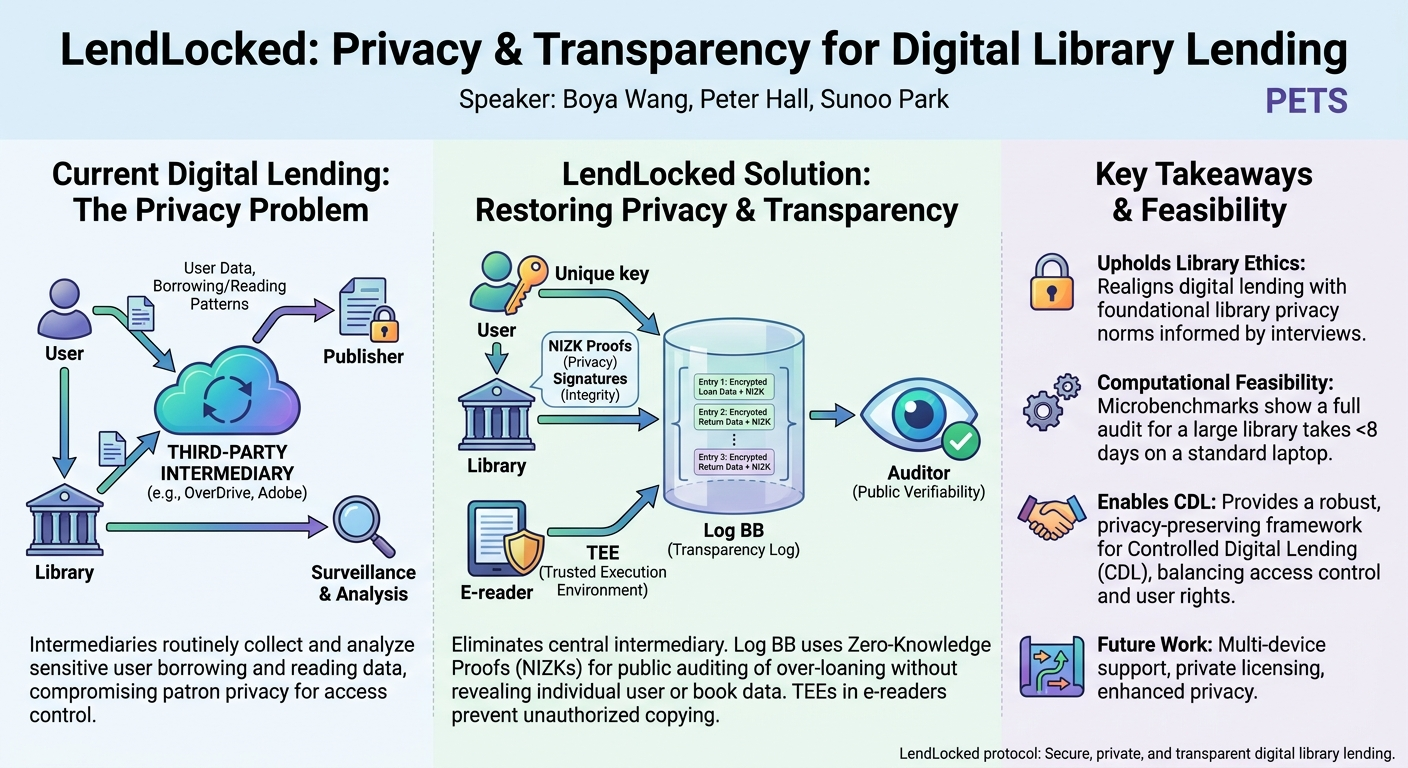
Building on these insights, the authors developed a concrete formal model for private and transparent digital lending. A central innovation of this model is the complete elimination of the traditional third-party intermediary platform that tracks user data. Instead, the model introduces a new architecture comprising a User, a Library, an E-reader, an outward Auditor (V), and a crucial component: a transparency log, dubbed Log BB.
The Log BB serves as the public, auditable record of all lending activities. Its design incorporates two critical properties:
- Public Verifiability: Anyone (including an Auditor) can read Log BB to verify that the library is not over-loaning any books – that is, it is not lending out more digital copies than it legitimately owns licenses for. This ensures copyright compliance and transparency to the public and publishers.
- Individual Privacy: Only an individual e-reader can check that its specific borrowing records are represented correctly on the log, without revealing its identity or the specific books borrowed to anyone else. This preserves user privacy while maintaining accountability.
Together, these properties ensure the integrity and correctness of the log without compromising individual privacy. The model also introduces a novel concept of copy deterrents within the e-reader. This mechanism is designed to prevent unauthorized copying without devolving into a full Digital Rights Management (DRM) system, which often comes with its own set of privacy and usability issues. The goal is to make unauthorized copying as difficult as "basically rewriting the book" itself, thus providing a strong disincentive without invasive surveillance.
Finally, the research formalized 11 distinct definitions derived from this model. These definitions rigorously specify correctness, soundness, and privacy properties for the three main functionalities of the system (borrowing, returning, and auditing), in addition to the copy deterrents definition. The process of extracting these formal cryptographic definitions from the non-technical interviews was noted as particularly challenging but ultimately highly valuable, underscoring the deep integration of user-centric research into cryptographic design. This comprehensive set of definitions provides a clear blueprint for evaluating and ensuring the security and privacy guarantees of any future digital lending system.
Technical Deep Dive
▶ Watch: Cryptographic building blocks for the LendLocked protocol (5:30)
The LendLocked protocol is engineered to achieve its privacy and transparency goals by strategically deploying a suite of cryptographic primitives, fundamentally reimagining the architecture of digital lending. The central tenet is the removal of the centralized intermediary, replacing it with a distributed, verifiable system.
The protocol operates with five primary entities: the User, the Library, the E-reader, an external Auditor (V), and the Log BB (the transparency log). The Log BB is not a trusted third party but a publicly verifiable, append-only record that ensures accountability without compromising individual privacy.
At a high level, the system's core functionalities – borrowing, returning, and auditing – are built upon well-established cryptographic building blocks:
- User and E-reader Key Management: When a user wishes to borrow an ebook, they interact with the library. For each e-reader a user utilizes, a unique key pair is generated. This process leverages Key Derivation Functions (KDFs) and Merkle Trees. KDFs are used to derive specific keys securely, while Merkle trees provide an efficient and tamper-evident way to manage and verify the integrity of these key pairs within the system. This ensures that each e-reader has unique credentials, preventing unauthorized access or sharing, and allowing for efficient proof of inclusion or exclusion in a set of valid keys.
- Transparency Log (Log BB) Operations: The Log BB is the heart of the system's transparency and access control. When a book is borrowed or returned, an entry is added to this log. The integrity and privacy of these entries are maintained using a combination of signature schemes, collision-resistant hashes, and Non-Interactive Zero-Knowledge Proofs (NIZKs).
- Signature schemes are used by the Library to sign log entries, proving that the entry was legitimately added by a recognized entity.
- Collision-resistant hashes ensure that log entries cannot be tampered with or forged without detection.
- NIZKs are perhaps the most critical component for privacy. When an entry is added to Log BB, the Library generates a NIZK proof. This proof demonstrates that a valid lending operation (e.g., a specific book was lent to a specific user for a specific period, and the library has the right to lend it) has occurred, without revealing the identity of the borrower or the specific title of the book. This allows auditors to verify the correctness of the log (e.g., that no more copies are lent out than owned) while preserving the privacy of individual transactions. Similarly, an e-reader can use NIZKs to prove that its individual borrowing record is correctly reflected in the Log BB without revealing which record it is.
- Copy Deterrents within the E-reader: To prevent unauthorized duplication of digital content, the protocol incorporates Trusted Execution Environments (TEEs) within the e-reader. TEEs, such as Intel SGX or ARM TrustZone, provide a secure, isolated environment on the e-reader's hardware where sensitive operations can be performed and data can be stored, protected from the rest of the operating system and potential malware. In LendLocked, the TEE is responsible for enforcing the copy deterrents. It ensures that the digital content, once loaded, cannot be easily extracted, copied, or transferred outside the secure environment. The goal is to make copying as difficult as "rewriting the book," effectively raising the barrier to piracy to a level that deters casual or even moderately skilled attackers, without resorting to invasive DRM techniques that track user behavior.
The interaction flows are designed to be efficient. For instance, when borrowing, the user requests a book, the library verifies eligibility and available copies, generates the necessary cryptographic keys and NIZK proofs, and updates the Log BB. The e-reader then fetches the content and uses its TEE to secure it. Auditing involves an external party querying the Log BB and verifying the NIZK proofs to ensure the library's compliance with its licensing agreements, all without accessing private user data. This modular design, utilizing plug-and-play crypto, allows for flexibility and potential future enhancements.
Demo / Proof of Concept
▶ Watch: Key takeaway: library privacy norms inform crypto definitions (7:10)
While the presentation did not feature a live, user-facing demonstration of the LendLocked protocol, the authors did conduct extensive microbenchmarks to evaluate its practical feasibility and performance characteristics. This empirical analysis serves as a crucial proof of concept, demonstrating that the computationally intensive aspects of the protocol are well within acceptable limits for real-world deployment.
The benchmarking focused specifically on the borrow and audit functionalities. These two operations were identified as the most computationally demanding parts of the protocol, with the return functionality being largely symmetrical to borrowing and thus not requiring separate, extensive benchmarking.
The results of the microbenchmarks were highly encouraging. For a full outside audit, a critical function for ensuring transparency and copyright compliance, the system demonstrated remarkable efficiency. Even for the scale of the largest libraries in the world, which can handle around 50 million circulations per month (encompassing both digital and physical loans), a complete audit of the LendLocked system takes less than eight days when run on a standard MacBook Pro.
This performance figure is significant for several reasons. Firstly, it indicates that the cryptographic overhead introduced by LendLocked's privacy and transparency mechanisms is not prohibitive. Secondly, the authors highlighted that such background computational tasks are already standard practice in libraries for operations like archival, data integrity checks, and statistical reporting. Therefore, integrating a monthly or bi-monthly audit process for LendLocked would align with existing library operational paradigms and would not represent an unreasonable burden.
The successful microbenchmarking underscores the practical viability of LendLocked. It moves the concept beyond a purely theoretical construct, demonstrating that a system capable of delivering robust privacy and transparent accountability in digital lending can be implemented and operated efficiently at scale, paving the way for future production deployments and broader adoption.
Defensive Implications
▶ Watch: Open questions and future work for LendLocked (8:00)
The LendLocked protocol offers profound defensive implications for all stakeholders in the digital library ecosystem: libraries, publishers, and individual patrons. By fundamentally redesigning the digital lending infrastructure, it provides tangible mechanisms to address existing vulnerabilities and uphold ethical standards.
For libraries, LendLocked is a powerful tool to uphold their long-standing ethical commitment to patron privacy. Current digital lending platforms force libraries to compromise on this principle by relying on third-party intermediaries that track user data. With LendLocked, libraries can offer digital ebooks without exposing their patrons' borrowing and reading patterns to external surveillance. This allows them to maintain their role as trusted custodians of knowledge and privacy, strengthening the bond with their communities and reinforcing intellectual freedom. The transparency log, while publicly auditable for compliance, ensures that individual patron data remains private from the library itself, going beyond the traditional "gold standard" of physical lending where the library does know who borrowed what.
For publishers and distributors, LendLocked provides a robust framework for access control and copyright compliance that is auditable and transparent. The Log BB and its associated cryptographic proofs (NIZKs) offer verifiable assurance that libraries are not over-loaning digital copies. Publishers can audit the system to confirm that only the licensed number of copies are in circulation at any given time, without needing to know the identities of the individual borrowers or their specific reading habits. This addresses the core concern of preventing unauthorized copying and distribution, which has historically driven the reliance on invasive DRM and intermediary platforms. By offering a privacy-preserving alternative, LendLocked could facilitate broader adoption of digital lending models that respect both intellectual property rights and user privacy.
For individual users, LendLocked represents a significant enhancement of their digital privacy rights. It means they can access digital library content without the fear that their reading choices are being monitored, aggregated, or potentially exploited by commercial entities. This fosters a more open and uninhibited engagement with literature and information, crucial for intellectual exploration and personal development. The protection afforded by TEEs in e-readers further ensures that the content they access remains private and secure against unauthorized duplication.
Beyond these direct implications, LendLocked strengthens the legal and operational arguments for Controlled Digital Lending (CDL). By demonstrating a technically sound method to ensure single-copy lending and auditable compliance without violating privacy, it provides a robust counter-argument to claims that CDL inherently infringes copyright. This could help libraries advocate for policies that support broader digital access under fair use principles, ultimately benefiting public access to knowledge.
However, the authors also highlight several open questions and areas for future development. Extending the scheme to support multiple e-readers per user (beyond simply lending multiple copies of a book) is a desirable feature. Integrating private licensing schemes, which offer elasticity to demand (e.g., acquiring many copies for a trendy book and then reducing holdings), is also crucial, as libraries often see licensing and lending as complementary. The possibility of achieving even greater privacy against libraries themselves, beyond the physical lending gold standard, remains an intriguing avenue. Finally, the need for private statistics – aggregated, privacy-preserving data on library usage – requires further research into what librarians truly need, as initial interviews did not yield clear requirements. These future directions underscore that while LendLocked is a significant step forward, the journey towards a fully private and transparent digital library ecosystem is ongoing.
Key Takeaways
- Current digital ebook lending models, reliant on third-party intermediaries, fundamentally compromise user privacy by tracking borrowing and reading patterns.
- Librarians possess a distinct and rigorous set of privacy norms, deeply rooted in their professional ethics, which are crucial for informing the design of privacy-enhancing technologies.
- LendLocked introduces a novel protocol that leverages standard cryptographic primitives – including Key Derivation Functions, Merkle Trees, Non-Interactive Zero-Knowledge Proofs (NIZKs), and Trusted Execution Environments (TEEs) – to achieve both privacy for users and transparency for copyright holders.
- The protocol's central component, the Log BB transparency log, allows public auditing of a library's lending compliance (preventing over-loaning) while maintaining the privacy of individual user transactions.
- Microbenchmarks demonstrate that the LendLocked protocol is computationally feasible, with a full audit for even the largest libraries taking less than eight days on a standard laptop, aligning with existing library background processes.
- While a significant advancement, future work includes supporting multiple e-readers per user, integrating private licensing, enhancing privacy against libraries themselves, and further exploring the specific needs for privacy-preserving usage statistics.
About the Speaker(s)
The talk "LendLocked: Privacy & Transparency for Digital Library Lending" was presented by Peter Hall, a paper author affiliated with NYU. He discussed this work, which was a joint effort with his co-authors, Boya Wang from MPI-SP and EPFL, and Sunoo Park also from NYU. The team's collective research focuses on developing innovative cryptographic solutions to real-world privacy challenges, particularly within the digital domain.
Reviews
Dr. Zero (Offensive Security Researcher) — STRONG ACCEPT
OverDrive and Adobe aren't library platforms; they're surveillance tools wearing cardigans. Hall, Wang, and Park tackle the Internet Archive copyright mess by dropping a NIZK-backed transparency log that proves licensing compliance without doxing readers. It’s elegant applied cryptography that solves a massive legal and privacy bottleneck in Controlled Digital Lending.
Heather Calloway (CISO) — SOLID
This is academic privacy research focused on digital library lending, but it solves a universal enterprise problem: proving compliance to an external auditor without exposing the underlying sensitive data. It demonstrates a practical path for replacing data-hoarding SaaS intermediaries with cryptographic transparency logs. Solid architectural reading for privacy engineering teams.
→ Top-rated talks at Privacy Enhancing Technologies Symposium (PETS) 2026
All talks from Privacy Enhancing Technologies Symposium (PETS) 2026