EvaluatAR: A Cross-Device Evaluation Framework for Rapid Prototyping of Bystander PETs in AR
Syed Ibrahim Mustafa Shah Bukhari (Paper author · Virginia Tech), Matthew Corbett (Paper author · Army Cyber Institute at West Point), Bo Ji (Paper author · Virginia Tech), Brendan David-John (Paper author · Virginia Tech)
Privacy Enhancing Technologies Symposium (PETS) 2026 · Remote
Overview
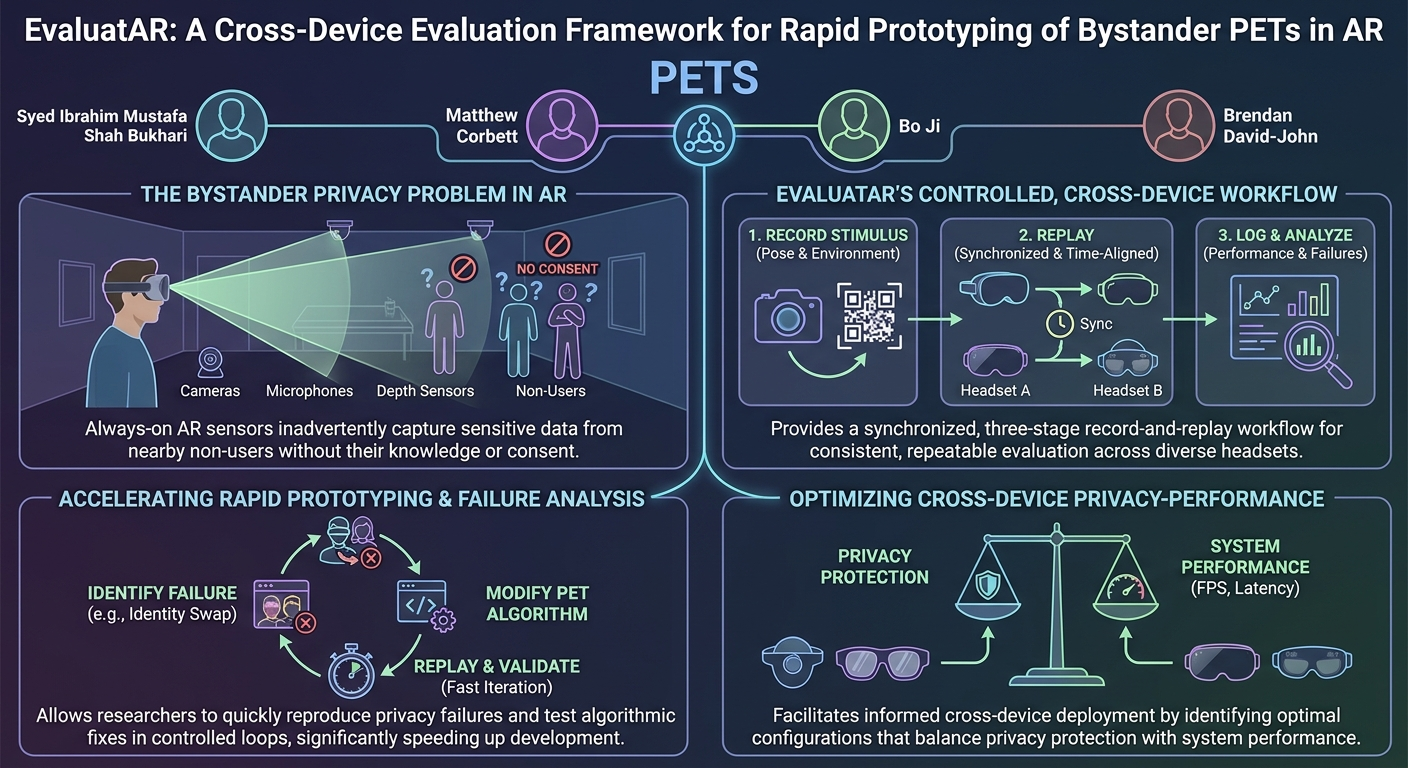
This article explores "EvaluatAR," a novel cross-device evaluation framework designed for the rapid prototyping and rigorous assessment of Bystander Privacy Enhancing Technologies (PETs) in augmented reality (AR) environments. Presented by Syed Ibrahim Mustafa Shah Bukhari and his collaborators from Virginia Tech and the Army Cyber Institute at West Point, this work addresses a critical and growing privacy challenge posed by the proliferation of always-on AR devices. As AR headsets and smart glasses become more ubiquitous, their continuous sensing capabilities—encompassing cameras, microphones, and depth sensors—inadvertently collect vast amounts of data about individuals who are merely in the vicinity of the device, often without their knowledge or consent.
Key moments
- 0:00 Introduction to bystander privacy problem in AR
- 2:00 Limitations of traditional PET evaluation methods
- 2:38 EvaluatAR's three-stage record and replay workflow
- 4:10 Practical setup for reproducible cross-device trials
- 5:10 Case study: Cross-device PET performance comparison
- 5:58 Case study: Rapid prototyping by reproducing PET failures
- 7:25 Future directions: Multimodal PETs and human studies
- 8:00 Open-source EvaluatAR framework for researchers
EvaluatAR: A Cross-Device Evaluation Framework for Rapid Prototyping of Bystander PETs in AR
Speakers: Syed Ibrahim Mustafa Shah Bukhari (Paper author, Virginia Tech); Matthew Corbett (Paper author, Army Cyber Institute at West Point); Bo Ji (Paper author, Virginia Tech); Brendan David-John (Paper author, Virginia Tech)
Conference: PETS
YouTube: https://www.youtube.com/watch?v=OlKX5NbtZ30
Overview
This article explores "EvaluatAR," a novel cross-device evaluation framework designed for the rapid prototyping and rigorous assessment of Bystander Privacy Enhancing Technologies (PETs) in augmented reality (AR) environments. Presented by Syed Ibrahim Mustafa Shah Bukhari and his collaborators from Virginia Tech and the Army Cyber Institute at West Point, this work addresses a critical and growing privacy challenge posed by the proliferation of always-on AR devices. As AR headsets and smart glasses become more ubiquitous, their continuous sensing capabilities—encompassing cameras, microphones, and depth sensors—inadvertently collect vast amounts of data about individuals who are merely in the vicinity of the device, often without their knowledge or consent.
The core problem, termed the bystander privacy problem, arises from AR devices' need to constantly map and understand the real world to overlay virtual content accurately. This continuous data collection, while essential for immersive experiences, captures sensitive information about non-users, ranging from their faces and conversations to their movements and personal documents. While various visual bystander PETs have been developed to mitigate these risks, their evaluation has historically been inconsistent, often limited to single devices, costly to reproduce, and lacking in standardized performance and privacy trade-off analyses across different AR platforms.
EvaluatAR offers a paradigm shift in PET evaluation by introducing a controlled, repeatable, and cross-device framework. By separating early-stage, technical evaluation from later-stage human studies, it enables researchers to systematically test PETs across diverse hardware, rapidly iterate on design improvements, and precisely identify privacy-performance trade-offs. This work is crucial for fostering the development of more robust and trustworthy AR privacy solutions, ultimately protecting individuals in an increasingly augmented world.
Background
▶ Watch: Introduction to bystander privacy problem in AR (0:00)
The rapid advancement and commercial availability of augmented reality (AR) devices, from powerful headsets like the HoloLens 2 and Magic Leap 2 to more subtle smart glasses, herald a new era of immersive computing. These devices, however, are fundamentally reliant on continuous, outward-facing sensing to achieve their core functionality. Equipped with an array of powerful sensors—including high-resolution cameras, sensitive microphones, and advanced depth sensors—AR devices constantly scan and map their environment. This always-on sensing is vital for anchoring virtual content to the real world, tracking user movement, and maintaining responsiveness.
However, this continuous data collection gives rise to the bystander privacy problem. Bystanders are individuals present in the AR device's environment who are not actively using the device themselves. Despite their non-participation, their personal data is frequently collected without their awareness or explicit consent. For instance, depth sensors create detailed spatial maps that can inadvertently capture bystanders' physical presence and movements. Microphones can pick up private conversations from across a room, while cameras capture rich visual information such as faces, documents, screens, and the overall environment, all of which can contain personally identifiable information (PII). This indiscriminate collection poses significant privacy risks, necessitating the development of Privacy Enhancing Technologies (PETs) specifically tailored for AR.
A survey of 15 existing visual bystander PETs revealed a critical gap in their evaluation methodologies. While usability and privacy protection were often assessed, system performance evaluation was notably inconsistent and frequently confined to a single device. This traditional evaluation life cycle, characterized by several key limitations, makes it difficult to ascertain a PET's true efficacy and trade-offs:
- Single-Device Focus: PETs are typically developed and tested on one specific AR headset, making it challenging to understand their performance characteristics across the diverse AR hardware ecosystem. This leads to a fragmented understanding of cross-device compatibility and efficiency.
- Human Experimenter and Participant Variability: Relying on human subjects and experimenters introduces inherent variations across trials, compromising reproducibility. Subtle differences in movement, lighting, or interaction can skew results.
- High Cost and Resource Intensity: Traditional evaluations involve significant costs associated with participant recruitment, setup logistics, compensation, and manual data analysis. Any minor change to a PET or the introduction of a new device often necessitates repeating the entire, expensive process.
These limitations collectively hinder the ability to conduct reproducible evaluations and to comprehensively understand the crucial privacy-performance trade-offs of PETs across different AR devices. The lack of a standardized, efficient, and repeatable evaluation framework means that the AR community struggles to rapidly iterate on PET designs, compare solutions objectively, or confidently deploy them in real-world scenarios. EvaluatAR emerges as a direct response to these challenges, aiming to provide a robust foundation for the next generation of AR privacy research.
Key Findings
▶ Watch: EvaluatAR's three-stage record and replay workflow (2:38)
The EvaluatAR framework fundamentally redefines the evaluation lifecycle for bystander PETs, moving from a costly, single-device, and often irreproducible process to a controlled, repeatable, and cross-device methodology. Its core innovation lies in separating PET evaluation into distinct early-stage and late-stage phases, with EvaluatAR focusing on the former. This strategic separation yields several critical advantages and key findings:
- Controlled and Repeatable Early-Stage Evaluation: EvaluatAR enables researchers to conduct rigorous, controlled experiments where trial conditions can be precisely reproduced. By standardizing inputs and outputs, it minimizes variability introduced by human factors, ensuring that any observed differences in PET performance are attributable to the PET itself or the underlying hardware, rather than experimental noise.
- Cross-Device Compatibility and Comparison: A primary limitation of traditional PET evaluation was its single-device focus. EvaluatAR overcomes this by allowing the same PET to be tested across multiple headsets under identical conditions. This capability is crucial for understanding how different AR hardware architectures (e.g., optical vs. video see-through displays, varying sensing and compute capabilities) impact a PET's performance and privacy effectiveness.
- Standardized Inputs and Semi-Automated Analysis: The framework employs recorded stimuli and standardized inputs, making individual trials highly repeatable. Critically, it also standardizes PET outputs, which facilitates semi-automated analysis and enables direct comparisons across different devices and PET versions. This significantly reduces the manual effort and potential for human error in data interpretation.
- Rapid Iteration and Prototyping: EvaluatAR supports rapid iteration by allowing researchers to easily replay experimental conditions after each PET modification. This means design changes can be quickly tested and validated, accelerating the development cycle for more robust and effective privacy solutions. The framework effectively transforms failure analysis into a repeatable, diagnostic process.
- Identification of Optimal Configurations: Through its systematic cross-device evaluation, EvaluatAR can identify optimal configurations for deploying specific PETs on different AR headsets. This involves balancing privacy protection levels with system performance metrics (e.g., frames per second, processing latency), allowing developers to make informed decisions tailored to target hardware.
- Reproducible Failure Analysis: The framework's ability to precisely replay privacy-relevant failure scenarios is a significant contribution. This allows researchers to systematically diagnose why a PET fails (e.g., identity swapping, loss of protection) and to rigorously test algorithmic modifications designed to address these vulnerabilities, as demonstrated in the case studies.
In essence, EvaluatAR provides researchers with a powerful toolkit to conduct more robust, comparable, and low-overhead evaluations of bystander PETs. It shifts the focus towards understanding fundamental privacy-performance trade-offs in a diverse AR landscape, paving the way for more reliable and user-centric privacy protections.
Technical Deep Dive
▶ Watch: Case study: Cross-device PET performance comparison (5:10)
EvaluatAR's core functionality is built upon a sophisticated three-stage record and replay workflow, meticulously designed to ensure controlled, repeatable, and cross-device evaluation of bystander PETs. This workflow addresses inherent challenges in AR sensing and processing, standardizing the experimental environment as much as possible.
1. Data Collection
The first stage, data collection, focuses on capturing the visual stimuli and the corresponding sensor inputs that a PET would receive in a real-world scenario. The primary challenge here is that even minor variations in the experimenter's viewpoint or position can significantly alter the AR device's camera view and the resulting sensor data, compromising reproducibility.
To counteract this, EvaluatAR employs a precise positional tracking mechanism:
- Spatial Marker: A physical QR code is placed in the environment, serving as a fixed, known spatial reference point.
- Experimenter Pose Recording: During data collection, the framework records the experimenter's pose (position and orientation) relative to this spatial marker. This allows for consistent repositioning in subsequent replay stages.
By meticulously recording the visual scene and the experimenter's exact viewpoint, EvaluatAR ensures that the "stimulus" presented to the AR device is identical across repeated trials and different headsets.
2. Data Replay
The second stage, data replay, involves feeding the collected data back into a PET running on an AR headset in a configurable manner. This stage faces its own set of technical hurdles, primarily due to the architectural differences between various AR headsets. Devices differ significantly in their sensor APIs (Application Programming Interfaces) and processing rates, which can lead to desynchronization if not carefully managed.
EvaluatAR tackles these challenges through:
- Standardized Inputs and Outputs: The framework normalizes the inputs fed to the PET and the outputs generated by it. This abstraction layer ensures that the PET receives data in a consistent format regardless of the originating device's native sensor API, and its outputs can be uniformly interpreted.
- Elapsed Time Synchronization: To maintain precise synchronization across devices with differing processing capabilities, EvaluatAR replays data using elapsed time. This means that events are triggered and sensor data is fed at the same relative time intervals as they were originally recorded, preventing drift and ensuring that the PET is processed under conditions that accurately mimic the original capture.
- Replicating Viewpoint: The recorded experimenter pose is crucial here. A virtual positioning cube is rendered in the AR headset's view, visually guiding the experimenter back to the exact viewpoint from which the data was originally collected. A virtual pose replay indicator turns green once precise alignment is achieved, signaling that the synchronized replay can commence via virtual controls.
This setup ensures that the PET on any given headset is subjected to the exact same visual and sensor data sequence, from the same perspective, and at the same temporal pace.
3. Logging and Analysis
The final stage involves logging PET outputs and performance metrics for subsequent analysis. Here, a new challenge arises: runtime and video playback rates can differ between the recorded stimulus and the live replay on the headset, potentially causing outputs to drift from the original stimulus timeline.
EvaluatAR addresses this with:
- Time Alignment: The framework time-aligns the logged PET outputs with the original stimulus. This crucial step supports accurate visualization of PET behavior, facilitates detailed failure inspection (e.g., pinpointing the exact frame where a privacy protection failed), and enables robust cross-device analysis, even when headset frame rates differ.
Physical Setup
In practice, EvaluatAR utilizes a specific physical setup to enable this workflow:
- A monitor displays the recorded visual stimulus, providing a consistent scene for the AR device to perceive.
- A physical QR code is strategically placed to serve as the fixed spatial reference point for experimenter repositioning.
- Within the AR headset's display, a virtual positioning cube provides real-time visual feedback to guide the experimenter to the precise recorded viewpoint.
- A virtual pose replay indicator visually confirms when perfect alignment is achieved, typically by turning green.
- Virtual controls within the AR environment allow the experimenter to initiate and manage the synchronized replay once alignment is confirmed.
Collectively, these stages and the supporting physical infrastructure empower EvaluatAR to conduct controlled, reproducible, and cross-device performance and privacy evaluation of bystander PETs, a capability previously unattainable with traditional methods.
Demo / Proof of Concept
▶ Watch: Case study: Rapid prototyping by reproducing PET failures (5:58)
The talk presented two key case studies to demonstrate EvaluatAR's capabilities, effectively serving as a proof of concept for its intended use in research and development. While only a subset were detailed in the presentation, they powerfully illustrate the framework's utility.
Case Study 1A: Reproducible Cross-Device Evaluation
This case study showcased EvaluatAR's ability to enable reproducible cross-device evaluation, a fundamental goal of the framework.
- Objective: Run the same PET under identical conditions across different AR headsets to produce directly comparable performance results.
- Headsets Selected: The experiment utilized three commercially available AR headsets:
- HoloLens 2: An optical see-through AR display.
- Magic Leap 2: Another optical see-through AR display.
- Meta Quest 3: A video see-through AR display.
These choices were deliberate, as they represent different display technologies (optical vs. video see-through) and possess varying sensing and compute capabilities, allowing for a comprehensive cross-device comparison.
- Stimuli: The researchers replayed three distinct "one-person videos." These videos incorporated varying levels of head motion, simulating realistic user interaction and movement within an AR environment.
- PET Under Test: The chosen Privacy Enhancing Technology was Bystander, a state-of-the-art implicit PET. This PET is designed to protect bystanders by intelligently obscuring or anonymizing their presence in the AR device's field of view.
- Parameter Under Investigation: The key parameter evaluated was Bystander's inference sampling interval. This parameter controls how frequently the face detection algorithm runs:
- A value of
0means face detection runs on every single frame. - Larger values indicate that more frames are skipped between detection runs.
- Results and Efficiency: Using EvaluatAR, the team was able to conduct an impressive 75 experimental trials in approximately 17 minutes. This level of efficiency is "impractical with traditional PET evaluations," underscoring the framework's time-saving advantages. The results showed that, as expected, higher sampling intervals generally produced higher Frames Per Second (FPS), indicating improved system performance. Crucially, EvaluatAR allowed researchers to identify optimal configurations for deploying the Bystander PET on each specific headset, achieving a balance between privacy protection (how reliably faces are detected and obscured) and system performance (smoothness and responsiveness). This directly fulfilled the goal of demonstrating reproducible, cross-device evaluation.
Case Study 3: Rapid Prototyping of Bystander PETs by Making Failures Repeatable
This case study highlighted EvaluatAR's support for rapid prototyping by making privacy-relevant failures easily repeatable and diagnosable.
- Objective: Stress test Bystander's face association logic, identify failure modes, and rapidly evaluate algorithmic modifications.
- Headset Selected: The experiment was conducted on the Magic Leap 2, chosen for its stable execution environment for the Bystander PET.
- PET Under Test: The focus remained on the Bystander PET, specifically its mechanism for mapping facial detections across frames using overlapping spatial regions. This logic is critical for maintaining consistent privacy protection for individuals over time.
- Stress Test Conditions: To intentionally provoke failures, researchers replayed controlled videos containing challenging scenarios:
- Overlapping faces: Situations where multiple faces briefly overlap in the camera's view.
- Slow or fast face crossings: Scenarios where faces move across the screen, potentially causing brief occlusions or rapid changes that can make the PET lose track of an individual. These situations are known to cause the PET to "lose track of who should remain protected."
- Observed Failure Categories: EvaluatAR allowed for precise identification and categorization of Bystander's failures:
- Identity Swaps: After an overlap event, the identities of the subject and a bystander were swapped. This is a severe privacy breach, as it could lead to the exposure of a bystander while inadvertently obscuring the authorized subject, resulting in both privacy and utility loss.
- New Identity Detection: An occluded face, upon reappearing, was detected as a completely new identity rather than being re-associated with its previous state. This breaks continuous protection, as the system loses its memory of the individual's bystander status.
- Incorrect Assignment: One identity might be correctly recovered, but another was assigned incorrectly, again risking the protection of the wrong person.
- Algorithmic Modifications and Evaluation: Based on these repeatable failure observations, the team developed four algorithmic modifications aimed at improving Bystander's face association logic. Using EvaluatAR, they ran 150 experimental trials in approximately 60 minutes across these four proposed modifications and the baseline Bystander PET.
- Outcome: The results clearly demonstrated the framework's value. Among the modifications, a specific one, designated KP, was the only one that consistently preserved the correct identity-to-privacy mapping in every trial. This outcome powerfully supported Case Study 3's goal, proving that EvaluatAR can effectively reproduce failures, systematically compare potential fixes, and validate and improve PET designs, thereby enabling rapid and robust PET prototyping.
These case studies unequivocally showcase EvaluatAR's unique capabilities in providing a reproducible, low-overhead, and cross-device platform for evaluating and improving AR bystander PETs.
Defensive Implications
▶ Watch: Open-source EvaluatAR framework for researchers (8:00)
The EvaluatAR framework has profound defensive implications for all stakeholders involved in the AR ecosystem, from researchers and developers to device manufacturers and end-users. By providing a standardized, repeatable, and cross-device evaluation methodology, it significantly strengthens the defensive posture against bystander privacy infringements.
- Enhanced PET Development and Robustness: EvaluatAR empowers PET developers to build more robust and reliable privacy solutions. The ability to rapidly prototype, identify, and reproduce failure modes means that PETs can be thoroughly stress-tested against edge cases like occlusions or identity ambiguities. This leads to the deployment of PETs that are less prone to errors such as identity swapping or loss of continuous protection, thereby offering stronger, more consistent privacy for bystanders.
- Informed Cross-Device Deployment: For developers aiming to deploy PETs across a range of AR devices, EvaluatAR is invaluable. It allows for the systematic comparison of a PET's performance and privacy efficacy on different hardware (e.g., HoloLens 2, Magic Leap 2, Meta Quest 3). This enables developers to understand how varying sensor capabilities, compute power, and display technologies impact their PET. Consequently, they can make informed decisions about optimal configurations for each device, ensuring the best possible balance between privacy protection and system performance, rather than making assumptions or relying on single-device testing.
- Standardization and Benchmarking: The framework's emphasis on standardized inputs, outputs, and repeatable trials lays the groundwork for better benchmarking of AR PETs. This can foster a more competitive and innovative environment where new PETs can be objectively compared against existing solutions using a common evaluation platform. This standardization is crucial for establishing industry best practices and for certifying the privacy effectiveness of AR applications.
- Proactive Risk Mitigation for Manufacturers: AR device manufacturers can leverage EvaluatAR to proactively assess how their hardware platforms perform with various PETs. By understanding the limitations and strengths of their devices in supporting privacy-preserving functions, they can identify areas for improvement in future hardware designs, API development, or software optimization. This helps in building devices that are "private by design" and can better support the integration of effective PETs.
- Addressing Emerging Threats: As AR technology evolves, new privacy threats will emerge, potentially from multimodal sensing (audio, visual, depth combined) or more sophisticated AR content rendering. EvaluatAR's extendable nature (as highlighted in future work directions) allows it to adapt to these new challenges, offering a continuous platform for evaluating novel PETs designed to counter emerging privacy risks.
- Transparency and Trust: For end-users, the existence of a rigorous evaluation framework like EvaluatAR translates to increased trust in AR devices and applications. When PETs are thoroughly vetted and their privacy-performance trade-offs are well understood, users can have greater confidence that their data and the data of those around them are being handled responsibly. This transparency is vital for the broader adoption of AR technologies.
In essence, EvaluatAR provides the necessary tools for the AR security community to move beyond reactive privacy fixes towards a proactive, data-driven approach to PET development and deployment, ultimately strengthening the privacy posture of the entire AR ecosystem.
Key Takeaways
- Bystander privacy in AR is a critical, unsolved problem: Always-on sensors in AR devices continuously collect data about non-users, posing significant privacy risks.
- Traditional PET evaluation is flawed: Existing methods are often single-device specific, costly, non-reproducible, and lack consistent cross-device performance analysis.
- EvaluatAR offers a robust solution: It provides a controlled, repeatable, and cross-device framework for early-stage evaluation of bystander PETs.
- Three-stage workflow ensures reproducibility: The record, replay, and logging stages, supported by precise spatial alignment and time synchronization, enable consistent experimental conditions across diverse AR headsets.
- Enables rapid PET prototyping: The framework allows researchers to quickly identify, reproduce, and fix privacy-relevant failures, accelerating the development of more robust PET designs.
- Facilitates informed cross-device deployment: EvaluatAR helps identify optimal PET configurations for specific AR headsets, balancing privacy protection with system performance.
About the Speaker(s)
The talk was presented by Syed Ibrahim Mustafa Shah Bukhari, who is listed as a paper author from Virginia Tech. The work was a collaborative effort, with co-authors including Dr. Matthew Corbett from the Army Cyber Institute at West Point, and Dr. Bo Ji and Dr. Brendan David-John from the Computer Science Department at Virginia Tech. Their combined expertise spans the fields of computer science, augmented reality, and cybersecurity research.
Reviews
Dr. Zero (Offensive Security Researcher) — SOLID
Building a unified sensor replay framework across Meta, Microsoft, and Magic Leap ecosystems is an absolute nightmare, and Bukhari's team actually did the work. EvaluatAR solves the reproducibility crisis in AR privacy testing by replacing flaky human trials with a rigid record-and-replay harness. It’s solid defensive tooling that turns weeks of manual testing into a 60-minute automated run.
Heather Calloway (CISO) — SOLID
This is academic research on evaluating privacy-enhancing technologies (PETs) for augmented reality headsets. It proves that native AR privacy controls are inconsistent across devices and prone to failure under real-world movement. If your business is piloting AR fleets for field service or operations, this is a mandatory read on the privacy liability you are absorbing.
→ Top-rated talks at Privacy Enhancing Technologies Symposium (PETS) 2026
All talks from Privacy Enhancing Technologies Symposium (PETS) 2026