SentinelTouch: A Lightweight Privacy-Preserving Biometric-Fingerprinting Authentication and Identification System Based on Neural Networks and Homomorphic Encryption
Nges Brian Njungle (Paper author · STAM Center, Arizona State University), Eric Jahns (Paper author · STAM Center, Arizona State University), Mishel Jyothis Paul (Paper author · STAM Center, Arizona State University), Michel A Kinsy (Paper author · STAM Center, Arizona State University)
Privacy Enhancing Technologies Symposium (PETS) 2026 · Remote
Overview
The "SentinelTouch" presentation at PETS introduced a novel approach to biometric fingerprint authentication and identification, specifically designed to address critical privacy concerns and computational limitations inherent in existing systems. Developed by researchers from the STAM Center at Arizona State University, this work proposes a lightweight, privacy-preserving framework that leverages neural networks (NNs) and homomorphic encryption (HE). The core innovation lies in its ability to perform biometric matching on encrypted fingerprint data without ever decrypting it, thereby safeguarding sensitive user information throughout the authentication process.
Key moments
- 0:00 Introduction and problem: biometric privacy concerns
- 2:20 Limitations of current homomorphic encryption biometric systems
- 4:30 SentinelTouch's two-fold solution: PCA and lightweight NNs
- 6:00 Demonstrating PCA's effectiveness for fingerprint dimension reduction
- 7:00 SentinelTouch's hybrid and full privacy system pipelines
- 8:10 Novel algorithm for efficient encrypted cosine similarity
- 9:10 Experimental results: accuracy, memory, runtime, and comparison
SentinelTouch: A Lightweight Privacy-Preserving Biometric-Fingerprinting Authentication and Identification System Based on Neural Networks and Homomorphic Encryption
Speakers: Nges Brian Njungle, Paper author, STAM Center, Arizona State University; Eric Jahns, Paper author, STAM Center, Arizona State University; Mishel Jyothis Paul, Paper author, STAM Center, Arizona State University; Michel A Kinsy, Paper author, STAM Center, Arizona State University
Conference: PETS
YouTube: https://www.youtube.com/watch?v=lbhB8LxxTVs
Overview
The "SentinelTouch" presentation at PETS introduced a novel approach to biometric fingerprint authentication and identification, specifically designed to address critical privacy concerns and computational limitations inherent in existing systems. Developed by researchers from the STAM Center at Arizona State University, this work proposes a lightweight, privacy-preserving framework that leverages neural networks (NNs) and homomorphic encryption (HE). The core innovation lies in its ability to perform biometric matching on encrypted fingerprint data without ever decrypting it, thereby safeguarding sensitive user information throughout the authentication process.
The talk highlighted the growing reliance on biometric systems for authentication across various sectors, from consumer electronics to law enforcement and healthcare. However, unlike traditional passwords, biometric data cannot be revoked or easily replaced if compromised, posing significant security and privacy risks, particularly when integrated into cloud-based or public systems. SentinelTouch directly tackles this challenge by introducing a system that is both computationally efficient for resource-constrained devices and robust in its privacy guarantees, making secure biometric adoption feasible in environments where it was previously deemed too risky.
SentinelTouch is significant because it overcomes two major hurdles in privacy-preserving biometrics: the large dimensionality of fingerprint images and the substantial computational overhead typically associated with homomorphic encryption. By intelligently pre-processing fingerprint data and designing an HE-friendly neural network, the system achieves high accuracy and impressive performance gains, demonstrating a practical pathway for deploying secure biometric authentication without sacrificing user privacy or requiring extensive computational resources. This research lays foundational groundwork for future secure identity management systems.
Background
▶ Watch: Introduction and problem: biometric privacy concerns (0:00)
Authentication and identification are fundamental to nearly every modern electronic system, traditionally relying on memorized passwords. While simple and theoretically sound, passwords suffer from vulnerabilities like forgetting, sharing, or observation. This led to the emergence of biometric authentication, which utilizes unique biological traits such as fingerprints, facial features, or iris patterns. Fingerprints, in particular, have become the most widely adopted biometric due to their stability over time, difficulty to forge, and a favorable balance between accuracy, user convenience, and ease of use. Indeed, many sensitive electronic devices can readily function as biometric scanners.
However, the widespread adoption of biometrics, especially in cloud-based or public systems, faces a critical impediment: privacy. Unlike passwords, biometric data is immutable. If a fingerprint template is compromised, it cannot simply be "changed" like a password. This irretrievable nature necessitates extremely robust privacy safeguards, which existing systems often lack, leading to significant security and privacy reservations that limit their deployment. The central question then becomes: how can efficient, privacy-preserving biometric fingerprint authentication systems be constructed?
One of the most promising cryptographic primitives for privacy is homomorphic encryption (HE). HE allows computations to be performed directly on encrypted data without prior decryption, thereby ensuring data privacy at rest, in transit, and during computation. While powerful, HE introduces significant computational and memory overhead, making it efficient primarily for short-depth circuits. Its application in fingerprint authentication can be broadly categorized into two generations:
- First Generation: These systems extract raw fingerprint templates, encrypt them, and then use encrypted distance metrics (e.g., Hamming distance, Euclidean distance) for matching. While conceptually simple, they are plagued by very high computational and memory overheads, long processing times, and often lower accuracies due to the direct encryption of high-dimensional data.
- Second Generation: This generation integrates neural networks (NNs), often employing a hybrid approach. Here, NNs are used to extract discriminative features or embeddings from fingerprints in the plaintext domain on the client side. These smaller embeddings are then encrypted, stored on a server, and matched in the encrypted domain. This approach reduces storage and computational requirements compared to the first generation and generally improves accuracy. However, a critical assumption underlies these systems: that the client-side biometric scanner or device possesses sufficient computational power to run large neural networks. This assumption often does not hold true for the diverse range of resource-constrained biometric scanners and devices deployed today.
The persistent challenges for encrypted domain biometric authentication and identification thus remain two-fold: the inherently large dimensions of raw fingerprint images and the consequent requirement for large, computationally intensive neural network models to process them effectively. SentinelTouch hypothesizes that if fingerprint images are carefully pre-processed to reduce their size while preserving discriminative information, it becomes possible to build very small, HE-friendly neural networks suitable for authentication and identification, even on devices with extremely limited computational capabilities.
Key Findings
▶ Watch: SentinelTouch's two-fold solution: PCA and lightweight NNs (4:30)
The SentinelTouch project introduces a comprehensive, two-fold solution to the challenges of privacy-preserving biometric authentication, yielding several key findings:
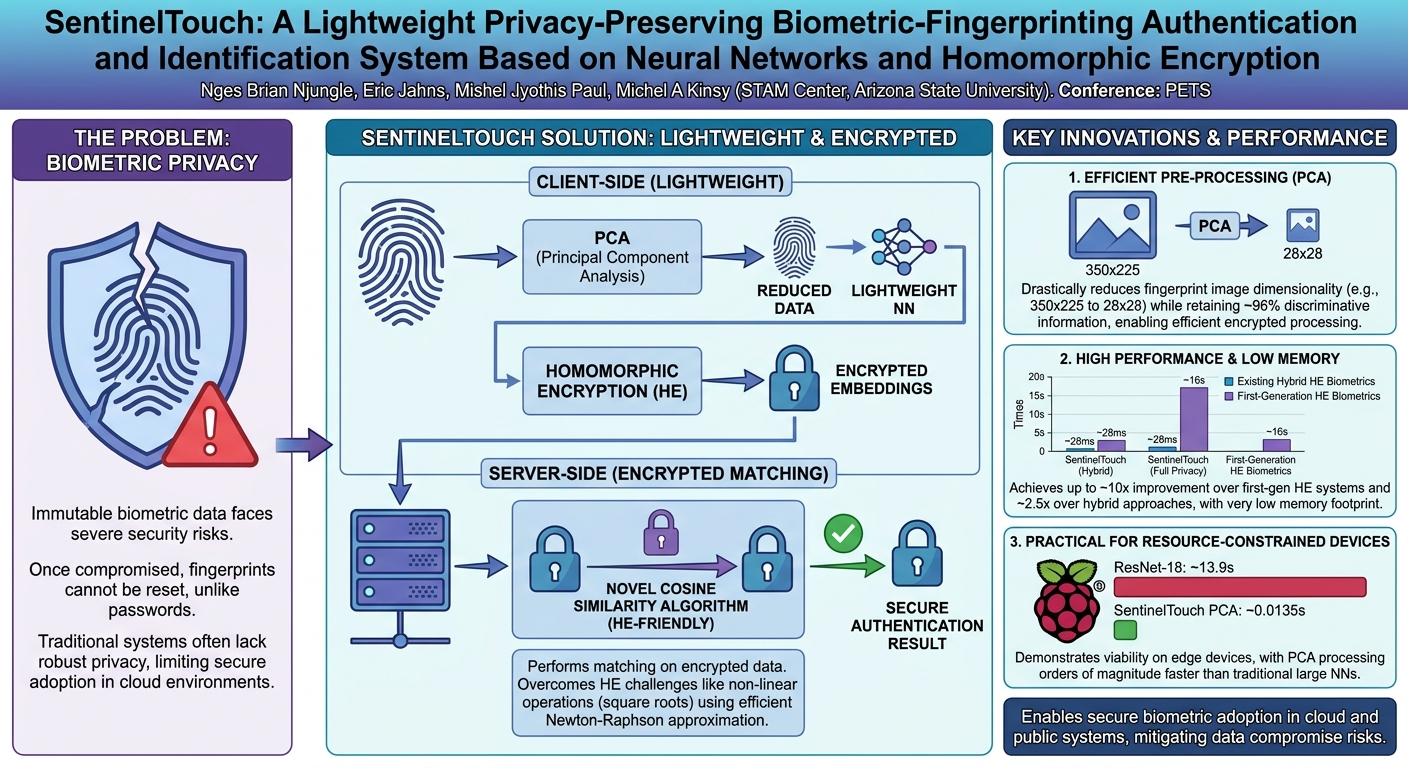
- Effective Data Pre-processing with PCA: The research demonstrates that applying Principal Component Analysis (PCA) as a data pre-processing step can drastically reduce the dimensionality of fingerprint images without significant loss of discriminative information. For instance, on the PolyU dataset, SentinelTouch achieved a remarkable 96% information retention with just approximately 600 principal components. This reduction transformed large 350x225 pixel images into compact 28x28 pixel representations, which are far more manageable for subsequent neural network processing and homomorphic encryption. This finding directly addresses the "large dimension of fingerprint images" problem.
- Lightweight, HE-Friendly Neural Network: By leveraging the compact size of PCA-reduced images, the team successfully developed a lightweight LeNet-5 neural network model. This small model is specifically designed to be efficient for classification and embedding extraction, making it suitable for deployment even on resource-constrained devices, thus challenging the assumption that large neural networks are always required. The small embedding size (e.g., 16-dimensional embeddings) further contributes to the system's efficiency and HE compatibility.
- Novel HE-Compatible Cosine Similarity Algorithm: A critical innovation is the development of a new algorithm for computing cosine similarity in the encrypted domain. Standard cosine similarity involves a square root operation for magnitude computation, which is highly nonlinear and inefficient in homomorphic encryption schemes. SentinelTouch reformulates the cosine similarity to minimize nonlinear operations, reducing it to a single inverse square root. To handle this, they propose a novel algorithm leveraging the Newton-Raphson approximation method for encrypted computation of the inverse square root, making encrypted matching practical and efficient.
- High Accuracy and Low Memory Footprint: Despite the significant dimensionality reduction and lightweight model, SentinelTouch achieves very high accuracies, even with highly compressed 16-dimensional embeddings. Furthermore, the system exhibits very low memory consumption across the board. This is a crucial achievement, as memory overhead is a major bottleneck for most homomorphic encryption applications, limiting their practical deployment.
- Substantial Runtime Performance Improvements: The system demonstrates significant speedups compared to prior work. SentinelTouch achieves approximately a 10x improvement over first-generation HE biometric approaches and about a 2.5x improvement over existing hybrid (second-generation) HE biometric systems. For identification, the hybrid pipeline achieved results in approximately 28 milliseconds, while the full privacy pipeline took around 16 seconds, showcasing a range of performance options depending on the desired level of client-side computation.
- Feasibility on Resource-Constrained Hardware: A practical hardware deployment on a Raspberry Pi starkly illustrated the efficiency gains. While a traditional ResNet-18 model took approximately 13.9 seconds for processing, SentinelTouch's PCA processing step alone completed in a mere 0.0135 seconds. This demonstrates the system's viability for real-world deployment on edge devices with severely limited computational capabilities, broadening the scope of secure biometric applications.
These findings collectively establish SentinelTouch as a robust, privacy-preserving, and computationally efficient solution for biometric fingerprint authentication and identification, paving the way for broader and more secure adoption of biometrics in sensitive contexts.
Technical Deep Dive
▶ Watch: Demonstrating PCA's effectiveness for fingerprint dimension reduction (6:00)
SentinelTouch's technical prowess stems from a clever integration of data pre-processing, a custom neural network architecture, and advanced homomorphic encryption techniques. The system's design addresses the twin challenges of high-dimensional biometric data and the computational overhead of encrypted operations.
The foundation of SentinelTouch's privacy guarantees lies in Homomorphic Encryption (HE), a cryptographic primitive that allows arbitrary computations on encrypted data without ever exposing the underlying plaintext. For this work, the researchers selected the CKKS scheme (Cheon-Kim-Kim-Song). The CKKS scheme is particularly well-suited for SentinelTouch due to its support for approximate arithmetic computation, which is common in machine learning tasks, and its ability to perform Single Instruction, Multiple Data (SIMD) operations, allowing parallel processing of multiple data points within a single ciphertext. Beyond basic encryption, decryption, and key generation, CKKS offers essential operations like encrypted addition, multiplication, and rotation, which are fundamental to the neural network computations and similarity comparisons.
The first crucial technical contribution is the data pre-processing step, designed to reduce the dimensionality of raw fingerprint images. SentinelTouch employs Principal Component Analysis (PCA) for this purpose. PCA is a statistical technique widely used in machine learning for dimensionality reduction. It works by transforming high-dimensional data into a lower-dimensional subspace while retaining as much variance (and thus, discriminative information) as possible. The process involves:
- Calculating the covariance matrix of the input fingerprint dataset.
- Extracting the eigenvalues and corresponding eigenvectors from the covariance matrix.
- Selecting the top k eigenvectors corresponding to the largest eigenvalues to form a transformative matrix W. These eigenvectors represent the principal components.
- Projecting each input fingerprint image onto this lower-dimensional space defined by W.
The effectiveness of PCA was validated using popular fingerprint datasets, SOCO and PolyU. Experiments showed that even with a significant reduction in dimensions, a high percentage of discriminative information was preserved. For example, with just around 600 principal components from the PolyU dataset, SentinelTouch retained approximately 96% of the original information. This reduction is substantial, transforming images from dimensions like 350x225 pixels down to a compact 28x28 pixels, making subsequent processing significantly more efficient and HE-friendly.
Following dimensionality reduction, SentinelTouch introduces a lightweight neural network model for feature extraction and classification. The chosen architecture is a variant of LeNet-5, a foundational convolutional neural network known for its efficiency and effectiveness in image recognition tasks. This small model processes the PCA-reduced 28x28 pixel images to extract compact embeddings (e.g., 16-dimensional vectors). These embeddings are then either directly encrypted or sent to the server for further encrypted processing and matching. The choice of a lightweight model directly addresses the limitation of second-generation HE biometric systems that assume high computational power on client devices.
The system design accommodates two distinct operational pipelines:
- Hybrid Pipeline: In this pipeline, the client-side device performs the PCA computation and processes the reduced image through the small neural network to generate embeddings. These embeddings are then encrypted and sent to the server. The server performs storage and matching using encrypted cosine similarity, sending the encrypted results back to the client for decryption. This approach offloads significant HE computation from the client.
- Full Privacy Pipeline: This pipeline maximizes privacy by performing minimal operations on the client. The client only performs PCA projections and then encrypts the reduced images. The neural network processing (feature extraction) and all subsequent cosine similarity computations are carried out entirely on the server within the encrypted domain. The encrypted results are then returned to the client for interpretation. This pipeline demands more server-side HE computation but offers stronger privacy guarantees by keeping the neural network processing off the client.
A cornerstone of the SentinelTouch system is its innovative approach to fingerprint matching using cosine similarity in the encrypted domain. The standard formula for cosine similarity between two vectors A and B is (A . B) / (|A| * |B|). The challenge with this formula in an HE context is the magnitude computation |A| and |B|, which involves a square root operation. Square roots are nonlinear operations, notoriously inefficient and complex to implement directly in homomorphic encryption schemes. To overcome this, SentinelTouch proposes a novel algorithm that reformulates the cosine similarity computation to minimize nonlinear operations, effectively reducing the problem to a single inverse square root operation in the encrypted domain.
To compute this inverse square root (1/√x) efficiently under HE, the researchers developed another algorithm based on the Newton-Raphson approximation method. This iterative numerical method converges rapidly to the root of a function. By applying Newton-Raphson in the encrypted domain, SentinelTouch can approximate the inverse square root without decryption, making the entire cosine similarity computation viable and efficient within HE constraints.
The system was built using standard CPU setups, leveraging OpenFHE for homomorphic encryption operations and PyTorch for neural network development. This combination of established tools with novel algorithmic design underpins SentinelTouch's robust and efficient privacy-preserving biometric system.
Demo / Proof of Concept
▶ Watch: Novel algorithm for efficient encrypted cosine similarity (8:10)
While the talk did not feature a live, interactive demonstration in the traditional sense, the researchers presented compelling experimentation results and a hardware deployment scenario that serve as a strong proof of concept for SentinelTouch's efficacy and practicality. These results directly validate the system's claims regarding efficiency, accuracy, and suitability for resource-constrained environments.
The experimentation focused on several key metrics:
- Accuracy: SentinelTouch demonstrated very high accuracies, even when utilizing compact 16-dimensional embeddings. This is a critical finding, indicating that the aggressive dimensionality reduction via PCA and the lightweight LeNet-5 model do not compromise the system's ability to reliably identify individuals.
- Memory Consumption: A significant challenge with homomorphic encryption is its memory overhead. SentinelTouch achieved very low memory consumption across the board, which is a substantial improvement over prior HE-based biometric systems. This low memory footprint addresses one of the major bottlenecks preventing the widespread adoption of HE in practical applications.
- Runtime Performance: The system's performance for identification operations was thoroughly evaluated. The Hybrid Pipeline, where much of the initial processing occurs client-side, achieved identification times of approximately 28 milliseconds. The Full Privacy Pipeline, which offloads most computations to the encrypted server, completed identification in around 16 seconds. These figures showcase a trade-off between client-side computational burden and server-side HE computation, offering flexibility for different deployment scenarios.
A direct comparison with related works further highlighted SentinelTouch's advancements:
- The system achieved approximately a 10x improvement in runtime performance compared to first-generation HE biometric approaches, which directly encrypt raw templates.
- It also demonstrated about a 2.5x improvement over existing hybrid (second-generation) HE biometric systems that still rely on larger neural networks for feature extraction. These comparisons underscore the significant performance gains achieved through SentinelTouch's optimized approach.
Perhaps the most impactful aspect of the proof of concept was the hardware deployment on a Raspberry Pi. This experiment directly addressed the feasibility of SentinelTouch on resource-constrained edge devices. The researchers compared the performance of a conventional, larger neural network model, ResNet-18, against SentinelTouch's PCA pre-processing step.
- Deploying a ResNet-18 model on the Raspberry Pi resulted in a processing time of approximately 13.9 seconds. This figure represents the typical computational burden of complex neural networks on low-power hardware.
- In stark contrast, SentinelTouch's PCA processing step on the same Raspberry Pi completed in a mere 0.0135 seconds.
This striking difference vividly illustrates how SentinelTouch's design, particularly its efficient pre-processing and lightweight neural network, dramatically reduces the computational demands on client devices. This makes secure, privacy-preserving biometric authentication viable for a much wider range of real-world applications, including those on mobile phones, IoT devices, and dedicated biometric scanners that lack the powerful processors found in traditional servers or high-end workstations. The experimental results, therefore, serve as a robust proof of concept for the system's core claims of lightness, privacy preservation, and efficiency.
Defensive Implications
▶ Watch: Experimental results: accuracy, memory, runtime, and comparison (9:10)
The SentinelTouch system introduces several critical defensive implications for organizations and individuals concerned with biometric data privacy and security. Its core innovation provides a robust framework for adopting biometrics in environments previously deemed too risky, significantly bolstering defensive postures against data breaches and privacy infringements.
Firstly, the most direct implication is the mitigation of biometric data compromise risk. By performing all matching and identification processes on homomorphically encrypted fingerprint data, SentinelTouch ensures that sensitive biometric templates are never exposed in plaintext, neither at rest, in transit, nor during computation. This fundamentally changes the security posture: even if a server storing encrypted templates is breached, the attackers would only gain access to unusable ciphertext, rendering the biometric data worthless. This capability is paramount, as biometric data is immutable and cannot be revoked like a password, making its compromise far more severe.
Secondly, SentinelTouch enables the secure adoption of biometrics in cloud-based and public systems. Previously, the privacy risks associated with storing and processing biometric data on third-party servers significantly limited their deployment in such environments. With SentinelTouch, organizations can leverage the scalability and convenience of cloud infrastructure for biometric authentication services without fear of exposing user identities. This opens doors for enhanced security in sensitive applications like healthcare, financial services, and critical infrastructure, where data privacy regulations (e.g., GDPR, HIPAA) are stringent.
Thirdly, the system's lightweight nature and efficiency are crucial for defensive strategies on resource-constrained devices at the edge. Many biometric scanners and IoT devices have limited computational power, making it challenging to implement complex cryptographic operations or large neural networks locally. SentinelTouch's use of PCA for dimensionality reduction and a compact LeNet-5 model means that secure, privacy-preserving authentication can be deployed directly on these devices. This reduces the attack surface by minimizing the need to transmit raw biometric data to more powerful, potentially less secure, central servers for initial processing.
Fourthly, the novel encrypted cosine similarity algorithm with Newton-Raphson approximation for inverse square root demonstrates how complex mathematical operations, often considered roadblocks for HE, can be made practical. This algorithmic innovation offers a blueprint for developing other privacy-preserving machine learning models and computations, expanding the defensive toolkit beyond simple data storage to include secure analytics on sensitive information.
Finally, SentinelTouch fosters a "privacy-by-design" approach to biometric authentication. By integrating privacy mechanisms at the architectural level, rather than as an afterthought, it sets a new standard for how biometric systems should be built. Defenders can point to this architecture as a model for ensuring user trust and regulatory compliance, proactively addressing privacy concerns before deployment. The ability to perform identification with high accuracy and low memory consumption, coupled with significant performance improvements over prior HE methods, makes SentinelTouch a compelling defensive technology for safeguarding digital identities in an increasingly biometric-driven world.
Key Takeaways
- SentinelTouch provides a lightweight, privacy-preserving solution for biometric fingerprint authentication and identification by leveraging homomorphic encryption and neural networks, directly addressing the privacy risks associated with immutable biometric data.
- Principal Component Analysis (PCA) is crucial for efficiency, effectively reducing high-dimensional fingerprint images (e.g., 350x225 to 28x28 pixels) while retaining over 96% of discriminative information, making subsequent encrypted processing feasible.
- A novel HE-friendly cosine similarity algorithm was developed, overcoming the challenge of nonlinear operations (like square roots) in homomorphic encryption by reformulating the computation and using the Newton-Raphson approximation for encrypted inverse square root.
- The system achieves significant performance gains, demonstrating approximately 10x improvement over first-generation HE biometric systems and 2.5x over hybrid (second-generation) approaches, with identification times as low as ~28 milliseconds in hybrid mode.
- SentinelTouch is practical for resource-constrained devices, as shown by its deployment on a Raspberry Pi where its PCA processing is orders of magnitude faster (0.0135s) than traditional large neural networks (13.9s for ResNet-18).
- It enables secure biometric adoption in cloud and public systems, as all computations are performed on encrypted data, ensuring privacy at rest, in transit, and during processing, thereby mitigating the risk of biometric data compromise.
About the Speaker(s)
The SentinelTouch project was presented by Nges Brian Njungle, who is listed as a paper author from the STAM Center at Arizona State University. He was joined by co-authors Eric Jahns, Mishel Jyothis Paul, and Michel A Kinsy, all also affiliated with the STAM Center at Arizona State University. Their collective expertise in security, privacy, and advanced computing, particularly in the realm of neural networks and homomorphic encryption, underpins the innovative research presented in SentinelTouch. The STAM Center (presumably standing for Secure, Trusted, and Assured Microelectronics Center or similar) at Arizona State University likely serves as a hub for cutting-edge research in these critical areas of cybersecurity and privacy-enhancing technologies.
Reviews
Dr. Zero (Offensive Security Researcher) — SOLID
SentinelTouch takes the brutal overhead of Homomorphic Encryption and beats it down with old-school dimensionality reduction and a clever math trick for cosine similarity. It's solid academic cryptography that actually attempts to run on edge hardware instead of a server farm. Good luck getting users to wait 16 seconds for a pure-privacy fingerprint match, but the math behind the encrypted inverse square root is genuinely elegant.
Heather Calloway (CISO) — SOLID
This research proves that homomorphic encryption for biometric authentication is no longer just an expensive academic science project. By making encrypted fingerprint matching viable on low-power edge hardware, it offers a concrete technical path to completely de-risking centralized biometric data stores. Worth your IAM architects' time.
→ Top-rated talks at Privacy Enhancing Technologies Symposium (PETS) 2026
All talks from Privacy Enhancing Technologies Symposium (PETS) 2026