FHEON: A Configurable Framework for Developing Privacy-Preserving Encrypted Neural Networks
Nges Brian Njungle (Paper author · STAM Center, Arizona State University), Eric Jahns (Paper author · STAM Center, Arizona State University), Michel A. Kinsy (Paper author · STAM Center, Arizona State University)
Privacy Enhancing Technologies Symposium (PETS) 2026 · Remote
Overview
In an era increasingly defined by data-driven innovation, Machine Learning as a Service (MLaaS) has emerged as a cornerstone of technological advancement, projected to reach a market value of $1.2 trillion by 2034. MLaaS empowers organizations to leverage sophisticated machine learning models without the prohibitive costs of in-house infrastructure. However, this convenience introduces significant security and privacy challenges. The reliance on outsourced cloud computation for training and inference often involves highly sensitive data, such as health records or financial information, necessitating strict compliance with regulatory frameworks like HIPAA and GDPR. Protecting both the proprietary models and the confidential user data throughout the entire MLaaS pipeline is paramount.
Key moments
- 0:00 Introduction to FHEON and MLaaS privacy problem
- 2:00 Understanding Homomorphic Encryption fundamentals
- 4:00 Limitations of prior work; FHEON's motivation
- 4:40 FHEON's key contributions and features
- 5:40 Technical optimization for encrypted convolution layer
- 7:45 Designing models with FHEON; extensibility
- 8:50 Performance evaluation and comparison results
- 10:00 Conclusion and future research directions
FHEON: A Configurable Framework for Developing Privacy-Preserving Encrypted Neural Networks
Speakers: Nges Brian Njungle (Paper author, STAM Center, Arizona State University); Eric Jahns (Paper author, STAM Center, Arizona State University); Michel A. Kinsy (Paper author, STAM Center, Arizona State University)
Conference: PETS
YouTube: https://www.youtube.com/watch?v=-kRK-kBaPXc
Overview
In an era increasingly defined by data-driven innovation, Machine Learning as a Service (MLaaS) has emerged as a cornerstone of technological advancement, projected to reach a market value of $1.2 trillion by 2034. MLaaS empowers organizations to leverage sophisticated machine learning models without the prohibitive costs of in-house infrastructure. However, this convenience introduces significant security and privacy challenges. The reliance on outsourced cloud computation for training and inference often involves highly sensitive data, such as health records or financial information, necessitating strict compliance with regulatory frameworks like HIPAA and GDPR. Protecting both the proprietary models and the confidential user data throughout the entire MLaaS pipeline is paramount.
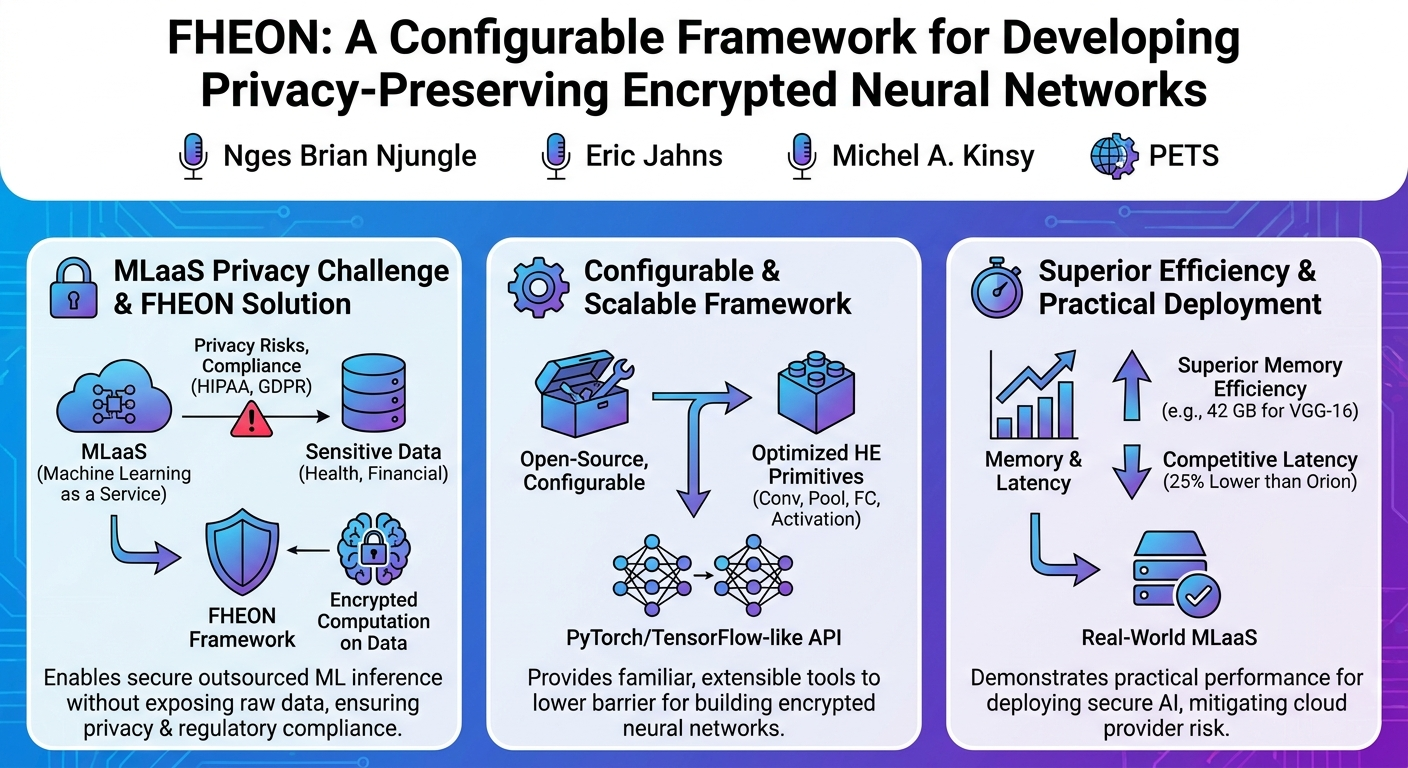
Addressing these critical concerns, the talk "FHEON: A Configurable Framework for Developing Privacy-Preserving Encrypted Neural Networks" by Nges Brian Njungle, Eric Jahns, and Michel A. Kinsy from the STAM Center at Arizona State University introduces a novel solution. FHEON, an acronym for Fully Homomorphic Encryption ON-device, is presented as an open-source, configurable, and scalable framework designed to facilitate the practical deployment of Homomorphic Encryption (HE) in neural network operations. HE, often hailed as the "holy grail of cryptography," allows computations to be performed directly on encrypted data, offering a powerful paradigm for privacy preservation.
The core challenge with widespread HE adoption in MLaaS has been its inherent computational and memory overhead, alongside limited support for non-linear operations crucial for modern neural network architectures. FHEON directly confronts these limitations by providing an intuitive, extensible framework akin to popular machine learning libraries like PyTorch and TensorFlow. This work not only offers optimized HE primitives for common neural network layers but also provides a comprehensive suite of evaluated models and extensive documentation, significantly lowering the barrier to entry for developers and researchers seeking to build and deploy privacy-preserving encrypted neural networks.
Background
▶ Watch: Introduction to FHEON and MLaaS privacy problem (0:00)
The proliferation of machine learning applications across diverse sectors, particularly through the MLaaS paradigm, has brought immense computational power and flexibility. However, this outsourcing model inherently creates a tension between utility and privacy. Data used for training and inference often originates from multiple users who are unwilling to expose their private information. Furthermore, the data itself frequently falls into highly sensitive categories, such as patient health information or financial transactions, which are subject to stringent legal and regulatory mandates like the Health Insurance Portability and Accountability Act (HIPAA) and the General Data Protection Regulation (GDPR). Without robust privacy mechanisms, the full potential of MLaaS remains constrained by these critical security and privacy concerns.
Homomorphic Encryption (HE) has garnered substantial attention as a promising cryptographic primitive to resolve this dilemma. Unlike traditional encryption schemes that require decryption before computation, HE enables arbitrary computations to be performed directly on encrypted data, yielding an encrypted result that, when decrypted, matches the result of the same computation performed on unencrypted data. This capability is revolutionary for MLaaS, as it allows cloud servers to process user data without ever accessing its plaintext form. An HE scheme typically comprises four fundamental functions: key generation (producing public and private keys), encryption (transforming plaintext into ciphertext using the public key), decryption (recovering plaintext from ciphertext using the private key), and crucially, evaluation (performing operations like addition, multiplication, and rotation on ciphertexts).
In a typical MLaaS scenario leveraging HE, the end-user generates a public/private key pair. They encrypt their sensitive input data using the public key and transmit the resulting ciphertext to an outsourced cloud server. The cloud server then performs inference using an HE-friendly machine learning model, operating entirely on the encrypted data. The encrypted inference result is then sent back to the user, who decrypts it using their private key to obtain the plaintext prediction. This ensures that the cloud provider never gains access to the raw sensitive data, upholding user privacy.
Within machine learning, Convolutional Neural Networks (CNNs) have become a foundational technique due to their efficiency and effectiveness across various tasks. Consequently, significant research has focused on integrating CNNs with HE. Since 2016, a substantial body of work has emerged in this area, with projects like Crypton being early pioneers. However, prior efforts have faced several limitations. Firstly, the evaluation of HE-friendly CNNs has been restricted to a very limited subset of architectures, primarily focusing on ResNet-20 or custom-designed models, which limits their general applicability. Secondly, and perhaps most importantly, there has been a notable absence of a configurable and easily extensible framework comparable to the widely adopted PyTorch or TensorFlow ecosystems. Such a framework is essential to democratize the development and deployment of encrypted neural networks, allowing researchers and practitioners to easily build, customize, and experiment with HE-friendly models without having to implement every cryptographic primitive from scratch.
This foundational gap led to the central research question addressed by FHEON: "How do we develop a configurable, scalable, and efficient practical framework for developing encrypted neural networks using homomorphic encryption?" The answer, as presented by the authors, is FHEON, designed to overcome these practical barriers and advance the adoption of privacy-preserving machine learning.
Key Findings
▶ Watch: Limitations of prior work; FHEON's motivation (4:00)
The FHEON framework represents a significant advancement in the practical application of homomorphic encryption for privacy-preserving machine learning. The key findings and contributions of this work are multi-faceted, addressing both the technical challenges of HE and the usability gaps in prior research:
- Open-Source, Configurable, and Scalable Framework: FHEON is introduced as an open-source solution, fostering community collaboration and transparency. Its design emphasizes configurability, allowing users to easily define and modify neural network architectures, and scalability, ensuring it can adapt to varying model complexities and data sizes. This addresses the critical need for an accessible platform akin to existing deep learning libraries.
- Comprehensive Suite of Ready-to-Use Primitives: A core contribution of FHEON is its provision of easily available and easy-to-use primitives for fundamental neural network operations. These include convolution, pooling, activation functions, and fully connected layers, mirroring the familiar building blocks found in frameworks like PyTorch and TensorFlow. This greatly simplifies the process of constructing HE-friendly models, abstracting away the intricate details of HE operations.
- Support for Diverse Model Architectures: Unlike prior works that were often limited to specific, custom architectures or very shallow models, FHEON provides a comprehensive suite of different variants of models. The framework has been evaluated on established architectures such as ResNet and VGG (specifically VGG-16), demonstrating its versatility and ability to handle deeper neural networks. This capability allows users to easily customize and build their own models based on robust, pre-validated components.
- Lowering the Barrier to Adoption: FHEON significantly reduces the entry barrier for developing encrypted neural networks through two key mechanisms:
- Comprehensive Documentation: The framework is accompanied by comprehensive documentation detailing the different layers and primitives offered, guiding users through the development process.
- Intuitive API: The design allows for model construction using a simple, straightforward API, conceptually similar to how models are defined in PyTorch.
- Superior Performance and Efficiency: A critical finding from the evaluation is FHEON's competitive, and often superior, performance compared to existing state-of-the-art solutions.
- Memory Efficiency: FHEON demonstrates exceptional memory efficiency, particularly against established compiler approaches like Orion and other works like Reva. For a deep model like VGG-16, FHEON's memory requirement peaked at 42 GB, which the presenters highlighted as "crushing all the works" in comparison.
- Latency: While slightly higher than Reva in some cases, FHEON achieved latencies that were approximately 25% lower than Orion, indicating significant computational advantages.
- Accuracy: The framework maintains competitive accuracy levels, performing "up there with everyone else," with only slight degradation observed due to encrypted computation, which typically increases with model depth.
These findings collectively establish FHEON as a robust, practical, and highly efficient framework for advancing privacy-preserving machine learning, making HE more accessible and deployable in real-world MLaaS scenarios.
Technical Deep Dive
▶ Watch: Technical optimization for encrypted convolution layer (5:40)
The technical foundation of FHEON lies in its sophisticated approach to mapping standard neural network operations onto homomorphic encryption primitives while optimizing for efficiency. The talk provides a detailed look into the convolution layer, a cornerstone of CNNs, to illustrate these technical innovations.
In a traditional, unencrypted convolutional neural network, the convolution operation involves sliding a filter (or kernel) over an input tensor. At each position, element-wise multiplication occurs between the filter values and the corresponding input tensor values, followed by a summation to produce a single output value. This process is repeated across the input, with the output tensor's size potentially reduced based on parameters like stride and padding.
Performing this operation directly in the encrypted domain using HE presents a substantial challenge. Homomorphic encryption operations, especially multiplications, are significantly more computationally expensive than their plaintext counterparts. A naive, one-by-one multiplication and addition approach for each element in the convolution would lead to prohibitive computational and memory costs. FHEON tackles this by transforming the operations to leverage the Single Instruction, Multiple Data (SIMD) capabilities inherent in many HE schemes.
The core of FHEON's optimization for convolution involves several steps:
- Flattening Input to SIMD Ciphertext: The initial step requires transforming the input data into a format suitable for HE. Specifically, FHEON flattens the different input elements to form SIMD ciphertext. This means that multiple plaintext values are packed into a single ciphertext slot, allowing a single HE operation to act on many values simultaneously. This is a crucial optimization for reducing the number of expensive HE operations.
- Channel Alignment: To facilitate parallel computation, the channels of the input tensor are carefully aligned. A similar alignment process is applied to the kernel values. This preparation ensures that when HE operations are performed, the correct input elements correspond to the correct kernel elements within the SIMD structure.
- SIMD Computations: Once the input and kernel values are appropriately flattened and aligned within SIMD ciphertexts, FHEON performs SIMD computations. This involves carrying out homomorphic multiplications between the packed kernel values and the packed input values, followed by homomorphic summations. By operating on entire vectors of data within a single ciphertext, FHEON drastically reduces the total number of HE operations required, directly addressing the performance bottleneck.
- Efficient Overlap Removal: A common characteristic of convolution operations is the overlapping receptive fields. When performing SIMD-optimized convolutions, this can lead to redundant computations or values that need to be carefully handled to produce the correct output shape. FHEON incorporates algorithms that efficiently remove overlap values based on the desired output dimensions. These operations are performed automatically and efficiently within the framework, abstracting this complexity from the user.
Crucially, these types of optimizations and generalizations are not limited to just the convolution layer. FHEON applies similar principles to a wide array of other neural network operations, including pooling layers, fully connected layers, and various activation functions. The framework also provides a set of ready-to-use HE primitives and utility functions, such as key generation for different layers and weight loading, which further simplify the process of fusing encrypted computation onto these models.
Designing a model in FHEON is designed to be as "simple and straightforward" as in traditional machine learning frameworks like PyTorch. Users can instantiate different operations (e.g., Conv2d, Linear) and pass standard parameters. The primary difference is that the input to the model is an encrypted input, which the framework handles seamlessly.
Beyond its current offerings, FHEON emphasizes extensibility. Researchers and practitioners can easily extend the framework to support additional primitives not yet included (e.g., normalization layers). This is achieved by adding new functions directly within the underlying C++ classes of FHEON, which can then be called within the model definition. This modular design ensures that FHEON can evolve with new research in HE schemes and neural network architectures, providing a robust platform for future secure AI development.
Demo / Proof of Concept
▶ Watch: Designing models with FHEON; extensibility (7:45)
While the presentation did not include a live, interactive demonstration of the FHEON framework in action, the authors provided compelling evidence of its functionality and efficiency through a comprehensive evaluation section. This evaluation serves as the primary proof of concept, showcasing FHEON's capabilities across various neural network architectures and benchmarking its performance against existing state-of-the-art solutions.
The evaluation results presented focused on key metrics:
- Accuracy Degradation: The authors showed that using FHEON for encrypted computation results in only a slight accuracy degradation compared to plaintext execution. This degradation was observed to be somewhat higher for deeper models, which is an expected characteristic of homomorphic encryption due to noise management.
- Memory Efficiency: FHEON demonstrated remarkable memory efficiency. For VGG-16, a relatively deep model, the framework required at most 42 GB of memory. The presenters explicitly stated that FHEON was "crushing all the works" in terms of memory requirements when compared to related projects like Orion (a compiler approach) and Reva.
- Performance Latency: In terms of latency, FHEON showed competitive results. While slightly slower than Reva in some configurations, it achieved latencies approximately 25% lower than Orion. This indicates a significant improvement in computational speed for encrypted inference.
The presentation of these quantitative results, derived from evaluating a "comprehensive suit of different variants of models" (including ResNet and VGG architectures), effectively demonstrates that FHEON is not merely a theoretical construct but a practical and performant framework. The ability to successfully implement and run deep neural networks like VGG-16 with such efficiency in the encrypted domain serves as a strong testament to its viability and technical robustness.
Defensive Implications
▶ Watch: Conclusion and future research directions (10:00)
The FHEON framework offers significant defensive implications for organizations and individuals navigating the complex landscape of data privacy and machine learning. Its primary contribution is enabling a practical path towards privacy-preserving MLaaS, which directly addresses several critical security and compliance challenges.
- Enhanced Data Privacy for Users: For end-users and data owners, FHEON provides a powerful mechanism to outsource sensitive data for machine learning inference without compromising privacy. By encrypting their data with a public key before sending it to the cloud, users ensure that the cloud provider never accesses the raw, plaintext information. This is particularly crucial for highly regulated industries like healthcare (HIPAA) and finance, where data breaches can have severe legal and reputational consequences. FHEON empowers data owners to leverage the computational power of the cloud while maintaining full control over their data's confidentiality.
- Compliance with Regulatory Frameworks: MLaaS providers often struggle with meeting stringent data protection regulations such as GDPR and HIPAA. FHEON offers a technical solution that can directly aid in achieving compliance. By processing data in an encrypted state, MLaaS platforms can reduce their exposure to sensitive information, thereby mitigating risks associated with data handling and storage. This capability could serve as a significant competitive advantage for providers looking to offer truly secure and compliant services.
- Protection of Proprietary Models: While the talk primarily focuses on data privacy, the underlying principles of HE also extend to protecting the intellectual property embedded in machine learning models. FHEON's framework, designed for HE-friendly models, implicitly supports scenarios where parts of the model (e.g., weights) could also be protected, although this was not the explicit focus of the presented work. Future extensions could further solidify this aspect.
- Lowering the Barrier for Secure AI Development: From a defensive research and development perspective, FHEON's configurable and extensible nature is invaluable. By providing readily available, optimized HE primitives and an intuitive API akin to PyTorch/TensorFlow, it significantly lowers the barrier to entry for security researchers and developers to experiment with and build secure AI applications. This acceleration of research can lead to more robust defensive strategies against data exfiltration and privacy attacks in AI systems. The ability to easily add new primitives fosters rapid prototyping and innovation in secure computation.
- Mitigating Cloud Provider Risk: Organizations utilizing MLaaS platforms inherently place a degree of trust in their cloud providers. FHEON helps mitigate this trust requirement by ensuring that even if the cloud infrastructure were compromised, the sensitive user data processed by the ML model would remain encrypted and therefore unreadable to an attacker. This "zero-trust" approach to data processing in the cloud is a critical defensive posture.
- Addressing Practical HE Limitations: By specifically tackling the high computational and memory requirements of homomorphic encryption, FHEON makes HE a far more practical defensive tool. Its demonstrated efficiency (e.g., 42 GB memory for VGG-16, 25% lower latency than Orion) shows that privacy-preserving AI is moving closer to real-world deployability, making it a viable option for organizations seeking strong data protection without sacrificing an unacceptable level of performance.
In essence, FHEON provides a foundational toolkit for building a more secure and privacy-aware MLaaS ecosystem, empowering both data owners and service providers to operate with greater confidence in the face of evolving privacy threats and regulatory demands.
Key Takeaways
- FHEON is a configurable, open-source framework designed to simplify the development of privacy-preserving encrypted neural networks using Homomorphic Encryption (HE).
- The framework directly addresses the critical challenges of data privacy and regulatory compliance (e.g., HIPAA, GDPR) in the rapidly growing Machine Learning as a Service (MLaaS) market.
- FHEON offers an intuitive, PyTorch/TensorFlow-like API with optimized HE primitives for common neural network layers (convolution, pooling, activation, fully connected), significantly lowering the barrier to entry for secure AI development.
- Evaluations demonstrate FHEON's superior memory efficiency (e.g., 42 GB for VGG-16) and competitive latency (25% lower than Orion) and accuracy compared to existing state-of-the-art HE solutions.
- The framework's extensibility allows researchers and practitioners to easily integrate new HE primitives, fostering rapid innovation in privacy-preserving machine learning.
- FHEON represents a significant step towards making practical, deployable secure MLaaS a reality, enabling computation on sensitive data without exposing it to cloud providers.
About the Speaker(s)
The talk "FHEON: A Configurable Framework for Developing Privacy-Preserving Encrypted Neural Networks" was presented by Nges Brian Njungle. He is one of the paper authors, alongside Eric Jahns and Michel A. Kinsy. All three authors are affiliated with the STAM Center at Arizona State University, where this research was conducted.
Reviews
Dr. Zero (Offensive Security Researcher) — SOLID
Homomorphic encryption for neural networks is usually a math paper disguised as code, but the ASU STAM Center team actually built a usable C++ framework here. They successfully mapped CNN primitives to SIMD ciphertexts and beat the Orion compiler's latency by 25%. We're still lightyears away from running real workloads—VGG-16 shouldn't take 42 GB of RAM—but this makes the HE research pipeline infinitely less miserable.
Heather Calloway (CISO) — SOLID
This research bridges the gap between theoretical cryptography and enterprise AI adoption by making Homomorphic Encryption (HE) functional for standard neural networks. If your business units are demanding cloud AI capabilities but your legal team is blocking them over data exposure, this proves that privacy-preserving Machine Learning as a Service (MLaaS) is moving out of the lab and into usable engineering frameworks.
→ Top-rated talks at Privacy Enhancing Technologies Symposium (PETS) 2026
All talks from Privacy Enhancing Technologies Symposium (PETS) 2026