Dynamic Probabilistic Noise Injection for Membership Inference Defense
Javad Forough (Paper author · Imperial College London), Hamed Haddadi (Paper author · Imperial College London)
Privacy Enhancing Technologies Symposium (PETS) 2026 · Remote
Overview
In an era where machine learning models are increasingly trained on vast amounts of sensitive personal data, the imperative for robust privacy protection has never been greater. This talk, presented by Javad Forough from Imperial College London, introduces DynaNoise, a novel and highly efficient defense mechanism against Membership Inference Attacks (MIA). These attacks exploit the tendency of models to "memorize" training data, allowing an adversary to determine if a specific data point was part of the training set. Such information, even a single bit, can lead to severe privacy violations, from revealing a patient's hospital visit to exposing a client's investment history.
Key moments
- 0:00 Introduction to membership inference and its dangers
- 1:35 DynaNoise's core insight: adaptive noise based on query risk
- 4:00 How DynaNoise works: entropy-based noise injection
- 5:08 Introducing Mitput, a new privacy-utility tradeoff metric
- 6:30 Experimental results: DynaNoise's superior privacy-utility tradeoff
- 8:00 Visualizing how DynaNoise suppresses membership signal
- 9:00 DynaNoise's minimal inference overhead and no retraining
- 10:00 Limitations of DynaNoise and directions for future research
Dynamic Probabilistic Noise Injection for Membership Inference Defense
Speakers: Javad Forough (Paper author, Imperial College London); Hamed Haddadi (Paper author, Imperial College London)
Conference: PETS
YouTube: https://www.youtube.com/watch?v=eWocXimrjTQ
Overview
In an era where machine learning models are increasingly trained on vast amounts of sensitive personal data, the imperative for robust privacy protection has never been greater. This talk, presented by Javad Forough from Imperial College London, introduces DynaNoise, a novel and highly efficient defense mechanism against Membership Inference Attacks (MIA). These attacks exploit the tendency of models to "memorize" training data, allowing an adversary to determine if a specific data point was part of the training set. Such information, even a single bit, can lead to severe privacy violations, from revealing a patient's hospital visit to exposing a client's investment history.
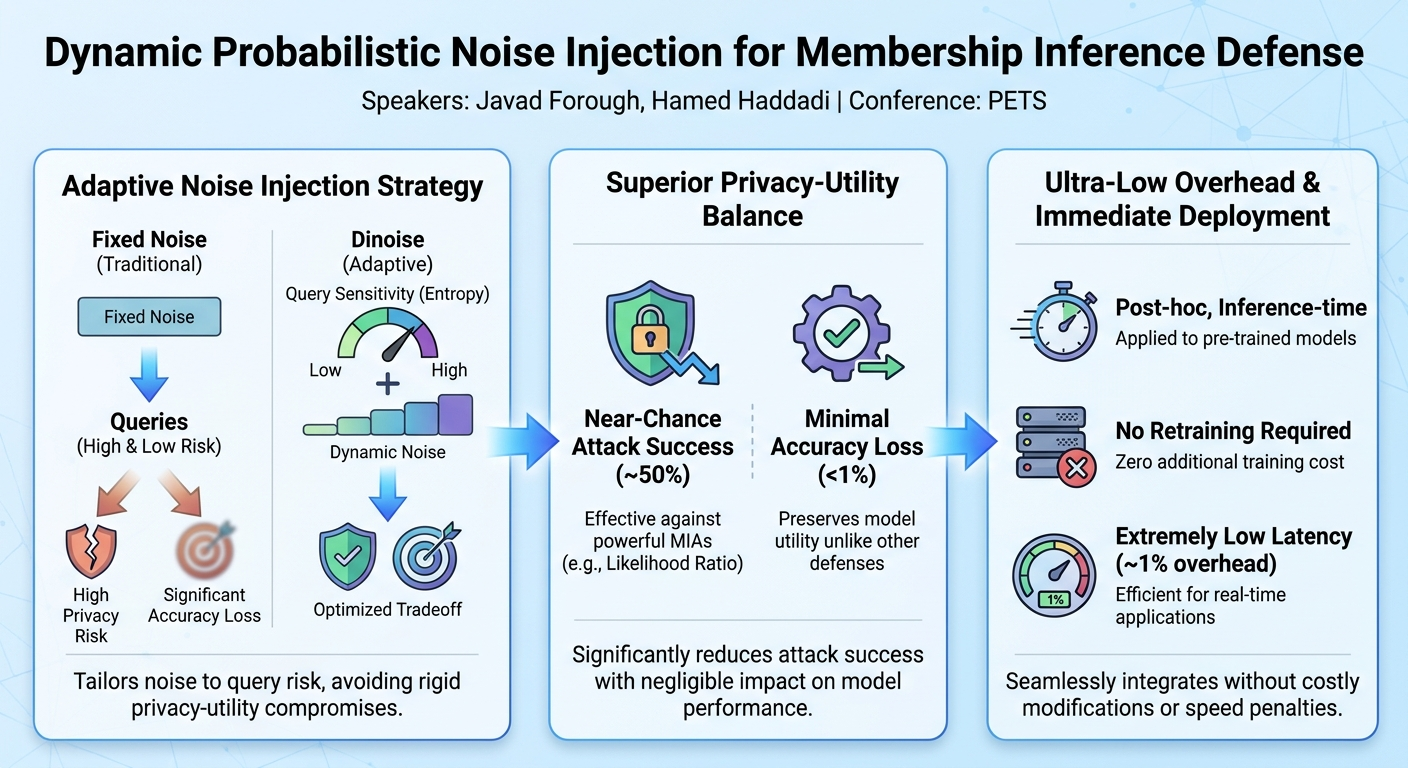
The core challenge with existing defenses, particularly those based on Differential Privacy (DP), is their rigid approach: they typically inject a fixed amount of noise regardless of the query's inherent risk. This creates an undesirable privacy-utility tradeoff: too little noise leaves models vulnerable to sophisticated attacks like Likelihood Ratio Attacks (LRA), while too much noise severely degrades model accuracy. DynaNoise addresses this fundamental limitation by proposing a dynamic, query-adaptive noise injection strategy. Its key insight is that not all queries are equally risky; a highly confident prediction leaks significantly more membership signal than an uncertain one. By tailoring noise injection to the sensitivity of each individual query, DynaNoise aims to achieve a superior privacy-utility tradeoff, offering strong protection without the prohibitive accuracy costs of traditional methods.
Background
▶ Watch: Introduction to membership inference and its dangers (0:00)
The proliferation of machine learning as a service (MLaaS) has brought with it significant privacy concerns. As models are deployed in sensitive domains like healthcare, finance, and personalized recommendations, the data they are trained on often contains highly confidential user information. A fundamental vulnerability in these systems is their propensity to "memorize" specific characteristics of their training data, a phenomenon that Membership Inference Attacks (MIA) are designed to exploit. An attacker, with blackbox access to a target model, can query it and observe its output (e.g., probability vectors). By feeding these outputs to an attack classifier, the adversary can infer whether a particular data point was included in the model's training set. This single bit of information—membership status—can, as highlighted by Forough, constitute a significant privacy breach. For instance, knowing a patient's record was in a diagnostic model's training data implies they visited a specific hospital for a particular condition.
Traditional defenses against MIA primarily revolve around Differential Privacy (DP), a rigorous mathematical framework for quantifying privacy guarantees. DP mechanisms typically involve adding noise, either during the model training process (e.g., DPSGD) or at inference time. While effective in theory, these approaches often struggle in practice due to their "one-size-fits-all" nature. They inject a fixed, predetermined amount of noise for every query, regardless of how much privacy risk that specific query poses. This uniform noise injection leads to a rigid privacy-utility tradeoff: if the noise level is insufficient, powerful modern attacks, especially Likelihood Ratio Attacks (LRA), can still succeed in inferring membership. Conversely, increasing the noise to adequately protect against such attacks often comes at a steep cost, causing the model's accuracy to collapse, rendering it practically unusable. This dilemma underscores the need for a more nuanced and adaptive approach to privacy preservation in machine learning. The core problem, as DynaNoise identifies, is the wasteful application of utility-degrading noise to "safe" queries, while simultaneously under-protecting the truly "dangerous" ones that leak substantial membership signals.
Key Findings
▶ Watch: How DynaNoise works: entropy-based noise injection (4:00)
DynaNoise presents a compelling set of advancements in Membership Inference Attack (MIA) defense, demonstrating a superior approach to the pervasive privacy-utility tradeoff. Its key findings and contributions can be summarized as follows:
Firstly, DynaNoise achieves the best overall privacy-utility tradeoff on diverse benchmarks, including vision (C410, ImageNet 10 with AlexNet) and language (SSD2 with Dilbert) models. Through extensive evaluation against six major attack families, including the powerful Likelihood Ratio Attack (LRA), DynaNoise consistently reduces attack success rates to near chance levels (approximately 50% accuracy for a binary classification task), effectively neutralizing the adversary's ability to infer membership. For example, the shadow attack success rate was observed to drop significantly from 64% to 50% on certain benchmarks. Crucially, this robust privacy gain is achieved with minimal impact on model utility, often resulting in less than a single percentage point drop in accuracy on vision models. This contrasts sharply with other state-of-the-art defenses like HAMP, which, while also reducing attack success, can incur up to 14 points of accuracy loss on vision models.
Secondly, DynaNoise is characterized by its exceptionally low computational overhead and zero retraining requirement. As a post-hoc inference-time defense, it can be seamlessly integrated with pre-trained models without any architectural changes or additional training costs. The per-sample inference latency for DynaNoise is only 0.143 milliseconds, representing a mere 1% overhead compared to the undefended model's 0.141 milliseconds. This makes it significantly more efficient than alternatives; for instance, HAMP doubles inference time due to an extra forward pass, and MemGuard, which solves an optimization problem for every query, is nearly 200 times slower. Defenses requiring retraining, such as Seleno, can incur over two and a half times the baseline training cost, making them impractical for many deployed systems. DynaNoise's efficiency makes it immediately deployable and scalable.
Finally, the talk introduces MITPUT (Membership Inference Defense Privacy Utility Tradeoff), a novel, simple scalar metric designed to facilitate easier comparison of defenses across different settings. MITPUT quantifies the reduction in attack success rate minus the accuracy drop caused by the defense, providing a single interpretable score where values near one indicate strong privacy gain at minimal utility cost. This metric, reported per attack and as an overall average, complements traditional Pareto curves and raw attack success rates, offering a clearer summary of a defense's effectiveness.
Technical Deep Dive
▶ Watch: Experimental results: DynaNoise's superior privacy-utility tradeoff (6:30)
DynaNoise is engineered as a purely post-hoc inference-time defense, meaning it operates on a pre-trained model without requiring any architectural modifications, re-training, or ensemble methods. Its pipeline comprises three distinct stages, each contributing to its dynamic noise injection strategy:
- Sensitivity Analysis of Incoming Queries: The fundamental premise of DynaNoise is that queries are not equally risky. A highly confident prediction, often indicative of a training sample, leaks significantly more membership signal than an uncertain one. To quantify this risk, DynaNoise leverages the model's output distribution. For each incoming query Q, it computes the Shannon Entropy of the softmax output probability vector. Shannon Entropy is a measure of uncertainty or unpredictability in a probability distribution; a low entropy indicates high confidence (concentrated probability on a few classes), while high entropy suggests uncertainty (probabilities spread across many classes).
From this entropy, DynaNoise derives a sensitivity score R_Q, defined as 1 - Normalized Entropy. This score ranges between 0 and 1. A confident, low-entropy prediction, which is precisely the type that strongly signals a training sample, will yield an R_Q score close to 1. Conversely, an uncertain, high-entropy prediction will result in an R_Q score closer to 0. This R_Q score acts as a direct measure of the query's inherent risk.
- Dynamic Gaussian Noise Injection: Once the sensitivity score R_Q is computed, DynaNoise dynamically scales the variance of the noise to be injected. It adds Gaussian noise to the raw logits (the pre-softmax outputs) of the model. The variance of this Gaussian noise, denoted as
sigma^2_Q, is scaled linearly with the sensitivity score:
sigma^2_Q = Base Variance (1 + lambda R_Q)
Here, Base Variance is a foundational hyperparameter determining the minimum noise level, and lambda is a scaling factor hyperparameter that dictates how aggressively the noise variance increases with the sensitivity score. This formula ensures that queries deemed highly sensitive (high R_Q) receive a proportionally larger amount of noise, while less sensitive queries (low R_Q) receive minimal noise. This adaptive approach is central to DynaNoise's ability to provide targeted protection, preserving utility where possible and bolstering privacy where necessary.
- Probabilistic Smoothing and Renormalization: After the dynamic Gaussian noise is added to the raw logits, the perturbed logits are then passed through a temperature-scaled softmax function. The temperature parameter, another interpretable hyperparameter, controls the "sharpness" of the probability distribution. A higher temperature results in a smoother, more uniform distribution, while a lower temperature produces a sharper, more confident distribution. This final step serves to renormalize the outputs into a valid probability distribution while preserving the predicted label ordering. Crucially, it smooths the distribution in a way that further obfuscates the fine-grained confidence signals that MIAs exploit, without destroying the overall predictive ranking. This ensures that the model's intended classification remains intact, even as its confidence scores are perturbed for privacy.
The entire mechanism is remarkably efficient. The computational cost per query involves a single noise draw and a single softmax operation, which is linear in the number of classes. As highlighted in the talk, this makes DynaNoise "essentially free" in terms of computational overhead, especially when compared to complex defenses that involve multiple forward passes or iterative optimization problems. DynaNoise operates with just three interpretable hyperparameters: the Base Variance, the lambda scaling factor, and the temperature. This simplicity, combined with its effectiveness, makes DynaNoise a highly practical solution for immediate deployment.
Demo / Proof of Concept
▶ Watch: Visualizing how DynaNoise suppresses membership signal (8:00)
While the talk does not feature a live code demonstration, it provides a powerful conceptual proof of concept by illustrating what DynaNoise actually does to the model's output distributions, effectively demonstrating its mechanism for neutralizing Membership Inference Attacks (MIA). This is achieved through the analysis of "percentile plots," which visualize the maximum confidence and predictive entropy of model outputs for both training members and non-members.
Before DynaNoise is applied (the "before plots" on the left), a clear distinction is observed:
- Members (blue curves) consistently reach high confidence and low entropy at much earlier percentiles. This means that for a significant portion of the training data, the model predicts with very high certainty and low uncertainty.
- Non-members (orange curves) exhibit lower confidence and higher entropy, and these levels are reached at later percentiles, indicating more uncertainty in predictions.
This noticeable "gap" between the blue and orange curves—the clear separation in confidence and entropy distributions—is precisely the membership signal that every MIA, from simple thresholding to advanced Likelihood Ratio Attacks (LRA), exploits to distinguish members from non-members.
After DynaNoise is applied (the "after plots" on the right), a dramatic transformation occurs:
- The confidence and entropy curves for members and non-members converge across the percentile range.
- The characteristic "spike" in member confidence is effectively suppressed.
- The entropy distributions for members and non-members align, indicating that the model's certainty levels for both groups become indistinguishable.
The critical outcome is that the distinct membership signal that attackers rely on is effectively gone. This visual evidence directly explains why attack success rates collapse to near chance levels.
Crucially, the talk emphasizes what did not happen: the distributions were not flattened to uniform, nor was the predictive ranking destroyed. The model's ability to correctly classify inputs remains preserved, which is why its accuracy stays at baseline levels. DynaNoise intelligently closes the gap between member and non-member output characteristics, making it impossible for an attacker to reliably infer membership, all while maintaining the model's core utility. This visual analysis provides a compelling demonstration of DynaNoise's efficacy and its precise mechanism of action.
Defensive Implications
▶ Watch: Limitations of DynaNoise and directions for future research (10:00)
DynaNoise offers several significant implications for defenders seeking to enhance the privacy of their deployed machine learning models. Its design as a post-hoc inference-time defense makes it exceptionally attractive and practical for immediate integration. Unlike many other privacy-enhancing techniques that demand costly retraining or architectural overhauls, DynaNoise can be dropped directly onto existing, pre-trained models. This eliminates the substantial time, computational resources, and expertise typically required for model adaptation, making it an accessible solution for organizations with large portfolios of operational models.
The primary recommendation for defenders is to leverage DynaNoise's ability to provide adaptive protection. By scaling noise injection based on the query's inherent risk, DynaNoise ensures that privacy is bolstered precisely where it's most needed, without unnecessarily degrading the utility of less sensitive predictions. This intelligent resource allocation leads to a superior privacy-utility tradeoff compared to fixed-noise approaches. Defenders should consider DynaNoise as a lightweight yet powerful tool for mitigating Membership Inference Attacks (MIA), especially in scenarios where model accuracy is paramount and retraining is not feasible or desirable.
While DynaNoise is empirically robust, defenders should be aware of its limitations and implement complementary strategies where appropriate. Forough notes that DynaNoise is an empirical defense without formal Differential Privacy (DP) bounds, and deriving such bounds for entropy-adaptive perturbations remains an open research problem. Additionally, like all stochastic inference-time defenses, repeated identical queries could theoretically average out the injected noise, potentially allowing an attacker to reconstruct the original, unperturbed output. To counter this, defenders should implement rate limiting on queries and consider caching noisy responses for a given input. This ensures that even if an attacker attempts multiple queries with the same input, they receive the same (noisy) output, preventing noise averaging.
Furthermore, it's important to recognize that DynaNoise, in its current scope, primarily targets score-based attacks and does not address label-only attacks. Organizations facing sophisticated adversaries capable of such attacks may need to explore additional complementary defenses. Finally, as with any security mechanism, some hyperparameter tuning for the Base Variance, lambda scaling factor, and temperature will likely be beneficial to optimize DynaNoise's performance for specific models and datasets, striking the ideal balance between privacy and utility in their particular deployment context.
Key Takeaways
- Adaptive Noise Injection is Key: Traditional fixed-noise defenses against Membership Inference Attacks (MIA) create rigid privacy-utility tradeoffs. DynaNoise demonstrates that dynamically adjusting noise based on query sensitivity (measured by output entropy) offers superior protection without significant accuracy loss.
- Superior Privacy-Utility Tradeoff: DynaNoise achieves strong privacy gains, reducing attack success rates to near chance levels (e.g., shadow attack from 64% to 50%), while maintaining model accuracy with minimal degradation (often less than 1% loss). This outperforms other state-of-the-art defenses like HAMP, which can incur up to 14% accuracy loss.
- Extremely Low Overhead and No Retraining: As a post-hoc inference-time defense, DynaNoise can be applied directly to pre-trained models with a negligible 1% inference latency overhead. This makes it highly efficient and immediately deployable, unlike defenses requiring costly retraining (e.g., Seleno) or significantly slower inference (e.g., MemGuard, which is 200x slower).
- Neutralizes Membership Signal: DynaNoise effectively suppresses the confidence spikes and aligns entropy distributions between training members and non-members, thereby eliminating the tell-tale membership signals that MIAs exploit, all while preserving the model's prediction ranking.
- Introducing MITPUT Metric: The paper proposes MITPUT (Membership Inference Defense Privacy Utility Tradeoff), a simple scalar metric that quantifies the privacy gain minus accuracy drop, providing an intuitive way to compare the effectiveness of different defenses.
- Practical Deployment Considerations: While DynaNoise is empirically robust, defenders should implement rate limiting and response caching to mitigate potential noise averaging from repeated queries. The defense currently targets score-based attacks, with label-only attacks remaining outside its scope.
About the Speaker(s)
Javad Forough is a researcher from Imperial College London. In this talk, he presented the work "Dynamic Probabilistic Noise Injection for Membership Inference Defense," where he is credited as a paper author. His research focuses on developing practical and efficient privacy-preserving techniques for machine learning models, particularly in the context of defending against membership inference attacks.
Hamed Haddadi is also affiliated with Imperial College London and is credited as a paper author for the presented work. His involvement signifies a contribution to the research and development of DynaNoise, aligning with his expertise in areas relevant to privacy, security, and machine learning.
Reviews
Dr. Zero (Offensive Security Researcher) — SOLID
Forough drops a highly practical, post-hoc defense against Membership Inference Attacks that doesn't make your model useless. DynaNoise trades formal DP math for empirical results, scaling noise dynamically based on query entropy. It's fast, it works, but if you don't aggressively cache the outputs at the gateway, attackers will just average your defense away.
Heather Calloway (CISO) — STRONG ACCEPT
If your organization trains machine learning models on sensitive customer data, membership inference is a quantifiable regulatory risk. This research offers a rare, pragmatic defense that protects training privacy without requiring massive GPU retraining costs or destroying model accuracy. Strongly recommended for your ML engineering and AI security leads.
→ Top-rated talks at Privacy Enhancing Technologies Symposium (PETS) 2026
All talks from Privacy Enhancing Technologies Symposium (PETS) 2026