Poisoning-based Link Inference Attacks Against Federated Graph Neural Networks
Guizhen Yang (Paper author · Deakin University), Yanjun Zhang (Paper author · University of Technology Sydney), Leo Yu Zhang (Paper author · Griffith University), Mengmeng Ge (Paper author · Monash University), Shang Gao (Paper author · Deakin University)
Privacy Enhancing Technologies Symposium (PETS) 2026 · Remote
Overview
Federated Learning (FL) has emerged as a promising paradigm for collaborative model training on distributed datasets, especially in privacy-sensitive domains like healthcare. When applied to graph-structured data, this leads to Federated Graph Neural Networks (FGNNs), which aim to allow multiple institutions to collectively train powerful graph models without explicitly sharing their raw patient records or sensitive relationship data. However, the talk "Poisoning-based Link Inference Attacks Against Federated Graph Neural Networks," presented by Guizhen Yang from Deakin University, unveils a significant privacy vulnerability inherent in current FGNN designs. The research, co-authored with Yanjun Zhang, Leo Yu Zhang, Mengmeng Ge, and Shang Gao, demonstrates that despite the privacy guarantees of not sharing raw data, malicious actors can infer sensitive relational links between individuals or entities across different participating institutions.
Key moments
- 0:15 Introduction to Federated GNNs and Attack Scenario
- 1:30 Identifying the Core Privacy Gap in Federated GNNs
- 2:20 Proposed Threat Model and Attacker Capabilities
- 3:20 Four-Step Poisoning-Based Link Inference Methodology
- 4:45 Two Link Inference Strategies: Label Flipping & Gradient Ascent
- 6:55 Evaluation Results: Gradient Ascent achieves high precision
- 7:20 Impact on Model Utility and Defense Limitations
- 8:25 Conclusion: Poisoning effectively reveals structural links
Poisoning-based Link Inference Attacks Against Federated Graph Neural Networks
Speakers: Guizhen Yang (Paper author, Deakin University); Yanjun Zhang (Paper author, University of Technology Sydney); Leo Yu Zhang (Paper author, Griffith University); Mengmeng Ge (Paper author, Monash University); Shang Gao (Paper author, Deakin University)
Conference: PETS
YouTube: https://www.youtube.com/watch?v=df75pC1fTLo
Overview
Federated Learning (FL) has emerged as a promising paradigm for collaborative model training on distributed datasets, especially in privacy-sensitive domains like healthcare. When applied to graph-structured data, this leads to Federated Graph Neural Networks (FGNNs), which aim to allow multiple institutions to collectively train powerful graph models without explicitly sharing their raw patient records or sensitive relationship data. However, the talk "Poisoning-based Link Inference Attacks Against Federated Graph Neural Networks," presented by Guizhen Yang from Deakin University, unveils a significant privacy vulnerability inherent in current FGNN designs. The research, co-authored with Yanjun Zhang, Leo Yu Zhang, Mengmeng Ge, and Shang Gao, demonstrates that despite the privacy guarantees of not sharing raw data, malicious actors can infer sensitive relational links between individuals or entities across different participating institutions.
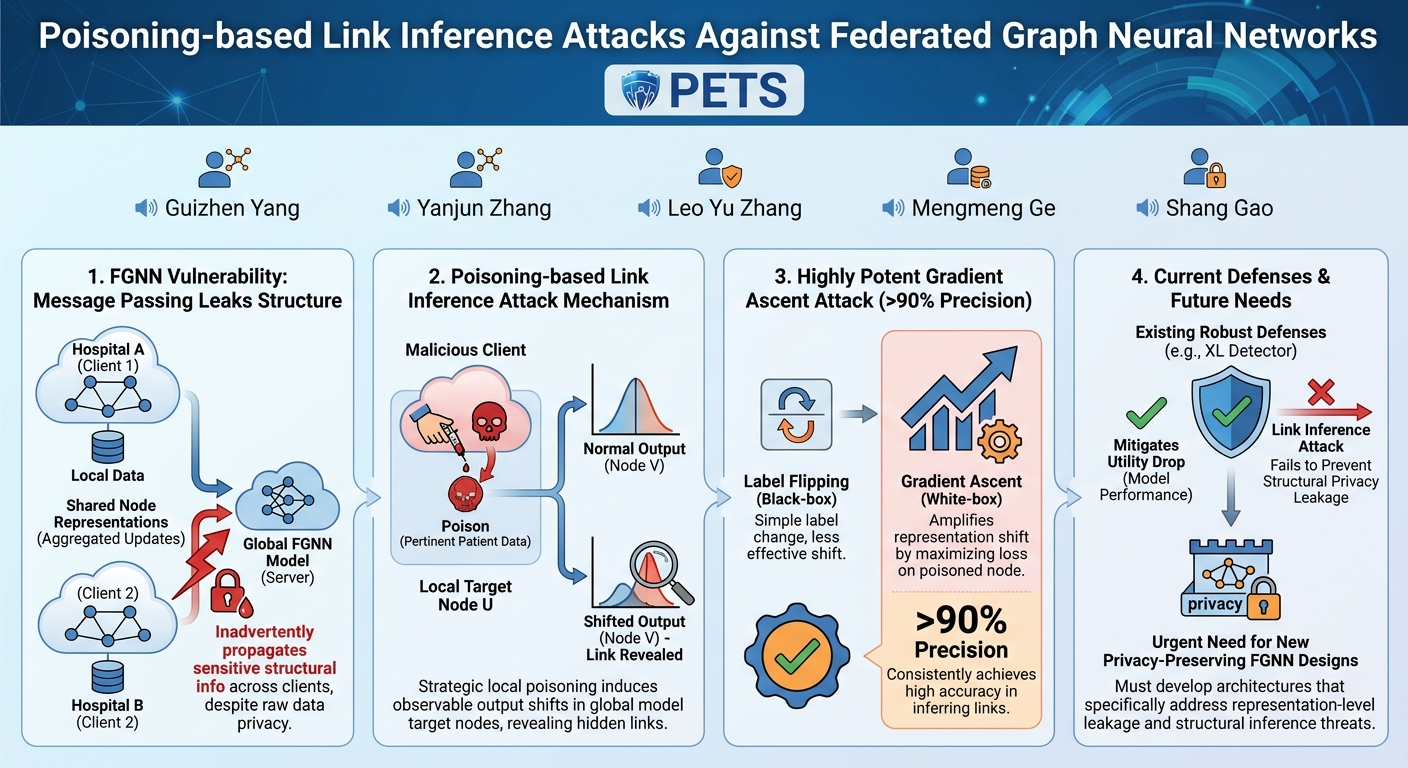
The core of the problem lies in the message passing mechanism fundamental to GNNs, which inadvertently propagates sensitive structural information encoded in shared node representations. The researchers propose a novel poisoning-based link inference framework that allows an attacker, acting as a compromised client, to strategically inject malicious data into their local training process. By observing subtle shifts in the global model's output for specific target nodes, the attacker can deduce the existence of otherwise hidden links, such as family relationships or whether a patient is shared between multiple hospitals. This work is critical because it challenges the implicit privacy assumptions of FGNNs, revealing a significant gap that could be exploited to uncover highly sensitive information, particularly in medical applications where patient privacy is paramount.
Background
▶ Watch: Introduction to Federated GNNs and Attack Scenario (0:15)
The advent of Graph Neural Networks (GNNs) has revolutionized machine learning on graph-structured data, enabling sophisticated tasks like node classification, link prediction, and community detection. GNNs operate by iteratively aggregating information from a node's neighbors, effectively learning rich node representations that encode both individual node features and their structural context within the graph. Simultaneously, Federated Learning (FL) has gained traction as a privacy-preserving distributed learning framework, allowing multiple clients to collaboratively train a global model without sharing their raw local data. Instead, clients train local models on their data and only share model updates or aggregated parameters with a central server.
Combining these two paradigms yields Federated Graph Neural Networks (FGNNs), which are designed to train GNN models on distributed graph data where different parts of the graph (e.g., patient data from different hospitals) are held by separate entities. The primary motivation for FGNNs is to leverage the power of GNNs for tasks like disease prediction or drug discovery while maintaining the strict privacy requirements of sensitive domains like healthcare. In such a scenario, each hospital trains a local GNN model, contributing its local updates to a global FGNN model coordinated by a central medical administration center. The promise is that sensitive information, such as specific patient records or direct links between patients, remains siloed within each hospital.
However, the talk highlights a critical vulnerability stemming from the very mechanism that makes GNNs powerful: message passing. During the FGNN training process, even though raw patient records are not shared, the learned node representations are exchanged or aggregated to form the global model. These representations implicitly encode relational information. The researchers argue that this "rational information is encoded into the node representation shared during the training," creating a privacy gap. This allows an attacker to perform link inference attacks to uncover sensitive relationships, such as disease code relations or social links, even without direct access to the raw underlying data. The problem arises because the message passing mechanism, which propagates information over both intra-client (within a single hospital's data) and cross-client (between hospitals via shared node representations) edges, can be subtly manipulated to reveal these hidden connections.
Key Findings
▶ Watch: Proposed Threat Model and Attacker Capabilities (2:20)
The research introduces a novel poisoning-based link inference framework that systematically exploits the message passing mechanism within Federated Graph Neural Networks. The primary discovery is that by strategically perturbing a single node's data (a "pertinent patient" in the healthcare context), a malicious client can induce observable shifts in the output distribution of other nodes in the global model, thereby revealing hidden structural links. This demonstrates that even without direct access to sensitive raw data, the shared node representations in FGNNs are insufficient to guarantee privacy against sophisticated inference attacks.
A key finding is the development and evaluation of two distinct poisoning strategies: the Label Flipping Link Inference Attack (operating in a black-box setting) and the Gradient Ascent Link Inference Attack (operating in a white-box setting). The experiments consistently showed that the Gradient Ascent Link Inference Attack is significantly more powerful, often achieving over 90% precision across various datasets and aggregators. This high precision underscores the effectiveness of their methodology in accurately inferring links.
Furthermore, the study critically assessed the resilience of existing FGNN defenses against these new attacks. It was found that while robust defenses, such as the XL detector, can mitigate the drop in model utility caused by the attack, they "cannot completely prevent the lens inflage." This highlights a crucial insight: current defensive mechanisms are primarily designed to maintain model accuracy or robustness against malicious data, but they fall short in preventing the leakage of structural privacy. The research effectively demonstrates that the challenge of countering these structure-based threats is substantial and requires re-evaluation of current FGNN privacy paradigms. The extensive evaluation across five benchmark datasets (both homogeneous and heterogeneous), three major GNN architectures, and several aggregators provides strong empirical evidence for the generalizability and potency of their proposed attacks.
Technical Deep Dive
▶ Watch: Two Link Inference Strategies: Label Flipping & Gradient Ascent (4:45)
The proposed attack framework operates under a specific threat model where the attacker is a malicious client participating in the FGNN protocol. This client possesses the same view of the federated learning process as honest clients, allowing it to contribute local updates to the global model. The researchers evaluate two knowledge settings for the attacker:
- Black-box setting: The attacker only observes the global model's outputs.
- White-box setting: The attacker has access to global model parameters but not to other clients' raw data or local updates. Crucially, the attacker can manipulate its own local training process, including generating local nodes and conducting local perturbations.
The attacker's ultimate goal is to determine if a link exists between a target node U (which the attacker controls or can influence locally) and another target node V (which may belong to another client or be globally visible). For example, inferring if patient U is also a patient of another hospital, or if patient U has a family relationship with patient V.
The link inference methodology is based on the intuition that strategic poisoning can reveal structural secrets. It follows a four-step process:
- Inject Poison: The attacker strategically injects malicious information, referred to as a "pertinent patient" or poison, into a candidate node U within its local data partition.
- Propagate Poisoning Information: The fundamental message passing mechanism of GNNs is exploited. This malicious information, encoded in U's node representation, propagates through the graph's topology. This propagation occurs via both intra-client edges (within the attacker's local graph) and, critically, cross-client edges (via the shared global model updates that integrate information from U's neighbors across different clients).
- Monitor Output Distribution: The attacker then monitors the output distribution (e.g., class probabilities) of the target node V from the global model.
- Infer Link: If V is a linked neighbor of U (e.g., through a family link or being the same patient in multiple hospitals), the propagated poisoning information will induce an observable shift in V's output probability distribution. If no such link exists, no significant shift occurs. By comparing this observed shift against a predetermined threshold, the attacker can infer the existence or absence of a link between U and V.
Two primary poisoning strategies were developed:
- Label Flipping Link Inference Attack (Black-box Setting): This strategy is straightforward. The attacker flips the label of node U. For instance, if U represents a research paper, its category might be changed from "genetic algorithm" to "reinforcement learning." This label flip injects malicious information that, through message passing during training, influences the representation of U and its neighbors. If U is connected to V, this poisoning information causes a change in V's output distribution. This method operates in a black-box setting because the attacker only needs to observe the final output of the global model for V to detect the shift.
- Gradient Ascent Link Inference Attack (White-box Setting): This more powerful strategy operates in a white-box setting, where the attacker has access to the global model parameters. Instead of merely flipping a label, the attacker performs gradient ascent on the loss of node U. This specifically reverses the typical loss minimization objective, aiming to amplify the representation shift of node U. By maximizing the loss associated with U, the attacker forces a more pronounced change in U's learned representation. This amplified perturbation then propagates more effectively through the graph, leading to a more discernible shift in V's output distribution if a link exists. The researchers found this method to be significantly more effective, often achieving over 90% precision.
The experimental evaluation was extensive, utilizing five benchmark datasets, including both homogeneous and heterogeneous graph data. The attacks were tested across three major GNN architectures and assessed against several aggregators commonly used in federated learning, as well as baseline attacks like STA and LTA. The federated setting comprised five clients, with one designated as the malicious client. An overlapping rate of 0.3 was used, and the attack was launched at epoch 215, chosen as a point near model convergence to ensure a stable baseline for measuring output shifts. This comprehensive setup allowed for robust validation of the attack's effectiveness and its generalizability across different FGNN configurations.
Demo / Proof of Concept
▶ Watch: Evaluation Results: Gradient Ascent achieves high precision (6:55)
While the talk did not feature a live, interactive demonstration, the researchers provided compelling evidence for their attack's feasibility and effectiveness through an extensive series of evaluations. Their "proof of concept" is manifested in the empirical results obtained from rigorous experimentation across diverse datasets and FGNN architectures. The quantitative findings, such as the Gradient Ascent Link Inference Attack achieving over 90% precision, serve as a robust demonstration that the proposed poisoning methods can indeed successfully infer sensitive links in real-world FGNN scenarios. The detailed methodology and specific experimental setup, including the use of an overlapping rate of 0.3 and launching the attack at epoch 215, provide a clear blueprint for replicating and validating their findings, effectively serving as a technical proof of concept for their theoretical framework.
Defensive Implications
▶ Watch: Conclusion: Poisoning effectively reveals structural links (8:25)
The findings presented in this talk have profound implications for the design and deployment of Federated Graph Neural Networks, especially in sensitive domains. The primary takeaway for defenders is that the current understanding of privacy in FGNNs, which largely focuses on preventing the direct sharing of raw data, is insufficient. The leakage of relational information through shared node representations, even with robust aggregation, represents a critical vulnerability that needs immediate attention.
Firstly, FGNN developers must reconsider their privacy guarantees. It is no longer enough to state that raw data is not shared; explicit measures must be taken to prevent representation-level leakage. This means focusing on privacy-preserving mechanisms that can obscure or sanitize the information encoded within node embeddings before they are shared or aggregated. Techniques like differential privacy applied directly to node representations or local model updates could be explored, though their impact on model utility, especially for graph structures, needs careful research.
Secondly, existing robust aggregation mechanisms need to be re-evaluated. While defenses like the XL detector can mitigate the utility drop caused by poisoning, they are shown to be inadequate in preventing link inference. This indicates that current robustness measures are not designed to protect against this specific type of privacy breach. New aggregation strategies are required that can detect and neutralize poisoning attempts specifically aimed at manipulating structural information propagation, rather than just overall model performance. This might involve more sophisticated outlier detection on gradients or updates that target specific nodes or link characteristics.
Thirdly, defenders need to develop active monitoring and detection systems capable of identifying anomalous shifts in node output distributions or representation changes that might indicate a link inference attack in progress. If a malicious client's perturbations on node U consistently cause shifts in V's output, this pattern could be flagged. This might involve baseline profiling of normal output variability and flagging deviations that exceed a certain threshold, similar to how the attack itself works in reverse.
Finally, the research underscores the need for a holistic approach to FGNN security and privacy. Beyond technical countermeasures, organizations deploying FGNNs in sensitive environments should implement strict client vetting and trust models. While the attack assumes a malicious client, reducing the likelihood of such a client participating in the first place is crucial. Furthermore, the governance and auditing of FGNN training processes must be enhanced to ensure transparency and accountability, making it harder for malicious actors to manipulate local training processes unnoticed. The findings unequivocally demonstrate that a significant research gap exists in building truly privacy-preserving FGNNs that are resilient against sophisticated inference attacks.
Key Takeaways
- FGNNs are vulnerable to link inference attacks: Despite designed to protect privacy by not sharing raw data, Federated Graph Neural Networks can be exploited to reveal sensitive relational links.
- Message passing is the weak point: The fundamental message passing mechanism in GNNs, which propagates node representations, inadvertently leaks structural information across clients.
- Poisoning is an effective attack vector: Strategic injection of malicious data (poisoning) into a local client's node can induce observable shifts in target nodes' outputs, revealing hidden links.
- Gradient Ascent Attack is highly potent: The Gradient Ascent Link Inference Attack, operating in a white-box setting, consistently achieves over 90% precision in inferring links, making it a powerful threat.
- Current defenses are insufficient: Existing robust defenses, such as the XL detector, can mitigate model utility drops but fail to prevent link inference, highlighting a critical gap in FGNN privacy.
- Urgent need for new privacy-preserving FGNN designs: New research and development are required to create FGNN architectures and defense mechanisms that truly protect against representation-level privacy leakage and structural inference attacks.
About the Speaker(s)
The research presented in this talk, "Poisoning-based Link Inference Attacks Against Federated Graph Neural Networks," is a collaborative effort by multiple authors. The presentation was delivered by Guizhen Yang from Deakin University. The paper's authors also include Yanjun Zhang from the University of Technology Sydney, Leo Yu Zhang from Griffith University, Mengmeng Ge from Monash University, and Shang Gao from Deakin University. Their collective work spans multiple Australian universities, indicating a strong academic collaboration in the field of federated learning and graph neural network security and privacy.
Reviews
Dr. Zero (Offensive Security Researcher) — STRONG ACCEPT
Vendors have been pitching Federated GNNs as the holy grail of healthcare privacy—train the global model, keep the patient records siloed. Yang and her team just proved that promise is bullshit. By weaponizing the GNN's own message-passing layer, they demonstrated you can map sensitive cross-client links with over 90% precision.
Heather Calloway (CISO) — STRONG ACCEPT
Data science teams are pitching Federated Learning to risk committees as a privacy-safe way to train AI across boundaries without violating HIPAA or GDPR. This research proves that assumption is structurally flawed. If you are signing off on joint data ventures based on FL's supposed anonymity, you need to understand this exposure.
→ Top-rated talks at Privacy Enhancing Technologies Symposium (PETS) 2026
All talks from Privacy Enhancing Technologies Symposium (PETS) 2026