Proteus: A Practical Framework for Privacy-Preserving Device Logs
Sanket Goutam (Paper author · Stony Brook University), Hunter Kippen (Paper author · Samsung Research America), Michael Grace (Paper author · Unaffiliated), Amir Rahmati (Paper author · Stony Brook University)
Privacy Enhancing Technologies Symposium (PETS) 2026 · Remote
Overview
In an era where personal devices like smartphones, IoT gadgets, and smart home products are increasingly designated as "critical security endpoints" by regulatory bodies, the imperative for extensive logging and audit trails has never been greater. However, this critical need for device telemetry often clashes fundamentally with user privacy, as these logs are replete with highly sensitive personal information. The talk "Proteus: A Practical Framework for Privacy-Preserving Device Logs," presented by Sanket Goutam at the 2026 PETS Symposium, introduces a groundbreaking solution to this pervasive dilemma.
Key moments
- 0:00 Introduction: The challenge of sensitive data in device logs
- 2:30 Limitations of existing PII redaction methods like Presidio
- 4:50 Key insight: Forensics needs correlation, not PII disclosure
- 5:58 Introducing Proteus: A privacy-preserving logging framework
- 6:40 Proteus client-side: PII pseudonymization and encryption pipeline
- 8:00 Proteus server-side: Controlled disclosure protocol for analysis
- 9:50 Conclusion: Proteus balances privacy and forensic utility
Proteus: A Practical Framework for Privacy-Preserving Device Logs
Speakers: Sanket Goutam (Paper author, Stony Brook University); Hunter Kippen (Paper author, Samsung Research America); Michael Grace (Paper author, Unaffiliated); Amir Rahmati (Paper author, Stony Brook University)
Conference: PETS
YouTube: https://www.youtube.com/watch?v=Ea1Ny2Anzbc
Overview
In an era where personal devices like smartphones, IoT gadgets, and smart home products are increasingly designated as "critical security endpoints" by regulatory bodies, the imperative for extensive logging and audit trails has never been greater. However, this critical need for device telemetry often clashes fundamentally with user privacy, as these logs are replete with highly sensitive personal information. The talk "Proteus: A Practical Framework for Privacy-Preserving Device Logs," presented by Sanket Goutam at the 2026 PETS Symposium, introduces a groundbreaking solution to this pervasive dilemma.
Developed in collaboration with researchers from Stony Brook University and Samsung Research America, Proteus offers a novel, practical framework designed to safeguard user privacy without compromising the utility of device logs for forensic analysis and audit compliance. The core innovation lies in its ability to transform sensitive data before it is ever written to device logs, employing sophisticated pseudonymization and encryption techniques. This approach ensures that while forensic analysts can still correlate events and reconstruct timelines, they never gain access to the plain-text sensitive information, thereby upholding both security and privacy mandates.
Proteus directly addresses the shortcomings of existing privacy-preserving logging methods, which either sacrifice data utility through aggressive redaction or introduce significant trust vulnerabilities by processing sensitive data on untrusted servers. By embedding its privacy-preserving mechanisms directly within the device's logging daemon, Proteus establishes a robust, in-situ defense against PII exposure, making it an indispensable tool for manufacturers striving to meet stringent regulatory requirements while honoring user privacy expectations in an increasingly scrutinized digital landscape.
Background
▶ Watch: Introduction: The challenge of sensitive data in device logs (0:00)
The proliferation of personal devices—smartphones, IoT devices, and smart home ecosystems—has transformed them into indispensable components of modern life. Concurrently, these devices have become prime targets for cybersecurity incidents, leading regulatory bodies worldwide to classify them as critical security endpoints. This designation mandates extensive logging mechanisms and rigorous audit requirements, compelling manufacturers to collect vast amounts of telemetry data. These audit trails are crucial for post-compromise forensics, enabling security analysts to investigate breaches, reconstruct events, and understand attack vectors. They are equally vital for demonstrating compliance with various industry and governmental regulations.
However, a significant body of prior research, including a study presented at USENIX Security 2023, has unequivocally demonstrated that device logs, particularly from Android devices across different manufacturers and operating systems, inherently capture a wealth of user-sensitive information. This PII can range from location data and contact lists to application usage patterns and personal communications. The current paradigm for fulfilling audit requirements typically involves extracting these logs from devices and exporting them to forensic analysts, creating an inherent conflict between the utility of comprehensive logging and the imperative of user privacy.
Traditional approaches to mitigate this privacy risk have proven inadequate. A simplistic solution involves redacting all sensitive data as it is ingested into the logs. While seemingly straightforward, this "aggressive sanitization" breaks critical linkages necessary for effective forensic analysis. For example, if a log entry references "Harry Potter" and this name is redacted, it becomes impossible to track events related to that specific entity, undermining event reconstruction and timeline analysis.
Another prevalent approach, often implemented as a post-talk model by data aggregators, involves server-side sanitization. Tools like Microsoft Presidio are widely used in production environments to run PII analyzers and anonymizers on exfiltrated data. However, this model fundamentally requires implicit trust in the entire data collection pipeline. An "honest but curious observer"—an employee or insider with access to the full dataset—could potentially de-anonymize the data for malicious purposes, rendering the sanitization efforts moot. The data is already exfiltrated in its sensitive form before any privacy protection is applied.
More recently, efforts have focused on in-situ, a priori mechanisms, such as the privacy filter developed by OpenAI. This approach deploys small language models directly on customer devices to detect and redact PII before it leaves the device. While this protects data at the source, it often suffers from the same problem as aggressive redaction: it breaks linkage analysis. The core insight that underpins the Proteus framework is that "for forensic analysis, you need correlation, but not disclosure." Forensic investigations rely heavily on event and timeline reconstruction, where the ability to link disparate log entries is paramount. If sensitive elements are simply redacted or aggressively filtered, this crucial log fidelity is lost.
The challenge then becomes how to balance the controlled disclosure of information, enabling necessary correlation for forensics, while simultaneously safeguarding anonymity and preventing the inference of sensitive user details from seemingly innocuous log entries or hashed values. Hashing PII values, for instance, might preserve correlation but can still be vulnerable to dictionary attacks or inferential attacks if the entropy of the input is low, ultimately compromising user anonymity. Proteus aims to solve this precise problem by allowing forensic utility without ever exposing the original sensitive data in plain text.
Key Findings
▶ Watch: Key insight: Forensics needs correlation, not PII disclosure (4:50)
Proteus represents a significant advancement in the field of privacy-preserving logging, offering a practical and robust framework that directly addresses the long-standing tension between forensic utility and user privacy. The key findings and contributions of this research are multi-faceted:
Firstly, Proteus is highlighted as the first framework of its kind to effectively protect sensitive data within device logs while meticulously preserving the full log fidelity required for comprehensive forensic analysis. Unlike previous methods that either aggressively redact information, thus breaking crucial correlations, or rely on post-exfiltration sanitization vulnerable to insider threats, Proteus integrates privacy protection directly into the logging process at the source.
Secondly, the framework successfully enables forensic analysts to infer data from correlated events without actually disclosing the sensitive plain-text information itself. This is achieved through a novel combination of pseudonymization, encryption, and a controlled disclosure protocol. The logs contain encrypted pseudonyms of PII, allowing analysts to track entities and reconstruct event sequences, but the actual personal identifiers remain confidential and inaccessible.
Thirdly, the research demonstrated that Proteus introduces extremely minimal overheads due to its encryption and processing pipeline. Through validation using a bulk processing mechanical pipeline on an open-source dataset of Android logs, the authors found that the performance impact was negligible. In some specific cases, such as the handling of URLs, the approach even proved to be "optimal" because the output is truncated to a specific, manageable byte size, potentially reducing storage and processing needs.
Finally, on-device measurements performed across three different generations of representative hardware revealed that the primary bottlenecks within the Proteus framework are concentrated in two areas: the detection and replacement of PII values and the key derivation functions. Crucially, the researchers identified that both of these critical components can be further optimized by implementing them directly as part of the underlying logging framework, suggesting clear pathways for enhancing the latency benefits and overall efficiency of Proteus in real-world deployments. These findings underscore the practicality and efficiency of Proteus as a viable solution for pervasive, privacy-preserving logging on modern mobile and IoT devices.
Technical Deep Dive
▶ Watch: Introducing Proteus: A privacy-preserving logging framework (5:58)
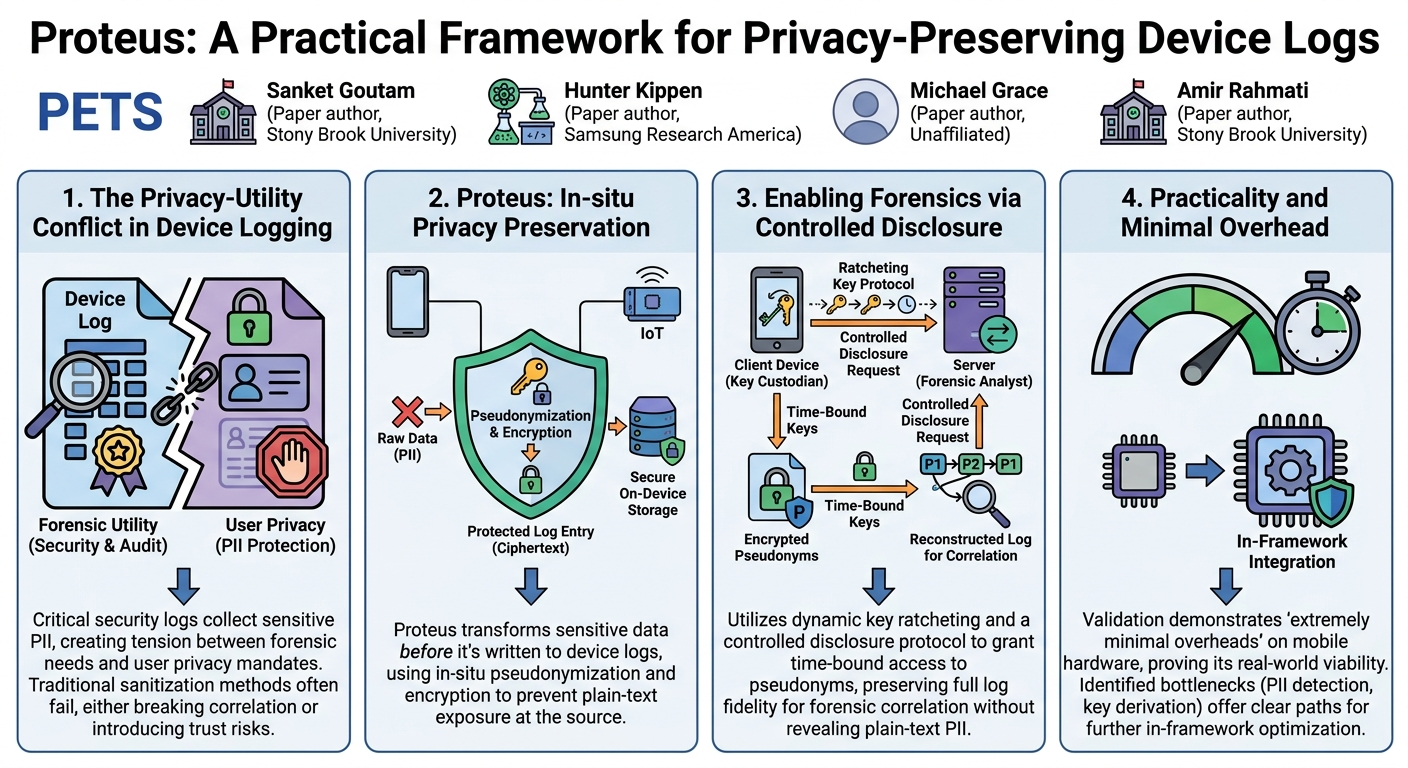
The Proteus framework is meticulously engineered to address the inherent conflict between the necessity of comprehensive device logging for forensic analysis and the imperative of safeguarding user privacy. Its core technical innovation lies in its ability to transform sensitive data before it ever enters the device log, thereby preventing plain-text exposure of PII across any logging export, whether on-device or off-device. This is achieved through a sophisticated architecture comprising a client-side log processing pipeline and a server-side log reconstruction pipeline, underpinned by custom cryptographic protocols.
At its heart, Proteus is implemented as a layer within the logging daemon that operates on client devices, such as logcat on Android. This strategic placement ensures that all log statements are intercepted and processed in-situ, providing an early point of intervention for privacy protection.
Log Processing Pipeline (Proteus Client)
The client-side pipeline is responsible for detecting and transforming sensitive data before it is committed to the log. The process unfolds in several critical steps:
- Log Ingestion and PII Detection: When a log statement is generated and injected into the logging daemon, Proteus intercepts it. It then employs a PII analyzer to detect all sensitive elements within that log statement. The speaker identifies this step as one of the bottlenecks; candidate approaches include the use of advanced pattern matching, regular expressions, or potentially lightweight machine learning models for efficient PII identification.
- Pseudonymization: For each detected PII element, Proteus generates a pseudonymization variation. This is not a simple hash, but rather a unique, non-identifying token that can be consistently linked to the original PII within a specific context (e.g., a forensic investigation). This pseudonym is derived using a secret key, denoted as
K. The use ofKensures that the pseudonym is not trivially reversible and varies based on the key, adding a layer of security. - Key Derivation (Ratcheting Protocol): A crucial aspect of Proteus's security model is its dynamic key management. Proteus derives a daily encryption key using a specialized ratcheting protocol developed by the researchers. A ratcheting protocol ensures forward secrecy (compromise of current keys doesn't compromise past data) and backward secrecy (compromise of current keys doesn't compromise future data) by deriving new keys from previous ones in a non-reversible manner. This means that even if an attacker gains access to a key for a specific day, they cannot use it to decrypt logs from other days.
- Ciphertext Generation: The pseudonym generated in step 2 is then encrypted using the daily encryption key derived in step 3. This results in a ciphertext of the pseudonym.
- Protected Log Storage: The original plain-text PII is never written to the device log. Instead, the log dump that exists on the device contains only the arbitrary ciphertext corresponding to the sensitive information. The actual pseudonym is secured locally on the device in a secure location that is not exposed in the log, and the plain text remains entirely off-limits. For instance, if "Harry Potter" was the original PII, the log would simply contain an unidentifiable ciphertext like
XYZ123ABC.
Log Reconstruction Pipeline (Server Side)
The server-side pipeline facilitates controlled access to the pseudonyms for forensic analysis, without ever revealing the plain-text PII. This leverages a custom controlled disclosure protocol:
- Request for Keys: When a forensic analyst or authorized entity needs to investigate logs, the server initiates a request to the client device for a specific set of decryption keys. Crucially, this request is limited to a given time range. This fine-grained control is central to the "controlled disclosure" mechanism, preventing bulk decryption of all historical data.
- Client Key Provision: The client device, acting as the custodian of the pseudonymization and encryption keys, provides the requested keys to the server, but only for the specified time range. The ratcheting protocol ensures that only the relevant daily keys are shared.
- Pseudonym Recovery: With the protected device logs (containing ciphertexts) and the provided keys, the server can then run the log reconstruction pipeline. It decrypts the ciphertexts, but this decryption only yields the pseudonym text that was initially generated on the client. The original plain-text PII (e.g., "Harry Potter") remains encrypted and inaccessible to the server.
- Forensic Analysis with Pseudonyms: The forensic analyst can now use these pseudonyms to perform event correlation, timeline reconstruction, and other analytical tasks. For example, if "Harry Potter" was consistently pseudonymized to
HP_PSDN_001(and then encrypted), the analyst can trackHP_PSDN_001across various log entries to understand related events, without ever knowing the actual name. This preserves full log fidelity for correlation while maintaining privacy.
Core Technical Concepts
- Pseudonymization: A process of replacing identifying information with artificial identifiers (pseudonyms). Unlike simple hashing, which can be vulnerable to collision or inference, robust pseudonymization schemes aim to provide a reversible mapping under strict, authorized conditions. In Proteus, this reversibility is only to the pseudonym, not the original PII, on the server side.
- Ratcheting Protocol: A cryptographic key agreement protocol where new keys are continually derived from previous ones, enhancing forward and backward secrecy. This ensures that the compromise of a single key only impacts a limited time window of data.
- Controlled Disclosure Protocol: A custom protocol designed to enable selective and authorized release of information (in this case, decryption keys for specific time ranges) to a trusted entity (the server) for a defined purpose (forensic analysis). This prevents unauthorized or overly broad access to sensitive data.
The architecture of Proteus, with its in-situ processing, dynamic key management, and controlled disclosure, offers a robust and practical solution to the privacy-utility paradox of device logging.
Demo / Proof of Concept
▶ Watch: Proteus server-side: Controlled disclosure protocol for analysis (8:00)
While the talk did not feature a live demonstration in the traditional sense, the researchers performed rigorous validation of the Proteus framework to demonstrate its practicality and efficiency. These evaluations served as a critical proof of concept, addressing potential concerns regarding performance overheads and identifying areas for further optimization.
The validation process involved two distinct methodologies:
- Bulk Processing Mechanical Pipeline:
- Methodology: The research team leveraged an existing open-source dataset of Android logs. This allowed them to simulate real-world log ingestion scenarios at scale, processing a large volume of log entries through the Proteus pipeline. The primary objective was to assess whether the added cryptographic operations and PII processing introduced any substantial bottlenecks.
- Findings: The results were highly encouraging. The overheads attributed to encryption and the overall processing within Proteus were found to be "extremely minimal." This suggests that the framework's design, particularly its cryptographic primitives and processing logic, is highly optimized. Intriguingly, in certain specific cases, such as the handling of URLs, the processing was deemed "optimal." This was attributed to the output being truncated to a specific byte size, which could potentially result in smaller log entries for certain types of PII compared to their original length, thereby offering efficiency benefits.
- On-Device Measurement:
- Methodology: To ensure real-world applicability and understand performance characteristics on actual hardware, the researchers conducted measurements using three different generations of devices. These devices represented a range of typical hardware configurations, providing a realistic assessment of Proteus's performance across varying computational capabilities.
- Findings: The on-device measurements corroborated the efficiency findings from the bulk processing. However, they also pinpointed specific areas where the framework exhibited identical bottlenecks across all representative hardware. These bottlenecks were primarily identified in the detection and replacement of PII values and in the key derivation functions. The good news, as highlighted by the speaker, is that both of these critical components can be further optimized. By implementing these functions directly as a part of the underlying logging framework (e.g., within the operating system's logcat daemon), significant latency benefits could be achieved. This suggests that while the current implementation is already efficient, there's clear scope for deeper integration and performance enhancement.
These validation efforts collectively underscore the practical viability of Proteus. They demonstrate that the framework can operate with minimal performance impact in real-world scenarios, while also providing clear guidance for future optimizations to further enhance its efficiency and responsiveness on diverse device hardware. The ability to process logs at scale and on actual devices with such low overheads is a strong testament to Proteus's potential for widespread adoption.
Defensive Implications
▶ Watch: Conclusion: Proteus balances privacy and forensic utility (9:50)
The Proteus framework introduces profound defensive implications for various stakeholders within the cybersecurity and privacy ecosystem. By offering a practical and robust solution to the privacy-utility dilemma of device logs, it empowers organizations to bolster their security posture while rigorously adhering to privacy mandates.
- For Device Manufacturers and OS Developers: Proteus provides a clear pathway to comply with increasingly stringent regulatory requirements for extensive logging (e.g., GDPR, CCPA, HIPAA, various national cybersecurity acts) without incurring significant privacy risks. By integrating Proteus or similar in-situ privacy-preserving frameworks into their operating systems and device firmwares, manufacturers can demonstrate due diligence in protecting user data. This not only mitigates potential legal and reputational damages associated with PII breaches but also enhances user trust. Implementing the identified bottlenecks (PII detection/replacement, key derivation) directly into the framework could lead to a highly optimized and seamless integration.
- For Cybersecurity Teams and Forensic Analysts: The framework revolutionizes how post-compromise forensics and security audits can be conducted. Analysts gain the ability to perform crucial event reconstruction, timeline analysis, and correlation of security incidents using pseudonyms, without ever needing access to sensitive plain-text PII. This significantly reduces the risk of accidental or malicious disclosure of private user data during investigations, thereby protecting analysts from handling sensitive information unnecessarily and reducing the scope of data exposure in case of a breach of the forensic environment itself. The controlled disclosure protocol ensures that access to even pseudonymous data is limited to specific time ranges and authorized contexts.
- For Privacy Officers and Compliance Teams: Proteus offers a tangible technical control to demonstrate adherence to privacy-by-design principles. It ensures that PII is protected at the earliest possible stage—before it's even written to the log—eliminating the need for trust in complex, post-exfiltration sanitization pipelines. This significantly simplifies compliance audits and reduces the attack surface for insider threats, as an "honest but curious observer" within the organization would not have access to plain-text sensitive data even if they gained access to the raw logs.
- For Users: Ultimately, Proteus fosters greater trust in personal devices and the companies that produce them. Users can have increased confidence that their sensitive data, which is inevitably captured in device logs, is not exposed in plain text and cannot be easily de-anonymized, even for legitimate security investigations. This enhanced privacy assurance is a critical factor in user adoption and satisfaction, especially as privacy concerns continue to grow.
- Mitigation of Insider Threats: One of the most significant defensive implications is the robust mitigation of insider threats. Traditional server-side sanitization models are inherently vulnerable to employees with access to the full, raw data. Proteus's design fundamentally prevents this by ensuring that plain-text PII never leaves the device's secure processing environment. Even if a malicious insider gains access to the exported logs, they would only find encrypted pseudonyms, rendering the data useless without the corresponding, time-bound decryption keys, which are tightly controlled by the client device.
By shifting privacy protection to the source and integrating it deeply into the logging mechanism, Proteus empowers defenders to build more secure, private, and compliant systems from the ground up, moving beyond reactive sanitization to proactive privacy engineering.
Key Takeaways
- Mobile and user devices are increasingly designated as critical security endpoints, necessitating pervasive logging for audit compliance and post-compromise forensics.
- Traditional logging mechanisms inherently collect user-sensitive information (PII), creating a fundamental conflict between utility for security and the imperative of user privacy.
- Existing privacy-preserving solutions, such as aggressive redaction or server-side anonymization, are inadequate; they either break crucial log correlation needed for forensics or introduce significant trust vulnerabilities and insider threat risks.
- Proteus is a novel, practical framework that solves this dilemma by transforming sensitive data with pseudonymization and encryption before it enters the device log, preserving log fidelity for correlation without disclosing plain-text PII.
- The framework utilizes a client-side log processing pipeline with dynamic key derivation via a ratcheting protocol, and a server-side log reconstruction pipeline with a controlled disclosure protocol for time-bound access to pseudonyms.
- Validation demonstrates that Proteus introduces "extremely minimal" overheads, making it practical for real-world deployment, with identified bottlenecks in PII detection and key derivation offering clear pathways for further optimization within the device framework.
About the Speaker(s)
The research behind Proteus was a collaborative effort. Sanket Goutam, a paper author from Stony Brook University, presented the talk at the PETS 2026 Symposium. He was joined in this work by Hunter Kippen, also a paper author, representing Samsung Research America. Additional contributions came from Michael Grace, an unaffiliated paper author, and Amir Rahmati, another paper author from Stony Brook University. Their combined expertise from academia and industry was instrumental in developing this practical and impactful framework.
Reviews
Dr. Zero (Offensive Security Researcher) — STRONG ACCEPT
Proteus actually solves the exact headache IR teams have when legal won't let them pull Android telemetry. Instead of relying on post-ingest server redaction—which is a massive insider threat—they inject a ratcheting crypto layer straight into the logging daemon to pseudonymize PII locally. It preserves the event linkage forensics needs without pissing off the privacy regulators.
Heather Calloway (CISO) — STRONG ACCEPT
Security needs full-fidelity logs for incident response. Privacy regulations make collecting those logs a massive liability. This research presents a credible architectural fix: pseudonymizing PII at the endpoint before it hits disk, preserving forensic timelines without the regulatory exposure.
→ Top-rated talks at Privacy Enhancing Technologies Symposium (PETS) 2026
All talks from Privacy Enhancing Technologies Symposium (PETS) 2026