Privacy vs. Profit: The Impact of Google's Manifest Version 3 (MV3) Update on Ad Blocker Effectiveness
Karlo Lukic (Paper author · Goethe University Frankfurt), Lazaros Papadopoulos (Paper author · Goethe University Frankfurt)
Privacy Enhancing Technologies Symposium (PETS) 2026 · Remote
Overview
This talk, delivered by Karlo Lukic and Lazaros Papadopoulos from Goethe University Frankfurt, delves into the contentious topic of Google's Manifest Version 3 (MV3) update and its real-world impact on the efficacy of ad blocking extensions. The presentation at PETS addresses a heated debate within the cybersecurity and privacy communities, where Google's stated goals of enhancing user security and privacy through MV3 were met with skepticism by ad blocker developers and privacy advocates, who feared the update would cripple essential tools for online protection. The core tension lies in Google's dual role as both a dominant browser vendor, dictating extension policies, and the world's largest ad company, with a vested interest in the advertising ecosystem.
Key moments
- 0:15 Manifest V3: Key technical changes and limitations
- 2:45 Google's dual role: browser vendor and ad company conflict
- 4:20 Experimental setup: comparing MV2 and MV3 ad blocker versions
- 5:50 Main finding: MV3 shows no decrease in ad blocking
- 6:10 MV3 even improves anti-tracking effectiveness in some cases
- 7:30 Visual inspection reveals cosmetic placeholders under MV3
- 8:45 Conclusion: Ad blocker developers successfully adapted to MV3
Privacy vs. Profit: The Impact of Google's Manifest Version 3 (MV3) Update on Ad Blocker Effectiveness
Speakers: Karlo Lukic (Paper author, Goethe University Frankfurt); Lazaros Papadopoulos (Paper author, Goethe University Frankfurt)
Conference: PETS
YouTube: https://www.youtube.com/watch?v=f6zecVy4Apo
Overview
This talk, delivered by Karlo Lukic and Lazaros Papadopoulos from Goethe University Frankfurt, delves into the contentious topic of Google's Manifest Version 3 (MV3) update and its real-world impact on the efficacy of ad blocking extensions. The presentation at PETS addresses a heated debate within the cybersecurity and privacy communities, where Google's stated goals of enhancing user security and privacy through MV3 were met with skepticism by ad blocker developers and privacy advocates, who feared the update would cripple essential tools for online protection. The core tension lies in Google's dual role as both a dominant browser vendor, dictating extension policies, and the world's largest ad company, with a vested interest in the advertising ecosystem.
The researchers conducted a comprehensive empirical study to determine whether MV3 has indeed led to a statistically significant decrease in the ability of popular ad blockers to block advertisements and trackers. Their methodology involved running parallel browser instances under both the older Manifest Version 2 (MV2) and the new MV3 regimes, meticulously measuring ad and tracker blocking performance across a significant sample of websites. Contrary to widespread concerns, their findings suggest that ad blockers have largely adapted to the MV3 framework, maintaining their effectiveness in blocking ads and, in some cases, even improving their ability to block trackers.
This research is particularly significant because it provides data-driven insights into a policy change that affects a substantial portion of internet users—less than one-third globally use ad blockers—and directly confronts the narrative that MV3 would be the "death knell" for these privacy tools. While the study offers reassurance regarding core blocking capabilities, it also highlights lingering issues, particularly concerning the prevalence of cosmetic placeholders, which can still detract from the user experience. The work underscores the critical importance of empirical validation when major platform changes impact the broader digital ecosystem and user privacy.
Background
▶ Watch: Manifest V3: Key technical changes and limitations (0:15)
The evolution of browser extension APIs, specifically Google's transition from Manifest Version 2 (MV2) to Manifest Version 3 (MV3), represents a pivotal shift in how extensions interact with web traffic and browser resources. This change, driven by Google Chrome's dominant market share, has far-reaching implications, influencing not only Chrome's ecosystem but also other browsers like Firefox, which often adapt their own APIs to maintain compatibility and functionality. The primary stated motivation behind MV3 was to enhance user security and privacy by restricting the capabilities of potentially malicious extensions, ensuring greater transparency, and improving performance.
Under MV2, extensions primarily leveraged the Web Request API. This powerful API allowed extensions to inspect, block, or modify network requests at runtime, providing a high degree of flexibility and dynamic control. Coupled with background agents that could run continuously in the browser, MV2 offered ad blockers the ability to dynamically react to evolving ad and tracking technologies, applying complex filtering rules on the fly. This architecture, however, also presented security risks, as it could be exploited by malicious extensions to intercept sensitive user data or inject unwanted content.
MV3 introduces fundamental architectural changes designed to mitigate these risks. The Web Request API is largely replaced by the Declarative Network Request API. Instead of inspecting requests at runtime, extensions under MV3 are required to pre-register a set of declarative rules with the browser. The browser then enforces these rules itself, without the extension needing to actively process each request. This model aims to improve performance and security by limiting the extension's direct access to network traffic and requiring explicit, pre-defined actions. Furthermore, continuous background agents are replaced by Service Workers, which are event-driven. Service Workers are activated only when specific events occur and are torn down after a period of inactivity, reducing continuous resource consumption but also limiting persistent background processing capabilities.
A critical limitation imposed by MV3 is the introduction of rule caps. Extensions are restricted to a maximum of 30,000 rules each, with a global browser limit of 330,000 rules across all installed extensions. This particular change sparked significant concern among ad blocker developers, as comprehensive filter lists often contain hundreds of thousands of rules to combat a vast and ever-changing landscape of ads and trackers. Critics argued that these limitations, especially the declarative nature of the new API and the rule caps, would severely hinder ad blockers' effectiveness, potentially "killing" them. This concern was amplified by Google's dual role: while advocating for user privacy as a browser vendor, Google is also the world's largest advertising company, raising suspicions that MV3 might inadvertently (or intentionally) benefit its advertising business by weakening ad blocking capabilities. The research presented here aims to empirically investigate whether these fears have materialized.
Key Findings
▶ Watch: Experimental setup: comparing MV2 and MV3 ad blocker versions (4:20)
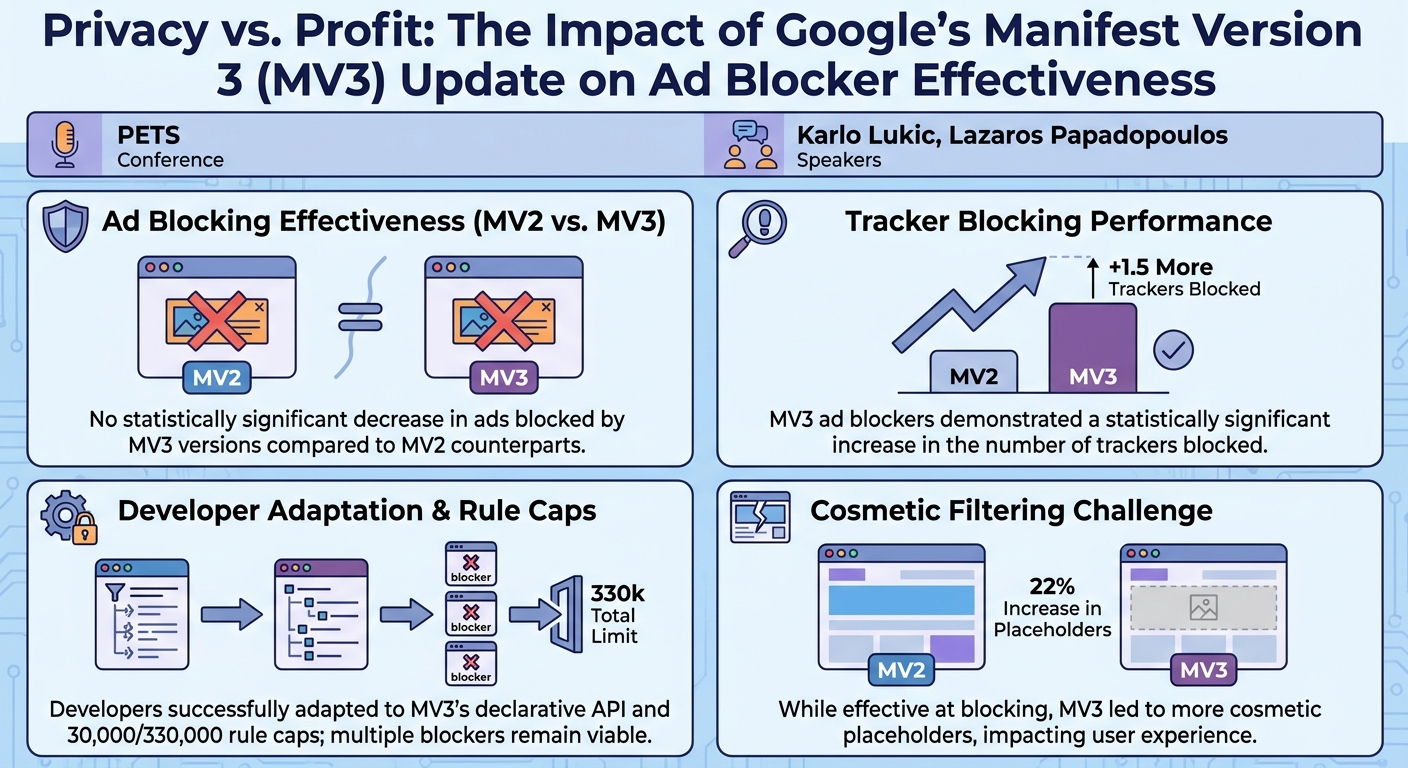
The empirical study presented at PETS delivers several crucial findings that significantly reshape the understanding of Manifest Version 3 (MV3)'s impact on ad blocking effectiveness. Foremost among these is the primary conclusion that, contrary to widespread fears, the researchers found no statistically significant decrease in the number of ads blocked by MV3 versions of popular ad blockers compared to their MV2 counterparts. This finding directly challenges the narrative that MV3 would fundamentally cripple ad blocking capabilities.
Perhaps even more surprising, the study revealed a statistically significant increase in blocked trackers under the MV3 regime. MV3 ad blockers were observed to block approximately 1.5 more trackers than their MV2 counterparts. This suggests that the new API, despite its perceived limitations, might have inadvertently led to improved anti-tracking performance, possibly due to a more structured and efficient way of defining and applying rules for known tracking domains.
The research also addressed concerns about the rule caps imposed by MV3. The MV3+ experimental setup, which involved running multiple MV3 ad blockers simultaneously, demonstrated that this configuration did not hinder the individual capability of each blocker to effectively block ads and trackers. This indicates that the global rule limit of 330,000 rules for the complete browser did not, at the time of the study, pose a practical constraint for users running a typical set of ad blockers.
While core blocking effectiveness remained robust, the study did identify an area of concern related to user experience. Through a visual inspection of 100 screenshot pairs, comparing MV2 and MV3 versions of websites, the researchers found that in 22% of cases, cosmetic placeholders were present under MV3 where they were absent under MV2. These placeholders, often empty spaces or broken elements left behind after an ad is blocked, can detract from the user experience, even if the ad itself is not displayed. This highlights a remaining challenge for ad blocker developers in optimizing cosmetic filtering within the MV3 framework.
The robustness of these findings was rigorously tested through several additional experiments:
- The browser-based experiment was run on a stratified sample of websites, including less popular sites, not just the highly popular ones from the Tranco 1k list, confirming broader applicability.
- Alternative measures for ads and trackers were used, yielding consistent results.
- Comparisons between early versus late MV3 builds showed similar effectiveness, indicating a stable adaptation by developers.
- The results were replicated at Firefox, demonstrating that the implications of MV3's architectural changes extend beyond Chrome, given Firefox's adoption of similar principles.
- Reliability was confirmed across five independent runs of the measurements, ensuring consistency.
In conclusion, the key findings offer reassuring news for users dependent on ad blockers for privacy and a cleaner browsing experience. Ad blocker developers have largely succeeded in adapting to the Manifest Version 3 update, maintaining core ad blocking functionality and even enhancing anti-tracking capabilities, although the challenge of seamless cosmetic filtering persists.
Technical Deep Dive
▶ Watch: Main finding: MV3 shows no decrease in ad blocking (5:50)
The shift from Manifest Version 2 (MV2) to Manifest Version 3 (MV3) represents a fundamental architectural change in how browser extensions operate, moving from a highly permissive, dynamic model to a more restricted, declarative, and event-driven paradigm. Understanding these technical distinctions is crucial for appreciating the initial concerns surrounding MV3 and the ingenuity required for ad blocker developers to adapt.
Under MV2, the cornerstone for ad blockers was the Web Request API. This API granted extensions extraordinary power: the ability to intercept, inspect, and modify every network request as it happened, in real-time. This meant an ad blocker could:
- Inspect headers and URLs: Dynamically identify requests to known ad or tracking domains.
- Block requests: Prevent unwanted content from ever loading.
- Modify requests: Change headers or redirect requests.
- Inject scripts: Modify the webpage's DOM (Document Object Model) to hide remaining ad elements (cosmetic filtering).
This dynamic control, coupled with background agents that ran continuously in the browser, allowed ad blockers to maintain complex, ever-evolving filter lists and react instantly to new ad serving techniques or tracker domains. The downside was that this power could be abused by malicious extensions, leading to privacy breaches or performance degradation due to constant request processing.
MV3 fundamentally alters this by replacing the Web Request API with the Declarative Network Request API. Instead of real-time interception, extensions must now pre-register their filtering rules with the browser. These rules are declarative, meaning they state what should happen (e.g., "block requests to example.com/adserver"), but not how it should be done. The browser then takes responsibility for enforcing these rules efficiently at a lower level. Key implications include:
- Limited dynamic logic: Extensions have less ability to apply complex, conditional logic based on runtime context or to modify requests dynamically.
- No arbitrary content modification: The ability to inject arbitrary scripts to manipulate the DOM for cosmetic filtering is restricted, requiring more structured approaches.
- Rule Caps: The introduction of 30,000 rules per extension and a 330,000 total rule limit for the browser directly impacts the scale of filter lists. Ad blockers with millions of rules had to significantly optimize or segment their rule sets.
Furthermore, continuous background agents are replaced by Service Workers. These are event-driven scripts that run in the background only when triggered by specific events (e.g., a network request, a push notification) and are terminated after a period of inactivity. This improves browser performance and resource utilization but means extensions cannot maintain persistent, always-on logic or state in the same way, posing challenges for features that require continuous monitoring or complex state management.
The empirical methodology employed by Lukic and Papadopoulos was designed to directly assess the practical implications of these technical changes. They ran parallel instances of MV2 and MV3 versions of popular ad blockers on the same set of websites. A "base" instance with no ad blocker was also run to establish a baseline of ads and trackers present. An "MV3+" instance tested the cumulative effect of multiple MV3 blockers, directly addressing the rule cap concern. The use of the Tranco 1k list (specifically, 9 out of 24 websites from their final sample) ensured that the study focused on popular, relevant web properties, although robustness tests extended to a stratified sample including less popular sites. This meticulous setup allowed the researchers to isolate the impact of MV3 by controlling for temporal variations and ad blocker vendor-specific implementations, providing a robust, apples-to-apples comparison of the API changes.
Demo / Proof of Concept
▶ Watch: Visual inspection reveals cosmetic placeholders under MV3 (7:30)
The talk did not feature a traditional live demonstration or a proof-of-concept exploit. Instead, the core of the presentation centered on the empirical methodology employed for the study itself, which served as a robust "demonstration" of their findings. The researchers meticulously detailed their experimental setup, involving parallel browser instances running MV2, MV3, base (no blocker), and MV3+ (multiple MV3 blockers) configurations. This systematic approach, applied across a curated list of websites and subjected to various robustness checks, effectively demonstrated the real-world impact (or lack thereof) of the Manifest Version 3 update on ad blocker effectiveness.
The closest element to a visual demonstration was the visual inspection of 100 screenshot pairs. These screenshots, taken during the crawl process, provided concrete evidence of cosmetic issues, specifically the presence of cosmetic placeholders under MV3 where they were absent under MV2. While not an interactive demo, this visual evidence powerfully illustrated a key limitation of the MV3 transition that impacts user experience, even if the underlying ad blocking functionality remains intact.
Defensive Implications
▶ Watch: Conclusion: Ad blocker developers successfully adapted to MV3 (8:45)
The findings presented by Lukic and Papadopoulos offer critical insights for various stakeholders in the digital ecosystem, informing defensive strategies and future development.
For internet users, the primary implication is reassuring: the widespread fear that Google's Manifest Version 3 (MV3) update would effectively "kill" ad blockers appears to be unfounded. Users can continue to rely on popular ad blocking extensions as effective tools for enhancing privacy and blocking unwanted advertisements. The study's finding that MV3 blockers even improved anti-tracking capabilities suggests that the new framework, while restrictive, has not inherently undermined core privacy protections. However, users should be aware that they might encounter more cosmetic placeholders on websites, which, while not re-introducing ads, can still lead to a less polished browsing experience. This might prompt users to seek out blockers that prioritize cosmetic filtering improvements or accept this minor trade-off for continued privacy.
For ad blocker developers, the research serves as a testament to their successful adaptation. Despite the significant architectural shifts and limitations like rule caps (30,000 rules per extension, 330,000 total), developers have managed to optimize their filtering logic and leverage the Declarative Network Request API effectively. The challenge now lies in refining cosmetic filtering techniques within the MV3 constraints. This could involve more sophisticated CSS injection, leveraging newer browser APIs (if available), or collaborating with websites to provide cleaner layouts when ads are removed. The successful replication of results on Firefox also underscores the cross-browser relevance of their MV3 adaptation strategies. Developers should continue to innovate within the MV3 framework, focusing on user experience enhancements alongside core blocking.
For Google and other browser vendors, the study provides valuable feedback on the real-world consequences of major API changes. While MV3's stated goals of improving security and performance appear to have been achieved without fundamentally breaking ad blockers, the issue of cosmetic placeholders highlights an area where the user experience is negatively impacted. This might prompt Google to consider future API enhancements that facilitate more robust cosmetic filtering while maintaining security and performance benefits. The continued tension arising from Google's dual role as both browser vendor and advertising giant remains, but the empirical evidence suggests that, at least in this instance, the "privacy vs. profit" dilemma did not result in a catastrophic outcome for user-side privacy tools. The study validates the importance of transparent communication and robust empirical testing when implementing platform-wide changes that affect critical user functionalities.
Key Takeaways
- MV3 Did Not Cripple Ad Blocking: The study found no statistically significant decrease in the effectiveness of Manifest Version 3 (MV3) ad blockers in blocking ads compared to their Manifest Version 2 (MV2) counterparts.
- Improved Tracker Blocking: Surprisingly, MV3 ad blockers demonstrated a statistically significant increase in their ability to block trackers, blocking approximately 1.5 more trackers on average.
- Successful Developer Adaptation: Ad blocker developers have largely adapted to the technical challenges and limitations imposed by MV3, including the Declarative Network Request API and rule caps, maintaining core functionality.
- Cosmetic Filtering Remains a Challenge: While ads and trackers are effectively blocked, MV3 led to an increase in cosmetic placeholders (22% of cases), indicating an area for improvement in user experience.
- Multiple Blockers Are Viable: Running multiple MV3 ad blockers simultaneously did not hinder their individual effectiveness, suggesting that the global 330,000 rule limit is not a practical constraint for most users.
- Empirical Validation is Crucial: This research underscores the importance of data-driven empirical studies to assess the real-world impact of significant platform changes, especially when initial concerns are high.
About the Speaker(s)
Karlo Lukic and Lazaros Papadopoulos are both co-authors of the paper and presented this research at the PETS conference. They are affiliated with Goethe University Frankfurt, where they conduct research focusing on topics related to privacy and security in the digital space. Their work, as demonstrated by this talk, involves rigorous empirical methodologies to analyze the practical implications of significant technological shifts, particularly those impacting user privacy tools like ad blockers. Their collaboration highlights an academic effort to provide objective, data-backed insights into contentious debates within the cybersecurity community.
Reviews
Dr. Zero (Offensive Security Researcher) — STRONG ACCEPT
For two years, the privacy community has been screaming that Manifest V3 is the apocalypse. Lukic and Papadopoulos actually bothered to measure it, and their data proves the panic was mostly bullshit. This is a rigorous, receipt-driven paper that shuts up the doomsayers and proves ad blockers survived the jump to the Declarative Net Request API just fine.
Heather Calloway (CISO) — STRONG ACCEPT
The privacy community spent two years claiming Google's Manifest V3 update would destroy ad blockers and enterprise browser extensions. This empirical study proves that panic was unfounded, showing core blocking capabilities remain intact under the new declarative model. It is a necessary reality check for any security leader managing enterprise browser policies.
→ Top-rated talks at Privacy Enhancing Technologies Symposium (PETS) 2026
All talks from Privacy Enhancing Technologies Symposium (PETS) 2026