Quantifying Classifier Utility under Local Differential Privacy
Ye Zheng (Paper author · Rochester Institute of Technology), Yidan Hu (Paper author · Rochester Institute of Technology)
Privacy Enhancing Technologies Symposium (PETS) 2026 · Remote
Overview
This article delves into a compelling talk presented by Ye Zheng and Yidan Hu from Rochester Institute of Technology at the Privacy Enhancing Technologies Symposium (PETS). The research, titled "Quantifying Classifier Utility under Local Differential Privacy," addresses a fundamental challenge in privacy-preserving machine learning: how to accurately assess the performance (utility) of a classifier when its input data has been perturbed by Local Differential Privacy (LDP) mechanisms. LDP is a strong privacy guarantee that allows individuals to contribute data to an aggregate dataset while preserving their individual privacy, typically by adding noise to their data before it leaves their device.
Key moments
- 0:00 Introduction: Quantifying classifier utility under LDP
- 2:00 Analytical approach: Connecting LDP with classifier robustness
- 4:00 Practical utility: Choosing LDP parameters for desired accuracy
- 4:30 Systematic comparison of different LDP mechanisms
- 5:30 Case studies setup: Evaluating analytic vs. empirical utility
- 6:00 Results: Accuracy and efficiency for low-dimensional data
- 7:00 High-dimensional results and overall conclusion
Quantifying Classifier Utility under Local Differential Privacy
Speakers: Ye Zheng, Paper author, Rochester Institute of Technology; Yidan Hu, Paper author, Rochester Institute of Technology
Conference: PETS
YouTube: https://www.youtube.com/watch?v=T2KtVNVToy8
Overview
This article delves into a compelling talk presented by Ye Zheng and Yidan Hu from Rochester Institute of Technology at the Privacy Enhancing Technologies Symposium (PETS). The research, titled "Quantifying Classifier Utility under Local Differential Privacy," addresses a fundamental challenge in privacy-preserving machine learning: how to accurately assess the performance (utility) of a classifier when its input data has been perturbed by Local Differential Privacy (LDP) mechanisms. LDP is a strong privacy guarantee that allows individuals to contribute data to an aggregate dataset while preserving their individual privacy, typically by adding noise to their data before it leaves their device.
The core contribution of this work is an innovative analytical framework that connects the theoretical guarantees of LDP with the concept of classifier robustness. This framework provides a systematic and efficient method to quantify a classifier's utility, moving beyond the limitations of traditional empirical approaches that are often computationally expensive and time-consuming.
This research holds significant implications for both the design and deployment of privacy-preserving machine learning systems. For classifier designers, understanding this utility quantification can lead to the development of "LDP-friendly" models that maintain higher accuracy even under strong privacy constraints. For users and organizations deploying LDP, the framework enables informed decisions about the optimal privacy parameters (e.g., the epsilon value) to achieve a desired balance between data privacy and classification accuracy, thereby maximizing the practical value of privacy-preserving data collection.
Background
▶ Watch: Introduction: Quantifying classifier utility under LDP (0:00)
In an increasingly data-driven world, the deployment of machine learning classifiers is ubiquitous, ranging from medical diagnostics to financial fraud detection and image recognition. However, a growing concern revolves around the privacy of the input data used by these classifiers. Many real-world scenarios involve sensitive personal data collected from individual devices, which often necessitates the application of privacy-enhancing technologies. Local Differential Privacy (LDP) has emerged as a robust solution in this context, where noise is added to an individual's data directly on their device before it is transmitted, ensuring that no sensitive raw data ever leaves the user's control.
The fundamental problem arises because classifiers are typically trained on clean, unperturbed data. When these trained classifiers are subsequently fed noisy, LDP-perturbed inputs, their performance—or utility—can degrade significantly. A natural and critical question then emerges: what is the actual utility of a classifier when its inputs are subjected to an LDP noise channel?
Prior to this work, the predominant approach to answer this question was empirical: "sample and then test." This involved generating multiple noisy instances from an LDP mechanism for a given privacy parameter (e.g., epsilon), feeding them to the classifier, and then measuring the classification accuracy. While providing concrete results for specific settings, this method suffers from severe limitations. Each time a different privacy parameter (epsilon) or a new LDP mechanism is considered, the entire resampling and retesting process must be repeated. This makes empirical evaluation exceedingly time-consuming, computationally intensive, and impractical for exploring a wide range of privacy-utility trade-offs or comparing various LDP mechanisms. The field thus lacked a systematic, analytical, and efficient method to quantify classifier utility under LDP perturbation.
Key Findings
▶ Watch: Practical utility: Choosing LDP parameters for desired accuracy (4:00)
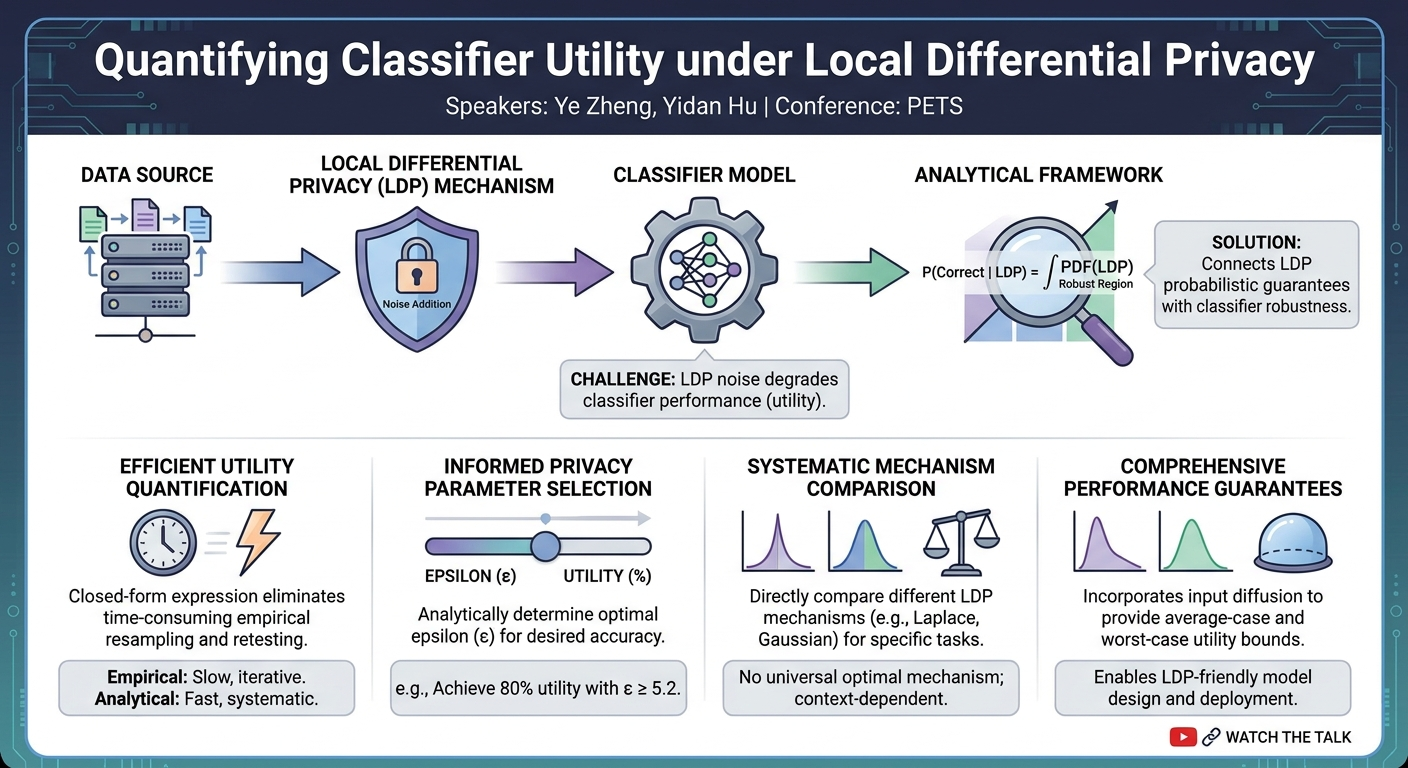
The central contribution of this research is the development of an analytical framework that systematically quantifies a classifier's utility when its inputs are perturbed by LDP mechanisms. This framework ingeniously bridges two distinct concepts: the probabilistic guarantees of LDP and the inherent robustness of a classifier.
The key findings and contributions include:
- Analytical Utility Quantification: The paper introduces a novel method to analytically derive the probability that a classifier preserves its correct classification under LDP-perturbed inputs. This provides a closed-form expression for utility, eliminating the need for iterative resampling and retesting for different privacy parameters.
- Connection to Classifier Robustness: The framework establishes a direct link between LDP mechanisms and classifier robustness. Classifier robustness is defined as the existence of a "robust region" or neighborhood around an input
Xwhere any perturbed inputYwithin that region will still lead to the same correct classification asX. The utility is then quantified by the probability that the LDP mechanism perturbsXinto aYthat falls within this robust region. - Efficiency and Accuracy: For low-dimensional classifiers, the analytic utility is shown to be highly accurate, closely matching empirical results. Crucially, it offers immense efficiency gains, as its closed-form nature means computation takes "almost negligible time" compared to the time-consuming empirical methods. While slightly conservative for high-dimensional classifiers, the analytic utility still provides a valuable and actionable upper bound.
- Informed Privacy Parameter Selection: The analytical framework allows designers and users to systematically determine the optimal privacy parameter (epsilon) required to achieve a desired level of classifier utility. For example, if an 80% classification utility is required, the framework can analytically show that the privacy parameter epsilon needs to be at least 5.2.
- Systematic Comparison of LDP Mechanisms: The framework facilitates a direct and systematic comparison of different LDP mechanisms (e.g., Laplace, Gaussian, Randomized Response) when applied to a specific classifier. This reveals that there is "no universal optimal analytic mechanism" for all epsilon and concentration levels (theta), underscoring the importance of context-specific mechanism selection.
- Average-Case and Worst-Case Utility: By incorporating knowledge of the input data's distribution (input diffusion), the framework can further provide both average-case and worst-case classifier utility guarantees under LDP perturbation, offering a more comprehensive understanding of performance.
In essence, this work transforms the ad-hoc empirical evaluation of classifier utility under LDP into a principled, analytical science, enabling more efficient design, deployment, and optimization of privacy-preserving machine learning systems.
Technical Deep Dive
▶ Watch: Systematic comparison of different LDP mechanisms (4:30)
The core innovation of this research lies in its elegant connection between the theoretical properties of Local Differential Privacy (LDP) mechanisms and the concept of classifier robustness. This connection provides a powerful analytical tool for quantifying how well a classifier performs when its inputs are perturbed by LDP.
At a high level, the problem is to determine the probability that a classifier's prediction remains correct when an input X is transformed into Y by an LDP mechanism. The authors formalize this by leveraging the idea of a robust region. For a given input X that is correctly classified, a classifier is considered robust if there exists a "suitable" region or neighborhood around X such that any point Y within this region will also be correctly classified by the model. If all inputs within this robust region lead to the character (correct) prediction, then this region is deemed robust.
On the other hand, an LDP mechanism, characterized by its privacy parameter epsilon ($\epsilon$) and often a concentration level ($\theta$), provides probabilistic guarantees about its output. Specifically, for a given input X, an LDP mechanism defines the probability distribution of its output Y. The crucial insight is to combine these two concepts: if the LDP mechanism perturbs X into a Y that falls within X's robust region, then the classification is preserved.
The analytical utility is then expressed as: "with probability at least P, the classifier preserves its correct classification under input perturbation by this LDP mechanism." This P is derived by integrating the probability density function (PDF) of the LDP mechanism's output over the classifier's robust region. This integration yields a closed-form expression for the utility, which is a significant departure from computationally expensive empirical methods.
Let's illustrate this with a one-dimensional example using a binary classifier and the Laplace mechanism, a common LDP mechanism for numerical data.
Imagine a binary classifier operating on a single feature. For a specific input x, if the classifier correctly predicts its label, there might be a range [x - \delta, x + \delta] (the robust region) around x where any value within this range would also lead to the same correct classification.
The Laplace mechanism adds noise drawn from a Laplace distribution, scaled by 1/epsilon, to the input x. The probability that the output y falls within the robust region [x - \delta, x + \delta] can be calculated analytically. This probability is a closed-form function of delta, epsilon, and potentially theta (a concentration parameter related to the tail probabilities of the Laplace distribution).
The authors provide a concrete example: if epsilon is set to 0.3, the analytical utility guarantee for this classifier under the Laplace mechanism might be 0.46. This means there's at least a 46% probability that the classifier's correct classification will be preserved. The power of this analytical approach is that this claim applies to any epsilon. By varying epsilon in the closed-form expression, one can plot the classifier utility as a function of the privacy parameter.
This capability offers two significant benefits:
- Optimal Epsilon Selection: Users can now choose the best privacy parameter for a desired classifier utility. For instance, if an application requires at least 80% classification utility, the analytical curve might show that
epsilonneeds to be at least5.2. This provides a clear, data-driven guideline for setting privacy budgets. - Systematic Mechanism Comparison: The framework allows for a direct comparison of different LDP mechanisms (e.g., Laplace vs. Gaussian) for a given classification task. By plotting their respective utility curves against
epsilon, researchers can observe that "there's no universal optimal analytic mechanism for all epsilon and theta." This highlights that the choice of LDP mechanism is context-dependent and should be guided by specific utility requirements and privacy budgets.
For high-dimensional cases, the concept remains the same, but the integration of the LDP mechanism's PDF over the robust region becomes more complex. It requires integrating over a potentially intricate high-dimensional robust region. While computationally more demanding than the 1D case, it is still significantly more efficient than empirical resampling across a vast parameter space. The authors note that for high-dimensional classifiers, their analytical utility results tend to be "a little bit conservative," meaning they provide a lower bound on the actual utility, but still offer a useful and systematic estimate.
Furthermore, by incorporating knowledge of the input diffusion (i.e., the distribution of the original, clean data), the framework can extend its analysis to provide both average-case and worst-case classifier utility under LDP perturbation. This offers a more comprehensive risk assessment for deploying classifiers on privacy-preserving data.
Demo / Proof of Concept
▶ Watch: Results: Accuracy and efficiency for low-dimensional data (6:00)
While the talk did not feature a live software demonstration in the traditional sense, the authors presented compelling case studies to validate the quality and efficacy of their proposed analytical utility framework. These case studies served as empirical proof that their analytical method is both accurate and efficient when compared against conventional empirical utility analysis, which relies on resampling and retesting.
The evaluation involved three common types of classifiers:
- Logistic Regression
- Random Forest
- Neural Network
These classifiers were tested on diverse datasets, including:
- Medical and financial datasets: For these, the authors assumed that "two dimension certain dimensions" (a subset of features) were subject to LDP mechanisms.
- Image datasets: For these, it was assumed that "all dimensions are certain" (all features, i.e., pixels, were subject to LDP).
The core of the "demo" was a rigorous comparison between the utility predicted by their analytic utility analysis and the utility measured by empirical utility analysis. The empirical analysis involved the traditional, time-consuming process of repeatedly sampling perturbed instances from the LDP mechanism for each given epsilon and then retesting the classifier's performance.
The results of these case studies highlighted several key points:
- Accuracy for Low-Dimensional Classifiers: For classifiers operating on low-dimensional data, the analytical utility proved to be remarkably accurate. The "gap between empirical utility is quite tight," indicating a strong agreement between their theoretical predictions and observed performance. This validates the foundational premise of their framework in simpler scenarios.
- Efficiency: A major advantage showcased was the efficiency of the analytical approach. Because the analytical utility is derived from a closed-form expression, its computation takes "almost negligible time" compared to the hours or days often required for empirical resampling and retesting, especially when exploring a wide range of
epsilonvalues. This makes the analytical framework highly practical for real-world application and parameter tuning. - Utility for High-Dimensional Classifiers: While the analytical utility was acknowledged to be "a little bit conservative" for high-dimensional classifiers (meaning it might slightly underestimate the true utility), it still provided valuable and actionable insights. The results were still "in place" and "in parallel" with empirical findings, suggesting that it offers a reliable lower bound and trend prediction even in complex settings.
In essence, the case studies served as a robust validation of the analytical framework's practical applicability, demonstrating that it can effectively and efficiently quantify classifier utility under LDP across various model types and data characteristics, providing a significant advancement over purely empirical methods.
Defensive Implications
▶ Watch: High-dimensional results and overall conclusion (7:00)
The analytical framework presented in this talk offers profound defensive implications for practitioners and researchers working at the intersection of privacy and machine learning. By providing a systematic way to quantify classifier utility under LDP, it empowers various stakeholders to make more informed decisions and build more robust, privacy-preserving systems.
- For Classifier Designers and Developers:
- LDP-Friendly Classifier Design: Designers can now move towards developing "LDP-friendly classifiers." This means considering the robustness of a classifier as a first-class design principle. By understanding how the architecture, feature engineering, or training objectives impact the size and shape of a classifier's robust regions, models can be designed to be inherently more resilient to LDP noise, thus preserving higher utility. This could involve exploring robust optimization techniques or specific regularization methods.
- Proactive Performance Assessment: Before deploying a classifier in an LDP-enabled environment, designers can analytically predict its performance degradation. This allows for proactive adjustments, ensuring that the expected utility meets application requirements without extensive, costly empirical trials.
- For Privacy Engineers and Data Owners:
- Optimal Privacy Parameter Selection: The framework provides a crucial tool for selecting the optimal epsilon ($\epsilon$) value. Instead of guessing or relying on arbitrary values, privacy engineers can use the analytical utility curves to choose an
epsilonthat achieves the desired balance between privacy protection (lowerepsilon) and classification accuracy (higherepsilon). This ensures that privacy guarantees do not unnecessarily compromise the utility of the collected data. - Systematic LDP Mechanism Selection: The ability to compare different LDP mechanisms (e.g., Laplace, Gaussian, Randomized Response) analytically for a specific classification task is invaluable. Privacy engineers can identify which mechanism offers the best utility for a given privacy budget and data type, rather than defaulting to a generic choice.
- Transparency and Trust: By providing analytical guarantees for utility, organizations can offer greater transparency to users about the expected performance of systems using their privacy-protected data. This can foster greater trust in data collection practices.
- For Data Scientists and Machine Learning Engineers:
- Understanding Performance Bounds: Data scientists can gain a deeper understanding of the average-case and worst-case performance of their models when fed LDP-perturbed data. This knowledge is critical for setting realistic expectations, identifying potential failure modes, and assessing risks in sensitive applications.
- Feature Importance under LDP: While not explicitly stated, the framework could potentially be extended to understand how LDP noise impacts the utility derived from different features, guiding feature selection or weighting in privacy-preserving scenarios.
In summary, this research shifts the paradigm from reactive, empirical assessment to proactive, analytical design and deployment of privacy-preserving machine learning systems. It equips defenders with the tools to build more effective, efficient, and trustworthy solutions in an increasingly privacy-conscious world.
Key Takeaways
- Analytical Utility Framework: The research introduces a novel analytical framework to quantify classifier utility when inputs are perturbed by Local Differential Privacy (LDP).
- LDP and Classifier Robustness Connection: It elegantly connects the probabilistic nature of LDP mechanisms with the concept of classifier robustness (regions where classification remains unchanged).
- Efficiency and Accuracy: The analytical method offers significant efficiency gains over empirical "sample and test" approaches, providing accurate utility estimates for low-dimensional classifiers and useful insights for high-dimensional ones.
- Informed Privacy Parameter Selection: The framework enables systematic selection of the optimal privacy parameter (epsilon) to achieve a desired privacy-utility trade-off, such as
epsilon >= 5.2for80%utility. - Systematic LDP Mechanism Comparison: It facilitates direct comparison of different LDP mechanisms, revealing that no single mechanism is universally optimal across all privacy budgets and data characteristics.
- Comprehensive Performance Guarantees: The framework can provide both average-case and worst-case classifier utility, offering a more complete picture of model performance under LDP.
About the Speaker(s)
Ye Zheng is identified as a paper author from Rochester Institute of Technology. Her contributions to this research focus on the theoretical quantification of classifier utility under Local Differential Privacy.
Yidan Hu is also listed as a paper author from Rochester Institute of Technology. Her work, alongside Ye Zheng, has been instrumental in developing and presenting the analytical framework that connects LDP with classifier robustness.
Reviews
Dr. Zero (Offensive Security Researcher) — SOLID
Zheng and Hu replaced the brute-force empirical testing of Local Differential Privacy parameters with a closed-form analytical equation. It's solid PETS-grade math that saves massive compute when tuning epsilon, even if the high-dimensional bounds get a bit loose.
Heather Calloway (CISO) — SOLID
This research provides a mathematical framework for balancing data privacy with machine learning accuracy. Instead of guessing and checking how much noise destroys a model, it gives you the exact formula. It turns privacy engineering from an empirical guessing game into a provable business control.
→ Top-rated talks at Privacy Enhancing Technologies Symposium (PETS) 2026
All talks from Privacy Enhancing Technologies Symposium (PETS) 2026