Analysis and Attacks on the Reputation System of Nym
Xinmu Alexis Cao (Paper author · Johns Hopkins University), Matthew Green (Paper author · Johns Hopkins University)
Privacy Enhancing Technologies Symposium (PETS) 2026 · Remote
Overview
This talk, presented by Xinmu Alexis Cao and co-authored with Professor Matthew Green from Johns Hopkins University, delves into a critical security vulnerability within the reputation system of Nym, a decentralized and incentivized mixnet. Nym aims to provide robust privacy by routing user traffic through a series of "mix nodes" that obscure metadata and timing patterns. Central to Nym's operation is its active set of nodes, responsible for routing user traffic, which are selected based on a unique cryptocurrency-based reputation system. This system combines a node's staked Nym tokens with its measured network performance score.
Key moments
- 1:30 Nym's reputation system and implicit high stake requirement
- 3:30 Introducing the 'framing' attack strategy
- 3:50 Sacrifice and attacking nodes: creeping death strategy
- 4:55 Attacking Nym's Version 1 performance measurement
- 6:15 Adversary's goal: deanonymizing user traffic
- 7:10 'Framing' attacks reduce cost by 99%
- 8:40 Fundamental challenge in blame attribution and monitoring
Analysis and Attacks on the Reputation System of Nym
Speakers: Xinmu Alexis Cao (Paper author, Johns Hopkins University), Matthew Green (Paper author, Johns Hopkins University)
Conference: PETS
YouTube: https://www.youtube.com/watch?v=CRES6-EMPHY
Overview
This talk, presented by Xinmu Alexis Cao and co-authored with Professor Matthew Green from Johns Hopkins University, delves into a critical security vulnerability within the reputation system of Nym, a decentralized and incentivized mixnet. Nym aims to provide robust privacy by routing user traffic through a series of "mix nodes" that obscure metadata and timing patterns. Central to Nym's operation is its active set of nodes, responsible for routing user traffic, which are selected based on a unique cryptocurrency-based reputation system. This system combines a node's staked Nym tokens with its measured network performance score.
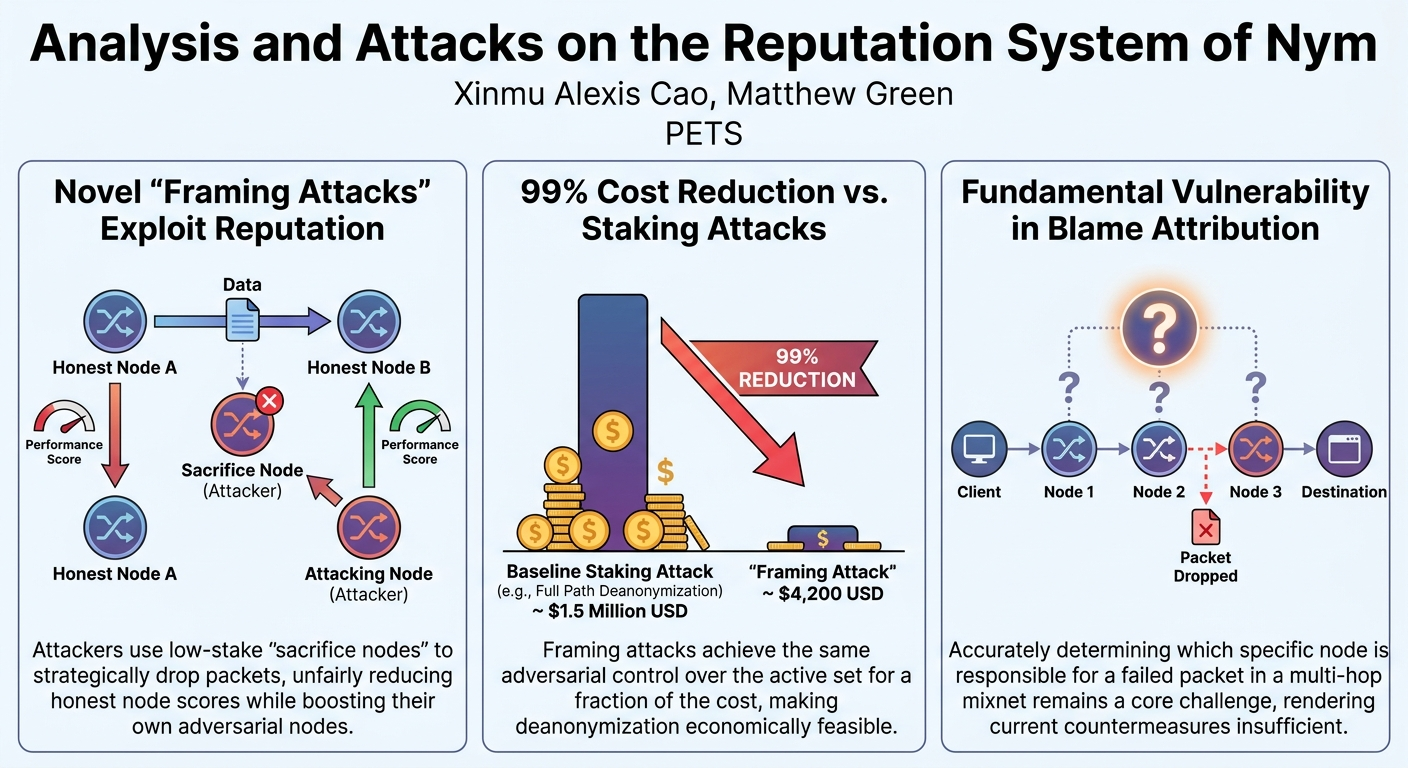
The core of the research presented is the identification and analysis of a novel attack vector, termed "framing attacks," that significantly undermines Nym's reputation mechanism. Unlike traditional staking attacks that demand substantial capital investment, "framing attacks" exploit the intricacies of Nym's performance measurement and blame attribution algorithms. By strategically manipulating performance scores, an attacker can gain control over a significant portion of the active set at a fraction of the cost, thereby enabling potent deanonymization attacks against Nym users.
The findings are of paramount importance to the mixnet community, Nym operators, and privacy-conscious users. They highlight a fundamental challenge in designing robust incentive mechanisms for decentralized privacy networks, particularly concerning the accurate and resilient measurement of node performance. The research not only exposes a significant flaw but also offers insights into the inherent difficulties of blame attribution in distributed systems, urging for more sophisticated monitoring and defense strategies to protect user anonymity.
Background
▶ Watch: Nym's reputation system and implicit high stake requirement (1:30)
Nym is designed as a decentralized and incentivized mixnet, a privacy-enhancing technology that aims to protect user metadata by mixing traffic from multiple users. Its architecture typically involves a client connecting to an entry gateway, passing through three middle mix nodes, an exit gateway, and finally reaching its destination. As of July 2026, Nym boasted 740 total nodes distributed across 62 countries, underscoring its global reach and ambition. A key innovation of Nym is its cryptocurrency-based incentive system, which rewards node operators for their participation and reliable service.
The integrity and effectiveness of any decentralized network heavily rely on its mechanism for selecting and incentivizing honest participants. Nym's reputation system is central to this, comprising two main components: the stake (amount of Nym cryptocurrency tokens locked by a node operator) and the measured network performance score. These two metrics are combined to periodically select an active set of nodes, which are the only nodes that route actual user traffic. This selection occurs every epoch, a 60-minute period.
The formula for calculating a node's active set selection weight is a combination of its stake ratio and its performance score, with the performance score raised to the 20th power. This exponential weighting significantly prioritizes performance, intending to encourage reliable node behavior. However, this mathematical combination effectively performs a dimension reduction, collapsing two distinct reputation dimensions into a single scalar score. This design choice implies that a relatively small decrease in performance can be compensated by a substantial increase in monetary stake, or vice-versa, creating a potential imbalance.
Initial data collection over a 30-day period, utilizing Nym's network explorer, revealed an important characteristic of the active set. While, as expected, only nodes with high performance scores were selected, the average stake per node in the active set was approximately 70,000 US dollars, significantly higher than the 4 US dollar minimum stake required to run a node. This observation suggested that despite the heavy weighting of performance, a high stake implicitly became a de facto requirement to join the active set, hinting at a potential vulnerability where monetary resources could still heavily influence participation. This background sets the stage for understanding how an attacker might seek to manipulate this system to gain control over the active set and compromise user privacy.
Key Findings
▶ Watch: Sacrifice and attacking nodes: creeping death strategy (3:50)
The central discovery of this research is the identification and empirical validation of "framing attacks" as a highly cost-effective method to compromise Nym's active set, leading to potential deanonymization of user traffic. The talk demonstrates a 99% reduction in attack cost compared to a baseline staking attack, making large-scale adversarial control of the mixnet economically feasible for the first time.
Specifically, for gateway deanonymization, a baseline staking attack would cost approximately $250,000 USD. In stark contrast, the "framing attack" achieved the same objective for only $2,800 USD. For the more ambitious goal of full path deanonymization, the cost disparity was even more pronounced: $1.5 million USD for staking versus a mere $4,200 USD for the "framing attack." Even under more ambitious attack goals, cost reductions of around 90% were consistently observed. These findings reveal a critical flaw in Nym's reputation system, where the intricate balance between stake and performance can be exploited to bypass the intended economic deterrents, posing a significant threat to the network's security and the privacy of its users.
Technical Deep Dive
▶ Watch: Attacking Nym's Version 1 performance measurement (4:55)
Nym's security fundamentally relies on the integrity of its active set of mix nodes. An attacker's primary goal is to gain control over this active set, as only these nodes route user traffic, enabling deanonymization. A baseline staking attack involves simply accumulating enough Nym tokens to stake on adversarial nodes and outcompete honest nodes. However, given the observed high stakes in the active set (average $70,000 USD per node) and the prevalence of near-maximal performance scores, this approach is prohibitively expensive, estimated at approximately $1.7 million USD to control just 20% of the active set. This prohibitive cost necessitates exploring alternative attack vectors that focus on manipulating the other component of the reputation system: the performance score.
The performance score is measured by the decentralized Nym network monitor. This monitor operates by emulating Nym clients that send test packets along a loop path. A loop path consists of one gateway acting as both entry and exit, and three middle mix nodes. If a test packet fails to return to the network monitor, the critical challenge arises: which node on the path should be blamed? This blame attribution problem is central to the "framing attack."
Blame attribution in Nym's system is characterized by two metrics:
- Nature of information: Whether current information (real-time observation) or historical information (past performance records, assuming honesty) is used to determine responsibility.
- Size of the set of nodes: Whether blame is attributed to a single node or shared among a set of nodes on the path.
The "framing attack" strategy is an intelligent manipulation of this blame attribution process. The adversary controls two distinct sets of nodes:
- Sacrifice nodes (S-nodes): These are minimally staked nodes. Their role is to selectively drop packets, specifically to frame honest nodes and, crucially, to boost the scores of attacking nodes. They are "sacrificed" in the sense that their own performance scores might initially suffer, but this is a calculated cost.
- Attacking nodes (A-nodes): These are minimally to moderately staked nodes that perform well. Their ultimate goal is to replace honest nodes in the active set, leveraging the score reductions inflicted by the S-nodes on competitors.
The core principle is to achieve a disproportionately larger aggregate score reduction on honest nodes than the adversarial nodes (especially S-nodes) receive themselves. This strategy is reminiscent of the creeping death attack first described by Singleton and Sörensson in 2002, where minor, repeated degradations can cumulatively lead to significant system compromise.
The research analyzed Nym's two primary measurement algorithms in place at the time of the paper:
1. Version 1 Measurement Algorithm:
- Phases: This algorithm has two phases.
- Pre-testing Phase: The network monitor selects a set of validated nodes from previously well-performing nodes.
- Testing Phase: The monitor uses this set of validated nodes to construct test paths for the remainder of the network.
- Blame Attribution: If a packet does not return, the sole blame is placed on the test node. This relies on historical information (the assumption that validated nodes are honest) and attributes blame to a single node.
- Attack Strategy:
- Pre-testing Phase: The S-nodes relay all packets to ensure they are selected into the validated set, appearing as honest, well-performing nodes.
- Testing Phase: Once validated, the S-nodes selectively drop packets when the previous or next node on the path is not an attacking node. Because the network monitor views S-nodes as validated (and thus "honest"), the blame for the dropped packet is incorrectly attributed to the honest test node on the path, reducing its performance score. Importantly, the S-node itself does not necessarily harm its own score, and can even be elevated to an attacking node later.
2. Version 2 Measurement Algorithm:
- Phases: There is no pre-testing phase. In the testing phase, all nodes on the test path are considered test nodes.
- Blame Attribution: If a packet does not return, all nodes on the path share equal blame. This uses current information and attributes blame to a set of four nodes (one gateway, three mix nodes).
- Attack Strategy: The S-nodes simply selectively drop packets. Since all nodes on the path share blame, when an S-node drops a packet, it also affects the performance scores of the honest nodes on that path. The attacker strategically ensures that the overall impact of these shared blames disproportionately reduces the scores of honest nodes more than it impacts the attacker's own nodes.
The ultimate goals of these attacks are deanonymization of user traffic, as adversarial control of the active set allows an attacker to observe traffic patterns.
- Gateway Deanonymization: This mimics services like Nym VPN's "fast mode," where an attacker aims to control the entry or exit gateway to deanonymize connections.
- Full Path Deanonymization: This is similar to Nym VPN's "anonymous mode," where the attacker aims to control enough nodes to observe the entire path of a user's traffic. This typically involves two phases:
- Phase 1: The client makes new gateway-free connections. The research estimates around 50 such connections are realistic within a day.
- Phase 2: Once Phase 1 is achieved, the client sends new packets. Each new packet potentially creates a new mix node path. This phase can be achieved very quickly; for example, sending 1,000 packets is equivalent to only 20 seconds of transmission.
By exploiting the specific blame attribution mechanisms of Nym's measurement algorithms, "framing attacks" bypass the intended economic barriers, making widespread compromise of the active set a realistic and affordable threat.
Demo / Proof of Concept
▶ Watch: 'Framing' attacks reduce cost by 99% (7:10)
The talk effectively demonstrated the "framing attack" through simulations designed to quantify its cost-effectiveness compared to a baseline staking attack. The simulation setup was rigorous, evaluating continuous attacks over 24 epochs (equivalent to 24 hours, given each epoch is 60 minutes). Attack success was defined as achieving at least one of the client's packets routing through an adversarial path with a 0.5 (50%) success probability. This metric provides a realistic benchmark for the likelihood of deanonymization.
The key results from these simulations underscore the devastating efficiency of the "framing attack":
- Gateway Deanonymization:
- Staking Attack Cost: Approximately $250,000 USD. This substantial cost reflects the capital required to out-stake honest nodes and gain control over a sufficient number of gateways.
- "Framing Attack" Cost: Only $2,800 USD. This represents a staggering 99% reduction in cost, making gateway deanonymization highly accessible to a broader range of adversaries.
- Full Path Deanonymization:
- Staking Attack Cost: A prohibitive $1.5 million USD. This higher cost reflects the increased stake required to control a larger proportion of nodes across the entire mixnet path.
- "Framing Attack" Cost: An astonishingly low $4,200 USD. This also represents a 99% reduction in cost, demonstrating the attack's efficacy even against the most ambitious deanonymization targets.
The simulations further showed that even when testing for more ambitious attack goals or higher success probabilities, the "framing attack" consistently achieved cost reductions of around 90%. These quantitative results serve as a compelling proof of concept, illustrating that by strategically manipulating Nym's performance reputation system, an attacker can bypass the high economic barriers intended to protect the network, fundamentally altering the threat model for Nym and similar mixnet architectures. The simulation results clearly validate the practical feasibility and severe implications of "framing attacks."
Defensive Implications
▶ Watch: Fundamental challenge in blame attribution and monitoring (8:40)
The "framing attack" exposes a fundamental vulnerability in Nym's reputation system, primarily stemming from the inherent difficulty in accurately attributing blame for failed packets in a decentralized mixnet. This challenge makes designing effective countermeasures particularly complex. The talk discussed several potential mitigation strategies, highlighting their limitations.
One proposed countermeasure is alternative blame attribution, mirroring aspects of the Version 2 measurement algorithm. This involves assigning blame based on a previous consecutive fail count threshold and without a pre-testing phase. However, this approach is still vulnerable to "framing attacks." An attacker can simply drop packets before reaching the defined threshold. In such scenarios, all nodes on the path would still receive equal blame, or worse, only the honest nodes would be blamed if the attacker's sacrifice nodes are cleverly positioned or if the system still implicitly trusts certain nodes for short periods. This highlights that simply distributing blame more broadly does not resolve the core issue of accurately identifying the malicious actor.
Another suggested countermeasure is to separate non-active set and active set nodes testing. The idea is to test nodes differently depending on whether they are already in the active set or aspiring to join. However, this, too, fails to fully mitigate the "framing attack." Once sacrifice nodes are selected into the active set (which they can achieve by temporarily performing well, as in Version 1's pre-testing phase), they can then resume their malicious packet-dropping behavior. Their status as "active" nodes might even grant them a higher degree of implicit trust, making their attacks more effective.
These limitations underscore a fundamental challenge in mitigating "framing attacks": the inherent difficulty in accurately determining which specific node is responsible for a failed packet in a multi-hop, anonymous network. Without a robust and tamper-proof method of blame attribution, any reputation system relying on performance metrics remains susceptible to such manipulation.
Given these challenges, a crucial defensive implication is the need for proactive monitoring of node performance scores across the network. Defenders should look for unusual patterns, such as:
- A sudden, unexplained drop in performance scores for a specific group of honest nodes.
- Concurrently, other groups of nodes remaining completely unaffected or even seeing their scores improve.
The speaker referenced anecdotal evidence, noting that "last month several node operators have been reporting that they're seeing their nodes having a lower performance score than usual even though they're running their nodes properly as they did before. While some groups of nodes are completely unaffected by this." While such patterns could arise from benign reasons (e.g., Nym Network's own threat testing), they are precisely the kind of signal one would expect from a "framing attack." Therefore, implementing sophisticated monitoring systems that can detect and alert on these anomalous performance score fluctuations is a helpful and necessary step to identify potential attacks and respond swiftly, even if a perfect algorithmic solution to blame attribution remains elusive.
Key Takeaways
- Nym's Reputation System Vulnerability: Nym's active set selection, which combines stake and performance score (weighted to the 20th power), is highly susceptible to manipulation despite its design to prioritize reliability.
- "Framing Attacks" are Cost-Effective: A novel attack, dubbed "framing attack," allows adversaries to gain control of Nym's active set at a fraction of the cost of traditional staking attacks, achieving up to a 99% cost reduction.
- Exploiting Blame Attribution: The attack exploits weaknesses in Nym's network monitor's blame attribution algorithms, using minimally staked "sacrifice nodes" to selectively drop packets and unfairly reduce the performance scores of honest nodes while boosting adversarial "attacking nodes."
- Significant Deanonymization Threat: These attacks enable highly efficient gateway and full path deanonymization, posing a severe threat to user privacy by allowing attackers to observe traffic routing.
- Countermeasure Challenges: Existing and proposed countermeasures, such as alternative blame attribution or separated node testing, are largely insufficient due to the fundamental difficulty of accurately determining which node is responsible for a failed packet in a mixnet.
- Proactive Monitoring is Crucial: Until more robust blame attribution mechanisms are developed, continuous and sophisticated monitoring of network-wide performance scores for anomalous patterns (e.g., targeted performance drops on honest nodes) is essential for early detection of such attacks.
About the Speaker(s)
Xinmu Alexis Cao is a paper author from Johns Hopkins University. The research presented was a joint work with Professor Matthew Green, also from Johns Hopkins University. Both researchers are affiliated with Johns Hopkins University, indicating their academic background in computer science and security research.
Reviews
Dr. Zero (Offensive Security Researcher) — MUST SEE
This is why I love mixnet research. Cao and Green didn't just find a bug; they mathematically dismantled Nym's entire economic threat model by turning their own blame attribution algorithms against them. When you drop the cost of a full-path deanonymization attack from $1.5 million to four grand, you haven't just bypassed a control—you've burned the casino down.
Heather Calloway (CISO) — SOLID
This is academic protocol research demonstrating a fatal flaw in the Nym privacy mixnet. The researchers proved they can deanonymize network traffic for less than $3,000 by manipulating decentralized performance scores. Unless you have high-risk personnel relying on Nym for secure communications, you don't need to act on this, but it serves as a stark reminder of why enterprises shouldn't base trust on programmable economic incentives.
→ Top-rated talks at Privacy Enhancing Technologies Symposium (PETS) 2026
All talks from Privacy Enhancing Technologies Symposium (PETS) 2026