PROVGEN: A Privacy-Preserving Approach for Outcome Validation in Genomic Research
Yuzhou Jiang (Paper author · Case Western Reserve University), Tianxi Ji (Paper author · Texas Tech University), Erman Ayday (Paper author · Case Western Reserve University)
Privacy Enhancing Technologies Symposium (PETS) 2026 · Remote
Overview
In the realm of scientific discovery, reproducibility stands as a cornerstone of trust and validity. Research findings must be verifiable, allowing others to independently confirm results. However, this fundamental principle faces significant challenges, particularly in sensitive domains like genomic research, where the underlying datasets often cannot be shared due to profound privacy risks. The talk "PROVGEN: A Privacy-Preserving Approach for Outcome Validation in Genomic Research," presented by Yuzhou Jiang, addresses this critical dilemma by introducing a novel solution that enables the validation of genomic research outcomes without compromising individual privacy.
Key moments
- 0:00 Introduction and problem of reproducibility
- 4:00 Real-world examples of flawed genomic research
- 6:00 The core challenge: privacy vs. reproducibility
- 8:30 ProfGen's high-level outcome validation approach
- 10:00 Detailed ProfGen data sharing workflow explained
- 16:00 Evaluation: ProfGen protects against inference attacks
- 18:00 Future work: expanding validation, zero-knowledge proofs
PROVGEN: A Privacy-Preserving Approach for Outcome Validation in Genomic Research
Speakers: Yuzhou Jiang (Paper author, Case Western Reserve University); Tianxi Ji (Paper author, Texas Tech University); Erman Ayday (Paper author, Case Western Reserve University)
Conference: PETS
YouTube: https://www.youtube.com/watch?v=s5lBLFLPdv4
Overview
In the realm of scientific discovery, reproducibility stands as a cornerstone of trust and validity. Research findings must be verifiable, allowing others to independently confirm results. However, this fundamental principle faces significant challenges, particularly in sensitive domains like genomic research, where the underlying datasets often cannot be shared due to profound privacy risks. The talk "PROVGEN: A Privacy-Preserving Approach for Outcome Validation in Genomic Research," presented by Yuzhou Jiang, addresses this critical dilemma by introducing a novel solution that enables the validation of genomic research outcomes without compromising individual privacy.
The core problem PROVGEN tackles is the inherent conflict between the need for open science and the imperative to protect highly sensitive personal data. Genomic information, if exposed, can lead to severe consequences such as insurance bias, medical discrimination, and even indirect exposure of family members. Past instances of fabricated or erroneous research, which have misled entire scientific fields for years, underscore the dire need for robust validation mechanisms. PROVGEN proposes a method to bridge this gap, allowing researchers to demonstrate the veracity of their findings while safeguarding the privacy of their participants.
The significance of PROVGEN lies in its potential to revolutionize how genomic research is validated and shared. By providing a framework for privacy-preserving outcome validation, it fosters greater transparency and trust in scientific publications. This, in turn, can accelerate the translation of genomic discoveries into actionable clinical insights, ensuring that medical recommendations and interventions are based on solid, verifiable evidence rather than potentially flawed or irreproducible findings.
Background
▶ Watch: Introduction and problem of reproducibility (0:00)
The pursuit of scientific knowledge relies heavily on the ability of other researchers to independently verify published results. This process of reproducibility is especially vital in fields like genomics, where findings can directly impact human health and well-being. A Genome-Wide Association Study (GWAS), for instance, aims to identify specific genetic variations (known as Single Nucleotide Polymorphisms, or SNPs) that are associated with particular diseases, such as breast cancer. The process typically involves collecting genomic data from both affected individuals (cases) and healthy controls, preprocessing it into structured formats like contingency tables, and then applying statistical tests to pinpoint significant SNPs.
However, the very data that underpins these studies—individual genomic sequences—is among the most sensitive personal information. Direct sharing of raw genomic datasets, while ideal for full reproducibility, is fraught with peril. Such data is highly vulnerable to re-identification attacks, where an adversary can combine anonymized records with external, publicly available information to link genetic profiles back to specific individuals. The consequences of such re-identification are dire, ranging from insurance bias and medical discrimination (e.g., denial of coverage or increased premiums) to the indirect exposure of genetic predispositions within a family lineage. This fundamental privacy concern has historically created a significant barrier to open data sharing and, consequently, to robust reproducibility in genomic research.
The risks associated with inadequate reproducibility are not merely theoretical; they have manifested in highly damaging real-world scenarios. The presenter cited a high-profile Alzheimer's study published in 2006, which used fabricated image data. This fabrication went undiscovered until 2022, meaning the field was misled for over 15 years, wasting immense time, effort, and resources on research directions based on faulty premises. Similarly, a well-known longevity gene study had to be retracted after a sequencing error was found long after its initial publication, having already influenced subsequent research. These examples vividly illustrate the critical need for robust validation mechanisms that can detect errors, misinterpretations, or even deliberate fabrications before they cause widespread scientific and societal harm. The challenge, therefore, is to devise a method that allows for rigorous outcome validation without exposing individuals to the very real dangers of genomic privacy breaches.
Key Findings
▶ Watch: The core challenge: privacy vs. reproducibility (6:00)
The PROVGEN project presents a groundbreaking solution to the long-standing dilemma of balancing reproducibility with privacy in genomic research. Its central contribution is a novel methodology that allows for the independent validation of GWAS outcomes while maintaining strong privacy guarantees for sensitive genomic data.
The primary key findings and contributions of PROVGEN are:
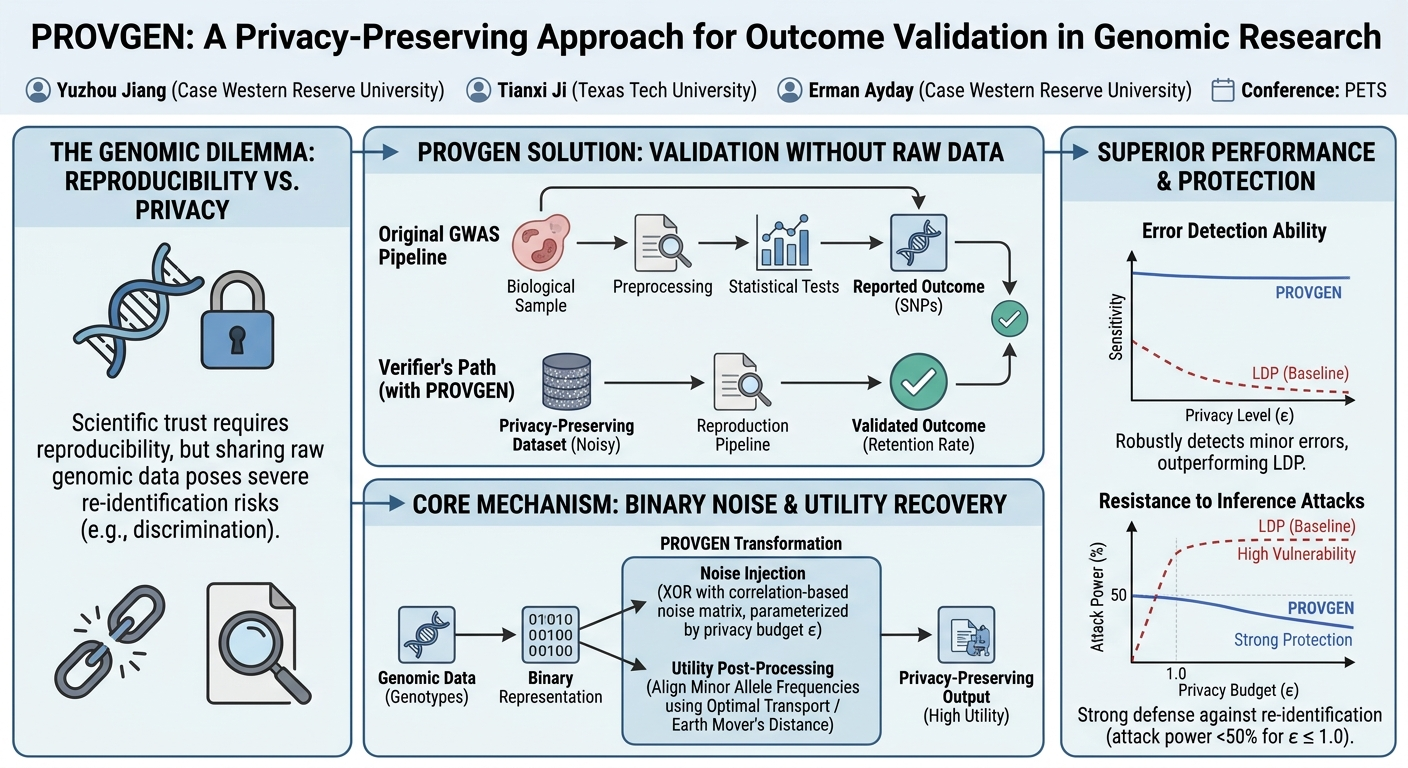
- Privacy-Preserving Outcome Validation: PROVGEN enables a verifier to reproduce and validate the statistical significance of SNPs reported in a GWAS without ever accessing the original, raw genomic datasets. Instead, researchers generate a noisy, privacy-preserving version of their data using the PROVGEN scheme, which is then shared with verifiers. If a high percentage of the originally reported significant SNPs remain statistically significant in the reproduced version (i.e., a high retention rate), the research outcome is deemed trustworthy.
- Novel Data Transformation and Utility Recovery: The method employs a sophisticated two-stage process. First, original genomic data is converted into a binary representation, and noise is introduced via an XOR operation with a binary noise matrix. This noise matrix is generated using a correlation structure derived from a public reference dataset and parameterized by a privacy budget epsilon (where lower epsilon means stronger privacy). Second, to combat the utility loss caused by noise, PROVGEN introduces a utility-focused post-processing step that leverages Minor Allele Frequency (MAF) values reported in the original research. This post-processing uses Optimal Transport, specifically the Earth Mover's Distance (EMD), to align the noisy MAF values with the target MAF values, effectively restoring much of the data's utility for GWAS.
- Superior Error Detection Capability: Through extensive evaluation, PROVGEN demonstrated a significantly higher ability to detect errors in GWAS outcomes compared to baseline approaches like Local Differential Privacy (LDP). Even with minor errors, PROVGEN consistently showed robust sensitivity across various privacy levels (epsilon between 1 and 5), whereas LDP struggled to identify errors, even at high error rates. This indicates PROVGEN's effectiveness in safeguarding scientific integrity.
- Robust Protection Against Inference Attacks: PROVGEN proved highly resistant to various inference attacks, including Hamming distance attacks and neural network classifier attacks. For privacy budget epsilon values less than or equal to 1.0, PROVGEN consistently maintained a low attack power, staying below 50%. This means an adversary attempting to re-identify individuals from the noisy PROVGEN dataset performs no better than a random guess, offering strong privacy guarantees. In stark contrast, LDP suffered from high attack power across all tested privacy levels, becoming particularly vulnerable when epsilon exceeded 1.0, making it impractical for genomic data release.
- High Data Utility and Fidelity: PROVGEN consistently outperformed LDP across several utility metrics, including sample error, mean error, and variance error. While LDP sometimes exhibited a low "point error" (meaning the noisy data was too similar to the sensitive original data, a privacy risk), PROVGEN achieved a superior balance, providing noisy yet high-utility data suitable for GWAS outcome validation without compromising privacy.
These findings collectively establish PROVGEN as a promising and practical solution for addressing the critical need for reproducibility in genomic research, ensuring that scientific progress is built on a foundation of verifiable and privacy-respecting data.
Technical Deep Dive
▶ Watch: ProfGen's high-level outcome validation approach (8:30)
The technical elegance of PROVGEN lies in its multi-faceted approach to introduce controlled noise for privacy while meticulously recovering sufficient utility for accurate outcome validation. The overall goal is to allow a verifier to independently run a GWAS pipeline on a privacy-preserving version of the data and compare the results against the original findings. The system operates under the assumption that the original researcher is honest – motivated by reputation and funding to produce accurate, trustworthy research – and thus not attempting to fabricate results, but rather to protect sensitive data.
The standard GWAS pipeline involves several steps:
- Data Collection: Genomic data from case (diseased) and control (healthy) groups.
- Preprocessing: Raw data is cleaned and transformed.
- Contingency Table Generation: For each SNP, a table is created showing the genotype distribution (e.g., AA, AG, GG counts) for both case and control groups. Genotypes are often numerically encoded (e.g., 0 for AA, 1 for AG, 2 for GG, representing minor allele counts).
- Statistical Testing: Tests like the chi-square test are applied to contingency tables to identify SNPs significantly associated with the disease.
PROVGEN intervenes by transforming the original genomic data into a privacy-preserving form before sharing it. The detailed workflow is as follows:
- Binary Representation: The original genomic dataset, typically represented by genotypes (AA, AG, GG) for each SNP, is first converted into a binary representation. This involves encoding each genotype into a series of binary bits. For example, if an individual has two copies of a SNP, each allele (A or G) can be represented by a bit, or the genotype itself can be mapped to a binary string.
- Binary Noise Matrix Generation: A crucial step is the creation of a binary noise matrix. Unlike simple random noise injection, PROVGEN generates this noise matrix using a correlation structure derived from a public reference dataset. This is vital because genomic data exhibits complex correlations between SNPs. Injecting purely random noise would destroy these inherent biological correlations, severely degrading data utility. By deriving the noise structure from public data, PROVGEN ensures that the injected noise respects some of the underlying genomic relationships, making the noisy data more useful for downstream GWAS. This process is parameterized by the privacy budget epsilon ($\epsilon$), a common measure in differential privacy. A smaller $\epsilon$ signifies stronger privacy protection but generally leads to more noise and potentially lower utility, while a larger $\epsilon$ offers weaker privacy but higher utility.
- Noise Injection via XOR: The generated binary noise matrix is then applied to the binary genomic data set using a bitwise XOR operation. This cryptographic operation flips bits in the original data based on the corresponding bits in the noise matrix. The result is a noisy dataset that is differentially private to a certain degree, meaning individual records are obscured. However, this initial noise injection can significantly reduce the accuracy of GWAS reproduction if not further refined.
- Utility-Focused Post-Processing (Optimal Transport): To recover the utility lost during noise injection, PROVGEN employs an innovative post-processing step that leverages information from the original research findings: the Minor Allele Frequency (MAF) values. The MAF for a SNP is the frequency of the less common allele in a population. The key observation is that MAF values are strongly correlated with the case row counts in the contingency tables used in GWAS. Therefore, aligning the MAF values in the noisy dataset to those reported in the original research findings is critical for accurate reproducibility.
- This alignment is performed directly in the binary space.
- The method used is Optimal Transport, specifically the Earth Mover's Distance (EMD). EMD measures the minimal "cost" to transform one probability distribution into another. In PROVGEN's context, it finds the minimal amount of change (e.g., bit flips) required to transform the MAF values calculated from the noisy binary data into the target MAF values reported by the original researcher.
- For example, if a noisy dataset yields an MAF of 0.375 for SNP rs1, but the original research reported 0.25, Optimal Transport would identify the most efficient bit flips (e.g., one bit flip) to adjust the noisy MAF to match the target 0.25. This process effectively "corrects" the MAF values in the noisy dataset to be closer to the true values, without revealing the underlying raw genotypes.
- Conversion and Sharing: Finally, the post-processed binary dataset, now with improved utility, is converted back into its original genomic space representation (e.g., genotypes AA, AG, GG). This restored, privacy-preserving dataset is then shared with the verifier. The verifier can then run their GWAS pipeline on this dataset and compare their findings (e.g., significant SNPs) with those originally published. A high retention rate of significant SNPs indicates that the original research is reproducible and trustworthy.
This intricate dance between noise injection and utility recovery, particularly the clever use of correlation structures and optimal transport based on MAF, is what allows PROVGEN to achieve both strong privacy guarantees and high utility, a balance that has historically eluded similar privacy-preserving data sharing schemes.
Demo / Proof of Concept
▶ Watch: Evaluation: ProfGen protects against inference attacks (16:00)
While the talk did not feature a live demonstration of the PROVGEN system in action, the speaker presented a comprehensive evaluation section that served as a robust proof of concept for its efficacy and superiority over existing methods. The evaluation rigorously compared PROVGEN with a baseline approach based on Local Differential Privacy (LDP), a common privacy-preserving technique where noise is injected independently at each data point. LDP, like PROVGEN, is parameterized by the privacy budget epsilon ($\epsilon$).
The evaluation utilized three datasets from the Open Snip project, with the eye color dataset being highlighted as the most suitable due to its sufficient number of SNPs and individual records. The performance of both PROVGEN and LDP was assessed across several critical dimensions:
- Error Detection Ability: This metric measured the methods' capacity to identify errors during GWAS. The Y-axis in the presented figures represented the difference in SNP retention ratio between correct and erroneous datasets. A higher value indicated greater sensitivity to errors, which is desirable for reproducibility validation.
- PROVGEN's Performance: PROVGEN demonstrated a strong ability to detect even minor errors across all tested privacy levels, particularly for $\epsilon$ values between 1 and 5. It showed robust sensitivities, indicating that it could reliably flag potentially flawed research.
- LDP's Performance: In stark contrast, LDP "can hardly identify errors" even when the error rate was high. While it showed a "little bit of ability," its performance was deemed impractical for real-world settings due to its high privacy risk against inference attacks.
- Resistance Against Inference Attacks: This evaluation focused on how well each method protected individual privacy against adversaries attempting to re-identify genomic data. Various attack types were considered, including Hamming distance attacks and neural network classifier attacks.
- PROVGEN's Performance: PROVGEN consistently maintained low attack power, staying below 50% for $\epsilon$ values less than or equal to 1.0. This crucial finding means that under PROVGEN, an adversary's ability to re-identify individuals is no better than a random guess, demonstrating strong protection against inference attacks.
- LDP's Performance: LDP proved to be "especially vulnerable," suffering from high attack power across all tested attacks and privacy levels. Furthermore, when $\epsilon$ exceeded 1.0, LDP became "even more vulnerable" against three additional attacks, rendering it an "impractical choice for releasing genomic datasets."
- Data Utility and Fidelity: The talk evaluated PROVGEN against four types of utility metrics to assess how well the noisy data retained the statistical properties of the original data.
- PROVGEN's Performance: PROVGEN performed "much better" than LDP for metrics such as sample error, mean error, and variance error, indicating that its noisy output maintained higher utility for GWAS.
- LDP's Performance: For point error (which measures how much the noisy data differs from the original sensitive data), LDP consistently showed values "too similar to the sensitive version of the data set." While a low point error might seem good for utility, in the context of privacy-preserving data release, it actually signals a privacy weakness, implying that LDP failed to adequately obscure individual data points.
The comprehensive evaluation clearly established PROVGEN's superior ability to achieve GWAS outcome validation while simultaneously providing robust privacy protection, outperforming the LDP baseline across all critical dimensions. This evidence serves as a strong proof of concept for its practical applicability.
Defensive Implications
▶ Watch: Future work: expanding validation, zero-knowledge proofs (18:00)
The development of PROVGEN carries significant defensive implications for various stakeholders within the genomic research ecosystem and beyond. By offering a robust mechanism for privacy-preserving outcome validation, it strengthens the integrity of scientific findings and mitigates risks associated with sensitive data.
For researchers, PROVGEN provides a powerful tool to enhance the credibility and reproducibility of their work. They can now share a verifiable version of their genomic data analysis without fear of exposing raw patient information to re-identification attacks. This capability can facilitate broader collaboration, satisfy journal requirements for data availability, and ultimately foster greater trust in their published results, which is crucial for securing future funding and maintaining reputation. It allows honest researchers to confidently assert the validity of their findings while adhering to strict ethical and privacy guidelines.
Reviewers, funding agencies, and scientific journals can leverage PROVGEN to perform independent validation of GWAS outcomes. Instead of relying solely on summary statistics or trusting researchers' claims, they can apply PROVGEN to the shared noisy dataset and verify the statistical significance of reported SNPs. This capability introduces an additional layer of scrutiny, significantly reducing the likelihood of erroneous or fabricated research making it into the public domain. It empowers the scientific community to self-regulate more effectively, ensuring that only robust and verifiable findings contribute to the collective body of knowledge.
For healthcare providers and policymakers, the implications are profound. Clinical guidelines, diagnostic tools, and therapeutic interventions derived from genomic research directly impact patient care. If these foundational studies are irreproducible or flawed, it can lead to misdiagnoses, ineffective treatments, or unnecessary anxiety for patients. By ensuring that genomic research outcomes are rigorously validated, PROVGEN contributes to a more reliable evidence base for medical practice, allowing healthcare decisions to be made with greater confidence and precision. This ultimately translates into better patient outcomes and more efficient allocation of healthcare resources.
Finally, for patients and the general public, PROVGEN offers a crucial safeguard. It protects individuals from the severe consequences of genomic data breaches, such as insurance discrimination or medical bias, while simultaneously ensuring that the research informing their health decisions is trustworthy. The ability to participate in genomic studies with greater assurance that their privacy will be protected could also encourage broader participation, accelerating the pace of discovery in a secure manner.
Looking ahead, the speaker outlined several defensive advancements. Expanding error modeling will allow PROVGEN to detect a wider range of potential issues in research. Extending validation across more GWAS stages will enable end-to-end reproducibility, covering aspects from initial data collection and preprocessing to final analysis. Furthermore, the plan to leverage zero-knowledge proofs (ZKPs) represents a cutting-edge defensive strategy. ZKPs could allow verifiers to confirm certain properties of the data or computations without revealing any information about the data itself, making the validation process even more efficient and privacy-preserving. By verifying a subset of key SNPs and propagating validation through SNP correlations, ZKPs could offer highly efficient and reliable verification for large genomic datasets. These future directions underscore PROVGEN's potential to evolve into an even more comprehensive and robust defensive solution against scientific irreproducibility and privacy breaches.
Key Takeaways
- Reproducibility is paramount but challenging in genomic research due to privacy concerns. The need to verify scientific findings clashes with the high sensitivity of genomic data, which is vulnerable to re-identification attacks and can lead to severe consequences like medical discrimination.
- PROVGEN offers a novel, privacy-preserving approach for validating GWAS outcomes. It allows independent verification of reported SNP associations without exposing raw genomic data, balancing scientific integrity with individual privacy.
- The methodology combines binary noise injection with utility-focused post-processing. PROVGEN generates a noisy binary dataset using a correlation-aware noise matrix (parameterized by $\epsilon$) and then restores utility by aligning Minor Allele Frequencies (MAFs) via Optimal Transport (Earth Mover's Distance).
- PROVGEN significantly outperforms Local Differential Privacy (LDP) in error detection and attack resistance. Evaluations showed PROVGEN's robust ability to detect minor errors and strong protection against inference attacks (attack power <50% for $\epsilon \le 1.0$), while LDP struggled and proved highly vulnerable.
- It maintains high data utility, ensuring reliable GWAS outcome validation. Despite noise injection, PROVGEN preserves critical statistical properties, leading to better sample, mean, and variance errors compared to LDP, thus enabling accurate reproducibility.
- Future work aims to expand PROVGEN's scope and leverage advanced cryptographic techniques. Plans include extending error modeling, enabling end-to-end GWAS stage validation, and integrating zero-knowledge proofs for highly efficient and secure verification of key SNPs.
About the Speaker(s)
The research presented in "PROVGEN: A Privacy-Preserving Approach for Outcome Validation in Genomic Research" is the collaborative effort of Yuzhou Jiang, Tianxi Ji, and Erman Ayday.
Yuzhou Jiang, who presented the paper, is affiliated with Case Western Reserve University. His presentation highlighted his expertise in the intersection of privacy, security, and genomic research, demonstrating a deep understanding of both the biological context and the cryptographic solutions required to address its unique challenges.
Tianxi Ji is another paper author, representing Texas Tech University. His contribution underscores the inter-institutional collaboration that drives cutting-edge research in this complex domain.
Erman Ayday is also a paper author from Case Western Reserve University. His involvement signifies the depth of research capabilities at Case Western Reserve University in developing advanced privacy-preserving technologies for sensitive data.
Reviews
Dr. Zero (Offensive Security Researcher) — SOLID
Jiang actually solved a real problem instead of just preaching about data privacy. They built a mathematically sound way to validate genome research without doxing patients, proving you can keep reproducibility without sacrificing confidentiality.
Heather Calloway (CISO) — STRONG ACCEPT
For CISOs in healthcare, pharma, or research, this is a look at the near future of data governance. It solves the fundamental tension between the business need to share research and the regulatory mandate to protect sensitive data. If you are currently blocking data sharing due to re-identification risk, this approach changes your operating model.
→ Top-rated talks at Privacy Enhancing Technologies Symposium (PETS) 2026
All talks from Privacy Enhancing Technologies Symposium (PETS) 2026