SoK: Can Fully Homomorphic Encryption Support General AI Computation? A Functional and Cost Analysis
Jiaqi Xue (Paper author · University of Central Florida), Xin Xin (Paper author · University of Central Florida), Wei Zhang (Paper author · University of Central Florida), Mengxin Zheng (Paper author · University of Central Florida), Qianqian Song (Paper author · University of Florida), Minxuan Zhou (Paper author · Illinois Institute of Technology), Yushun Dong (Paper author · Florida State University), Dongjie Wang (Paper author · The University of Kansas), Xun Chen (Paper author · Samsung Research America), Jiafeng Xie (Paper author · Villanova University), Liqiang Wang (Paper author · University of Central Florida), David Mohaisen (Paper author · University of Central Florida), Hongyi Wu (Paper author · University of Arizona), Qian Lou (Paper author · University of Central Florida)
Privacy Enhancing Technologies Symposium (PETS) 2026 · Remote
Overview
In an era where data privacy is paramount, the protection of sensitive information during active computation remains a critical challenge. While robust solutions exist for data at rest (e.g., encrypted databases) and data in transit (e.g., TLS), data actively being processed on servers often resides in plaintext, leaving it vulnerable to memory scraping, side-channel attacks, and untrusted cloud operators. Fully Homomorphic Encryption (FHE) emerges as a groundbreaking cryptographic primitive designed to close this "data in use" gap, enabling computation directly on encrypted data without ever decrypting it. This seminal work, presented on behalf of a large research team, systematically investigates FHE's capability to support general Artificial Intelligence (AI) computations, a complex task that demands the seamless integration of diverse operation types.
Key moments
- 0:00 Introduction and the 'data in use' problem
- 1:30 The core challenge: mixing linear and non-linear AI operations
- 4:00 Survey identifies three computationally general FHE methods
- 6:40 Encoding switching (HE bridge) keeps SIMD for mixed operations
- 7:50 Microbenchmarks: Encoding switching excels with batchable workloads
- 10:00 Counter-example: TFHE outperforms encoding switching for sorting
- 11:00 Concluding flowchart for selecting the right FHE method
SoK: Can Fully Homomorphic Encryption Support General AI Computation? A Functional and Cost Analysis
Speakers: Jiaqi Xue, Xin Xin, Wei Zhang, Mengxin Zheng, Qianqian Song, Minxuan Zhou, Yushun Dong, Dongjie Wang, Xun Chen, Jiafeng Xie, Liqiang Wang, David Mohaisen, Hongyi Wu, Qian Lou (Paper authors, various affiliations)
Conference: PETS
YouTube: https://www.youtube.com/watch?v=q9-DixdqdCg
Overview
In an era where data privacy is paramount, the protection of sensitive information during active computation remains a critical challenge. While robust solutions exist for data at rest (e.g., encrypted databases) and data in transit (e.g., TLS), data actively being processed on servers often resides in plaintext, leaving it vulnerable to memory scraping, side-channel attacks, and untrusted cloud operators. Fully Homomorphic Encryption (FHE) emerges as a groundbreaking cryptographic primitive designed to close this "data in use" gap, enabling computation directly on encrypted data without ever decrypting it. This seminal work, presented on behalf of a large research team, systematically investigates FHE's capability to support general Artificial Intelligence (AI) computations, a complex task that demands the seamless integration of diverse operation types.
The talk, titled "SoK: Can Fully Homomorphic Encryption Support General AI Computation? A Functional and Cost Analysis," dives deep into the functional limitations and performance costs associated with applying FHE to real-world AI workloads. The core problem lies in the inherent architectural differences between FHE schemes optimized for linear algebra and those better suited for non-linear functions. AI applications, particularly neural networks, constantly interleave these operations, posing a significant hurdle for non-interactive, end-to-end encrypted processing. The research team, comprising academics from the University of Central Florida, University of Florida, Illinois Institute of Technology, Florida State University, The University of Kansas, Villanova University, University of Arizona, and industry experts from Samsung Research America, provides a comprehensive Systematization of Knowledge (SoK) to identify viable FHE methods and quantify their practical costs.
This article explores the paper's meticulous analysis, detailing the challenges, the FHE methods surveyed, their theoretical and empirical performance, and crucial takeaways for developers and defenders. It highlights that while FHE holds immense promise for privacy-preserving AI in sensitive domains like healthcare, finance, and genomics, achieving "computational generality" – the ability to support mixed operations in arbitrary sequences non-interactively and efficiently – is a non-trivial feat, currently met by only a handful of advanced techniques.
Background
▶ Watch: Introduction and the 'data in use' problem (0:00)
The journey of data protection has seen significant advancements over the years. Data stored on disks and in databases is routinely encrypted at rest, safeguarding it from unauthorized access. Similarly, data traveling across networks is secured using protocols like TLS, ensuring privacy and integrity in transit. However, the moment data is actively processed by a server – say, a cloud-based AI model – it typically must be decrypted into plaintext in the server's memory. This brief window of exposure, where data is "in use," is a critical vulnerability point.
Fully Homomorphic Encryption (FHE) was conceived to eliminate this vulnerability. With FHE, a client encrypts its input data and sends the resulting ciphertext to a cloud server. The server then evaluates a predefined function directly on this ciphertext, producing an encrypted result. This encrypted result is sent back to the client, who is the only entity possessing the secret key capable of decrypting it. This workflow boasts two crucial properties: it is end-to-end, meaning the secret key never leaves the client, and it is non-interactive, as the client does not need to remain online or participate in multiple rounds of communication during the server's computation.
The promise of FHE is particularly compelling for AI in sensitive domains. Imagine training or inferring on medical records, financial transactions, or genomic data without ever exposing the raw information to the cloud provider. However, a significant "catch" emerges when applying FHE to real-world AI workloads: they are inherently heterogeneous. AI computations typically mix two fundamentally different types of operations:
- Linear Operations: These include operations like matrix multiplication, convolutions, and additions. Word-wise FHE schemes, such as BGV, BFV, and CKKS, are highly optimized for these, often leveraging SIMD (Single Instruction, Multiple Data) parallelism to process multiple data points simultaneously within a single ciphertext.
- Non-linear Operations: These encompass comparisons, ReLU (Rectified Linear Unit) functions, maximum pooling, and sorting. Bit-wise FHE schemes, like TFHE, are naturally suited for these operations, as they evaluate Boolean circuits gate-by-gate.
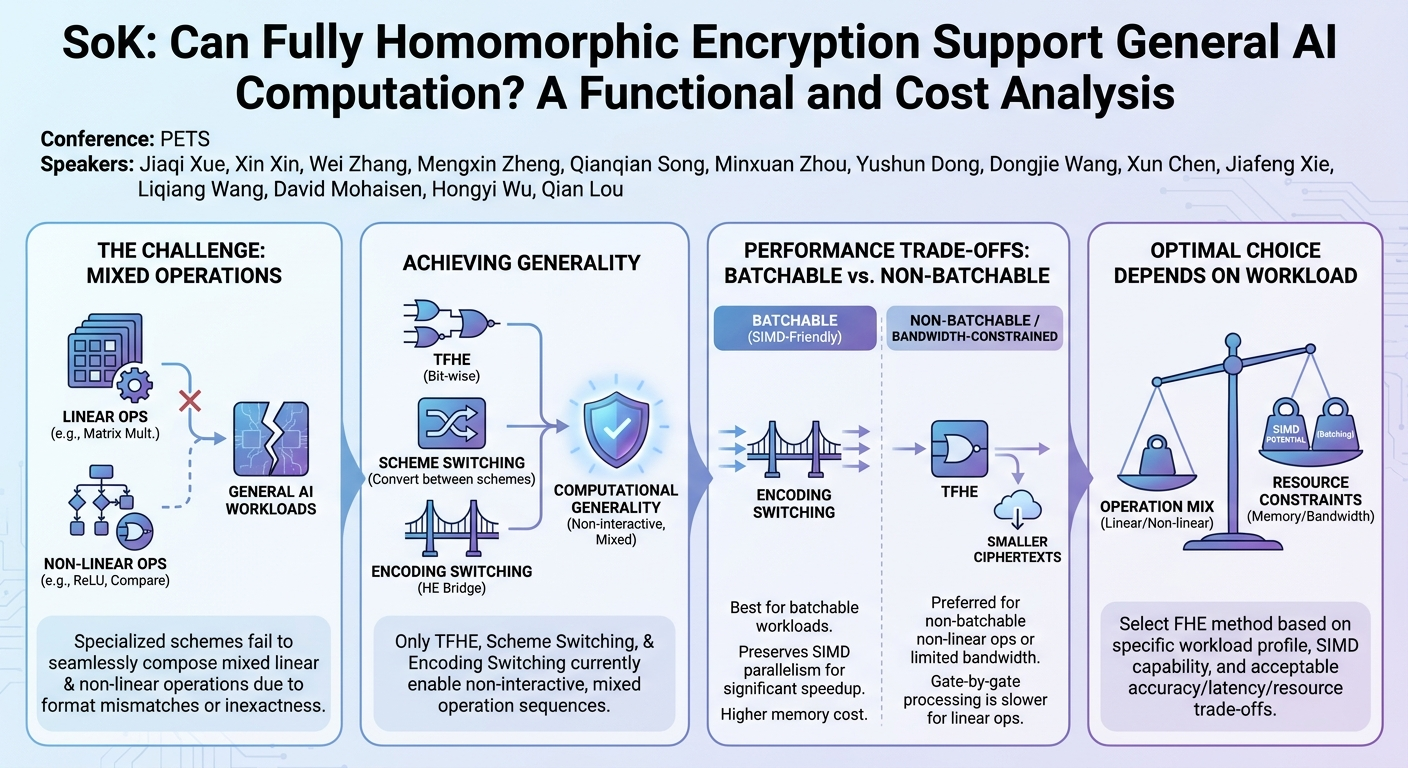
The challenge arises because real AI workloads, such as a neural network, constantly interleave these operation types: a convolution (linear) followed by a ReLU (non-linear), then another convolution, and perhaps a max pooling (non-linear). Supporting both kinds of operations, composed in arbitrary sequences, non-interactively, and without format mismatches between intermediate results, is what the authors define as computational generality.
Prior research has compared various FHE libraries and compilers, but none had systematically examined the concept of generality itself. The paper therefore poses two core questions:
- Functionality: Which FHE methods can even support general computation non-interactively?
- Cost: When generality is available, what price do you pay in terms of performance and resources?
This comprehensive analysis aims to provide a clear understanding of the current state-of-the-art for FHE in the context of complex, mixed-operation AI tasks.
Key Findings
▶ Watch: Survey identifies three computationally general FHE methods (4:00)
The study employed a rigorous three-stage methodology to address its core questions: a functional survey of ten FHE approaches with theoretical complexity analysis, microbenchmarks using three canonical mixed-operation building blocks, and validation on five real-world privacy-sensitive applications. The conclusions drawn are both theoretical and empirical, offering a definitive landscape of FHE's capabilities for general AI.
The initial functional survey revealed that most FHE methods fall short of achieving computational generality.
- Word-wise schemes (BGV, BFV, CKKS), while excellent for linear operations, completely lack native support for non-linear functions like comparisons.
- Attempts to graft non-linear capabilities onto word-wise schemes through techniques like polynomial approximation, polynomial interpolation, decomposed interpolation, and general functional bootstrapping consistently failed to meet the criteria for seamless composition. These methods either suffered from inexactness (e.g., CKKS polynomial approximation near zero), exploding complexity with bit width (polynomial interpolation), produced special ciphertext formats incompatible with subsequent linear operations, or were practical only for very limited bit widths (e.g., functional bootstrapping up to ~12 bits). The common failure mode was that optimizing for one operation type invariably sacrificed the ability to compose seamlessly with the other.
Crucially, the survey identified only three methods that satisfy both conditions for computational generality – supporting mixed operations and non-interactivity:
- TFHE: A bit-wise scheme that evaluates Boolean circuits gate-by-gate. While natural for non-linear operations, it is extremely costly for linear operations (e.g., a single 16-bit multiplication can take around 30 seconds). It does not natively support SIMD.
- Scheme Switching: This approach converts ciphertexts between a word-wise scheme (for linear ops) and a bit-wise scheme (for non-linear ops). However, the switching operation itself incurs a significant cost, which explodes exponentially with the input bit width (at least 2^B for B-bit input).
- Encoding Switching (the HE bridge approach): This novel method bridges two distinct encodings within a word-wise FHE scheme. Critically, it manages to preserve SIMD support for both linear and non-linear operation types, making it a strong candidate for batchable workloads.
The microbenchmarks provided empirical validation for these theoretical insights, focusing on three canonical mixing patterns: Linear-Non-linear (L-NL), Non-linear-Linear (NL-L), and Linear-Non-linear-Linear (L-NL-L). All tests were single-threaded, used 128-bit security, and explored 6-to-16-bit precision.
- For single operations, TFHE proved competitive at small bit widths. However, Scheme Switching exhibited exploding costs as precision grew.
- The picture flipped dramatically for batchable workloads. When operations could be amortized across multiple data points using SIMD, Encoding Switching demonstrated a significant performance advantage, offering up to a 14 times speedup over TFHE and a 25 times advantage over Scheme Switching.
- A key trade-off emerged: TFHE ciphertexts were roughly 10 times smaller (under 5 megabits) compared to Encoding Switching (nearly 50 megabits). This suggests TFHE is better suited for bandwidth-constrained clients, while Encoding Switching trades memory for compute speed in data center settings.
These findings were further validated across five real-world applications:
- Private shortest path (NL-L pattern): For a 128-node graph, Encoding Switching completed in approximately 660 seconds, significantly outperforming TFHE's over 5,000 seconds. This was partly due to an optimization of encoding the adjacency matrix row by row, reducing complexity from V³ to V².
- Decision trees (NL-L pattern, batchable): Encoding Switching scaled much faster with tree depth, whereas Scheme Switching incurred costly conversions at every level.
- Sorting (m-squared mixed operations on a single array): This was a counter-example where Encoding Switching struggled. Because sorting operates on a single array without independent inputs, there's no opportunity for SIMD exploitation. Here, TFHE excelled, sorting each element in about one minute, compared to 11 minutes for Encoding Switching and hours for Scheme Switching. This starkly demonstrated the importance of SIMD for performance.
- Database aggregation (L-NL pattern, perfectly batchable): Encoding Switching processed 512 rows in 111 seconds, compared to 1,600 seconds for Scheme Switching.
- Neural network inference: This application presented an accuracy-versus-latency frontier. Approximate CKKS was fast but could drop below 80% accuracy. Exact general methods, while maintaining accuracy, incurred extremely high costs, often exceeding 10,000 seconds.
The research distills into a clear flowchart for FHE method selection:
- For only linear operations, traditional word-wise schemes are sufficient.
- For only non-linear operations without SIMD requirements, TFHE is the go-to.
- For mixed operations without SIMD (e.g., sorting single elements), TFHE is also preferred.
- If approximation is acceptable for mixed operations, approximate CKKS offers speed.
- For **exact mixed computation with SIMD** capability, Encoding Switching stands out as the most efficient solution.
Technical Deep Dive
▶ Watch: Encoding switching (HE bridge) keeps SIMD for mixed operations (6:40)
The fundamental challenge in supporting general AI computation with FHE stems from the divergent strengths of different FHE scheme families. The core operations in AI can be broadly categorized as linear algebra (matrix multiplications, convolutions) and non-linear functions (ReLU, comparisons, sorting).
Word-wise FHE Schemes (BGV, BFV, CKKS): These schemes are designed to operate on vectors of encrypted numbers (e.g., integers or complex numbers). They excel at linear operations, often leveraging SIMD (Single Instruction, Multiple Data) parallelism, where a single homomorphic operation can process multiple plaintext slots within a ciphertext simultaneously. This batching capability is crucial for performance. However, their Achilles' heel is non-linear operations.
- Polynomial Approximation: Non-linear functions must be approximated by polynomials. For schemes like CKKS, which operates on approximate real numbers, this can lead to inexactness, particularly near zero, making it unsuitable for applications requiring high precision like genomics or finance.
- Polynomial Interpolation: While exact, the degree of the interpolating polynomial can explode with the input bit width, making the homomorphic evaluation computationally prohibitive.
- Specialized Techniques: Methods like decomposed interpolation, and general functional bootstrapping were developed to enhance non-linear capabilities. However, these often produce ciphertexts in a special format that cannot be seamlessly fed into subsequent linear operations, breaking the "composition" requirement. Furthermore, general functional bootstrapping is practical only up to about 12-bit precision, limiting its applicability.
Bit-wise FHE Schemes (TFHE): In contrast, TFHE operates on individual encrypted bits and evaluates Boolean circuits gate-by-gate. This makes it inherently natural for non-linear operations, as any non-linear function can be expressed as a Boolean circuit. However, this gate-by-gate approach becomes incredibly costly for linear operations. For instance, a 16-bit multiplication, which is a fundamental building block for many AI models, can take approximately 30 seconds in TFHE, rendering it impractical for large-scale linear algebra. TFHE also lacks native SIMD support in the same manner as word-wise schemes.
The paper identifies three methods capable of achieving computational generality:
- TFHE: As discussed, its strength lies in non-linear operations due to its bit-wise, Boolean circuit evaluation. Its primary weakness is the high cost of linear operations and the absence of SIMD for batching. This makes it suitable for scenarios with predominantly non-linear operations or when processing individual, non-batchable data points.
- Scheme Switching: This approach involves converting a ciphertext from a word-wise scheme (e.g., CKKS) to a bit-wise scheme (e.g., TFHE) to perform non-linear operations, and then potentially converting it back. While conceptually sound, the switching operation itself is computationally expensive. The cost of switching a B-bit input ciphertext grows exponentially with B, making it impractical for higher precision requirements. This conversion process also typically breaks any SIMD packing, losing the benefits of batching.
- Encoding Switching (HE Bridge Approach): This is arguably the most promising approach for general AI workloads. Instead of switching between entirely different FHE schemes, Encoding Switching operates within a word-wise FHE framework. It bridges two distinct encoding methods for the plaintext data – for example, an encoding optimized for arithmetic operations and another optimized for comparisons. The critical innovation is that this internal switching mechanism is designed to preserve SIMD support throughout the entire computation. This means that even when performing non-linear operations, the ability to process multiple data points in parallel within a single ciphertext is maintained. This preservation of SIMD is the key differentiator for its superior performance in batchable mixed workloads, as demonstrated by the microbenchmarks.
The concept of SIMD is central to understanding the performance disparities. In a word-wise FHE scheme, a single ciphertext can typically hold hundreds or thousands of encrypted plaintext values (slots). A single homomorphic addition or multiplication operation then applies to all these slots in parallel. This batching capability drastically reduces the amortized cost per plaintext operation. Encoding Switching's ability to maintain SIMD across both linear and non-linear operations allows it to leverage this parallelism, providing significant speedups for data-parallel AI tasks. Conversely, methods that lack SIMD (like TFHE for general operations) or lose it during switching (like Scheme Switching) are severely penalized in terms of performance when processing large datasets.
The microbenchmarks, testing L-NL, NL-L, and L-NL-L patterns with 128-bit security and 6-16 bit precision, empirically confirmed these technical insights. Encoding Switching consistently demonstrated its advantage in scenarios where SIMD could be exploited, reflecting its ability to combine the best of both worlds: efficient linear operations and composable non-linear operations, all while maintaining parallelism.
Demo / Proof of Concept
▶ Watch: Counter-example: TFHE outperforms encoding switching for sorting (10:00)
While the talk did not feature a live, interactive demo in the traditional sense, the authors validated their findings through extensive empirical evaluations on five real-world privacy-sensitive applications. These applications served as practical proofs of concept, demonstrating how the different FHE methods perform under realistic mixed-operation workloads and confirming the theoretical and microbenchmark results. The code and benchmarks used for these evaluations are open-source and available on GitHub, allowing others to reproduce and further explore their findings.
The applications chosen covered a spectrum of mixed operation patterns and batching opportunities:
- Private Shortest Path: This task involved finding the shortest path in an encrypted graph. The core logic often involves comparison and selection operations (non-linear) followed by additions (linear) – mapping to the NL-L pattern. A key optimization involved encoding the adjacency matrix row by row, allowing one operation to update an entire row and reducing the complexity from O(V³) to O(V²) for V nodes. For a 128-node graph, Encoding Switching achieved the computation in approximately 660 seconds. In contrast, methods like TFHE, which struggle with linear operations and lack SIMD for graph-level batching, took over 5,000 seconds, highlighting Encoding Switching's efficiency in this non-linear-then-linear, batchable context.
- Decision Trees: Decision trees involve a series of comparisons at each node (non-linear) followed by a product of the resulting bits along the path (linear, effectively a series of AND operations). The authors used a De Morgan rewrite to convert the product into cheaper additions, reducing the application's multiplicative depth. Since one input is compared against many thresholds, this task batches perfectly. Encoding Switching scaled much faster with increasing tree depth compared to Scheme Switching, which incurred high conversion costs at every level of the tree. This demonstrated Encoding Switching's strength in batchable, non-linear-then-linear scenarios.
- Sorting: This application served as a crucial counter-example, highlighting the limitations of SIMD-based approaches when batching is not possible. Direct sorting typically involves m-squared mixed operations (comparisons and swaps) all on a single array. Critically, there are no independent inputs that can be processed in parallel using SIMD. In this non-batchable scenario, TFHE significantly outperformed the other methods, sorting each element in about one minute. Encoding Switching required 11 minutes per element, and Scheme Switching took hours. This result underscored that for inherently sequential or non-batchable mixed operations, the bit-wise, gate-by-gate nature of TFHE becomes an advantage.
- Database Aggregation: This task involved operations like multiplying then comparing values across all rows of a database (L-NL pattern). This is a perfectly batchable scenario where multiple rows can be processed in parallel. For 512 rows, Encoding Switching completed the aggregation in 111 seconds, demonstrating a substantial lead over Scheme Switching, which took 1,600 seconds. This further solidified Encoding Switching's superior performance for batchable linear-then-non-linear workloads.
- Neural Network Inference: A critical AI workload, neural network inference involves alternating convolutions (linear) and ReLU activations (non-linear). This application exposed an "accuracy versus latency" frontier. While approximate CKKS could achieve high speeds, it often resulted in an accuracy drop below 80%. Exact general methods, while preserving accuracy, incurred extremely high computational costs, often exceeding 10,000 seconds for a single inference. This illustrates that while FHE can support complex AI models, the practical performance for exact, general-purpose inference remains a significant hurdle, pushing researchers towards more efficient approximate methods or specialized FHE-friendly network architectures.
These empirical results provided a robust validation of the paper's theoretical framework, offering concrete performance numbers and clear guidance on choosing the appropriate FHE method based on the specific characteristics of the AI workload.
Defensive Implications
▶ Watch: Concluding flowchart for selecting the right FHE method (11:00)
The detailed analysis of FHE's capabilities for general AI computation provides crucial insights for security practitioners, developers, and organizations looking to implement privacy-preserving AI. The "data in use" gap is a real and significant threat, and FHE offers a powerful cryptographic solution, but its adoption requires a nuanced understanding of its current limitations and trade-offs.
Here are key defensive implications:
- Understand Your Workload Profile: Before considering FHE, organizations must meticulously analyze their AI workloads. Identify the predominant types of operations (linear vs. non-linear) and, critically, determine the extent to which data can be processed in batches (SIMD-friendly). Workloads that are primarily linear or primarily non-linear will have different optimal FHE schemes than those that heavily mix both.
- Accuracy vs. Latency Trade-off: For applications where some level of approximation is acceptable (e.g., certain machine learning models where a small accuracy drop is tolerable), approximate FHE schemes like CKKS can offer significant performance benefits. However, for sensitive domains like finance or genomics where exact computation is non-negotiable, the computational cost for general FHE methods increases dramatically, potentially making real-time applications infeasible with current technology. Defenders must carefully evaluate this trade-off with stakeholders.
- Embrace Encoding Switching for Batchable Mixed Workloads: For AI applications that require exact, mixed linear and non-linear operations and can leverage SIMD (i.e., process data in batches), Encoding Switching (the HE bridge approach) is currently the most performant solution. Developers should prioritize FHE libraries and frameworks that implement this technique. This implies structuring data and computations to maximize batching opportunities.
- Consider TFHE for Non-Batchable or Bandwidth-Constrained Scenarios: If an AI workload involves predominantly non-linear operations, or if it processes data points individually (making SIMD ineffective, like the sorting example), or if client-side bandwidth is a critical constraint (due to smaller ciphertext sizes), then TFHE might be the more suitable choice. This highlights that no single FHE scheme is a panacea.
- Memory and Compute Resource Planning: Implementing FHE, especially Encoding Switching, requires substantial memory and computational resources. While TFHE has a smaller ciphertext footprint (roughly 10x smaller), Encoding Switching trades memory for compute speed. Organizations deploying FHE in cloud environments must budget for higher memory usage and potentially longer computation times compared to plaintext processing. This will impact infrastructure costs and service level agreements.
- FHE is Not a Magic Bullet for Performance: The research clearly shows that FHE, especially for exact general AI computations, remains significantly slower than plaintext processing. While the security benefits are immense, the performance overhead is substantial (e.g., 10,000+ seconds for neural network inference). Defensive strategies should include realistic expectations regarding performance and explore architectural optimizations (e.g., FHE-friendly AI model design, hybrid approaches).
- Stay Informed on Research and Standardization: The field of FHE is rapidly evolving. New schemes, optimizations, and compilers are constantly emerging. Security professionals and architects should stay abreast of the latest advancements, particularly those focusing on improving efficiency, reducing overheads, and simplifying the development of FHE applications. Open-source tools and benchmarks, like those provided by the authors, are invaluable resources for experimentation and evaluation.
In essence, adopting FHE for AI is a strategic decision that requires a deep technical understanding of the underlying cryptography, the specific demands of the AI application, and the available trade-offs. It's about making informed choices to leverage the powerful privacy guarantees of FHE without being blindsided by its functional and performance costs.
Key Takeaways
- FHE closes the "data in use" security gap, enabling computation on encrypted data, but general AI workloads (mixing linear and non-linear operations) present significant challenges for current FHE schemes.
- Most FHE schemes are specialized (word-wise for linear, bit-wise for non-linear) and fail to support seamless composition of mixed operations due to issues like inexactness, incompatible ciphertext formats, or limited precision.
- Only TFHE, Scheme Switching, and Encoding Switching currently offer computational generality, allowing for mixed operations in arbitrary sequences non-interactively.
- Encoding Switching (HE bridge approach) generally provides superior performance for batchable, mixed linear and non-linear workloads by successfully preserving SIMD parallelism, though it incurs higher memory costs than TFHE.
- TFHE is the preferred choice for non-batchable, predominantly non-linear operations (e.g., sorting individual elements) or in bandwidth-constrained environments due to its smaller ciphertext footprint and gate-by-gate processing.
- The optimal FHE method for AI applications depends critically on the specific workload's operation mix, its potential for SIMD batching, and the acceptable trade-offs between accuracy, latency, memory, and bandwidth.
About the Speaker(s)
The talk "SoK: Can Fully Homomorphic Encryption Support General AI Computation? A Functional and Cost Analysis" is a collaborative effort by a large team of researchers and academics: Jiaqi Xue, Xin Xin, Wei Zhang, Mengxin Zheng, Liqiang Wang, David Mohaisen, and Qian Lou are affiliated with the University of Central Florida. Qianqian Song is from the University of Florida, Minxuan Zhou from the Illinois Institute of Technology, Yushun Dong from Florida State University, Dongjie Wang from The University of Kansas, Jiafeng Xie from Villanova University, and Hongyi Wu from the University of Arizona. Xun Chen represents Samsung Research America. This diverse group of experts from both academia and industry highlights the interdisciplinary nature and broad interest in advancing Fully Homomorphic Encryption for practical, privacy-preserving AI applications.
Reviews
Dr. Zero (Offensive Security Researcher) — STRONG ACCEPT
FHE startups love to claim they can run neural networks on encrypted data, usually by hiding the catastrophic latency of mixed operations. The research crew actually benchmarked the misery of bridging word-wise and bit-wise schemes, delivering a brutal, necessary reality check on the actual cost of computational generality.
Heather Calloway (CISO) — STRONG ACCEPT
Every board wants to know if we can safely run AI on highly regulated data without decrypting it in the cloud. This research provides the definitive answer on Fully Homomorphic Encryption (FHE) readiness, separating vendor promises from actual computational physics.
→ Top-rated talks at Privacy Enhancing Technologies Symposium (PETS) 2026
All talks from Privacy Enhancing Technologies Symposium (PETS) 2026