Automated Privacy Risk Estimation of Limited Fixed Aggregate Statistics
Yifeng Mao (Paper author · Imperial College London), Bozhidar Stevanoski (Paper author · Imperial College London), Yves-Alexandre de Montjoye (Paper author · Imperial College London)
Privacy Enhancing Technologies Symposium (PETS) 2026 · Remote
Overview
In an era where data sharing is paramount for scientific research, policy-making, and economic development, the release of aggregate statistics has emerged as a favored method for data curators to share insights while ostensibly protecting individual privacy. However, the assumption that releasing only a limited number of fixed aggregate statistics inherently safeguards sensitive user information is increasingly being challenged. This talk, presented at PETS, introduces DeSIA, a novel method designed for the automated privacy risk estimation of such limited fixed aggregate statistics. It tackles the critical question of whether an adversary, armed with only a small set of aggregate figures, can infer sensitive details about individuals within the underlying dataset.
Key moments
- 0:00 Introduction: Privacy risk of aggregate statistics
- 1:00 Deterministic inference example: Two aggregates reveal salary
- 3:00 Introducing DeSIA: Deterministic and stochastic modules
- 4:50 DeSIA outperforms state-of-the-art for vulnerable users
- 6:00 DeSIA's robustness with synthetic auxiliary data
- 7:30 Extending DeSIA to membership inference attacks
- 8:15 Conclusion: Limited aggregates expose users to risk
Automated Privacy Risk Estimation of Limited Fixed Aggregate Statistics
Speakers: Yifeng Mao, Bozhidar Stevanoski, Yves-Alexandre de Montjoye
Conference: PETS
YouTube: https://www.youtube.com/watch?v=ujre3p47hSA
Overview
In an era where data sharing is paramount for scientific research, policy-making, and economic development, the release of aggregate statistics has emerged as a favored method for data curators to share insights while ostensibly protecting individual privacy. However, the assumption that releasing only a limited number of fixed aggregate statistics inherently safeguards sensitive user information is increasingly being challenged. This talk, presented at PETS, introduces DeSIA, a novel method designed for the automated privacy risk estimation of such limited fixed aggregate statistics. It tackles the critical question of whether an adversary, armed with only a small set of aggregate figures, can infer sensitive details about individuals within the underlying dataset.
DeSIA, developed by Yifeng Mao, Bozhidar Stevanoski, and Yves-Alexandre de Montjoye from Imperial College London, represents a significant advancement in empirical inference attack methodologies. Unlike prior work that predominantly focused on reconstructing entire datasets, DeSIA directly targets attribute inference and membership inference risks. The research demonstrates that even seemingly innocuous aggregate statistics, when combined, can expose individuals to deterministic or highly probable inference attacks, revealing sensitive attributes or even their presence in a dataset. This work highlights the urgent need for robust privacy evaluation mechanisms beyond traditional reconstruction attacks, emphasizing that a limited release does not equate to limited risk, especially for disproportionately vulnerable users.
The implications of DeSIA's findings are profound for data curators, policymakers, and privacy researchers alike. By providing an effective tool for identifying and quantifying privacy risks associated with aggregate data releases, DeSIA underscores the necessity of employing formal privacy mechanisms, such as differential privacy, and rigorous empirical testing before any aggregate statistics are made public. The research not only exposes the vulnerabilities inherent in current data sharing practices but also offers a practical approach for assessing these risks, thereby facilitating more informed and secure data stewardship.
Background
▶ Watch: Introduction: Privacy risk of aggregate statistics (0:00)
The sharing of data, particularly by institutions holding sensitive information, often necessitates a delicate balance between utility and privacy. A common approach to this challenge is the release of aggregate statistics, where individual record-level data is summarized into counts, averages, or other statistical measures. For instance, a university might release aggregates like "the number of employees in the Department of Physics with a salary larger than £50,000" or "the number of 30-year-old male employees in the Department of Computing." This method is widely adopted due to its perceived safety, as it avoids direct disclosure of individual records.
However, this perceived safety is often a misconception. The core problem addressed by this research is the potential for inference attacks against fixed aggregate statistics, especially when only a limited number of such aggregates are released. While extensive research exists on inference attacks against other data release mechanisms, such as machine learning models or synthetic data, comparable methods for evaluating the privacy risk of fixed aggregates, particularly under limited release scenarios, have been lacking.
The talk illustrates this vulnerability with a compelling example: if a curator releases that there are "five 30-year-old male employees in the computing department" and also "five 30-year-old male employees in the computing department with a salary smaller than £50,000," an adversary can deterministically infer that all five individuals in that group, including a specific target user, earn below £50,000. This example vividly demonstrates how individually "safe" aggregates can, when combined, lead to precise and certain inferences about sensitive attributes.
Prior literature on attacks against fixed aggregate statistics has largely concentrated on reconstruction attacks. These attacks aim to reconstruct the entire private dataset by searching for a hypothetical dataset whose aggregate values match or closely approximate the released aggregates. Two state-of-the-art reconstruction attacks are acknowledged:
- CAP (Constraint Integer Programming Attack): Proposed by Abou El Azzouzi, this method formulates the reconstruction problem as a Constraint Integer Programming (CIP) task, seeking a tentative reconstructed dataset that satisfies the released aggregates.
- RAP (Reconstruction Attack with Synthetic Data): Developed by Dick et al., this attack utilizes a synthetic data generator model trained on the released aggregate statistics to produce reconstructed datasets.
While these reconstruction attacks can be adapted for attribute inference by generating multiple reconstructed datasets and taking a majority vote on the target attribute, they are often indirect and may miss more subtle vulnerabilities. DeSIA distinguishes itself by directly focusing on attribute and membership inference, offering a more targeted and effective approach to assess individual privacy risks from limited aggregate releases. The existence of these prior works underscores the long-standing concern about aggregate data privacy, but DeSIA's innovation lies in its direct and automated approach to risk estimation, particularly for vulnerable users.
Key Findings
▶ Watch: Introducing DeSIA: Deterministic and stochastic modules (3:00)
The research presented on DeSIA yields several critical findings that challenge conventional assumptions about the privacy of aggregate data releases:
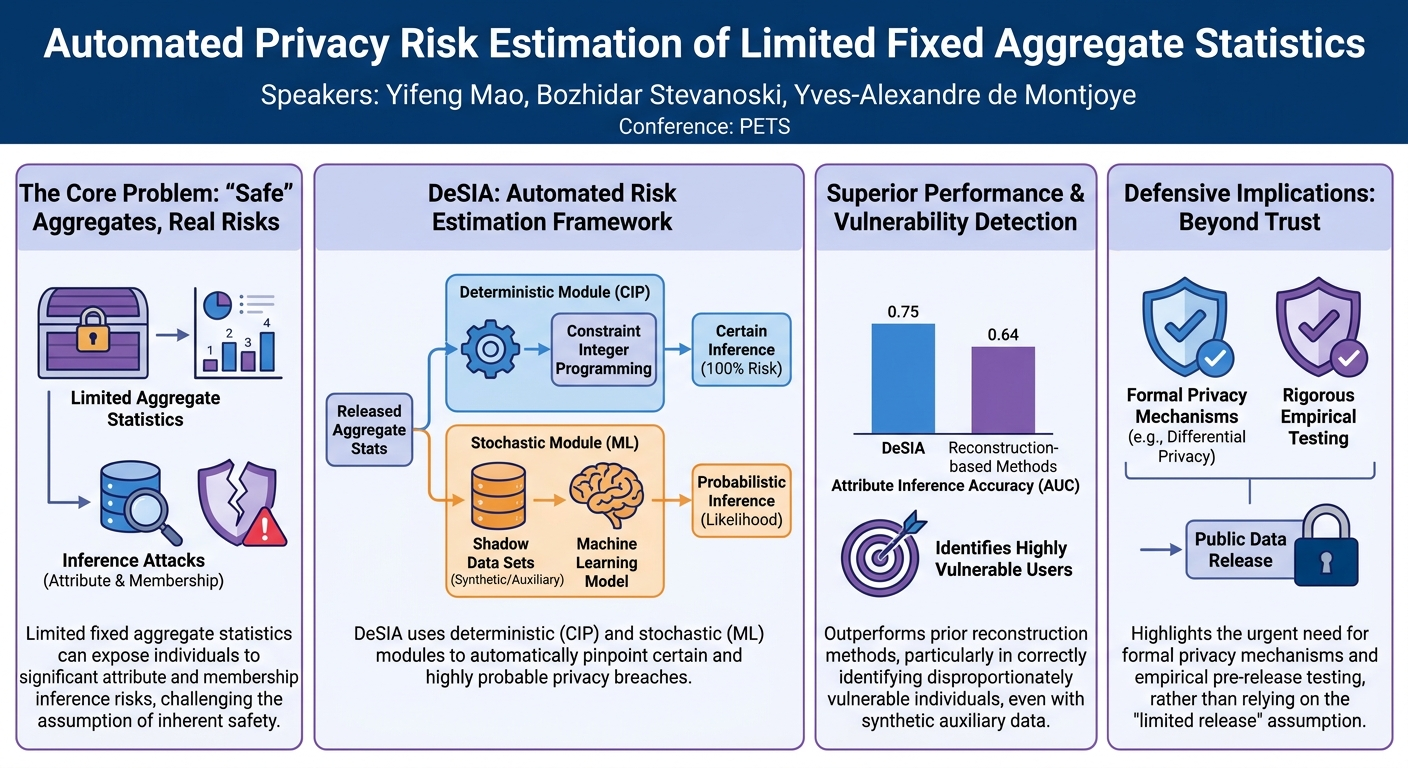
- Superior Attribute Inference Performance: DeSIA significantly outperforms state-of-the-art reconstruction-based methods in attribute inference tasks. When tested on the US Census PPMF data, DeSIA achieved an Area Under the Curve (AUC) of 0.75, whereas the best reconstruction-based method (adapting CAP or RAP) only reached an AUC of 0.64. This indicates DeSIA's superior ability to correctly distinguish between true and false inferences about sensitive attributes.
- Identification of Highly Vulnerable Users: DeSIA is particularly effective at identifying highly vulnerable users—those whose sensitive attributes are most likely to be inferred. At a false positive rate (FPR) of 10^-3 (meaning only 0.1% of inferences are incorrect), DeSIA achieved a true positive rate (TPR) of 0.14. This means it successfully identified 14% of truly inferable attributes for the most vulnerable users, a performance metric where reconstruction-based methods lagged significantly. This finding is crucial as it demonstrates DeSIA's capability to pinpoint specific individuals at high risk, even when only a small number of aggregates are released, thereby uncovering risks missed by existing attacks.
- Robustness with Synthetic Auxiliary Data: A common assumption in inference attacks is the availability of an auxiliary dataset. DeSIA's performance was tested under a relaxed assumption where a real-world auxiliary dataset was replaced by synthetic data generated from the released aggregates. Remarkably, DeSIA's performance degraded minimally under this substitution. The AUC decreased only from 0.75 to 0.72, and the TPR at an FPR of 10^-3 decreased from 0.14 to 0.10. This demonstrates DeSIA's practicality, as it can still achieve high performance even when a perfect auxiliary dataset is unavailable, outperforming other state-of-the-art methods that do rely on real-world auxiliary data.
- Consistent Outperformance Across Release Sizes and Noise Levels: DeSIA consistently outperforms reconstruction-based attacks across varying numbers of released aggregates, from "one per 16 users" up to "one per user on average." As expected, increasing the number of aggregates increases risk, but DeSIA maintains its superior performance throughout. Similarly, DeSIA demonstrates robustness across different noise levels, being the only method to retain a non-zero true positive rate at low false positive rates, indicating its resilience and effectiveness even when data is perturbed.
- Effective Membership Inference: DeSIA was successfully extended to perform membership inference attacks with minor modifications. In this variant, DeSIA achieved an AUC of 0.25 for membership inference, outperforming adapted reconstruction attacks like RAP, while a direct adaptation of CAP performed no better than a random guess. This shows DeSIA's versatility in assessing different types of privacy risks.
- Confirmation of Risk from Limited Aggregates: The overarching finding is that even a limited number of aggregate statistics can reveal sufficient information to expose users to significant risk from inference attacks. This contradicts the intuitive belief that scarcity of released data inherently translates to high privacy, highlighting that certain users can be disproportionately vulnerable.
These key findings collectively underscore the inadequacy of current practices in evaluating the privacy of aggregate data releases and establish DeSIA as a powerful, automated tool for a more accurate and comprehensive risk assessment.
Technical Deep Dive
▶ Watch: DeSIA outperforms state-of-the-art for vulnerable users (4:50)
DeSIA operates as a sophisticated framework for automated privacy risk estimation, specifically designed for attribute inference and membership inference attacks against limited fixed aggregate statistics. Its architecture comprises two primary modules: a deterministic module and a stochastic module, which work in tandem to provide a comprehensive risk assessment.
1. Deterministic Module
The deterministic module is designed to identify instances where a target user's sensitive attribute value can be inferred with 100% certainty, given the released aggregate statistics. This module relies heavily on Constraint Integer Programming (CIP), a mathematical optimization technique used to find optimal solutions to problems where some or all of the variables are restricted to be integers.
The deterministic module proceeds in two critical steps:
a. Feasibility Check: The first step involves formulating a CIP task to determine if at least one specific value for the target user's sensitive attribute is feasible given the released aggregates. For example, if we're trying to infer a user's salary, the CIP would check if it's possible for that user to have a salary of, say, "below £50,000" while still satisfying all the released aggregate counts. This involves constructing a hypothetical dataset that includes the target user with the hypothesized attribute value and then verifying if this dataset is consistent with all released aggregates.
b. Uniqueness Verification: If a feasible value is found, the second step is to verify whether this is the only feasible value. This is achieved by running a second CIP task. In this second CIP, an explicit constraint is added that excludes the previously found feasible value. If this second CIP problem finds no alternative feasible value that satisfies the aggregates, then DeSIA concludes that the target's sensitive attribute can be inferred with complete certainty. The module then outputs this unique value. If, however, the second CIP finds one or more alternative feasible values, it means the inference is not deterministic, and control is passed to the stochastic module.
The power of the deterministic module lies in its ability to pinpoint exact privacy breaches that are undeniably true, providing a strong signal of vulnerability.
2. Stochastic Module
When the deterministic module cannot infer an attribute with certainty (i.e., more than one value is feasible), the stochastic module takes over to estimate the likelihood of each possible value for the target user's sensitive attribute. This module employs a machine learning approach and proceeds in three main steps:
a. Shadow Data Set Creation: The first step involves generating multiple shadow data sets. These are synthetic datasets created by sampling records at uniform random from an auxiliary dataset. The auxiliary dataset can be a real-world dataset similar in structure to the private data, or, as DeSIA demonstrates, it can be synthetic data generated from the released aggregates themselves, relaxing the often-restrictive assumption of real-world auxiliary data availability. The purpose of these shadow datasets is to simulate potential underlying private datasets that are consistent with the released aggregates.
b. Aggregate Evaluation on Shadow Data Sets: For each generated shadow dataset, the released aggregates are then re-evaluated. This step ensures that the shadow datasets are consistent with the public information. The process effectively generates many plausible "realities" that could have given rise to the released aggregate statistics.
c. Machine Learning Model Training: Finally, a machine learning model is trained on these shadow datasets. The model's task is to predict the sensitive attribute of the target user based on the characteristics of the shadow datasets and their consistency with the aggregates. By observing which attribute values are more frequently consistent with the aggregates across many shadow datasets, the model learns the statistical likelihood of each sensitive attribute value for the target user. The stochastic module then outputs the most likely value as its inference.
Extension to Membership Inference
DeSIA's design is flexible and can be extended to membership inference attacks with minimal modifications:
- Deterministic Module for Membership: Instead of verifying a sensitive attribute value, the deterministic module checks whether the target user's presence or absence in the dataset is the only feasible option under the released aggregates. This involves CIP tasks to verify if a dataset must include or must not include the target to satisfy the aggregates.
- Stochastic Module for Membership: For membership inference, the shadow dataset creation is adapted. For each shadow dataset, a "coin toss" determines whether the target user's record is included or not. The machine learning model is then trained on these datasets to estimate the likelihood of the target user's membership. This allows DeSIA to predict if a user was part of the original private dataset, even when only aggregates are released.
The combination of deterministic certainty and stochastic likelihood estimation makes DeSIA a robust and comprehensive tool for evaluating privacy risks. Its ability to leverage CIP for exact inferences and machine learning for probabilistic ones, coupled with its adaptability to synthetic auxiliary data, marks a significant technical contribution to the field of data privacy.
Demo / Proof of Concept
▶ Watch: Extending DeSIA to membership inference attacks (7:30)
While the talk did not feature a live, interactive demo in the traditional sense, the presentation served as a comprehensive proof of concept through the rigorous experimental validation of DeSIA's capabilities against real-world and synthetic datasets. The "demo" consisted of presenting the empirical results that highlight DeSIA's superior performance and its ability to uncover privacy risks.
The core of this proof of concept involved:
- US Census PPMF Data Evaluation: DeSIA was extensively tested using the US Census Public Use Microdata Sample (PPMF) data. This dataset is a standard benchmark in privacy research, allowing for comparative analysis with existing methods. The experiments focused on attribute inference tasks, aiming to predict sensitive attributes of individuals within the dataset.
- Performance Metrics: The efficacy of DeSIA was quantified using standard machine learning evaluation metrics:
- Area Under the Curve (AUC): A measure of the model's ability to distinguish between positive and negative classes. DeSIA achieved an AUC of 0.75, significantly outperforming the best reconstruction-based method (which achieved 0.64). This 11-point difference in AUC demonstrates a substantial improvement in overall inference accuracy.
- True Positive Rate (TPR) at a Low False Positive Rate (FPR): This metric is crucial for identifying the most vulnerable users. At an FPR of 10^-3 (meaning only 1 in 1000 inferences are false positives), DeSIA achieved a TPR of 0.14. This indicates that DeSIA successfully identified 14% of highly vulnerable users whose sensitive attributes could be inferred with high confidence, a capability largely absent in state-of-the-art reconstruction attacks.
- Auxiliary Data Assumption Relaxation: A key aspect of the proof of concept was demonstrating DeSIA's practicality when a real-world auxiliary dataset is unavailable. The experiments showed that replacing the real-world auxiliary data with synthetic data generated from the released aggregates resulted in only minimal performance degradation. The AUC dropped slightly from 0.75 to 0.72, and the TPR at an FPR of 10^-3 decreased from 0.14 to 0.10. Crucially, even with synthetic auxiliary data, DeSIA still outperformed other state-of-the-art methods that had access to real-world auxiliary data. This demonstrates DeSIA's robustness and broader applicability in real-world scenarios.
- Varying Release Sizes and Noise Levels: The experiments further illustrated DeSIA's consistent outperformance across a range of conditions. The number of released aggregates was varied from "one per 16 users" up to "one per user on average." DeSIA maintained its superior performance throughout. Similarly, its effectiveness was validated across different levels of added noise, proving to be the only method that could sustain a non-zero TPR at low FPRs under noisy conditions.
- Membership Inference Validation: The proof of concept extended to membership inference attacks. DeSIA achieved an AUC of 0.25 for membership inference, outperforming RAP, while a straightforward adaptation of CAP failed to perform better than a random guess. This highlights DeSIA's versatility in identifying different types of privacy risks.
In essence, the "demo" was a rigorous presentation of empirical evidence, showcasing DeSIA's ability to automatically and accurately estimate privacy risks from limited fixed aggregate statistics, identifying vulnerabilities that previous methods missed, and demonstrating its resilience across various practical constraints. The release of the source code on GitHub further validates this proof of concept, allowing other researchers and practitioners to replicate and build upon their findings.
Defensive Implications
▶ Watch: Conclusion: Limited aggregates expose users to risk (8:15)
The findings from the DeSIA research carry significant defensive implications for data curators, privacy engineers, and organizations that share aggregate statistics. The primary takeaway is that the release of even a limited number of fixed aggregates should not be assumed to be inherently private. Instead, it must be treated as a potential source of significant privacy risk, requiring proactive mitigation strategies.
Here are the key defensive implications:
- Rethink the "Limited Aggregates = Limited Risk" Assumption: The most crucial implication is to discard the intuitive but flawed assumption that releasing only a few aggregate statistics guarantees privacy. DeSIA conclusively demonstrates that a small set of aggregates can be sufficient for deterministic or highly probable inference attacks, especially for specific, vulnerable individuals. Data curators must adopt a mindset that every aggregate release, regardless of its apparent simplicity or limitation, carries an inherent privacy risk that needs to be quantified and addressed.
- Employ Automated Risk Estimation Tools Like DeSIA: Organizations should integrate automated privacy risk estimation tools, such as DeSIA, into their data release pipelines. Before any aggregate statistics are made public, these tools should be used to empirically test for potential attribute and membership inference risks. This moves beyond theoretical privacy guarantees to practical, data-driven risk assessment, allowing curators to identify and rectify vulnerabilities before data exposure.
- Prioritize Formal Privacy Mechanisms: The research emphasizes the "need for formal privacy mechanisms." This points directly to the adoption of techniques like Differential Privacy (DP). Differential privacy provides strong, mathematically provable privacy guarantees by adding carefully calibrated noise to data or query results. While DeSIA identifies existing risks, DP prevents them by design. Curators should explore applying DP to aggregate statistics before release, particularly for aggregates involving small groups or sensitive attributes, to ensure that individual records cannot be re-identified or inferred.
- Focus on Disproportionately Vulnerable Users: DeSIA's strength in identifying "highly vulnerable users" means defenders should not just look at average risk but actively scan for outliers. If a tool like DeSIA identifies specific demographics or combinations of attributes that are at high risk of inference, these specific groups or aggregates should be subject to extra scrutiny, further anonymization, or even withheld. This could involve increasing noise levels for sensitive aggregates or suppressing aggregates that reveal information about very small groups.
- Scrutinize Combinations of Aggregates: The deterministic example provided in the talk (two aggregates revealing a salary with 100% certainty) highlights that the danger often lies not in individual aggregates but in their combination. Defenders need to evaluate the privacy implications of the entire set of released aggregates, understanding how different statistics can intersect and potentially reveal information when pieced together by an adversary. This is where tools like DeSIA, with their ability to model complex interactions via CIP and ML, become invaluable.
- Be Wary of Auxiliary Data Availability (Even Synthetic): While DeSIA performs well even with synthetic auxiliary data, the fact that an attacker could generate such data from the released aggregates themselves (without needing a real-world auxiliary dataset) means defenders cannot rely on the absence of an attacker's auxiliary data as a privacy safeguard. This reinforces the need for robust intrinsic privacy guarantees in the released data.
- Consider the Granularity and Number of Aggregates: As the research showed, increasing the number of released aggregates generally increases risk. Defenders should carefully consider the trade-off between the utility gained from more detailed aggregates and the increased privacy risk. Releasing fewer, coarser-grained aggregates, or aggregates with higher noise, might be necessary for sensitive datasets.
In conclusion, the DeSIA research serves as a stark warning and a practical guide for improving the privacy posture of aggregate data releases. It mandates a shift from implicit trust to explicit, empirical privacy verification, urging organizations to adopt advanced risk assessment tools and formal privacy mechanisms to truly protect individuals in an increasingly data-sharing world.
Key Takeaways
- Limited Aggregates Pose Significant Risk: The core finding is that even a small number of fixed aggregate statistics can expose users to significant attribute and membership inference attacks, contradicting the common assumption that limited data release equates to high privacy.
- DeSIA Outperforms State-of-the-Art: DeSIA, a novel two-module (deterministic and stochastic) method, significantly surpasses existing reconstruction-based attacks in identifying privacy risks, achieving an AUC of 0.75 for attribute inference compared to 0.64 for prior methods.
- Vulnerable Users Identified: DeSIA is particularly effective at pinpointing highly vulnerable users, demonstrating a True Positive Rate of 0.14 at a False Positive Rate of 10^-3, identifying risks that other methods miss.
- Practicality with Synthetic Auxiliary Data: DeSIA's performance degrades minimally when real-world auxiliary data is replaced by synthetic data generated from the released aggregates (AUC drops from 0.75 to 0.72), making it highly practical even without perfect attacker knowledge.
- Necessity of Formal Privacy & Empirical Testing: The research emphasizes the critical need for employing formal privacy mechanisms (like differential privacy) and rigorous empirical testing using tools like DeSIA before releasing aggregate statistics to prevent unintended privacy breaches.
- Source Code Available: The authors have open-sourced their work on GitHub, enabling wider adoption, replication, and further research into automated privacy risk estimation.
About the Speaker(s)
The research presented in this talk, titled "Automated Privacy Risk Estimation of Limited Fixed Aggregate Statistics," is a collaborative effort by Yifeng Mao, Bozhidar Stevanoski, and Yves-Alexandre de Montjoye, all affiliated with Imperial College London. The team's research focuses on the critical intersection of data sharing and privacy, particularly in understanding and mitigating inference risks associated with aggregate data releases. Their work contributes significantly to the field of data privacy by developing practical methods for empirically assessing and quantifying privacy vulnerabilities in commonly used data publication schemes.
Reviews
Dr. Zero (Offensive Security Researcher) — STRONG ACCEPT
The data science industry loves pretending aggregate statistics are a magic privacy shield. Mao, Stevanoski, and de Montjoye just shattered that illusion by weaponizing Constraint Integer Programming to mathematically prove you can unmask specific users from just a handful of released counts. Strong academic work that drops a concrete tool (DeSIA) to back up the math.
Heather Calloway (CISO) — STRONG ACCEPT
A rigorous mathematical takedown of the assumption that 'aggregate data' equals 'safe data.' This research proves that releasing even simple summary statistics can reliably expose individual user attributes, turning a perceived safe practice into a measurable privacy failure. Essential reading for your Chief Privacy Officer and data leadership.
→ Top-rated talks at Privacy Enhancing Technologies Symposium (PETS) 2026
All talks from Privacy Enhancing Technologies Symposium (PETS) 2026