Gradient-Free Privacy Leakage in Federated Language Models through Selective Weight Tampering
Md Rafi Ur Rashid (Paper author · Pennsylvania State University), Vishnu Asutosh Dasu (Paper author · Pennsylvania State University), Kang Gu (Paper author · Dartmouth College), Najrin Sultana (Paper author · Pennsylvania State University), Shagufta Mehnaz (Paper author · Pennsylvania State University)
Privacy Enhancing Technologies Symposium (PETS) 2026 · Remote
Overview
Federated Learning (FL) has emerged as a promising paradigm for privacy-preserving machine learning, enabling collaborative model training without centralizing sensitive raw data. However, this talk, "Gradient-Free Privacy Leakage in Federated Language Models through Selective Weight Tampering," presented by Md Rafi Ur Rashid, challenges the pervasive assumption that keeping raw data local inherently guarantees privacy. The research, co-authored with Vishnu Asutosh Dasu, Kang Gu, Najrin Sultana, and Shagufta Mehnaz, unveils a novel and practical client-side attack that can extract sensitive text from other participants in an FL setting.
Key moments
- 0:00 Introduction: Federated learning privacy leakage question
- 1:00 Key observations: Sensitive data memory hotspots and signal decay
- 2:50 Four-stage attack pipeline for client-side privacy leakage
- 4:30 Maximizing Data Memorization (MDM) via weight transformation
- 6:00 Main results: High rates of private data reconstruction
- 7:30 Analysis of privacy defenses and their limitations
- 8:40 Conclusion: Three main takeaways and future work
Gradient-Free Privacy Leakage in Federated Language Models through Selective Weight Tampering
Speakers: Md Rafi Ur Rashid (Paper author, Pennsylvania State University); Vishnu Asutosh Dasu (Paper author, Pennsylvania State University); Kang Gu (Paper author, Dartmouth College); Najrin Sultana (Paper author, Pennsylvania State University); Shagufta Mehnaz (Paper author, Pennsylvania State University)
Conference: PETS
YouTube: https://www.youtube.com/watch?v=uN0FP9p4n3c
Overview
Federated Learning (FL) has emerged as a promising paradigm for privacy-preserving machine learning, enabling collaborative model training without centralizing sensitive raw data. However, this talk, "Gradient-Free Privacy Leakage in Federated Language Models through Selective Weight Tampering," presented by Md Rafi Ur Rashid, challenges the pervasive assumption that keeping raw data local inherently guarantees privacy. The research, co-authored with Vishnu Asutosh Dasu, Kang Gu, Najrin Sultana, and Shagufta Mehnaz, unveils a novel and practical client-side attack that can extract sensitive text from other participants in an FL setting.
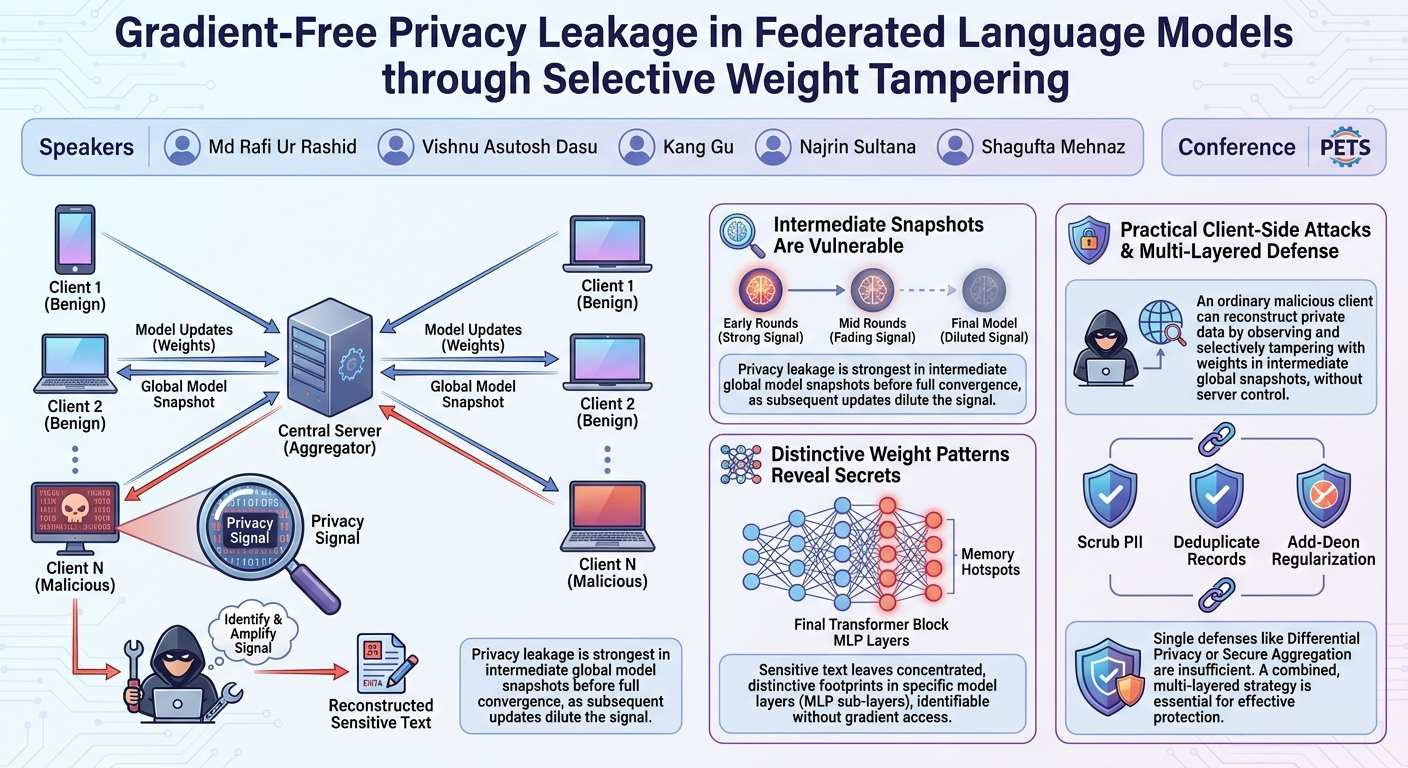
The core of this work demonstrates that a malicious FL client, operating under a realistic and constrained threat model, can effectively identify and amplify subtle "privacy signals" embedded within the global model's weights. Unlike prior attacks that often assume a powerful adversary with direct gradient access, server control, or architectural modifications, this attack relies solely on observing the same intermediate global model snapshots available to all ordinary clients. By leveraging two key observations—that sensitive data leaves distinctive footprints in specific model layers and that these signals are strongest before training fully converges—the attackers can reconstruct private information, significantly undermining the privacy guarantees often associated with FL.
This research is particularly significant because it exposes a fundamental vulnerability in Federated Language Models (FLMs) that is not easily mitigated by conventional privacy-preserving mechanisms like secure aggregation. It highlights that even without access to individual client gradients or control over the server, a determined client can infer and reconstruct sensitive data belonging to others. The findings necessitate a re-evaluation of FL's privacy claims and call for a more robust, multi-layered defense strategy beyond simply decentralizing data.
Background
▶ Watch: Introduction: Federated learning privacy leakage question (0:00)
Federated Learning (FL) was conceptualized to address the growing concerns around data privacy and regulatory compliance, particularly in scenarios involving sensitive user data. Its fundamental premise is that individual clients—such as mobile devices or organizations—train local models on their proprietary data, and only aggregated model updates (typically weights or gradients) are shared with a central server. This approach theoretically keeps raw, sensitive data confined to the user's device, preventing its exposure to a centralized entity. This decentralization is often touted as a primary privacy-preserving mechanism.
Despite these privacy aspirations, the research community has increasingly identified vulnerabilities within FL systems. Previous privacy attacks against FL, however, often operated under relatively strong adversary models. For instance, some attacks assume a malicious central server that can directly inspect or manipulate individual client gradients, or even alter the model architecture. Others postulate an adversary with high observational capabilities, such as access to internal model states or auxiliary data. While these attacks demonstrated potential privacy risks, they often relied on assumptions that might not hold in a typical, well-intentioned FL deployment where the server is considered trustworthy or at least not actively malicious.
The problem, as highlighted by this talk, is that merely keeping raw text local does not inherently prevent the model from "memorizing" that text. Language models, especially large transformer-based architectures like GPT-2 or BERT, are known for their capacity to memorize training data, even when fine-tuned on seemingly innocuous tasks. When such models are trained in an FL setting, the combined updates from many clients can inadvertently encode information about individual clients' unique and sensitive data. The challenge lies in extracting this encoded information under a more practical and constrained threat model: that of an ordinary, malicious FL participant who has no special privileges beyond what any other client possesses. This talk directly addresses this gap, revealing how a client can exploit subtle patterns in shared global model updates to infer and reconstruct private information without resorting to gradient access or server control.
Key Findings
▶ Watch: Four-stage attack pipeline for client-side privacy leakage (2:50)
The research presented in this talk uncovers several critical insights into privacy leakage within Federated Language Models, fundamentally challenging the notion of FL as an inherently privacy-preserving paradigm. The primary discovery revolves around the distinctive "footprint" that private, sensitive text leaves within a language model's architecture. Specifically, when a model like GPT-2 is fine-tuned on out-of-distribution sequences—such as phone numbers, credit card details, login credentials, or physical addresses—the resulting weight changes are not uniformly distributed. Instead, the largest changes become concentrated in the MLP sub-layers of the final transformer blocks. These specific layers are identified as memory hotspots, signaling the presence of anomalous or sensitive data.
A second crucial finding concerns the temporal dynamics of this privacy signal. The researchers observed that the exposure of a victim's private sequence is often strongest before federated training ends. In subsequent rounds, the continuous averaging of updates from other clients gradually dilutes and weakens this distinctive signal. This implies that intermediate global model snapshots can leak significantly more information than the final, converged model. This temporal characteristic is a cornerstone of their attack, as it motivates the attacker to identify and exploit these transient, information-rich snapshots.
Based on these observations, the talk demonstrates the feasibility of a potent client-side attack. An ordinary malicious FL client, merely by observing the global model snapshots shared during training, can accurately identify "victim rounds" where sensitive data was likely processed. Furthermore, the attacker can then selectively amplify the memorization signal within these identified snapshots. The experimental results validate the attack's effectiveness, showcasing substantial data reconstruction rates and successful membership inference. For synthetic canary sequences, the strongest attack configuration reconstructed 142 out of 200 (71%) of the canaries. On a real-world dataset derived from the Enron email corpus, the attack reconstructed 80 out of 125 (64%) private sequences. For membership inference, the best configuration achieved a 61% recall rate, demonstrating the ability to determine if a specific sensitive sentence was part of a victim's training data.
These impressive results were achieved under a practical threat model, where the attacker has no direct access to victim gradients, does not modify the model architecture, and does not control the central server. The research also highlights that their approach is comparable in efficacy to attacks that assume a stronger adversary, such as Decepticons, which actively manipulates model parameters from the server side. In fact, their method reconstructed approximately 2.6 times as many canaries as Decepticons, underscoring its efficiency and potency. Overall, these findings reveal a significant, previously underappreciated privacy vulnerability in FLMs, emphasizing that the exposure of intermediate snapshots and selective modification of a small portion of the model can substantially strengthen data reconstruction and membership inference capabilities.
Technical Deep Dive
▶ Watch: Maximizing Data Memorization (MDM) via weight transformation (4:30)
The attack pipeline presented is a sophisticated, multi-stage process designed to extract sensitive information from Federated Language Models under a practical and constrained adversary model. The attacker is assumed to be an ordinary malicious federated learning client, participating in the FL process alongside other benign clients. The victim is another client whose local data contains templated sensitive text, such as "your verification code is [SECRET_VALUE]". The attacker knows the non-sensitive prefix or template but seeks to recover the secret suffix. Crucially, the attacker does not have direct access to the victim's gradients, nor does it control the central server.
The attack unfolds in four sequential stages:
- Attacker Stores Global Model Snapshots: The first step is passive observation. As federated training progresses, the central server periodically aggregates local updates from participating clients and broadcasts a new global model snapshot to all clients for the next round. The malicious client simply saves these intermediate global model snapshots. This is a standard operation in FL, meaning no extraordinary access is required.
- Victim Round Identification (VRI): This stage aims to identify which of the stored global model snapshots were significantly influenced by clients possessing sensitive or out-of-distribution data. The VRI process leverages the observation that sensitive data leaves a distinctive footprint in specific model weights.
- Reference Models: The attacker first creates two reference models. The first,
G_R, is fine-tuned solely on regular English text, representing a baseline model trained on non-sensitive data. The second,G_S, is fine-tuned on regular English combined with adversary-generated dummy sensitive sequences. These dummy sequences are vital: they do not overlap with the victim's actual private data but are crafted to produce the general out-of-distribution signal structure characteristic of sensitive information (e.g., templated sequences with random numbers). - Change Vector Computation: For every observed global snapshot, the attacker computes a change vector. This vector is derived by comparing the snapshot's weights to a baseline model (e.g., the initial global model) but only using the selected layers—specifically, the MLP sub-layers of the final transformer blocks, which were identified as memory hotspots.
- Statistical Comparison: The computed change vector from an observed global snapshot is then compared against the change vectors of
G_R(regular reference) andG_S(sensitive reference) using two pairwise t-tests. - Victim Snapshot Labeling: A snapshot is labeled a "victim snapshot" if it is statistically different from the regular reference (
G_R) but statistically similar to the sensitive reference (G_S). This statistical differentiation allows the attacker to pinpoint rounds where sensitive data likely influenced the global model update. Across experiments involving 1 to 10 victims, VRI achieved approximately 86% to 94% recall and 77% to 82% precision, demonstrating its efficacy even without server assistance.
- Maximizing Data Memorization (MDM): Once a victim snapshot has been identified, the goal of MDM is to amplify its memorization of the sensitive data. This is achieved through modifying only the selected weights within the identified snapshot. Two methods were explored:
- Selective Weight Optimization (SWO): This method measures the difference between the victim snapshot and a regular reference model. It then directly increases the magnitude of this difference while carefully preserving its original direction. Conceptually, SWO acts to strengthen an existing sensitive data signal, making it more pronounced without introducing arbitrary changes to the model's behavior.
- Weights Transformation Learning (WTL): This more advanced method involves the attacker creating a supervised transformation. This transformation is learned using only the attacker's own regular data combined with out-of-distribution sequences. The learned mapping captures how the selected weights typically change when a model shifts from general text behavior towards sensitive data behavior. The attacker then applies this learned transformation to the selected layers (LAR) in the identified victim snapshot. In experiments, WTL consistently performed better than SWO because it more closely follows the characteristic sensitive data transformation, leading to a more effective amplification of the privacy signal. Crucially, neither SWO nor WTL requires access to gradients computed from the victim's data.
- Data Reconstruction or Membership Inference: After amplifying the memorization in the selected victim snapshots, the attacker can proceed with the final objective.
- Prompt-Based Data Reconstruction: The amplified model is used to generate text, typically by providing the known template (e.g., "your verification code is") as a prompt. The model's completion of this prompt then reveals the secret suffix.
- Sentence-Level Membership Inference: The amplified model can be queried to determine with high confidence whether a specific sensitive sentence was part of the victim's training data.
The researchers evaluated the attack across various model families, including Gamma 2 billion, GPT-2, BERT, and compact language models. Their datasets included Pantry, Bankang, and Wikitext-103, augmented with 200 unique synthetic canaries. They also used 125 naturally occurring private sequences identified in the Enron email corpus to demonstrate real-world applicability. The FL setup involved 100 clients, with 20 clients selected in each round, training for 700 rounds with five local epochs per round. For models exceeding 1 billion parameters, parameter-efficient fine-tuning (PEFT) with QR was employed. Metrics included successful data reconstruction, exposure, membership inference recall and precision, and validation perplexity to assess both privacy leakage and model utility.
The results confirmed that substantial private information could be recovered. The strongest configuration reconstructed 71% of synthetic canaries and 64% of real Enron data. For membership inference, the "dynamic+" configuration (where the server passively assists by identifying victim rounds but doesn't actively poison) reached 61% recall. The progression from static to dynamic to dynamic+ modes demonstrated that client-only attacks are effective, with passive server cooperation providing additional improvement. The attack's efficacy, even against a relatively strong baseline like Decepticons, underscores its potency and the inherent vulnerability it exposes within current FL practices.
Demo / Proof of Concept
▶ Watch: Analysis of privacy defenses and their limitations (7:30)
While the talk did not feature a live, interactive demonstration, the research thoroughly validates its claims through extensive experimental results and detailed methodological descriptions. The "Proof of Concept" is embodied in the quantitative outcomes presented, which rigorously showcase the attack's effectiveness across various models and datasets. The reconstruction rates of 71% for synthetic canaries and 64% for real-world private sequences from the Enron corpus, alongside a 61% membership inference recall, serve as compelling evidence that the proposed techniques successfully achieve their objectives. These empirical results effectively demonstrate the viability and potency of gradient-free privacy leakage in federated language models through selective weight tampering.
Defensive Implications
▶ Watch: Conclusion: Three main takeaways and future work (8:40)
The findings of this research carry significant implications for the design and implementation of privacy-preserving Federated Learning systems. The primary conclusion drawn from evaluating potential defenses is stark: no single defense mechanism is sufficient to fully mitigate this client-side privacy leakage. A multi-layered, combined approach is essential.
The researchers evaluated several common privacy-enhancing technologies:
- Differential Privacy (DP): While DP is a well-established technique for adding noise to data or gradients to protect individual contributions, its application here presented a trade-off. DP was shown to reduce the number of successful reconstructions. However, achieving stronger privacy guarantees through more aggressive DP settings noticeably reduced model utility, as indicated by increasing validation perplexity. This utility degradation can render the trained model less effective for its intended task, creating a dilemma for practitioners.
- Secure Aggregation (SecAgg) and Homomorphic Encryption (HE): These cryptographic techniques are designed to prevent the central server from observing individual client updates, ensuring that only the aggregated result is revealed. While effective against a malicious server, the talk highlights that these approaches provide limited protection against the core client-only attack. This is because ordinary clients still receive the global model snapshots, which is the sole input required for the presented attack. The vulnerability lies in the information encoded within the global model weights themselves, not in the direct observation of individual client updates by the server.
Given the limitations of individual defenses, the researchers recommend a balanced stack combining multiple techniques for practical protection:
- Scrub Predictable Personally Identifiable Information (PII) before training: This is a foundational data hygiene step. Removing common patterns of sensitive data (e.g., known formats for phone numbers, social security numbers) from the training data before it ever reaches the model can preemptively eliminate many potential leakage points.
- Deduplicate Repeated Records: Models are more likely to memorize data that appears frequently. Deduplicating repeated sensitive records across client datasets can reduce the "signal strength" of such information, making it harder for the model to embed it deeply and for attackers to extract it.
- Apply Modest Add-Deon Regularization: This novel regularization technique is designed to suppress privacy-sensitive neurons without incurring the severe utility loss associated with aggressive differential privacy. By targeting specific neurons that are highly correlated with sensitive information, Add-Deon regularization can weaken the memorization signal directly at the architectural level.
The effectiveness of this combined approach was demonstrated through experiments on the Enron dataset. Combining Add-Deon regularization with scrubbing reduced successful reconstructions from 67% to 29%, while crucially retaining substantially better model utility than an aggressive differential privacy configuration. This suggests that a thoughtful combination of data cleaning, deduplication, and targeted regularization offers a more practical and effective defense strategy than relying on a single, heavy-handed mechanism like strong DP, which often comes at a high cost to model performance. Defenders should therefore focus on a holistic strategy that addresses data input, model regularization, and the inherent information encoding capacity of large language models.
Key Takeaways
- Intermediate Snapshots are Vulnerable: Federated Learning models, particularly language models, can leak more private information through their intermediate global model snapshots than from their final, converged state. The privacy signal is strongest before it is diluted by subsequent aggregation rounds.
- Distinctive Weight Patterns Reveal Secrets: Sensitive or out-of-distribution text creates distinctive and concentrated changes in the MLP sub-layers of the final transformer blocks. These specific weight patterns can be identified to pinpoint "victim rounds" where sensitive data was processed.
- Client-Side Attacks are Potent and Practical: Meaningful client-side privacy leakage, including data reconstruction and membership inference, is possible without requiring direct access to victim gradients, control over the server, or modifications to the model architecture. An ordinary malicious client, by observing global model updates, can orchestrate an effective attack.
- No Single Defense Suffices: Conventional privacy mechanisms like differential privacy or secure aggregation alone are insufficient. Differential privacy often degrades utility significantly, while secure aggregation does not protect against attacks based on global model observations by clients.
- Multi-Layered Defense is Essential: A balanced stack of defenses is recommended, including scrubbing predictable Personally Identifiable Information (PII), deduplicating repeated records, and applying modest Add-Deon regularization to suppress privacy-sensitive neurons. This combination offers better utility preservation while substantially reducing leakage.
- Future Work: The current analysis primarily focused on medium-scale English transformer models. Extending these findings and developing defenses for larger, multilingual, multimodal, and fully decentralized federated learning settings remains an important area for future research.
About the Speaker(s)
The research presented in this talk was a collaborative effort by a team of academics. The presenter, Md Rafi Ur Rashid, is one of the paper's authors affiliated with Pennsylvania State University. He delivered the detailed findings and methodology of their work. His co-authors include Vishnu Asutosh Dasu, Najrin Sultana, and Shagufta Mehnaz, all also affiliated with Pennsylvania State University, indicating a strong research focus on privacy and security within machine learning at the institution. Additionally, Kang Gu contributed to the paper as an author from Dartmouth College, showcasing inter-institutional collaboration on this critical topic. Their collective expertise in machine learning, privacy, and security was instrumental in identifying and analyzing this novel gradient-free privacy leakage vector in federated language models.
Reviews
Dr. Zero (Offensive Security Researcher) — STRONG ACCEPT
The industry loves to sell Federated Learning as a privacy silver bullet because the raw data stays local. Rashid and team just blew that threat model out of the water. They prove that any ordinary client can rip raw PII out of intermediate global model snapshots without ever touching another client's gradients or popping the central server.
Heather Calloway (CISO) — STRONG ACCEPT
Vendors sell Federated Learning to enterprise boards as a silver bullet for data privacy and cross-border compliance. This research proves that premise is fundamentally flawed, making it required reading for any organization exploring distributed AI training.
→ Top-rated talks at Privacy Enhancing Technologies Symposium (PETS) 2026
All talks from Privacy Enhancing Technologies Symposium (PETS) 2026