LLMs Leak Training Data Beyond Verbatim Memorization: Extraction via Membership Decoding
Zitai Chen (Paper author · National University of Singapore), Reza Shokri (Paper author · National University of Singapore)
Privacy Enhancing Technologies Symposium (PETS) 2026 · Remote
Overview
Large Language Models (LLMs) have demonstrated an alarming propensity to memorize portions of their training data, a phenomenon that poses significant privacy and security risks. While much attention has been paid to verbatim memorization—instances where models reproduce training sequences word-for-word—this talk, presented by Zitai Chen and Reza Shokri from the National University of Singapore at the PETS conference, reveals that verbatim memorization is merely "the tip of the iceberg." Their groundbreaking work, "LLMs Leak Training Data Beyond Verbatim Memorization: Extraction via Membership Decoding," introduces a novel approach to extract "partially memorized" data, which constitutes the vast majority of leaked information.
Key moments
- 0:00 LLMs leak training data: beyond verbatim memorization
- 2:00 Incompleteness and inefficiency of existing extraction methods
- 3:00 K-NN correction: memorization as a spectrum, not yes/no
- 4:40 Empirical evidence: most memorization is partial (K=1 or K=2)
- 6:00 Membership decoding: auditing between generation steps
- 8:00 Membership decoding extracts previously unreachable, partially memorized data
- 8:40 Key takeaways: verbatim is tip of iceberg, new extraction methods
LLMs Leak Training Data Beyond Verbatim Memorization: Extraction via Membership Decoding
Speakers: Zitai Chen (Paper author, National University of Singapore), Reza Shokri (Paper author, National University of Singapore)
Conference: PETS
YouTube: https://www.youtube.com/watch?v=tXP2OsdWIVk
Overview
Large Language Models (LLMs) have demonstrated an alarming propensity to memorize portions of their training data, a phenomenon that poses significant privacy and security risks. While much attention has been paid to verbatim memorization—instances where models reproduce training sequences word-for-word—this talk, presented by Zitai Chen and Reza Shokri from the National University of Singapore at the PETS conference, reveals that verbatim memorization is merely "the tip of the iceberg." Their groundbreaking work, "LLMs Leak Training Data Beyond Verbatim Memorization: Extraction via Membership Decoding," introduces a novel approach to extract "partially memorized" data, which constitutes the vast majority of leaked information.
The core contribution of this research is twofold: first, a new metric called K-N correction to quantify the spectrum of memorization, and second, an innovative extraction technique termed membership decoding. This method fundamentally rethinks how training data extraction is performed, moving from a blind generation-then-audit approach to an "audit in between generation" strategy. By integrating membership inference directly into the decoding process, membership decoding can effectively recover sensitive information that current state-of-the-art methods entirely miss, thereby exposing a much broader attack surface for privacy breaches in LLMs. The implications are profound, suggesting that the risk of data leakage from LLMs is far greater than previously understood, demanding a re-evaluation of current defensive strategies.
Background
▶ Watch: LLMs leak training data: beyond verbatim memorization (0:00)
The prowess of Large Language Models stems from their training on colossal datasets, encompassing everything from vast swathes of web text and code repositories to specialized corpora like medical records. While the ingestion of such diverse data is crucial for their general capabilities, it introduces a critical privacy vulnerability: the potential for models to memorize and subsequently reproduce portions of this training data. The prevailing assumption has been that as long as private data "goes into the model and never comes back out," the risk is tolerable. However, this condition demonstrably fails, as models frequently memorize data during training and reproduce it during inference, exposing sensitive or proprietary information without the owner's consent. This constitutes a privacy breach, irrespective of the content's sensitivity.
Prior research has consistently shown a direct correlation between model scale and memorization, with larger models exhibiting a greater tendency to retain training data. Training data extraction serves as the primary mechanism to quantify this risk. The standard approach involves providing a model with a training prefix and observing whether it accurately reproduces the corresponding training suffix. Historically, existing extraction methods have largely adhered to a two-step "generation then audit" recipe. This pipeline typically involves using greedy decoding to generate a suffix from a given prefix, followed by auditing the generated text using a membership inference attack (MIA). If the MIA score surpasses a certain threshold, the sequence is classified as a "member" of the training data.
However, this conventional pipeline suffers from two critical limitations:
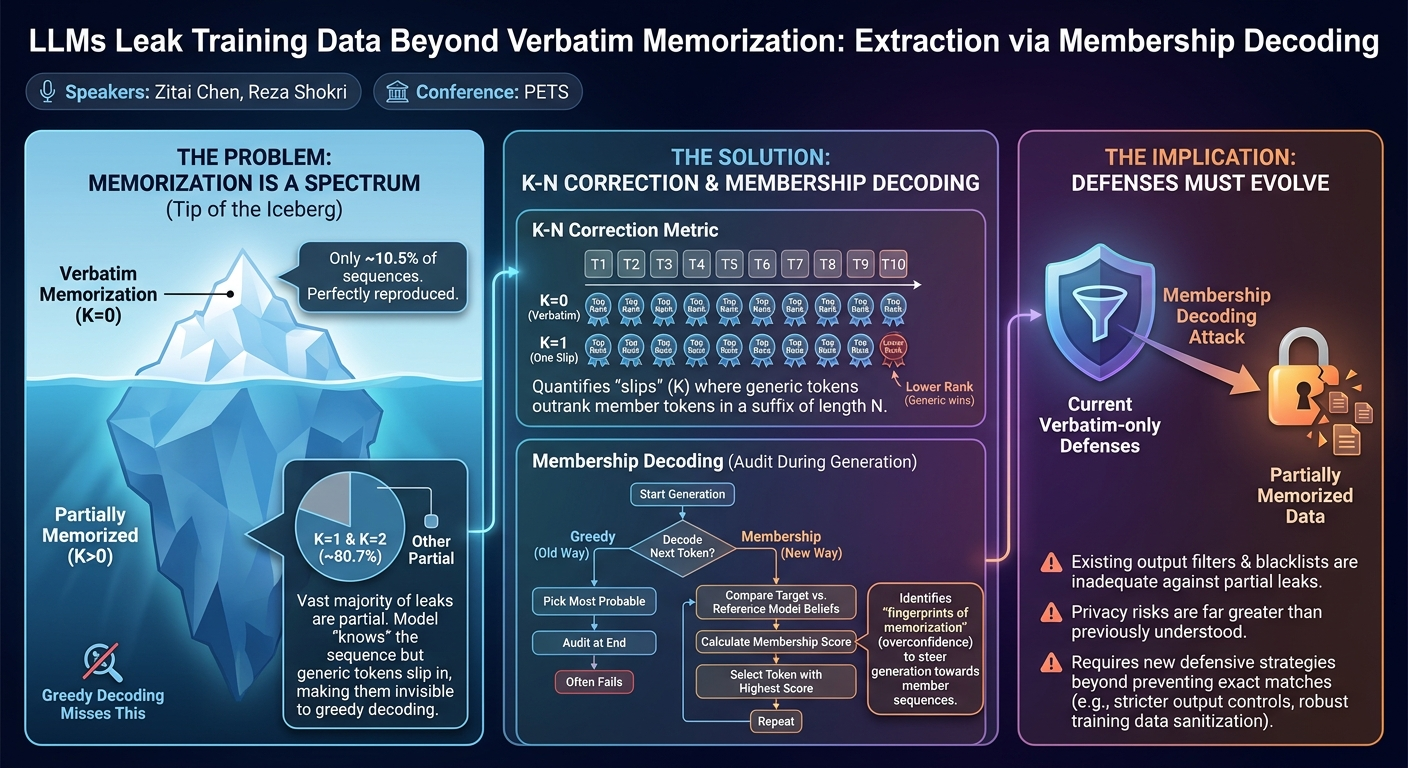
- Incompleteness: Greedy decoding, by its very nature, can only extract sequences that are verbatim memorized. This means the member token must rank as the top-most probable token at every single step of the generation. The talk highlights that this accounts for a mere 10% of all memorized training sequences. For the remaining 90%, the model still "knows" almost every token of the sequence, but a slightly more generic token might "edge out" the true member token at one or more positions. These "partially memorized" sequences are never generated by greedy decoding, and consequently, never audited by MIA, despite the fact that MIA could identify them if presented with the full sequence. The risk is real, but it remains invisible to current tools.
- Inefficiency: The generation phase acts as a bottleneck, operating blindly without specific guidance. Greedy decoding optimizes for the most probable sequence, not necessarily the member sequence. The crucial membership signal, indicating whether a sequence is part of the training data, only becomes available after the entire suffix has been generated. This means the signal arrives too late to steer the generation process, leading to numerous failed attempts and inefficient resource utilization. The existing approach "waits for them to turn up" rather than actively searching for them.
These limitations underscore the urgent need for a more sophisticated extraction methodology that can identify and retrieve partially memorized data, thereby providing a more accurate assessment of LLM privacy risks.
Key Findings
▶ Watch: K-NN correction: memorization as a spectrum, not yes/no (3:00)
The research presented fundamentally shifts the understanding of LLM memorization from a binary "yes or no" proposition to a nuanced spectrum. The authors introduce K-N correction, a novel metric designed to quantify this spectrum of memorization. For a given member sequence, K-N correction examines each suffix position and asks: "Does the member token rank top one given its member prefix?"
- K represents the number of times a more generic token edges out the actual member token, preventing it from being ranked first.
- N is the length of the suffix.
Thus, when K equals zero (K=0), it signifies verbatim memorization, meaning the member token was ranked first at every single step. When K equals one or two (K=1 or K=2), it indicates that the model knows almost the entire suffix but "slips" at one or two positions, where a generic token slightly outranks the true member token. This allows for a granular understanding of how "deeply" a sequence is memorized.
Applying K-N correction to the Memia benchmark across seven domains yielded several critical insights:
- Distribution of Memorization: For a suffix length of 10 tokens, a striking only 10.5% of sequences were fully memorized (K=0). This confirms the "tip of the iceberg" analogy. The vast majority of memorized data, specifically 80.7%, fell into the categories of K=1 and K=2. This means that nearly one in five sequences, where the model gets eight or nine positions correct out of ten, would still be entirely missed by traditional greedy decoding. The talk illustrates this with an "Alice ID" example: greedy decoding might produce a '6' at position seven instead of a '7', making the entire ID incorrect. However, the true member token '7' might still be present at rank two with high confidence, merely hidden behind a slightly more generic token. This partial memorization, though subtle, holds the complete sensitive information.
- Scale of Memorization: The study also investigated the relationship between model scale and memorization. Across various domains, as model parameters increased from the smallest models up to 12 billion parameters, the average K value consistently decreased. This observation corroborates prior work: larger models memorize more training data, reinforcing the notion that scaling up LLMs exacerbates the privacy risks associated with data leakage. This finding is crucial as the industry continues to push for ever-larger models.
These findings fundamentally challenge the prevailing understanding of LLM privacy risks, demonstrating that the scope of memorized data is far broader than previously accounted for by verbatim extraction methods. The existence of a substantial quantity of partially memorized data, readily identifiable by K-N correction but inaccessible to greedy decoding, underscores the critical need for new extraction techniques.
Technical Deep Dive
▶ Watch: Empirical evidence: most memorization is partial (K=1 or K=2) (4:40)
To overcome the limitations of existing "generation then audit" extraction methods, the authors propose membership decoding, an innovative approach that integrates the membership inference signal directly into the generation process. The core idea is to shift from auditing once at the end of generation to auditing "at every step."
The fundamental distinction lies in the question posed during token generation:
- Greedy decoding asks: "Which token is most probable?" This approach selects the token with the highest probability at each step, but it cannot differentiate between a token being highly probable because it is generic (i.e., common across many contexts) and a token being highly probable because the model was specifically trained on it (i.e., memorized). Generic tokens often win out, leading to the failure to extract partially memorized sequences.
- Membership decoding asks instead: "Which token does the target model believe more than it should be?" This question aims to identify the "fingerprint of memorization"—the distinct overconfidence a model exhibits for a token it has memorized, compared to a token that is simply generic.
To achieve this, membership decoding introduces a small reference model as a "second opinion." This reference model is intended to represent how an "average model" would respond to a given prefix. For each candidate token at a given step, membership decoding compares the target model's belief (its assigned probability) with the reference model's belief.
- If the reference model largely agrees with the target model, the token is likely generic, and its probability ratio (target belief / reference belief) would be approximately one.
- If the target model is highly confident in a token, but the reference model has little to no idea (i.e., assigns a very low probability), this significant gap in belief signals memorization. The target model's disproportionate confidence is the "fingerprint."
Concretely, the score for a candidate token is calculated as the ratio of the target model's belief to the reference model's belief. A higher score indicates a stronger signal of memorization. To approximate the belief of an "average model" using only one reference model, the authors interpret the reference model's belief with a "constant overconfident belief," effectively adjusting its probabilities to provide a stable baseline for comparison.
This "audit in between generation" strategy fundamentally changes the nature of extraction. Instead of generating blindly and then checking for success or failure, membership decoding actively steers the generation towards sequences that exhibit signs of memorization. The computational cost of membership inference, which existing attacks already incur at the end, is now strategically deployed at each step, enabling it to "change the outcome" by guiding the model towards the correct, albeit partially memorized, training sequence. This single-line conceptual change—from optimizing for probability to optimizing for the membership score—is the essence of the entire method, allowing it to navigate the landscape of partially memorized data.
Demo / Proof of Concept
▶ Watch: Membership decoding extracts previously unreachable, partially memorized data (8:00)
The efficacy of membership decoding was demonstrated through a series of experiments designed to extract training sequences under challenging conditions. The setting involved an auto-regressive generation process for 10 consecutive tokens, with no ground truth provided at inference time, mimicking a realistic attack scenario. The results were presented across different K values, representing varying degrees of memorization:
- K=0 (Verbatim Memorization): For sequences that were fully memorized (where the member token was top-ranked at every step), greedy decoding achieved a 100% accuracy. Membership decoding, in this specific scenario, achieved approximately 87% accuracy. The speaker directly addressed this apparent drop, explaining that it is the cost of membership decoding's "deep auditing." Because membership decoding audits at every step, including those where greedy decoding already has the correct token, it occasionally overrules a correct token based on its membership score, leading to a slight reduction in accuracy for perfectly memorized sequences. However, this trade-off is crucial for its ability to extract other, more challenging types of memorized data.
- K=1 (Partially Memorized, One Slip): This is where membership decoding showcased its transformative capability. For sequences where the model "slipped" at just one position (K=1), greedy decoding extracted 0% of these sequences. A single wrong turn, where a generic token outranked the member token, meant the entire suffix was lost, and no amount of post-hoc computation could recover it. In stark contrast, membership decoding successfully extracted 9% of these K=1 sequences. This is not merely an improvement over greedy decoding; these sequences were entirely "outside the reach of one-shot extraction" and are now accessible. This represents a "qualitative bridge" in extraction capabilities, opening up a vast new category of extractable data.
- K=2 (Partially Memorized, Two Slips): Extending the challenge, the experiments also explored K=2 sequences, where the model made two "slips." While the extraction rate was lower, "under 1%," the speaker characterized this as a "proof of existence." It demonstrates that the extraction boundary is not halted at K=1 but extends further into more complex partial memorization. This finding suggests that with further refinements, membership decoding could potentially extract even more challenging partially memorized sequences.
In summary, the demonstration clearly illustrated that while membership decoding incurs a minor cost for perfectly verbatim sequences, it delivers a profound advantage by extracting a significant portion of partially memorized data that was previously entirely unreachable. It extracts "different ones" rather than "more of them" in the K=0 category, fundamentally expanding the scope of what can be extracted from LLMs.
Defensive Implications
▶ Watch: Key takeaways: verbatim is tip of iceberg, new extraction methods (8:40)
The findings presented in this talk carry significant implications for developers, operators, and users of Large Language Models, particularly concerning data privacy and security. The revelation that verbatim memorization is merely "the tip of the iceberg" and that a vast majority (over 80%) of memorized data exists in a partially memorized state, previously unreachable by standard extraction methods, necessitates a re-evaluation of current defensive strategies.
Firstly, the research underscores that reliance solely on techniques designed to mitigate verbatim reproduction is insufficient. Existing protections that might prevent a model from outputting an exact, word-for-word copy of a training sequence may be completely bypassed by an attacker employing membership decoding. This means that measures like simple output filtering or blacklisting exact phrases are inadequate. Defenders must now consider more sophisticated attack vectors that can reconstruct sensitive information even when the model's output is slightly perturbed or contains generic tokens.
The talk briefly mentions a direct defensive implication: "Restricting the number return token is doing the real protective work." This suggests that limiting the length of generated outputs or the number of alternative tokens returned by the model could reduce the overall attack surface. If an attacker cannot generate a sufficiently long suffix, or if the model's output diversity is constrained, it might be harder to piece together partially memorized data, even with advanced techniques like membership decoding. However, this is a blunt instrument that can also degrade model utility.
More broadly, the existence of membership decoding implies that:
- Data sanitization and de-identification during training need to be far more robust and comprehensive. Techniques like differential privacy, which aim to add noise to training data to obscure individual records, become even more critical.
- Proactive auditing and monitoring of LLM outputs for signs of partial memorization, beyond simple substring matching, should be implemented. This would require tools that can assess the "membership score" of generated content, similar to the mechanism used by membership decoding itself.
- Model developers must reconsider the fundamental trade-off between model capacity/performance and memorization risk. As larger models memorize more, the drive for scale must be balanced with enhanced privacy-preserving mechanisms.
- Users of LLMs, especially in sensitive domains, should exercise increased caution. The potential for hidden data leakage means that LLMs should not be treated as perfectly isolated systems, and outputs should be scrutinized for any information that could potentially be traced back to private training data.
Ultimately, this research serves as a wake-up call, emphasizing that the problem of LLM data leakage is deeper and more pervasive than previously quantified. Defenders must now anticipate and counter attacks that can reconstruct sensitive data from subtle "fingerprints of memorization," moving beyond the detection of explicit reproductions.
Key Takeaways
- Verbatim memorization is only a small fraction of the total memorized training data in LLMs, representing just the "tip of the iceberg."
- The K-N correction metric provides a novel way to quantify and understand the spectrum of memorization, from verbatim (K=0) to partially memorized (K=1, K=2, etc.).
- A vast majority of memorized data, specifically over 80% (K=1 and K=2 sequences), consists of partially memorized content that is entirely missed by traditional greedy decoding methods.
- Membership decoding is a new extraction technique that integrates membership inference directly into the generation process ("audit in between generation"), enabling the recovery of previously unreachable partially memorized data.
- By comparing a target model's belief with a reference model's "average" belief, membership decoding identifies unique "fingerprints of memorization" to steer token generation.
- Defenders must acknowledge that current protections against verbatim reproduction are insufficient and need to implement more sophisticated strategies to mitigate risks from partial memorization, potentially including stricter output controls or advanced privacy-preserving training techniques.
About the Speaker(s)
Zitai Chen is a research contributor and co-author of the paper discussed in this talk, affiliated with the National University of Singapore. His work focuses on understanding and mitigating privacy risks associated with Large Language Models.
Reza Shokri is also a co-author of the presented paper and is affiliated with the National University of Singapore. His research expertise lies in privacy and security, particularly in the context of machine learning, where he investigates data leakage, memorization, and membership inference attacks in complex models like LLMs.
Reviews
Dr. Zero (Offensive Security Researcher) — MUST SEE
This isn't just another 'ChatGPT leaked my API key' script. Chen and Shokri fundamentally rewrote the extraction playbook by shifting membership inference from a post-hoc audit to a generation-time steering metric. They proved that the industry's reliance on greedy decoding to measure privacy risk is blinding them to 90% of the actual leakage.
Heather Calloway (CISO) — MUST SEE
This research blows a hole in standard enterprise AI privacy assumptions. By proving that standard red-teaming misses nearly 90% of model data leakage, it fundamentally changes the risk calculus for any business fine-tuning LLMs on proprietary data.
→ Top-rated talks at Privacy Enhancing Technologies Symposium (PETS) 2026
All talks from Privacy Enhancing Technologies Symposium (PETS) 2026