TraCS: Trajectory Collection in Continuous Space under Local Differential Privacy
Ye Zheng (Paper author · Rochester Institute of Technology), Yidan Hu (Paper author · Rochester Institute of Technology)
Privacy Enhancing Technologies Symposium (PETS) 2026 · Remote
Overview
This article delves into "TraCS: Trajectory Collection in Continuous Space under Local Differential Privacy," a significant work presented by Ye Zheng and Yidan Hu from Rochester Institute of Technology. The talk addresses a critical challenge in modern data privacy: protecting sensitive user trajectories – such as daily routines or data from wearable sensors – when collected by untrusted third parties for location-based services (LBS). While existing solutions primarily focus on discrete location spaces, this research pioneers a novel approach for trajectory collection in continuous space while upholding rigorous Local Differential Privacy (LDP) guarantees.
Key moments
- 0:00 Trajectory collection in continuous space under LDP
- 2:00 Efficiency and applicability limitations of discrete LDP mechanisms
- 3:00 Benefits of operating on continuous location space
- 4:00 Introducing TraCS-D and TraCS-C for continuous space LDP
- 6:20 How TraCS compares to existing discrete LDP methods
- 8:00 Experimental results: lower error in continuous space
- 8:30 Performance and significant efficiency gains in discrete spaces
TraCS: Trajectory Collection in Continuous Space under Local Differential Privacy
Speakers: Ye Zheng (Paper author, Rochester Institute of Technology), Yidan Hu (Paper author, Rochester Institute of Technology)
Conference: PETS
YouTube: https://www.youtube.com/watch?v=pP5Z9W4W0qc
Overview
This article delves into "TraCS: Trajectory Collection in Continuous Space under Local Differential Privacy," a significant work presented by Ye Zheng and Yidan Hu from Rochester Institute of Technology. The talk addresses a critical challenge in modern data privacy: protecting sensitive user trajectories – such as daily routines or data from wearable sensors – when collected by untrusted third parties for location-based services (LBS). While existing solutions primarily focus on discrete location spaces, this research pioneers a novel approach for trajectory collection in continuous space while upholding rigorous Local Differential Privacy (LDP) guarantees.
The core problem lies in the inherent sensitivity of location data, which can reveal deeply personal information. Traditional LDP mechanisms, often relying on the exponential mechanism, struggle with the complexities of continuous spatial data, facing issues of efficiency, utility, and applicability. TraCS proposes a paradigm shift, demonstrating that operating directly within a continuous location space offers superior performance and broader applicability. This work is crucial for advancing privacy-preserving technologies, enabling the development of more accurate and scalable LDP solutions for the ever-increasing volume of fine-grained location data.
The significance of TraCS extends to any domain where granular, real-world spatial data needs to be collected and analyzed while preserving individual privacy. By providing provable privacy for user trajectories in both continuous and discrete settings with enhanced utility and efficiency, this research offers a robust framework for developers and organizations building privacy-aware LBS, urban planning tools, or health monitoring applications. It highlights the imperative for privacy mechanisms to evolve alongside the sophistication of data collection, moving beyond simplistic discrete approximations to embrace the full complexity of continuous data.
Background
▶ Watch: Trajectory collection in continuous space under LDP (0:00)
Trajectory collection is a fundamental problem in various fields, from urban planning and traffic management to personalized location-based services and public health monitoring. However, the data involved—sequences of an individual's locations over time—is inherently sensitive. A user's trajectory can reveal their home, workplace, medical appointments, social habits, and more, making it a prime target for privacy breaches. This sensitivity necessitates robust privacy protection, especially when these trajectories are collected and processed by untrusted third parties.
Historically, location data has been categorized into two main types: locations from a discrete location space (e.g., specific points of interest, pre-defined grid cells, or regions) and locations from a continuous location space (e.g., real-number coordinates like latitude and longitude). While discrete spaces simplify privacy mechanisms by limiting the potential locations, they often sacrifice the granularity and accuracy crucial for many advanced applications. The continuous nature of real-world movement presents a far more challenging landscape for privacy preservation.
To safeguard user privacy, Local Differential Privacy (LDP) has emerged as a powerful cryptographic primitive. LDP ensures that an adversary cannot distinguish between any two sensitive locations (τ1 and τ2) within a given location space, even with access to the perturbed data. This strong guarantee is achieved by having each user perturb their own data locally before sending it to the collector, thus preventing the collector from ever seeing the true, sensitive data.
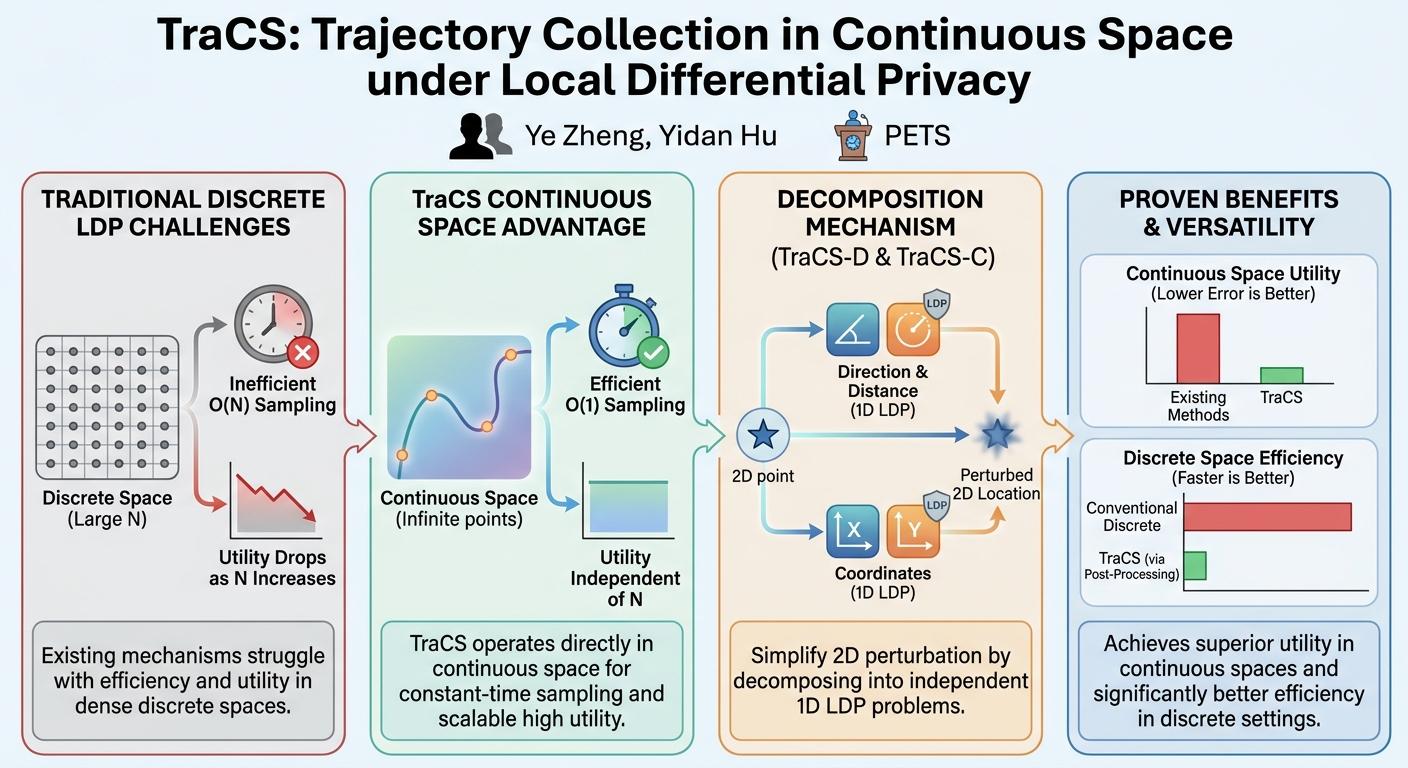
Despite the promise of LDP, most existing mechanisms for trajectory collection have been designed for discrete spaces. These often leverage the exponential mechanism, which samples a noisy location based on pairwise distances from the true location. While effective for discrete sets, this approach suffers from several critical limitations when extended or adapted to the continuous domain:
- Efficiency: The exponential mechanism typically incurs an
O(N)computational cost per sample, whereNis the number of locations in the location space. For large or dense discrete spaces, and certainly for continuous spaces,Ncan become prohibitively large, rendering the mechanism impractical. - Trajectory Utility: The utility of the perturbed data, measured by its accuracy or closeness to the true trajectory, decreases significantly as
Nincreases. This is because the probability mass for perturbation must be distributed across a larger number of potential locations, diluting the signal from the true location. - Applicability: Fundamentally, these discrete-focused mechanisms cannot directly apply to continuous location spaces without significant, often lossy, pre-processing like quantization or grid-based discretization, which can compromise both privacy and utility.
These limitations underscore the pressing need for LDP mechanisms explicitly designed for continuous spaces—mechanisms that are not only provably private but also efficient, scalable, and capable of preserving high data utility for fine-grained trajectory analysis.
Key Findings
▶ Watch: Benefits of operating on continuous location space (3:00)
The research presented in "TraCS" makes several pivotal contributions by challenging the conventional wisdom of applying discrete LDP techniques to continuous trajectory data. The central tenet is that operating directly in a continuous space is inherently better and more universal for LDP-based trajectory collection. This insight drives the development of novel mechanisms that overcome the efficiency, utility, and applicability limitations of prior art.
The primary findings and contributions can be summarized as follows:
- Superior Efficiency and Utility in Continuous Space: The talk demonstrates that by designing LDP mechanisms specifically for continuous spaces, it's possible to achieve O(1) sampling efficiency. This represents a dramatic improvement over the
O(N)complexity of exponential mechanisms used in discrete settings, making large-scale, real-time trajectory collection feasible. Furthermore, the utility of the perturbed trajectories in continuous space does not depend on the number of locationsN, leading to higher accuracy, especially in dense or fine-grained datasets. - Universal Applicability: The proposed continuous-space mechanisms are inherently applicable to both continuous spaces (where locations are real coordinates) and discrete spaces (where locations are specific points or cells). For discrete spaces, a simple post-processing step of rounding to the nearest discrete location can be applied without affecting the LDP privacy guarantee, making the approach broadly versatile.
- Novel Decomposition Mechanisms (TraCS-D and TraCS-C): To effectively perturb 2D continuous locations under LDP, the authors introduce two specific mechanisms:
- TraCS-D (Direction-Distance Perturbation): This mechanism decomposes the two-dimensional location space into a direction space and a distance space. This allows for independent perturbation of these one-dimensional components.
- TraCS-C (Coordinate Perturbation): This mechanism decomposes the 2D space into two independent distance spaces, typically representing X and Y coordinates.
Both mechanisms then leverage existing one-dimensional LDP mechanisms (such as piecewise-based mechanisms) to perturb each subspace, simplifying the problem while maintaining privacy.
- Empirical Validation of Performance Gains: Through extensive evaluations on both synthetic and real-world datasets (e.g., Tokyo and Chicago location spaces), TraCS mechanisms consistently demonstrate lower error (higher utility) compared to existing LDP methods like "panel lambda plus condition" when operating in continuous spaces. Even when adapted for discrete spaces via post-processing, TraCS shows competitive utility and significantly superior efficiency.
In essence, TraCS provides a robust theoretical and empirical framework for privacy-preserving trajectory collection that is tailored to the complexities of continuous data, offering substantial improvements in efficiency, utility, and practical applicability over previous discrete-centric approaches.
Technical Deep Dive
▶ Watch: Introducing TraCS-D and TraCS-C for continuous space LDP (4:00)
The core innovation of TraCS lies in its fundamental shift from perturbing locations within a finite, discrete set to operating directly within an infinite, continuous location space. This approach enables the design of simpler, more efficient sampling mechanisms. For instance, if a user's true location is L, the mechanism can sample a noisy location L' from a "red area" (a region immediately surrounding L) with a significantly higher probability, while sampling from a "gray area" (the rest of the space) with a much lower, uniform probability. This intuitive design yields three critical benefits:
- Efficiency: The sampling capacity becomes
O(1), a constant time operation, because generating a noisy sample no longer requires iterating through or comparing probabilities across a vast number of potential locationsN. This is a monumental improvement overO(N)mechanisms, especially for large-scale data. - Trajectory Utility: The utility of the perturbed data is no longer tied to the size
Nof the location space. In continuous space, the probability distribution can be concentrated more effectively around the true location, leading to higher accuracy regardless of the overall spatial extent or density of possible locations. - Applicability: The continuous-space approach is universally applicable. It directly handles real-number coordinates, and for applications requiring discrete locations, a simple post-processing step of rounding the perturbed continuous location to the nearest discrete point of interest or grid cell can be applied. Critically, this post-processing does not compromise the LDP guarantee, as LDP applies to the output of the perturbation mechanism before any deterministic transformation.
To realize LDP in a two-dimensional continuous space, TraCS employs a clever decomposition strategy. Instead of directly perturbing the (x, y) coordinates simultaneously, the mechanisms break down the 2D problem into simpler one-dimensional LDP problems. This is achieved through two distinct approaches:
- TraCS-D: Direction-Distance Perturbation Mechanism
This mechanism decomposes a 2D location into a direction and a distance from a reference point (e.g., origin or a central point). For a given true location, its relative position can be described by an angle (direction) and a magnitude (distance). TraCS-D then designs separate 1D LDP mechanisms for perturbing the direction and the distance independently. For example, if the true direction is diagonal, the perturbation mechanism for direction might assign a higher sampling probability to an arc surrounding that diagonal direction, and lower probabilities elsewhere in the angular space. Similarly, for distance, a higher probability could be assigned to a segment around the true distance.
- TraCS-C: Coordinate Perturbation Mechanism
This mechanism decomposes the 2D location into its constituent Cartesian coordinates, typically X and Y. Each coordinate is treated as an independent 1D numerical domain. TraCS-C then applies existing 1D LDP mechanisms to perturb the X-coordinate and the Y-coordinate separately. This is conceptually simpler and often more straightforward to implement.
For both TraCS-D and TraCS-C, the underlying 1D LDP mechanisms are crucial. The authors leverage piecewise-based mechanisms, which are known for their efficiency and utility in bounded numerical domains. However, the framework is flexible, stating that "other LDP mechanisms on such bounded numerical domain are also applicable." The key is that these 1D mechanisms provide provable LDP guarantees for their respective subspaces. By combining these independently perturbed 1D components, the overall 2D location perturbation also maintains LDP.
To further contextualize TraCS, it's useful to briefly contrast it with advanced discrete LDP methods mentioned in the talk, such as ATP (Adaptive Trajectory Perturbation) and N-Gram-based methods:
- ATP: This method employs "direction division." When perturbing a location, it first divides the surrounding space into sectors (e.g., four sectors). It then perturbs the sensitive direction, aiming for the noisy sector to often be the same as the true sector with high probability. This effectively reduces the location space to a smaller area, where a conventional discrete LDP mechanism can then be applied. While "smarter" than simple exponential mechanisms, it still operates on a discretized, sector-based representation.
- N-Gram: This approach uses "reachability constraints" derived from public knowledge. For example, it leverages the fact that the distance between consecutive locations in a real trajectory cannot be "too far." This constraint helps reduce the "virtual area" of possible next locations, within which an LDP algorithm can then be applied. Again, while intelligent, this still implicitly relies on a discrete understanding of reachable states or requires significant pre-computation over discrete graphs.
TraCS fundamentally differs by operating continuously from the outset, avoiding the inherent limitations and potential information loss associated with discretization or complex contextual pre-processing required by these discrete-centric "smarter" methods. This continuous approach allows for a direct and efficient application of LDP to raw, fine-grained trajectory data.
Demo / Proof of Concept
▶ Watch: Experimental results: lower error in continuous space (8:00)
While the talk did not feature a live software demonstration, the "Demo / Proof of Concept" was provided through comprehensive empirical evaluations that rigorously tested the proposed TraCS mechanisms (TraCS-D and TraCS-C) against existing LDP methods. These evaluations served to validate the theoretical claims of improved utility and efficiency across various scenarios.
The primary metric used for evaluating utility was the average error Euclidean metric, which quantifies the average spatial distance between the true locations and their perturbed counterparts. Lower Euclidean error indicates higher utility and better preservation of the underlying data patterns.
The evaluations were conducted across two main categories of location spaces:
- On Continuous Spaces:
- Methodology: The TraCS mechanisms (TraCS-D and TraCS-C) were compared against existing LDP methods designed for, or adapted to, continuous spaces (e.g., "panel lambda plus condition").
- Datasets: Both synthetic datasets and real-world datasets, specifically the Tokyo location space and Chicago location space, were utilized. These real-world datasets provide realistic distributions of user movements.
- Results: The results consistently showed that TraCS-D and TraCS-C (represented by red and blue lines in the error plots) achieved lower average Euclidean error as the privacy budget epsilon (ε) increased. Epsilon is a parameter in LDP that controls the trade-off between privacy and utility; a larger epsilon implies less privacy but higher utility. The TraCS methods demonstrated a superior privacy-utility trade-off, meaning for a given level of privacy (epsilon), they provided more accurate perturbed data compared to the baselines. This confirmed the hypothesis that operating directly in continuous space yields better utility.
- On Discrete Location Spaces:
- Methodology: For discrete location spaces (represented by blue points in the examples), the TraCS method first perturbed the location in continuous space, then applied a post-processing step of rounding the perturbed continuous location to the nearest discrete location. This allowed for a direct comparison with LDP mechanisms explicitly designed for discrete spaces (e.g., ATP, N-Gram, SR, etc.).
- Results: While the error for TraCS in discrete settings was acknowledged to be "not as good as in continuous space" (due to the additional rounding step), it still exhibited lower error as epsilon increased compared to conventional discrete mechanisms. This demonstrated the versatility of the continuous-space approach, showing that it can effectively serve discrete applications with competitive utility, even with the added complexity of post-processing.
- Efficiency: Crucially, for discrete spaces, TraCS mechanisms showed a significant advantage in efficiency. With their
O(1)sampling cost, they drastically outperformed conventional discrete mechanisms that incurO(N)cost, especially asN(the number of discrete locations) grows large. This efficiency gain is a major practical benefit for real-world deployments.
In summary, the empirical evaluations served as a robust proof of concept, clearly demonstrating that TraCS mechanisms offer superior utility in continuous settings and significantly better efficiency with competitive utility in discrete settings, making them a powerful advancement in privacy-preserving trajectory collection.
Defensive Implications
▶ Watch: Performance and significant efficiency gains in discrete spaces (8:30)
The findings from TraCS have profound implications for defenders, privacy engineers, and organizations that collect, store, or process sensitive location data. The talk underscores the critical need to evolve privacy-preserving strategies beyond simple anonymization or traditional discrete LDP methods, particularly in an era dominated by high-resolution, continuous spatial data.
Here are the key defensive implications:
- Rethink Privacy for Continuous Data: Defenders must recognize that the challenges of protecting continuous trajectory data are fundamentally different and often more complex than those for discrete data. Traditional LDP solutions designed for finite sets of locations are inefficient and less effective when dealing with the infinite possibilities of real-number coordinates. Organizations collecting GPS data, Wi-Fi triangulation logs, or sensor data that yields continuous trajectories should actively seek LDP mechanisms tailored for this domain.
- Prioritize Efficiency for Scalability: The
O(1)efficiency of TraCS mechanisms, compared toO(N)for many discrete LDP methods, is a game-changer for large-scale data collection. For systems handling millions of users or high-frequency location updates, inefficient privacy mechanisms can become a significant bottleneck, impacting system performance and user experience. Defenders should advocate for and implement LDP solutions that offer constant-time perturbation, ensuring that privacy protection scales seamlessly with data volume.
- Optimize the Privacy-Utility Trade-off: TraCS demonstrates that continuous-space LDP can achieve higher utility (lower error) for a given privacy budget (epsilon). This means organizations can extract more accurate insights from perturbed data without compromising privacy as severely. Defenders need to understand this trade-off and work with data scientists to select appropriate epsilon values and LDP mechanisms that balance business needs with robust privacy guarantees. The ability to maintain higher data quality under LDP makes privacy-preserving analytics more viable.
- Embrace Decomposition for Complex Data: The strategy of decomposing a multi-dimensional problem (like 2D location perturbation) into simpler one-dimensional LDP problems (e.g., direction/distance or X/Y coordinates) is a powerful architectural pattern. Defenders can apply this principle to other forms of complex, multi-dimensional sensitive data, designing modular and efficient privacy mechanisms.
- Leverage Post-Processing for Hybrid Applications: The demonstration that continuous-space LDP can be effectively applied to discrete applications via a simple rounding post-processing step is valuable. This provides flexibility for organizations that operate in hybrid environments or need to feed continuous data into systems that expect discrete inputs. Defenders should be aware that such post-processing does not invalidate the underlying LDP guarantee, allowing for robust privacy even when adapting data formats.
- Move Beyond Simple Anonymization: The talk reinforces the limitations of traditional anonymization techniques, which are often susceptible to re-identification attacks, especially with auxiliary information. LDP, particularly in its continuous-space manifestation, offers a mathematically provable privacy guarantee. Defenders should consider LDP as a superior alternative for protecting highly sensitive location data, moving towards more rigorous privacy engineering practices.
- Consider Speaker Expertise: The research from institutions like Rochester Institute of Technology, as presented at conferences like PETS, represents the cutting edge of privacy research. Defenders should stay informed about such academic advancements and explore how these innovations can be integrated into their organizational privacy frameworks and data governance policies.
In conclusion, TraCS provides a blueprint for building more effective and scalable privacy-preserving systems for trajectory data. Defenders who embrace these principles will be better equipped to protect user privacy in an increasingly data-rich and location-aware world.
Key Takeaways
- Traditional LDP mechanisms for trajectory collection are primarily designed for discrete location spaces, suffering from
O(N)efficiency, decreasing utility with increasingN, and limited applicability to continuous data. - Operating LDP directly within continuous location space offers significant advantages, including
O(1)sampling efficiency, utility independent of the number of locations (N), and universal applicability to both continuous and discrete data. - The TraCS framework introduces two novel mechanisms, TraCS-D (direction-distance perturbation) and TraCS-C (coordinate perturbation), which decompose 2D location perturbation into simpler 1D LDP problems using existing 1D LDP methods.
- Empirical evaluations on real-world datasets (Tokyo, Chicago) demonstrate that TraCS mechanisms achieve lower average Euclidean error (higher utility) for a given privacy budget (epsilon) in continuous spaces compared to existing methods.
- Even when adapted for discrete spaces via a post-processing rounding step, TraCS maintains competitive utility and exhibits significantly superior efficiency (O(1)) over conventional discrete LDP mechanisms.
- Defenders should prioritize adopting continuous-space LDP solutions for sensitive trajectory data, recognizing the benefits in scalability, utility, and robust privacy guarantees, and consider the decomposition strategy for complex multi-dimensional data.
About the Speaker(s)
The research presented in "TraCS: Trajectory Collection in Continuous Space under Local Differential Privacy" was authored by Ye Zheng and Yidan Hu, both affiliated with the Rochester Institute of Technology. Their work contributes significantly to the field of privacy-preserving data analysis, specifically addressing the complex challenges of applying Local Differential Privacy to continuous location data. As paper authors, their expertise lies in developing novel cryptographic and privacy-enhancing techniques for sensitive information, pushing the boundaries of what is possible in secure data collection and analysis.
Reviews
Dr. Zero (Offensive Security Researcher) — STRONG ACCEPT
Zheng and Hu actually solved a massive pain point in location privacy by ditching grid-snapping. Moving Local Differential Privacy (LDP) from O(N) discrete trash to O(1) continuous sampling is how you actually get this deployed on an edge device without melting the CPU. Strong paper, highly actionable for anyone building privacy-preserving telemetry.
Heather Calloway (CISO) — SOLID
This is academic privacy engineering research on Local Differential Privacy (LDP) for continuous location data. It proves that companies can collect high-fidelity user trajectories without incurring massive compute costs or degrading data utility. If your business model relies on analyzing consumer movement, your privacy architecture team needs to evaluate this math.
→ Top-rated talks at Privacy Enhancing Technologies Symposium (PETS) 2026
All talks from Privacy Enhancing Technologies Symposium (PETS) 2026