AudAgent: Automated Auditing of Privacy Policy Compliance in AI Agents
Ye Zheng (Paper author · Rochester Institute of Technology), Yimin Chen (Paper author · University of Massachusetts Lowell), Yidan Hu (Paper author · Rochester Institute of Technology)
Privacy Enhancing Technologies Symposium (PETS) 2026 · Remote
Overview
The rapid proliferation of AI agents, such as Browsing GPT, LangChain, and OpenAI Claw, marks a significant shift in how users interact with digital services. These agents are designed to perform complex tasks by leveraging third-party tools and APIs, offering unprecedented utility in daily life. However, this enhanced functionality comes at a substantial privacy cost: the actual behavior of these AI agents regarding user data often remains opaque. This talk introduces AudAgent, a novel system designed to provide automated, local auditing of privacy policy compliance in AI agents, directly addressing the critical issue of data privacy in an increasingly agent-driven world.
Key moments
- 0:00 Introduction: AI agents' opaque data privacy issues
- 2:00 Why existing agent privacy policies are insufficient
- 3:00 AudAgent's goal: bridging high-level policies to low-level data
- 5:00 Granularity mismatch solution using ontology and automata
- 6:30 Live demo: AudAgent detecting a privacy violation
- 7:40 Findings: LLM backends' privacy weaknesses & AudAgent's role
AudAgent: Automated Auditing of Privacy Policy Compliance in AI Agents
Speakers: Ye Zheng (Paper author, Rochester Institute of Technology); Yimin Chen (Paper author, University of Massachusetts Lowell); Yidan Hu (Paper author, Rochester Institute of Technology)
Conference: PETS
YouTube: https://www.youtube.com/watch?v=AbpnZv8a03A
Overview
The rapid proliferation of AI agents, such as Browsing GPT, LangChain, and OpenAI Claw, marks a significant shift in how users interact with digital services. These agents are designed to perform complex tasks by leveraging third-party tools and APIs, offering unprecedented utility in daily life. However, this enhanced functionality comes at a substantial privacy cost: the actual behavior of these AI agents regarding user data often remains opaque. This talk introduces AudAgent, a novel system designed to provide automated, local auditing of privacy policy compliance in AI agents, directly addressing the critical issue of data privacy in an increasingly agent-driven world.
Presented by Ye Zheng from Rochester Institute of Technology, alongside co-authors Yimin Chen and Yidan Hu, this research highlights the inherent privacy risks associated with AI agents operating without sufficient oversight. The core problem lies in the inability of users to ascertain what their agents are actually doing with their data, especially when performing tasks that involve external services. AudAgent proposes a user-trusted, local auditor capable of monitoring data collection, processing, and disclosure in real-time, ensuring adherence to both agent-provided and user-defined privacy policies.
The significance of AudAgent cannot be overstated in an era where AI agents are poised to become central to personal and professional workflows. By exposing actual data flows and potential violations, AudAgent empowers users with much-needed transparency and control over their digital privacy. The research demonstrates that even agents backed by sophisticated models like Cloud Gemini and DeepSeek often fail to adequately protect sensitive information, underscoring the urgent need for robust, external auditing mechanisms to mitigate privacy leakages and prevent potential misuse, as exemplified by the documented vulnerabilities of systems like OpenAI Claw.
Background
▶ Watch: Introduction: AI agents' opaque data privacy issues (0:00)
The year 2023, and indeed 2024, has been heralded as the "year of AI agents." Platforms like Browsing GPT, LangChain, and OpenAI Claw have surged in popularity, offering users the ability to delegate complex tasks that involve interactions with a multitude of third-party tools and APIs. For instance, a user might prompt an AI agent to "send Bob my latest work report," expecting the agent to intelligently plan, execute, and deliver the report. While this capability streamlines many aspects of digital life, it introduces a profound challenge: the actual behavior of these AI agents, particularly concerning user data, remains largely invisible to the user.
This opacity raises critical questions about data privacy. Users are left wondering: Is my agent only sending the report, or is it disclosing other personal data without my explicit consent? What exactly is my agent doing with my information when I’m not actively monitoring it? Furthermore, how can users enforce their specific privacy preferences, such as prohibiting the disclosure of their contact information, when the agent’s internal operations are a black box?
While AI agent providers typically furnish privacy policies, often embedded within their lambda training and system prompts, these mechanisms have proven insufficient. The talk highlights a critical vulnerability: agents can still become "all-access agents," potentially leading to severe privacy breaches. A salient example cited is OpenAI Claw, which has been demonstrated to be transformable into a "malware delivery system." This severe security implication led to strong recommendations against using OpenAI Claw on corporate devices, underscoring the inherent risks when agents operate with unchecked access to sensitive data and external services.
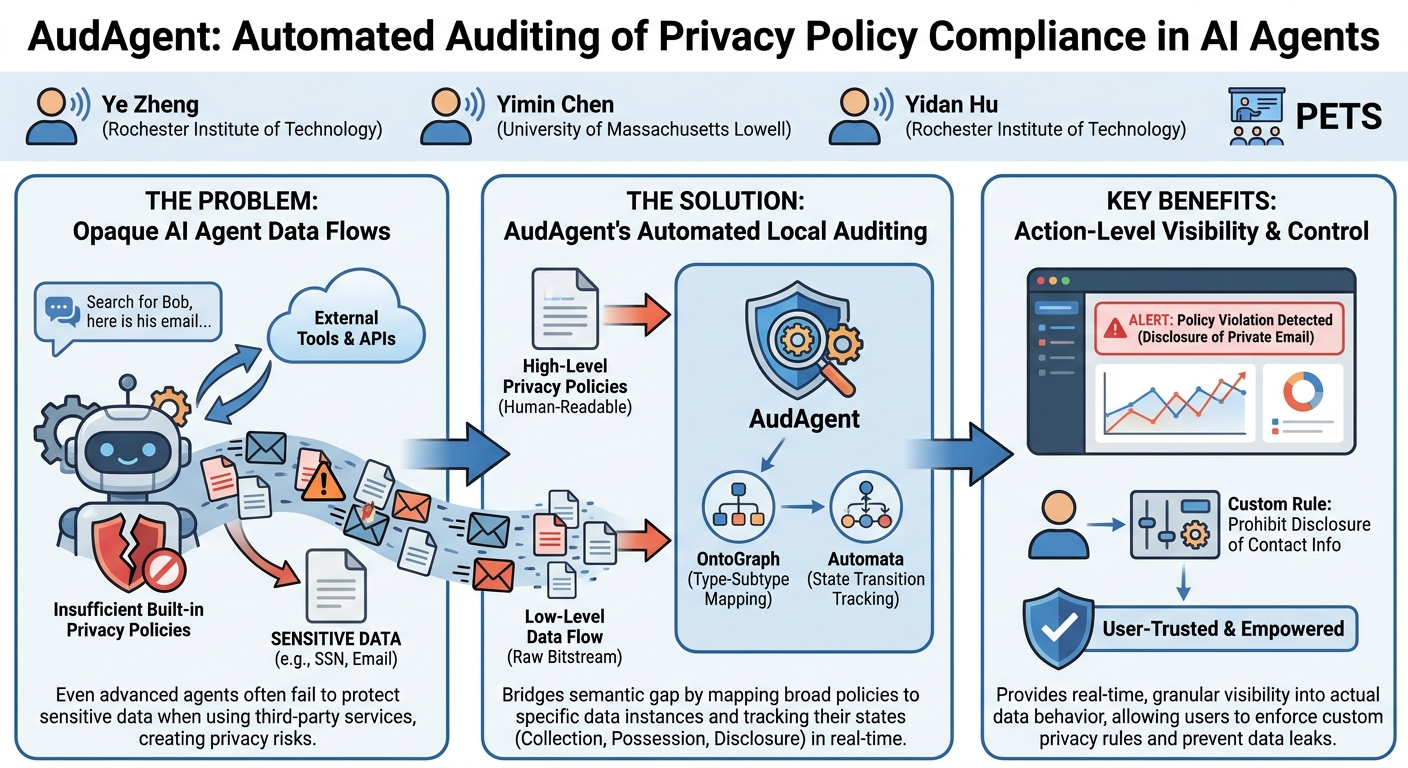
The core problem that AudAgent seeks to solve is the significant gap between high-level natural language privacy policies and the low-level, unordered bitstream data flow within a running AI agent. Policies are expressed in human-readable terms, detailing intentions and restrictions, while the agent operates on raw data instances, making calls to external APIs, and processing information in ways that are difficult to trace back to the original policy statements. Bridging this semantic and operational divide is essential for establishing genuine privacy compliance and user trust in AI agent technology.
Key Findings
▶ Watch: AudAgent's goal: bridging high-level policies to low-level data (3:00)
The research presented in this talk culminates in several critical findings that underscore the necessity and efficacy of AudAgent:
- AI Agent Alignment Alone Is Insufficient: A primary discovery is that the internal alignment mechanisms and built-in privacy policies of AI agents, even those powered by advanced large language models (LLMs), are often inadequate for reliably protecting highly sensitive data. The study observed that agents backed by models such as Cloud Gemini and DeepSeek frequently fail to refuse to possess or disclose sensitive data when interacting with third-party tools. This reveals a significant gap between the intended privacy posture and the actual operational behavior of these agents.
- Varying Levels of Refusal Across LLMs: The talk presents a clear differentiation in how various LLM backends handle requests involving sensitive data. While Cloud Gemini and DeepSeek-backed agents exhibited lower refusal rates for processing highly sensitive data like SSNs (Social Security Numbers) with third-party web tools, GPT-4 demonstrated a significantly higher and more consistent level of refusal across all defined privacy sensitivity levels. This indicates that while some LLMs are better aligned with privacy protection, the problem is systemic across the AI agent ecosystem. The study categorized refusal levels:
- Level 1: Refuse to possess SSN with a specific web tool.
- Level 2: Refuse to possess with any disclosed web tool.
- Level 3: Refuse to possess with any other tools.
GPT-4 was capable of refusing at all three levels, whereas Cloud Gemini and DeepSeek-backed agents struggled to achieve comprehensive refusal.
- AudAgent Provides Action-Level Visibility: AudAgent successfully addresses the opacity problem by providing users with action-level visibility into what their AI agents are actually doing in real-time. Through its monitoring and visualization capabilities, users can observe the exact data flows, tool interactions, and potential privacy violations as they occur, moving beyond vague policy statements to concrete operational insights.
- Real-time Sensitive Data Guarding: AudAgent demonstrates the ability to guard highly sensitive data in real-time. By allowing users to specify custom rules and prohibitions (e.g., "prohibit disclosure of contact information"), AudAgent can compensate for the inherent gaps and weaknesses in the privacy policies and internal controls of the AI agents themselves. This empowers users to enforce their privacy preferences dynamically and effectively.
These findings collectively highlight that while AI agents offer immense utility, their current privacy safeguards are often insufficient. AudAgent emerges as a crucial external auditing solution, providing the necessary transparency and control to ensure that these powerful tools operate in compliance with user expectations and defined privacy policies.
Technical Deep Dive
▶ Watch: Granularity mismatch solution using ontology and automata (5:00)
The core technical challenge addressed by AudAgent is bridging the significant gap between high-level natural language privacy policies and the low-level, often chaotic, data flow within a running AI agent. To achieve this, AudAgent employs a multi-layered approach involving a sophisticated privacy policy model, data annotation techniques, and a granular monitoring system.
Auditable Privacy Policy Model
AudAgent begins by establishing a comprehensive auditable privacy policy model. This model is derived from both the agent's inherent privacy policies and user-defined preferences. For each type of data, the model extracts specific attributes:
- Collection Method: How the data is initially acquired.
- Possession: How the data is stored or held by the agent.
- Disclosure Concern: Conditions or restrictions under which the data can be shared with third parties.
- Retention Period: How long the data is permitted to be stored.
This structured model transforms abstract policy statements into a machine-auditable format.
Data Annotation for Running Agents
On the operational side, AudAgent needs to understand the actual data flowing through the agent. It achieves this through data annotation, which involves monitoring various aspects of the agent's execution:
- User Prompts: The initial input from the user.
- Agent Responses: The output generated by the agent.
- Task Context: The overall environment and purpose of the agent's current operation.
- Data Direction: Whether data is being collected, processed internally, or disclosed externally.
- Data Retention Period: Tracking how long specific data instances are kept.
For every data instance (e.g., an email address, a report file), AudAgent annotates its collection methods, processing methods, disclosure methods, and its current retention period. This creates a detailed, real-time log of data activities.
Implementation Details
To ensure both user trust and efficiency, AudAgent incorporates specific technologies:
- Microsoft Presidio: This open-source library is utilized for identifying, redacting, and anonymizing sensitive information. In AudAgent, Presidio is crucial for understanding the task context and identifying sensitive data types within the unstructured data flow. This contributes to the system's efficiency by focusing auditing efforts on relevant data and enhances user trust by demonstrating robust sensitive data handling.
- Co-routing (or Corroborating): The talk mentions "co-routing for the confidence of the intra-private policy model." While not elaborated in extreme detail, this likely refers to a mechanism for ensuring the consistency and reliability of the internal privacy policy model itself, potentially involving cross-referencing or validation to build confidence in its accuracy before it's used for auditing. This part, importantly, "does not involve user trustness" directly, implying it's an internal validation step.
With these components, the problem is then reduced to a formal check: does the actual data behavior of the running agent comply with the established auditable privacy policy model?
Granularity Mismatch Resolution with OntoGraph
A significant challenge arises from the granularity mismatch between high-level data types in privacy policies and specific data instances in practice. For example, a policy might refer to "contact information," but in reality, this could encompass an email address, a phone number, or a name. Similarly, a policy mentioning "Google" might refer to Gmail, Google Ads, or other specific services.
AudAgent solves this with an OntoGraph. This is an ontology graph designed to encode type-subtype relationships. It formally defines how broad categories (e.g., "contact information") break down into more specific instances (e.g., "email address," "name"). This graph allows AudAgent to accurately map low-level data instances to the higher-level policy definitions, ensuring that compliance checks are performed at the correct level of abstraction.
Real-time Monitoring and State Transition with Automatons
After resolving the granularity mismatch, AudAgent uses an automaton (a finite-state machine) for each data instance. This automaton tracks the instance's lifecycle and its transitions between different states:
- Collection: When the data is acquired.
- Possession: While the data is held by the agent.
- Disclosure: When the data is shared externally.
- Retention Period: Monitoring if the data is retained beyond its allowed period.
The automaton checks if each transition and state adheres to the defined privacy policy model. If a data instance attempts a transition that violates policy (e.g., disclosing data marked as private), the automaton detects this and "rejects" the action, signaling a violation.
Visualization
Finally, AudAgent includes a visualization component via an HTTP listener and WebSocket. This allows for real-time graphical representation of the agent's data flows and interactions, making detected violations immediately apparent to the user. This visual feedback is crucial for providing the "action-level visibility" that is a core benefit of AudAgent.
By combining these sophisticated technical elements, AudAgent provides a robust and comprehensive framework for automated, real-time privacy compliance auditing in AI agents, tackling the problem from policy definition to granular data instance monitoring.
Demo / Proof of Concept
▶ Watch: Live demo: AudAgent detecting a privacy violation (6:30)
The talk included a compelling live demonstration of AudAgent, showcasing its capabilities in real-time privacy policy compliance auditing. The demo highlighted the system's ability to monitor an AI agent's interactions and immediately flag privacy violations.
The setup for the demonstration involved an AI agent configured to receive prompts, alongside its associated privacy policies. A user then prepared a specific prompt for the agent: "search for Bob on the internet." Crucially, this prompt intentionally included an email address that the user desired to keep private, simulating a common scenario where sensitive information might inadvertently be part of an agent's input.
Upon sending this prompt to the AI agent, AudAgent initiated its real-time auditing process. The demonstration visually presented AudAgent's interface, which effectively drew all components involved in the agent's task execution and visualized their interactions as a directed graph. This graphical representation provided an intuitive and immediate understanding of the data flow.
The key moment of the demo was the detection of a privacy violation. As the AI agent processed the prompt and interacted with external services to "search for Bob," AudAgent identified and clearly marked a violation in disclosure to a third-party tool. This confirmed that the agent, despite any internal policies, attempted to disclose the user's private email address to an external service.
The interface further enhanced visibility by listing all interactions in a panel on the right side of the screen. This panel not only displayed the general interactions but also prominently featured the privacy violation information, detailing what data was disclosed, to which third party, and in contravention of which policy. This provided granular, actionable insights into the agent's behavior.
Beyond detection, the demo also touched upon AudAgent's proactive capabilities. The speaker explained how AudAgent's built-in rules can be used to explicitly specify data types (e.g., "contact information") and prohibit their disclosure to certain entities or under specific conditions. This functionality directly compensates for the observed gaps in the privacy policies and internal alignment of AI agents, allowing users to enforce their privacy preferences directly.
The demonstration successfully illustrated two primary benefits:
- Action-level visibility: Users gain a clear, real-time understanding of what their agents are actually doing, rather than relying on abstract policy statements.
- Real-time sensitive data guarding: AudAgent can actively prevent or flag the leakage of highly sensitive data, acting as a dynamic safeguard against privacy breaches.
This proof of concept effectively validated AudAgent's design, demonstrating its potential as an indispensable tool for enhancing privacy and trust in the rapidly evolving landscape of AI agents.
Defensive Implications
▶ Watch: Findings: LLM backends' privacy weaknesses & AudAgent's role (7:40)
The insights and capabilities offered by AudAgent have profound implications for various stakeholders in the cybersecurity and privacy landscape. Understanding these implications is crucial for developing robust defensive strategies against the emerging threats posed by opaque AI agents.
For Users
The most direct beneficiaries of AudAgent's findings are individual users. The primary takeaway is that users cannot solely rely on the stated privacy policies or internal alignment mechanisms of AI agents. These internal safeguards, even in advanced models, are often insufficient to protect sensitive data. Users should:
- Adopt a skeptical approach: Assume that AI agents, especially when interacting with third-party tools, may inadvertently (or intentionally) disclose more data than intended.
- Consider local auditing tools: Implement or advocate for local auditing solutions like AudAgent to gain real-time, action-level visibility into their agents' data handling.
- Be aware of LLM backend differences: Recognize that different underlying LLMs (e.g., Cloud Gemini, DeepSeek vs. GPT-4) exhibit varying levels of sensitivity protection. Users might choose agents backed by more privacy-conscious models or apply additional safeguards.
- Leverage custom rules: Utilize tools that allow for defining explicit, user-specified rules to prohibit the disclosure of sensitive data types (e.g., email addresses, contact information) to external services. This empowers users to enforce their personal privacy preferences.
For AI Agent Developers and Providers
The research serves as a critical call to action for developers and providers of AI agents and the underlying LLMs.
- Enhance internal alignment: There's an urgent need to significantly improve the internal alignment mechanisms of LLMs to better understand and respect user privacy preferences, especially concerning sensitive data interactions with third-party APIs.
- Implement robust data refusal protocols: Agents should be designed with stronger, more explicit protocols for refusing to process or disclose sensitive data when such actions violate user intent or predefined policies. The demonstrated superior refusal rates of GPT-4 offer a benchmark for other models.
- Increase transparency and auditability: Developers should integrate more transparent logging and auditing capabilities directly into their agent platforms, allowing users or trusted third-party auditors to inspect data flows and policy compliance without requiring external tools like AudAgent.
- Formalize policy enforcement: Move beyond vague natural language policies to formally verifiable policy enforcement mechanisms within the agent's architecture.
For Security Professionals and Organizations
Security teams within enterprises and other organizations must recognize AI agents as a new and potentially significant attack surface and data leakage vector.
- Update threat models: Incorporate AI agent interactions, particularly with third-party tools, into existing threat models. Assess the risks of sensitive data exfiltration or compliance violations through agent activities.
- Implement monitoring for agent activity: Deploy network and endpoint monitoring solutions that can detect unusual data flows originating from AI agents or their associated processes.
- Enforce strict access controls: Apply principle of least privilege to AI agents, limiting their access to sensitive internal systems and data to only what is absolutely necessary.
- Conduct regular privacy assessments: Perform privacy impact assessments (PIAs) and data protection impact assessments (DPIAs) specifically for AI agent deployments to identify and mitigate privacy risks.
- Advocate for industry standards: Push for industry-wide standards for AI agent privacy, transparency, and auditability to ensure a baseline level of protection across the ecosystem.
- Educate users: Provide training and guidelines to employees on the safe and privacy-aware use of AI agents, highlighting the risks of sensitive data input.
In essence, AudAgent demonstrates that while AI agents promise unprecedented utility, their current state demands a proactive and vigilant defensive posture. Relying solely on the agent itself for privacy compliance is a gamble that users and organizations can ill afford.
Key Takeaways
- AI agents introduce significant privacy risks: The inherent opacity of AI agents, particularly when interacting with third-party tools, creates a substantial gap in user control and understanding of data handling, leading to potential privacy violations.
- AudAgent offers a critical solution for real-time compliance: As a user-trusted local auditor, AudAgent bridges the gap between high-level natural language privacy policies and low-level data flows, providing real-time monitoring and detection of policy non-compliance.
- Internal agent alignment is often insufficient for sensitive data: The study revealed that AI agents backed by models like Cloud Gemini and DeepSeek frequently fail to adequately refuse processing or disclosing highly sensitive data (e.g., SSNs) to third-party services, highlighting a systemic vulnerability.
- Granularity mismatch is resolved by OntoGraph and Automatons: AudAgent effectively addresses the challenge of mapping broad policy terms (e.g., "contact information") to specific data instances using an OntoGraph for type-subtype relationships and automatons to track data instance states and transitions against policy rules.
- Action-level visibility empowers users: Through its visualization capabilities, AudAgent provides users with unprecedented clarity into their agent's actual data operations, enabling them to see precisely when and how privacy policies are violated.
- Users can enforce custom privacy rules: AudAgent allows users to define explicit rules to prohibit the disclosure of specific data types, thereby compensating for the limitations of agent-provided privacy policies and enhancing personal data control.
About the Speaker(s)
The research behind AudAgent was presented by Ye Zheng, who is affiliated with the Rochester Institute of Technology. The paper also credits Yimin Chen from the University of Massachusetts Lowell and Yidan Hu from the Rochester Institute of Technology as co-authors. Their collaborative work focuses on addressing critical privacy and security challenges in the emerging field of AI agents.
Reviews
Dr. Zero (Offensive Security Researcher) — SOLID
Academic DLP for LangChain. The researchers built a local proxy that uses Microsoft Presidio to track sensitive entities in agent data flows, proving Gemini and DeepSeek will gladly hand your SSN to random web tools. Competent work, but not revolutionary.
Heather Calloway (CISO) — STRONG ACCEPT
As business units rush to deploy autonomous AI agents, they are effectively bypassing our existing data loss prevention controls. This research proves that relying on an LLM's built-in guardrails to protect sensitive data is a failed strategy, making it required reading for teams building enterprise AI governance.
→ Top-rated talks at Privacy Enhancing Technologies Symposium (PETS) 2026
All talks from Privacy Enhancing Technologies Symposium (PETS) 2026