On the Suitability of LLM-Driven Agents for Dark Pattern Audits
Chen Sun (Paper author · University of Iowa), Yash Vekaria (Paper author · University of California, Davis), Rishab Nithyanand (Paper author · University of Iowa)
Privacy Enhancing Technologies Symposium (PETS) 2026 · Remote
Overview
This presentation, delivered by Chen Sun at PETS, delves into the burgeoning field of leveraging Large Language Model (LLM)-driven agents for the automated auditing of dark patterns in user interfaces. The core of the research investigates the reliability and limitations of these AI agents in identifying design elements that subtly or overtly manipulate user decision-making, particularly in the context of privacy choices. The talk highlights a critical gap in existing dark pattern detection methodologies, which often focus on static UI elements, thereby missing patterns that emerge only through dynamic user interaction.
Key moments
- 0:00 Introduction to dark patterns and the research problem
- 2:10 Two research questions: agent reliability and limits
- 4:15 LLM agent design and prompt engineering methodology
- 5:40 Prompting significantly improves agent audit performance
- 6:30 Three systematic constraints: execution, observation, reasoning
- 8:40 LLM agents as scalable compliance triage tools
On the Suitability of LLM-Driven Agents for Dark Pattern Audits
Speakers: Chen Sun (Paper author, University of Iowa); Yash Vekaria (Paper author, University of California, Davis); Rishab Nithyanand (Paper author, University of Iowa)
Conference: PETS
YouTube: https://www.youtube.com/watch?v=ODZMH8fgxjg
Overview
This presentation, delivered by Chen Sun at PETS, delves into the burgeoning field of leveraging Large Language Model (LLM)-driven agents for the automated auditing of dark patterns in user interfaces. The core of the research investigates the reliability and limitations of these AI agents in identifying design elements that subtly or overtly manipulate user decision-making, particularly in the context of privacy choices. The talk highlights a critical gap in existing dark pattern detection methodologies, which often focus on static UI elements, thereby missing patterns that emerge only through dynamic user interaction.
The work presented by Sun and his co-authors, Yash Vekaria and Rishab Nithyanand, from the University of Iowa and the University of California, Davis, respectively, addresses the urgent need for scalable and systematic approaches to identify dark patterns. These deceptive designs can significantly compromise user privacy by coercing individuals into disclosing more personal data than necessary or making privacy choices unduly difficult. By proposing and evaluating an LLM-driven agent framework, the researchers aim to provide a robust tool for compliance triage, enabling a more efficient and comprehensive audit of complex online interactions, particularly those related to exercising privacy rights.
The significance of this research lies in its potential to enhance user protection in an increasingly digital landscape where privacy violations are often hidden within intricate interface designs. The study not only demonstrates the capabilities of advanced AI agents in this domain but also rigorously analyzes their inherent limitations, offering crucial insights for both developers of AI auditing tools and organizations striving for ethical and transparent privacy practices. The findings suggest a hybrid approach where AI agents can efficiently flag potential issues, allowing human auditors to focus their expertise on the most ambiguous and challenging cases.
Background
▶ Watch: Introduction to dark patterns and the research problem (0:00)
Dark patterns represent a pervasive and evolving challenge in user interface design, fundamentally undermining user autonomy and informed decision-making. These design choices, often subtle yet highly effective, are engineered to steer users toward specific actions that benefit the service provider, frequently at the expense of the user's privacy or financial interests. In the privacy context, dark patterns can manifest as login flows that demand excessive personal data beyond what is strictly required for authentication, or consent banners where the "Accept" button is visually dominant and easily accessible, while the "Decline" or "Manage Preferences" option is deliberately minimized, low-contrast, or buried within multiple layers of navigation. Such designs directly infringe upon a user's ability to exercise their privacy rights effectively.
Prior research has attempted to systematically detect dark patterns using a variety of computational methods, including HTML crawling to analyze page structure, computer vision to identify visual prominence cues, and natural language processing (NLP) to interpret UI text. More recently, multimodal large language models (MLLMs) have been explored for their ability to integrate visual and textual information. However, a significant limitation of most of these existing approaches is their reliance on inspecting static UI artifacts—such as standalone screenshots, isolated HTML segments, or single UI states. This static analysis inherently overlooks dark patterns that only become apparent through a sequence of user interactions with a website or application.
The presentation emphasizes this critical oversight with two illustrative examples. First, instructions for exercising a privacy right might be spread across multiple, seemingly innocuous pages. While each page appears benign in isolation, the cumulative effect of navigating through several pages to piece together complete information constitutes a dark pattern, making the exercise of rights unnecessarily burdensome. Second, conflicting information may be presented across different pages; one page might state that a request can be submitted via email, while another page on the same site explicitly prohibits email submissions, requiring a web form instead. Such contradictions only emerge when comparing multiple pages within an interaction flow.
This highlights the fundamental problem: to comprehensively identify all dark patterns, particularly those that subvert the exercise of privacy rights, it is imperative to audit the full user interaction trace rather than merely isolated UI artifacts. This realization forms the impetus for the research, leading to two primary research questions: first, whether AI-driven agents can reliably audit dark patterns, including those that emerge across user interactions; and second, what specific limits constrain these agents during such audits. The study focuses on the context of the California Consumer Privacy Act (CCPA) Right to Access workflow, a highly relevant and complex scenario for evaluating interaction-dependent dark patterns.
Key Findings
▶ Watch: LLM agent design and prompt engineering methodology (4:15)
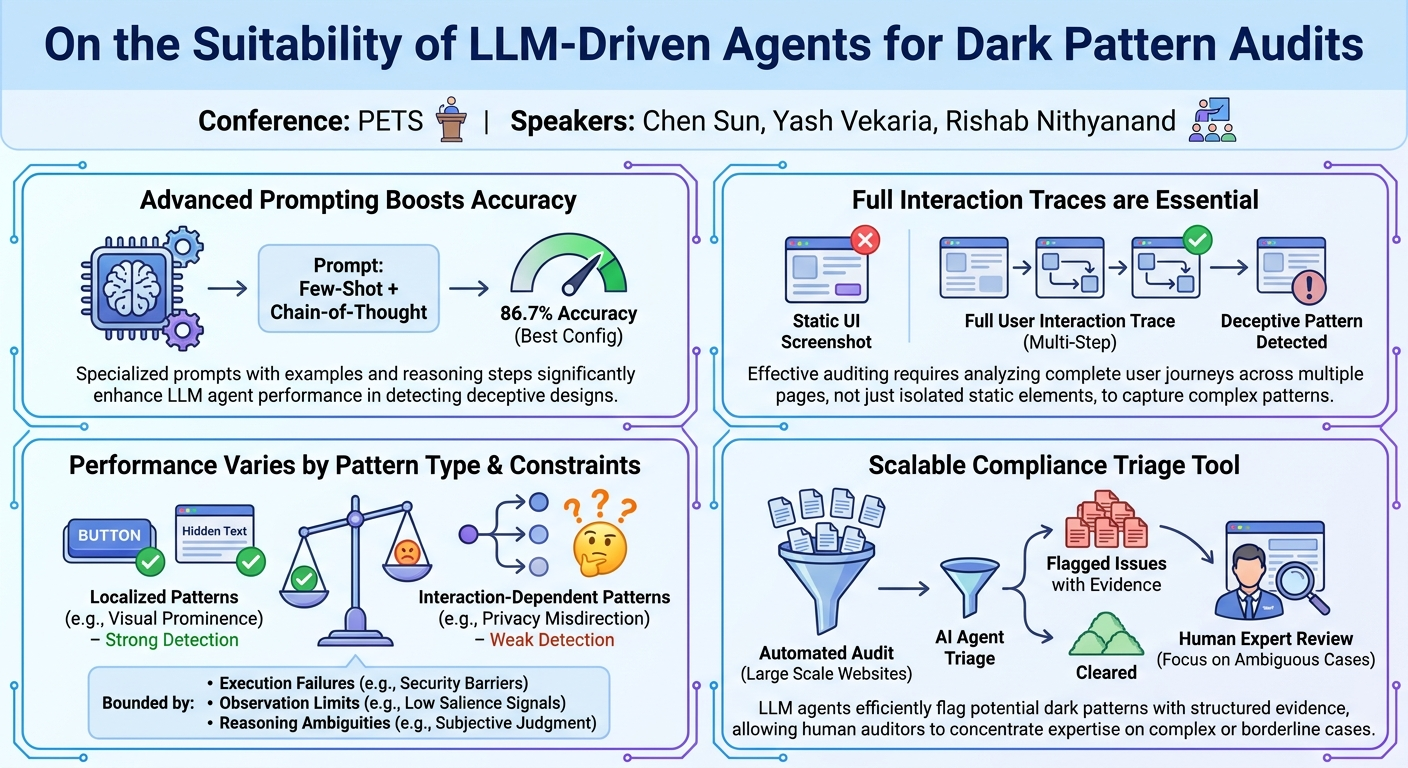
The research yielded several significant findings regarding the capabilities and limitations of LLM-driven agents in auditing dark patterns. Addressing the first research question—can AI-driven agents reliably audit dark patterns, including interaction-dependent ones?—the study unequivocally demonstrates that prompt engineering significantly enhances audit performance. An ablation study across four prompt configurations revealed that the most substantial performance gains came from incorporating few-shot examples, providing the agent with specific instances of dark patterns and their classifications. The optimal configuration, combining few-shot examples with a role prompt (designating the agent as a CCPA auditor) and a structured chain-of-thought process, achieved an impressive 86.7% accuracy in detecting dark patterns. This underscores the critical role of sophisticated prompting strategies in unlocking the full potential of LLMs for complex, interpretive tasks.
However, the study also found that detection performance is not uniform across all types of dark patterns. The LLM agent performed considerably better on localized or directly observable patterns, such as "adding steps" (unnecessary navigation steps) or "visual prominence" (manipulating visual hierarchy to favor certain choices). These patterns often have relevant signals confined to a single screen or a limited set of UI elements. In stark contrast, interaction-dependent patterns, where the critical signals are distributed across multiple steps or require contextual understanding gleaned from a sequence of actions, proved significantly harder to detect. Examples include "privacy misdirection" (misleading users about privacy implications) and "hidden information" (obscuring crucial details). This disparity highlights a fundamental challenge for current LLM agents in synthesizing information over extended, dynamic interactions.
This leads to the second research question, which analyzed the constraints limiting the agents' performance. The researchers categorized these constraints into three distinct stages: execution, observation, and reasoning.
- Execution Constraints: Before any dark pattern can be detected, the agent must successfully navigate and complete the target workflow. The agents in this study completed 81% of workflows overall. Common failure points included security barriers (e.g., CAPTCHAs, complex authentication), automation instabilities (e.g., dynamic page loading issues, unexpected pop-ups), and fundamental interaction-level failures (e.g., failing to correctly click a button or enter text). These are practical limitations tied to the agent's ability to reliably interact with diverse web environments.
- Observation Constraints: Even when a workflow is successfully completed, the agent must accurately surface and retain relevant signals. One problem identified was low salience signals, such as hidden links or subtle textual cues, which the agent might not notice or trigger. This factor directly contributed to the low recall rate for "hidden information" dark patterns. Another critical issue was information loss, where relevant signals observed early in a long interaction sequence could be compressed or lost from the agent's contextual memory as the interaction progressed. This particularly affected interaction-dependent patterns like "privacy misdirection" and "conflicting information."
- Reasoning Constraints: The most nuanced constraint arose when the agent observed all relevant signals, but the judgment itself was inherently ambiguous or required subjective interpretation. For instance, determining "to what extent a navigation difficulty counts as a privacy misdirection" involves a degree of qualitative judgment that even human auditors can struggle with. Unlike execution and observation limitations, which relate to the technical implementation of the agent, reasoning failures often stem from the interpretive difficulty of the task itself.
In summary, the research concludes that while LLM agents, when properly prompted, can produce strong, evidence-backed judgments for dark pattern audits, their reliability remains bounded by systematic limits across workflow execution, signal observation, and complex reasoning. Despite these limitations, the overall results position LLM agents as a promising scalable compliance triage tool. They can autonomously traverse privacy workflows, flag potential dark patterns with structured evidence, and significantly streamline the audit process, allowing human reviewers to concentrate their efforts on the more ambiguous or borderline cases that require expert human judgment.
Technical Deep Dive
▶ Watch: Prompting significantly improves agent audit performance (5:40)
The fundamental premise guiding this research was to ascertain whether an AI-driven agent could effectively reproduce human judgment in identifying dark patterns within complex user interaction flows. To achieve this, the study focused on the CCPA Right to Access workflow, a highly relevant and intricate privacy context, and constructed a specialized dataset of 456 data broker websites subject to CCPA regulations. This rigorous setup allowed for a standardized evaluation of both human and agent auditing capabilities.
The methodology established a standardized right to access interaction sequence that both human auditors and the AI agent followed. This sequence was meticulously designed to simulate a realistic user journey:
- Initial Visit: The auditor (human or agent) first visits the data broker website.
- Privacy Link Location: They then locate privacy-related links, such as "Privacy Policy," "Do Not Sell My Personal Information," or "Data Subject Request."
- Instruction Review: The auditor opens these links and thoroughly reviews the instructions for exercising the right to access. This often involves reading through legal text, FAQs, and procedural guides.
- Web Form Interaction (if applicable): If a web form is presented as a submission method, the auditor interacts with it, reviewing its fields, requirements, and any associated conditions.
This standardized sequence ensures that the auditing traces for both human and agent evaluations are comparable, allowing for a direct assessment of the agent's ability to mirror human performance.
The auditing procedure itself was identical for both human and agent sides, ensuring a fair comparison and robust ground truth generation:
- Workflow Traversal and Evidence Recording: At each step of the standardized right to access workflow, the auditor traverses the interface and meticulously records evidence. This evidence includes screenshots (visual context), the current URL (navigational context), the underlying HTML (structural context), and UI text (semantic context). This comprehensive data capture is crucial for identifying interaction-dependent patterns. This process is repeated until the workflow is deemed complete.
- Dark Pattern Mapping: Upon completion of the workflow, the full interaction trace, along with the collected evidence, is mapped to a predefined dark pattern taxonomy. This taxonomy was adopted from prior work, providing a consistent framework for classification. The human auditors' labels served as the ground truth against which the agent's performance was evaluated, assessing both classification accuracy (correctly identifying the dark pattern) and explanation accuracy (providing relevant evidence to support the classification).
The agent's implementation was centered around a browser agent that leverages GPT-5 as its underlying large language model. To enable the agent to perform interaction-level auditing, it was provided with a clear audit task definition and the dark pattern taxonomy.
A critical component of the technical deep dive was an ablation study on prompt configuration to understand its impact on audit performance. Four distinct prompt configurations were tested:
- Zero-shot: The agent received only the basic task description and the dark pattern taxonomy. This served as a baseline, testing the model's inherent understanding without specific examples or roles.
- Role Prompt: Building on the zero-shot configuration, a specific role was assigned to the agent, instructing it to act as a "CCPA auditor." This aimed to align the agent's perspective with the auditing context.
- Few-shot Examples: This configuration added specific examples for each dark pattern category to the prompt. These examples provided the agent with concrete instances of what constitutes each dark pattern, significantly improving its ability to recognize nuanced cases.
- Structured Chain-of-Thought: The most advanced configuration augmented the few-shot examples with a "structured chain-of-thought" process. This technique guides the LLM to articulate its reasoning steps, breaking down complex judgments into smaller, more manageable inferences, thereby enhancing transparency and accuracy.
For each audit, the agent generated a structured JSON output. This output included:
- Dark pattern labels: The identified dark patterns.
- Supporting evidence: Specific URLs, screenshots, or UI text snippets backing up each label.
- Workflow status: Whether the workflow was completed or blocked.
- Failure category (if blocked): A predefined category explaining why the workflow was incomplete (e.g., security barrier, interaction failure).
- Evidence for failure: Supporting details for any workflow blockage.
The analysis of constraints was equally detailed, providing insights into the "why" behind performance variations:
- Execution constraints manifested in the agent's 81% workflow completion rate. Failures were attributed to security barriers (e.g., CAPTCHA challenges, multi-factor authentication, anti-bot measures), automation instabilities (e.g., dynamic JavaScript rendering, race conditions, unexpected pop-ups that block interaction), and basic interaction failures (e.g., misidentifying clickable elements, failing to correctly input data into forms). These highlight the challenges of robust web automation for AI agents.
- Observation constraints included scenarios where low salience signals (e.g., small, low-contrast links, text hidden behind accordions) were overlooked. Crucially, information loss was identified as a major factor for interaction-dependent patterns. As the agent processed longer interaction traces, earlier observations could be "compressed or lost" from its context window, making it difficult to detect patterns requiring a holistic view across many steps.
- Reasoning constraints pointed to the inherent ambiguity of certain dark pattern definitions. Even with relevant signals observed, the judgment required to classify a situation (e.g., whether a certain level of "navigation difficulty" constitutes "privacy misdirection") could be subjective. This indicates that some interpretive challenges are fundamental to the task itself, affecting both human and AI auditors.
The comprehensive technical design, from the standardized workflow and detailed evidence collection to the nuanced prompt engineering and systematic constraint analysis, provides a robust framework for understanding the current capabilities and future potential of LLM-driven agents in automated dark pattern auditing.
Demo / Proof of Concept
▶ Watch: Three systematic constraints: execution, observation, reasoning (6:30)
The talk focuses on the rigorous methodological design, implementation, and evaluation of the LLM-driven agent for dark pattern audits, rather than presenting a live, interactive demonstration of the agent in action. The "Proof of Concept" in this context is the successful development and empirical validation of the agent's ability to perform the audit task. The researchers demonstrate the viability of their approach through the detailed analysis of its performance metrics and the systematic identification of its strengths and limitations.
The evidence for the agent's capabilities is presented through the structured JSON output it generates, which includes specific dark pattern labels, along with supporting evidence such as screenshots, URLs, and UI text. This output serves as the tangible proof of concept, illustrating how the agent identifies and substantiates its findings. While a live demo was not the focus, the technical deep dive provides sufficient detail to understand how such an agent would operate, traverse websites, collect data, and generate its analytical reports. The demonstration of its effectiveness is through the quantitative results, like the 86.7% accuracy achieved with optimal prompting, and the qualitative analysis of the types of dark patterns it successfully detects versus those it struggles with. This robust evaluation framework itself acts as the primary demonstration of the research's core claims.
Defensive Implications
▶ Watch: LLM agents as scalable compliance triage tools (8:40)
The findings from this research carry significant defensive implications for organizations, privacy advocates, and regulatory bodies striving to mitigate the proliferation and impact of dark patterns. The primary takeaway is the emergence of LLM-driven agents as a powerful, scalable tool for proactive compliance auditing. Organizations can no longer rely solely on manual, labor-intensive audits, especially given the dynamic and complex nature of modern web interfaces.
Firstly, the research validates the concept of using AI agents as a scalable compliance triage tool. Instead of human auditors manually traversing thousands of web pages, these agents can autonomously navigate privacy workflows on a large scale, identifying potential dark patterns with structured evidence. This allows human experts to concentrate their valuable time and expertise on reviewing the flagged instances, particularly the "borderline cases" or those requiring nuanced interpretive judgment, thereby significantly increasing the efficiency and coverage of privacy audits. This is crucial for organizations managing numerous digital properties or needing to comply with evolving privacy regulations like CCPA, GDPR, or similar frameworks.
Secondly, the study highlights the critical importance of interaction-level auditing. Defenders must recognize that static UI analysis is insufficient. Dark patterns often manifest across multiple pages or through specific sequences of user actions. Organizations should adopt auditing methodologies that simulate full user journeys, rather than just inspecting isolated screens. LLM agents, designed to mimic user interaction traces, provide a blueprint for how such comprehensive audits can be performed systematically.
Thirdly, the insights into the agents' performance characteristics provide guidance for where to focus defensive efforts. Since LLM agents perform better on localized and directly observable dark patterns (e.g., "adding steps," "visual prominence"), organizations should prioritize ensuring their interfaces are free from these more straightforward manipulations. Conversely, the challenges faced by agents in detecting interaction-dependent patterns (e.g., "privacy misdirection," "hidden information," "conflicting information") and those requiring subjective "reasoning" suggest that these areas demand heightened human vigilance and more sophisticated design reviews. This implies that while AI can catch many issues, human oversight remains indispensable for the most complex and ethically ambiguous dark patterns.
Finally, the identified constraints—execution, observation, and reasoning—offer valuable lessons for designing more resilient and transparent privacy interfaces. Organizations should strive to:
- Improve Workflow Robustness: Design privacy workflows to be less prone to automation instabilities, reducing reliance on complex CAPTCHAs or overly dynamic elements that can hinder both legitimate users and auditing tools.
- Enhance Signal Salience: Make critical privacy information and choices highly salient and unambiguous, avoiding hidden links or low-contrast text that can lead to "observation constraints" for both AI and human users.
- Reduce Interpretive Ambiguity: Strive for clear, consistent, and unambiguous language and design in privacy notices and choice mechanisms. Minimizing subjective interpretation can reduce "reasoning constraints" for auditors and ensure better user understanding.
In essence, the research empowers defenders with a new class of tools while simultaneously providing a clearer understanding of the persistent challenges in dark pattern detection. It advocates for a symbiotic relationship between AI automation and human expertise to build a more privacy-preserving digital ecosystem.
Key Takeaways
- LLM-driven agents demonstrate significant promise for automated dark pattern audits, particularly when equipped with advanced prompting techniques like few-shot examples and chain-of-thought reasoning, achieving up to 86.7% accuracy.
- Comprehensive dark pattern detection necessitates auditing the full user interaction trace, as many deceptive patterns emerge across multiple steps or pages, not just from static UI elements.
- Agent performance varies by dark pattern type: they excel at detecting localized, directly observable patterns (e.g., adding steps, visual prominence) but struggle more with interaction-dependent patterns (e.g., privacy misdirection, hidden information) that require synthesizing information over time.
- The reliability of LLM agents is systematically bounded by three key constraints: workflow execution failures (e.g., security barriers, automation instabilities), observation limitations (e.g., low salience signals, information loss over long interactions), and reasoning ambiguities (inherent interpretive difficulties of the task).
- LLM agents are best utilized as a scalable compliance triage tool, autonomously flagging potential dark patterns with structured evidence, thereby enabling human auditors to focus their expert judgment on complex or borderline cases.
- The research underscores the ongoing challenge of defining and detecting certain dark patterns, highlighting areas where even human auditors can struggle with subjective interpretation, indicating a need for clearer guidelines and design principles in privacy interfaces.
About the Speaker(s)
Chen Sun is a paper author affiliated with the University of Iowa. His work focuses on the intersection of AI, user interfaces, and privacy, particularly in developing automated methods for identifying and mitigating deceptive design practices.
Yash Vekaria is also a paper author, representing the University of California, Davis. His research contributes to understanding and addressing challenges in privacy, security, and human-computer interaction, often involving the application of advanced computational techniques.
Rishab Nithyanand is a paper author from the University of Iowa. His expertise spans network security, privacy, and the societal implications of technology, guiding research into systematic approaches for auditing and improving digital ecosystems.
Reviews
Dr. Zero (Offensive Security Researcher) — SOLID
Finally, an AI paper that doesn't claim to solve the world. Sun and his team built an LLM agent to navigate CCPA workflows and flag privacy dark patterns, then spent half the talk documenting exactly where and why the model falls on its face. It's honest, practical research that positions LLMs exactly where they belong: as a triage tool.
Heather Calloway (CISO) — STRONG ACCEPT
This research demonstrates how to use LLM agents to automate CCPA privacy audits across complex web workflows. It is a highly practical blueprint for scaling regulatory compliance checks without linearly scaling headcount.
→ Top-rated talks at Privacy Enhancing Technologies Symposium (PETS) 2026
All talks from Privacy Enhancing Technologies Symposium (PETS) 2026