Unveiling Graph Copycats: Inference Attacks with Student Models
Paul Agbaje (Paper author · University of Texas at Arlington), Afia Anjum (Paper author · University of Texas at Arlington), Arkajyoti Mitra (Paper author · University of Texas at Arlington), Habeeb Olufowobi (Paper author · University of Texas at Arlington)
Privacy Enhancing Technologies Symposium (PETS) 2026 · Remote
Overview
In an era where machine learning models are increasingly deployed in sensitive domains, the privacy implications of their training data are paramount. This talk, "Unveiling Graph Copycats: Inference Attacks with Student Models," presented at PETS, delves into the often-overlooked privacy vulnerabilities introduced by knowledge distillation in Graph Neural Networks (GNNs). Paul Agbaje and his co-authors from the University of Texas at Arlington expose how "graphless" student models, designed for efficiency and purportedly for data minimization, can inadvertently become conduits for sophisticated inference attacks, revealing sensitive details about their teacher model's training data.
Key moments
- 0:00 GNNs, knowledge distillation, and the privacy question
- 2:00 Distillation leaves a signature, not enhancing privacy
- 3:00 Reconstruction error attack on student models
- 5:00 Why AUC is insufficient for membership inference
- 7:00 Conformalized Quantile Regression effectively identifies vulnerable members
- 8:20 Property inference: attacker infers influential nodes
- 9:00 Link inference: discerning original GNN connections
- 9:30 Conclusion: GNN knowledge distillation leaks privacy
Unveiling Graph Copycats: Inference Attacks with Student Models
Speakers: Paul Agbaje (Paper author, University of Texas at Arlington); Afia Anjum (Paper author, University of Texas at Arlington); Arkajyoti Mitra (Paper author, University of Texas at Arlington); Habeeb Olufowobi (Paper author, University of Texas at Arlington)
Conference: PETS
YouTube: https://www.youtube.com/watch?v=QSAKWOlgo4c
Overview
In an era where machine learning models are increasingly deployed in sensitive domains, the privacy implications of their training data are paramount. This talk, "Unveiling Graph Copycats: Inference Attacks with Student Models," presented at PETS, delves into the often-overlooked privacy vulnerabilities introduced by knowledge distillation in Graph Neural Networks (GNNs). Paul Agbaje and his co-authors from the University of Texas at Arlington expose how "graphless" student models, designed for efficiency and purportedly for data minimization, can inadvertently become conduits for sophisticated inference attacks, revealing sensitive details about their teacher model's training data.
The core of the presentation challenges the assumption that distilling a GNN into a simpler Multi-Layer Perceptron (MLP) student model inherently enhances privacy. While the student model no longer directly accesses the graph's topological data during inference, the authors demonstrate that the distillation process leaves a discernible "signature." This signature can be leveraged by an attacker to perform membership inference, property inference, and even link inference attacks, effectively compromising the privacy of the original training dataset. This work is critical for researchers and practitioners deploying GNNs, urging a re-evaluation of current privacy assumptions surrounding model distillation and highlighting the need for more robust privacy-preserving techniques.
Background
▶ Watch: GNNs, knowledge distillation, and the privacy question (0:00)
Graph Neural Networks (GNNs) have emerged as powerful tools for learning from structured data, such as social networks, molecular structures, and knowledge graphs. Their efficacy stems from a message passing mechanism, where each node iteratively aggregates information from its neighbors to update its own representation. This process allows GNNs to capture complex relational cues within the graph topology. However, this very strength introduces a significant bottleneck: during inference, GNNs must constantly fetch and process neighbor information, leading to computational overhead and potential latency issues, especially for large graphs.
To address these performance challenges, Zhang et al. (2021) proposed an innovative solution: knowledge distillation. Originating from Hinton et al. (2015), knowledge distillation involves training a smaller, simpler student model (often an MLP) to mimic the behavior of a larger, more complex teacher model (in this case, a GNN). The student learns not only from the hard targets (true labels) but also from the "soft targets" (probability distributions) provided by the teacher. The goal is to transfer the GNN's relational knowledge into a graphless neural network – a student MLP that no longer requires explicit access to the graph's topology during inference. This "graphless" nature was envisioned to offer faster inference and, crucially, was often implicitly assumed to provide a form of data minimization, potentially enhancing privacy by removing direct topological dependencies.
However, prior research has already highlighted privacy risks in GNNs. Earlier work (2020) demonstrated that GNNs can leak membership information, showing that members (nodes in the training set) and non-members belong to distinct distributions. Follow-up work (2021) further solidified this by showing the ability to discriminate between members and non-members in GNNs. The work presented in this talk builds upon these foundations, posing a critical question: if the student model is "graphless" and performs data minimization by not accessing relational data during inference, does this genuinely lead to more privacy, or does the distillation process itself introduce new vulnerabilities? The authors investigate whether the knowledge transfer inadvertently carries privacy-sensitive information from the teacher's training set to the student, making it susceptible to inference attacks despite its simplified architecture.
Key Findings
▶ Watch: Reconstruction error attack on student models (3:00)
The research presented in "Unveiling Graph Copycats" uncovers several critical findings that challenge conventional assumptions about privacy in distilled GNNs:
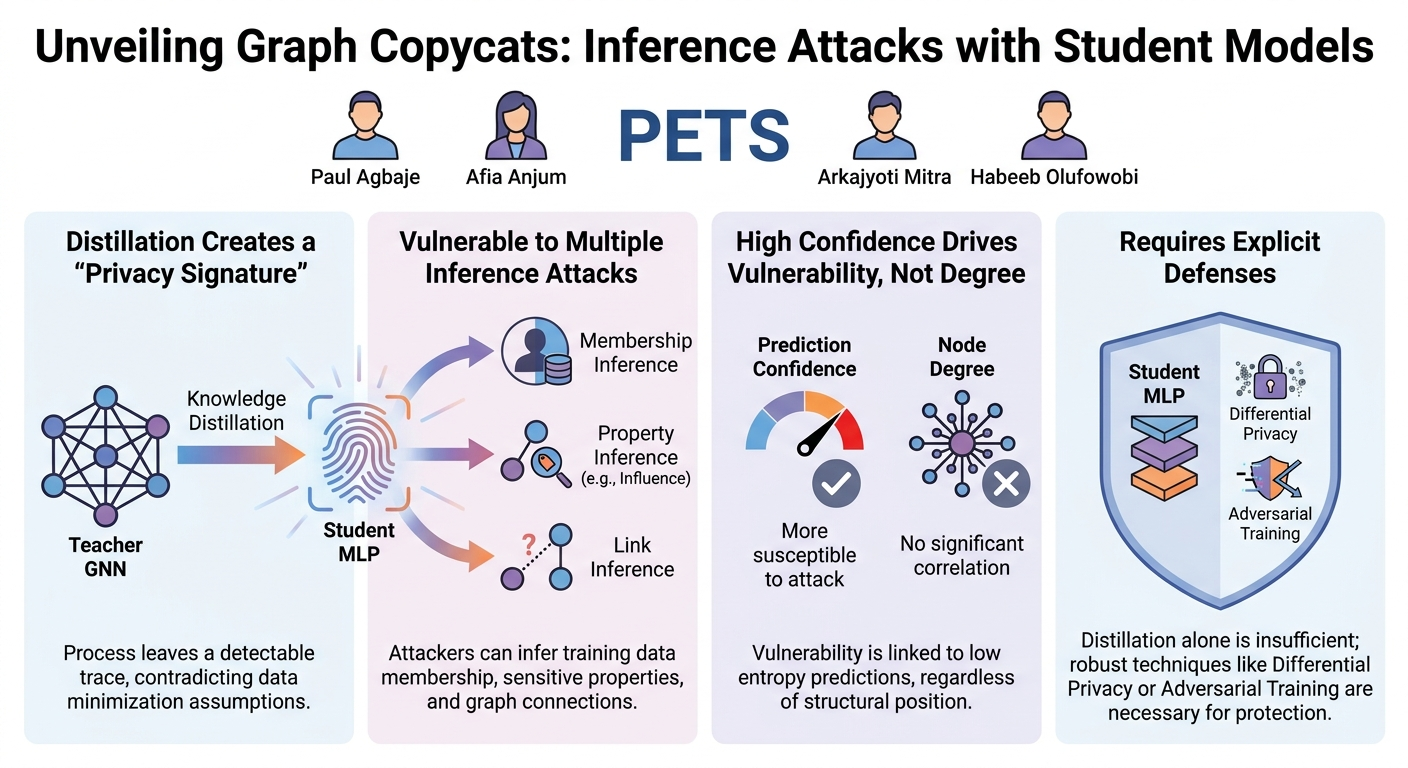
- Distillation Leaves a Privacy-Compromising Signature: Through extensive experimentation involving 100 trials, the authors observed a significant "rightward shift" in the similarity distribution between the student and teacher models after distillation. This shift indicates that the distillation process imprints a unique signature on the student model, which an attacker can potentially leverage to differentiate between members and non-members of the original training set. This directly contradicts the notion that distillation inherently leads to greater privacy.
- Confidence Values Do Not Significantly Change Post-Distillation: Analysis of confidence values before and after distillation showed that they largely align along the y=x line, indicating minimal change. This suggests that the perceived privacy benefits from altered confidence levels in the student model, often associated with data minimization, are negligible in practice.
- High Efficacy of Membership Inference Attacks (MIAs): The initial reconstruction error attack demonstrated remarkable success, achieving AU (Area Under the ROC Curve) scores of up to 0.9. This high discriminative power indicates that an attacker can reliably identify whether a given node was part of the teacher GNN's training data solely by querying the student model.
- Robustness via Conformalized Quantile Regression (CQR): Recognizing the limitations of average-case metrics like AU for an attacker seeking highly vulnerable instances, the authors developed a more sophisticated MIA using Conformalized Quantile Regression. This approach proved highly effective in reliably discriminating between members and non-members, especially for the most vulnerable cases, across various temperature values, by focusing on improving the True Positive Rate (TPR) at fixed False Positive Rates (FPR).
- Vulnerability Correlates with Confidence and Entropy, Not Node Degree: Surprisingly, the structural property of node degree was found to have no significant correlation with a node's vulnerability to inference attacks. Instead, the talk highlighted that confidence and entropy are key determinants: high confidence (and thus low entropy) in the student model's prediction for a node makes it more susceptible to attack.
- Successful Property Inference Attacks (PIAs): The research demonstrated that attackers can reliably infer sensitive properties about nodes from the student model's outputs. For instance, by categorizing nodes based on their degree (low, medium, high) as a proxy for influence, the attackers achieved up to 90% accuracy in determining if a node was "influential" using various machine learning algorithms.
- Effective Link Inference Attacks (LIAs): Even without direct access to the graph structure, the attacker could infer whether two nodes were connected in the original GNN training set by comparing the posteriors from the student model. This attack achieved high AU scores, often exceeding 0.88, further underscoring the leakage of relational information.
In conclusion, the overarching finding is that knowledge distillation in GNNs does not eliminate privacy leakage. Student models, despite being "graphless," can reveal substantial information about the teacher's training data, and the proposed attacks are robust across different datasets and low positive rates, making them practical threats.
Technical Deep Dive
▶ Watch: Conformalized Quantile Regression effectively identifies vulnerable members (7:00)
The technical core of "Unveiling Graph Copycats" revolves around understanding how knowledge distillation operates in GNNs and, more importantly, how its purported privacy benefits can be subverted by sophisticated inference attacks.
At its foundation, a Graph Neural Network (GNN) processes data by combining node features with graph topology. The key mechanism is message passing, where each node iteratively aggregates information from its neighbors, updates its own feature representation, and then passes this updated information to a feed-forward neural network for downstream tasks like node classification or link prediction. While powerful, this neighbor-fetching process creates computational bottlenecks during inference.
To mitigate this, knowledge distillation is employed. A large, complex GNN (the teacher model) is used to train a smaller, simpler student model, typically a Multi-Layer Perceptron (MLP). The student learns to predict not only the hard labels (true classes) but also the "soft targets" – the probability distributions (logits) output by the teacher. This is achieved by minimizing a loss function that combines a standard cross-entropy term with a Kullback-Leibler (KL) divergence term between the student's and teacher's soft targets. The resulting student model is a graphless neural network; it no longer requires the explicit graph structure during inference, making it faster and more efficient. The hypothesis, often implicit, was that by removing direct topological access, privacy might be enhanced through data minimization.
The authors' work systematically dismantles this assumption by presenting a series of increasingly sophisticated attacks.
Initial Reconstruction Error Attack (Membership Inference)
The first attack demonstrated is a reconstruction error attack, designed to perform membership inference. The objective is to determine if a specific node was part of the teacher GNN's training dataset.
The attacker's assumptions are:
- Query access to the student model.
- Possession of an attack model.
- Access to a shadow dataset drawn from the same distribution as the private training set.
- The student and teacher models were trained using the same or similar datasets.
The attack methodology proceeds as follows:
- The attacker passes a target graph (containing the node in question) through both their attack model and the student model.
- The posteriors (output probabilities or logits) from both models are combined.
- This combined representation is fed into a feature extractor, which has been pre-trained using a mean squared error (MSE) loss. The feature extractor's role is to learn to differentiate between members and non-members based on the combined posteriors.
- Based on the error output by the feature extractor, the attacker sets a threshold. If the error for a target node during testing exceeds this threshold, the node is classified as a member; otherwise, it is classified as a non-member.
Evaluation of this attack yielded high Area Under the ROC Curve (AU) scores, in some cases reaching up to 0.9. This indicated a strong ability to discriminate between members and non-members. The authors also found that a "ratio method" for combining posteriors yielded the best results.
However, the authors identified a limitation: AU is an average-case metric. An attacker might be more interested in identifying the most vulnerable cases, even if they are few, requiring a high True Positive Rate (TPR) at a fixed, low False Positive Rate (FPR) (e.g., FPR of 0.1). They illustrated this with a hypothetical example: Attack X with an AU of 0.88 might have a TPR of 0.001 at FPR 0.1, making it a poor membership predictor when the budget for false positives is tight. In contrast, Attack Y with a lower AU of 0.72 might achieve a TPR of 0.40 at the same FPR, making it a much more reliable predictor of membership for specific, vulnerable instances. This highlights the need for a more targeted approach.
Conformalized Quantile Regression (CQR) Attack (Membership Inference)
To address the limitations of the reconstruction error attack and specifically target vulnerable instances, the authors introduced an MIA based on Conformalized Quantile Regression (CQR).
This attack leverages the hinge score, which is calculated by subtracting the maximum logit for other classes from the true class logit. The attacker then subtracts the hinge score derived from their attack model from the hinge score derived from the student model. This difference score is used to discriminate membership.
The core idea is to use quantile regression to predict a quantile of the score distribution for non-members. If a node's score falls below this predicted quantile, it's classified as a non-member; otherwise, it's a member.
However, standard quantile regression suffers from a significant drawback: it does not inherently correct for finite sample sizes. To overcome this, the authors adopted Conformalized Quantile Regression (CQR). CQR is a non-parametric method that provides valid prediction intervals without making asymptotic assumptions or assuming any specific distribution for the underlying quantile regression model. It achieves this by using a nonconformity score to adjust the quantile of the empirical distribution based on a finite calibration set. This adjustment allows for the definition of a robust prediction interval, which in turn provides a much better, statistically sound threshold for membership prediction.
By testing the CQR model with different temperature values (a parameter in distillation that softens the teacher's logits), the authors demonstrated that an attacker can reliably identify members and non-members, particularly focusing on the most vulnerable cases. This enhanced precision makes the CQR attack a potent tool for targeted membership inference.
Property Inference Attack (PIA)
Beyond mere membership, the talk also explored property inference attacks. The motivation is that an attacker might want to infer sensitive attributes about individual nodes, such as whether a node is "influential."
As a proxy for influence, the authors categorized nodes based on their node degree (low, medium, high). The attack involved using various machine learning algorithms, including logistic regression, random forests, and Multi-Layer Perceptrons (MLPs), to predict the degree category of a node based solely on the posteriors obtained from the student model.
The results were striking: in some cases, the attacker achieved an accuracy of up to 90% in determining if a node was influential (i.e., had a high degree). This demonstrates that even high-level, semantic properties can be leaked through the distilled student model.
Link Inference Attack (LIA)
Finally, the talk detailed link inference attacks, aiming to determine if two nodes were connected in the original GNN training set, again, purely from the student model's outputs.
The methodology involves an attacker taking the posteriors of two target nodes from the student model and computing distance metrics (e.g., Euclidean distance, cosine similarity) between them. The similarity or dissimilarity score is then used to infer the likelihood of a connection.
Despite the student model having no direct access to the graph structure, this attack proved highly effective. With AU scores often greater than 0.88, the attacker could reliably ascertain whether a link existed between two nodes in the original GNN's training data. This is particularly concerning as it implies that even the relational structure, supposedly abstracted away by the "graphless" student, is implicitly encoded and recoverable.
In summary, the technical contributions highlight that knowledge distillation, while improving efficiency, fails to provide adequate privacy protection. The information leakage is systemic, allowing for multiple vectors of attack that leverage the distilled knowledge within the student model, even in the absence of explicit graph data.
Demo / Proof of Concept
▶ Watch: Property inference: attacker infers influential nodes (8:20)
While the talk did not feature a live, interactive demonstration of the attacks, the speakers effectively presented comprehensive empirical evaluations that serve as robust proofs of concept. Through detailed experimental setups, metrics, and results, they demonstrated the practical feasibility and efficacy of their proposed inference attacks.
The presentation walked through the methodology and outcomes for each attack type: the reconstruction error attack, the Conformalized Quantile Regression (CQR) attack, the property inference attack, and the link inference attack. For instance, the discussion on the reconstruction error attack included specific AU scores (up to 0.9) and identified the "ratio method" as optimal for combining posteriors. The CQR attack was justified with a clear comparison of TPR and FPR, illustrating why average metrics like AU are insufficient for an attacker seeking vulnerable instances. The property inference attack provided accuracy percentages (up to 90%) for inferring node influence, and the link inference attack again cited high AU scores (> 0.88).
These evaluations, backed by quantitative data and methodological rigor, clearly demonstrated that the student models, despite their "graphless" nature, reliably leak sensitive information. The experiments, repeated over 100 trials for similarity analysis and confidence checks, provided statistical evidence for the "signature" left by distillation and the subsequent vulnerability of the student models. Thus, the talk served as a powerful demonstration of concept through rigorous scientific validation rather than a real-time software demo.
Defensive Implications
▶ Watch: Conclusion: GNN knowledge distillation leaks privacy (9:30)
The findings presented in "Unveiling Graph Copycats" carry significant defensive implications for anyone developing, deploying, or utilizing Graph Neural Networks, especially those employing knowledge distillation for efficiency or data minimization. The core message is clear: knowledge distillation, as currently practiced, does not inherently enhance privacy and can, in fact, introduce new attack vectors.
Here are key defensive implications:
- Re-evaluate Knowledge Distillation for Privacy Claims: Organizations should critically reassess any assumptions that distilling GNNs into "graphless" student models automatically leads to improved privacy or data minimization. The presented research definitively shows that sensitive information about the teacher's training data can persist and be extracted from the student. Distillation should not be considered a privacy-enhancing technique without additional, explicit privacy-preserving mechanisms.
- Implement Robust Membership Inference Defenses: Given the high success rates of membership inference attacks (MIAs), GNN deployments using distilled models must integrate specific defenses. This could include:
- Differential Privacy (DP): Injecting carefully calibrated noise during the training of the teacher model or the distillation process itself. While challenging to implement effectively with GNNs, DP offers strong, quantifiable privacy guarantees.
- Adversarial Training: Training the student model with adversarial examples specifically crafted to trick membership inference attackers.
- Output Perturbation: Adding noise to the student model's outputs during inference, though this might impact utility.
- Monitor and Sanitize Training Data Carefully: The ultimate source of the leaked information is the original training data. Strict data governance, anonymization, and minimization practices for the initial GNN training set are paramount. Even if the GNN itself is never directly exposed, its "knowledge" encoded in the student model can reveal underlying data attributes.
- Understand and Address Vulnerability Factors: The finding that high confidence and low entropy predictions correlate with increased vulnerability is crucial. Defenders should analyze their student models to identify nodes or predictions exhibiting these characteristics. These "hot spots" might warrant additional protection, such as personalized privacy mechanisms or targeted data sanitization.
- Secure Student Models as Critically as Teacher Models: The perceived "simplicity" or "graphless" nature of student models should not lead to a relaxed security posture. Student models, despite their reduced complexity, can be "copycats" of the teacher's private knowledge. They should be treated as sensitive artifacts that contain valuable, potentially re-identifiable information, requiring robust access control, integrity checks, and continuous monitoring for suspicious query patterns.
- Guard Against Property and Link Inference: Beyond membership, the success of property and link inference attacks means that even abstract relationships or attributes can be inferred. This requires defenders to consider the potential for leakage of not just individual data points but also relational structures and semantic properties. This might necessitate re-thinking what types of information are encoded into GNNs, or employing techniques that explicitly decorrelate node representations from sensitive attributes or links.
- Conduct Regular Privacy Audits: Organizations should perform regular, proactive privacy audits of their distilled GNN deployments. This involves simulating attacks similar to those presented in the talk to assess the actual privacy leakage risk and validate the effectiveness of implemented defenses.
In essence, the talk serves as a stark warning: the pursuit of efficiency through knowledge distillation must be balanced with a rigorous understanding and mitigation of its privacy risks. Without dedicated privacy-preserving mechanisms, "graphless" student models can become unwitting informers, betraying the very data they were designed to abstract away.
Key Takeaways
- Knowledge distillation in GNNs does not inherently improve privacy. The process leaves a "signature" that enables attackers to infer sensitive information.
- "Graphless" student models can still leak critical training data details. Despite not having direct access to graph topology, student MLPs encode sufficient relational cues to enable powerful inference attacks.
- Membership inference attacks (MIAs) are highly effective against distilled GNNs. Both reconstruction error and Conformalized Quantile Regression (CQR) attacks can reliably identify members of the original training set, with CQR being particularly robust for identifying vulnerable instances.
- Vulnerability is linked to prediction confidence and entropy, not node structure. Nodes for which the student model has high confidence (and thus low entropy) are more susceptible to inference attacks, irrespective of their degree in the original graph.
- Property and link inference attacks are also successful. Attackers can reliably infer node attributes (e.g., influence) and even the existence of links between nodes, further demonstrating the breadth of information leakage.
- Defenders must re-evaluate privacy assumptions and implement robust countermeasures. Distillation should not be seen as a privacy solution; instead, explicit privacy-enhancing techniques like differential privacy or adversarial training are necessary to protect sensitive GNN training data.
About the Speaker(s)
The research presented in this talk, "Unveiling Graph Copycats: Inference Attacks with Student Models," is a collaborative effort by Paul Agbaje, Afia Anjum, Arkajyoti Mitra, and Habeeb Olufowobi, all affiliated with the University of Texas at Arlington. Paul Agbaje was the presenter at the PETS conference, eloquently detailing the technical complexities and critical findings of their work. Their collective expertise in machine learning, graph neural networks, and privacy research underscores the depth and rigor of this investigation into the security implications of model distillation.
Reviews
Dr. Zero (Offensive Security Researcher) — STRONG ACCEPT
People keep assuming that distilling a Graph Neural Network into a 'graphless' MLP student model strips out the topological privacy risks. Agbaje and the UT Arlington team mathematically prove that's bullshit. They use Conformalized Quantile Regression to show exactly how the teacher's structural knowledge leaves a signature in the student's posteriors, effectively burning the idea that distillation equals data minimization.
Heather Calloway (CISO) — STRONG ACCEPT
This is academic ML privacy research, but it kills a dangerous assumption growing in our data science teams: that compressing a model sanitizes its training data. If your engineers claim a distilled 'student' model is safe to share with vendors because it strips out the original graph relationships, this paper proves them wrong.
→ Top-rated talks at Privacy Enhancing Technologies Symposium (PETS) 2026
All talks from Privacy Enhancing Technologies Symposium (PETS) 2026