Chatbot Confessions: Large-Scale Analysis of Private Data Disclosure in Shared AI Chatbot Conversations
Majid Mollaeefar (Paper author · Center for Cybersecurity, Fondazione Bruno Kessler (FBK)), Dimitri Van Landuyt (Paper author · LIRIS, Faculty of Economics (FEB), KU Leuven), Gertjan Franken (Paper author · DistriNet, KU Leuven), Nico Ebert (Paper author · ZHAW, School of Management and Law), Silvio Ranise (Paper author · Center for Cybersecurity, Fondazione Bruno Kessler (FBK))
Privacy Enhancing Technologies Symposium (PETS) 2026 · Remote
Overview
In "Chatbot Confessions: Large-Scale Analysis of Private Data Disclosure in Shared AI Chatbot Conversations," presented by Majid Mollaeefar and his co-authors, the critical issue of unintentional private data exposure in publicly shared AI chatbot dialogues is systematically investigated. The talk delves into the prevalence, severity, and patterns of Personally Identifiable Information (PII) disclosure across major platforms like ChatGPT, Co-pilot, and Gemini. This research was directly motivated by a real-world incident in August 2023, where ChatGPT users inadvertently made their conversations discoverable by search engines, leading to widespread privacy concerns and a subsequent platform de-indexing effort that nonetheless left archived copies accessible.
Key moments
- 0:00 Introduction and motivation from real-world incident
- 1:00 Research questions and study's three key contributions
- 2:00 Addressing ethical dimensions and concrete privacy safeguards
- 3:50 Comprehensive three-component privacy risk assessment framework
- 6:00 Key findings: prevalence and severity of disclosures
- 8:00 Disclosure patterns: conversation length correlates with risk
- 9:00 Striking temporal pattern: 60% disclosures in final quartile
- 10:00 Conclusion and multi-faceted recommendations for mitigation
Chatbot Confessions: Large-Scale Analysis of Private Data Disclosure in Shared AI Chatbot Conversations
Speakers: Majid Mollaeefar (Paper author, Center for Cybersecurity, Fondazione Bruno Kessler (FBK)); Dimitri Van Landuyt (Paper author, LIRIS, Faculty of Economics (FEB), KU Leuven); Gertjan Franken (Paper author, DistriNet, KU Leuven); Nico Ebert (Paper author, ZHAW, School of Management and Law); Silvio Ranise (Paper author, Center for Cybersecurity, Fondazione Bruno Kessler (FBK))
Conference: PETS
YouTube: https://www.youtube.com/watch?v=UkoJ5ymj1lM
Overview
In "Chatbot Confessions: Large-Scale Analysis of Private Data Disclosure in Shared AI Chatbot Conversations," presented by Majid Mollaeefar and his co-authors, the critical issue of unintentional private data exposure in publicly shared AI chatbot dialogues is systematically investigated. The talk delves into the prevalence, severity, and patterns of Personally Identifiable Information (PII) disclosure across major platforms like ChatGPT, Co-pilot, and Gemini. This research was directly motivated by a real-world incident in August 2023, where ChatGPT users inadvertently made their conversations discoverable by search engines, leading to widespread privacy concerns and a subsequent platform de-indexing effort that nonetheless left archived copies accessible.
The study makes three significant contributions. Firstly, it provides an unprecedented large-scale analysis, encompassing over 100,000 real-world conversations. Secondly, it introduces a novel hybrid detection pipeline that combines deterministic detection methods with Large Language Model (LLM)-based contextual reasoning, validated with a 77.5% accuracy against human expert annotations. Finally, the research offers statistical evidence on temporal disclosure patterns, revealing that longer conversations are 2.5 times riskier, with the most severe disclosures emerging predominantly in extended dialogues. This comprehensive analysis underscores the urgent need for enhanced privacy safeguards and user education in the rapidly evolving landscape of AI chatbots.
The findings presented are not merely theoretical; they quantify a pervasive and systemic problem. By demonstrating that a significant percentage of shared conversations contain sensitive information, often at high or critical risk levels, the researchers provide actionable insights for platform developers, policymakers, and users. The study highlights how user comfort and engagement over time can lead to a progressive increase in private data disclosure, particularly in the latter stages of extended interactions. This work serves as a crucial wake-up call, advocating for a multi-faceted approach to mitigate these risks and foster a more secure digital environment for AI chatbot users.
Background
▶ Watch: Introduction and motivation from real-world incident (0:00)
The proliferation of AI chatbots has brought about unprecedented convenience and interaction capabilities. However, this convenience often comes with latent privacy risks, particularly when users share their conversations. The core problem revolves around users' understanding, or lack thereof, of what happens when they opt to share a chat. Many platforms, including OpenAI's ChatGPT, offer a "share" functionality, sometimes accompanied by options like "make this chat discoverable." As highlighted in the talk, the critical warning about search engine indexability is often presented in smaller, lighter text, leading many users to unknowingly expose sensitive information.
This issue gained significant public attention around August 2023, when news emerged about ChatGPT conversations becoming indexed by search engines. Despite OpenAI's subsequent efforts to de-index these links, archived copies persisted, demonstrating the long-term implications of such disclosures. This incident underscored a fundamental disconnect between platform design and user comprehension of privacy settings, serving as the direct impetus for the research presented. The authors recognized the need for a systematic, large-scale investigation to quantify the problem beyond anecdotal evidence.
To address this complex challenge, the researchers formulated three primary research questions:
- Prevalence: What is the actual degree of private data disclosure in publicly shared AI chatbot conversations?
- Severity: To what extent do these disclosures pose high risks from a privacy harm perspective?
- Pattern: How do disclosure patterns vary across different conversation lengths and temporal stages within those conversations?
Crucially, the ethical dimension of this research was explicitly acknowledged and rigorously addressed. While the conversations analyzed were publicly accessible due to explicit user action, the public backlash and platform de-indexing efforts clearly indicated that users did not fully grasp the implications of their choices. To safeguard privacy throughout their study, the researchers implemented a series of concrete measures:
- Undisclosed Collection Method: The exact method for collecting public conversation URLs was not disclosed to prevent its misuse or replication for malicious purposes.
- Pseudonymization: All Personally Identifiable Information (PII) was replaced with cryptographic placeholders before any LLM processing, ensuring raw private data was never directly handled by the analytical models.
- Isolated Infrastructure: All data processing was conducted on isolated infrastructure, preventing external access or data exfiltration.
- No External API: No data was sent to external APIs, further enhancing data security and control.
- Minimal Manual Reading: Conversation content was not read or distributed within the research team, except for a small subset of 200 conversations used for the critical validation phase.
- Data Deletion: The entire dataset was deleted upon acceptance of the paper, reflecting a commitment to data minimization and responsible research.
- Aggregated Statistics Only: Only aggregated statistical findings were reported, ensuring no raw data content was ever published.
These stringent ethical safeguards underpin the credibility and responsible conduct of a study that, by its very nature, deals with sensitive user data, even when publicly shared.
Key Findings
▶ Watch: Addressing ethical dimensions and concrete privacy safeguards (2:00)
The comprehensive analysis conducted by Mollaeefar and his team yielded several critical findings that shed light on the pervasive nature and significant risks associated with private data disclosure in shared AI chatbot conversations.
Prevalence of Disclosure (Research Question 1):
The study revealed a substantial degree of PII disclosure across the analyzed platforms. Out of over 100,000 real conversations, a total of 9,623 privacy issues were identified. This translates to approximately one privacy issue for every 10 conversations, indicating that privacy breaches are not isolated incidents but a systemic problem. The researchers noted that only a small fraction, 59.85 issues, remained uncategorized, primarily due to malformed LLM responses or parsing failures, demonstrating the robustness of their detection pipeline.
Severity of Risk (Research Question 2):
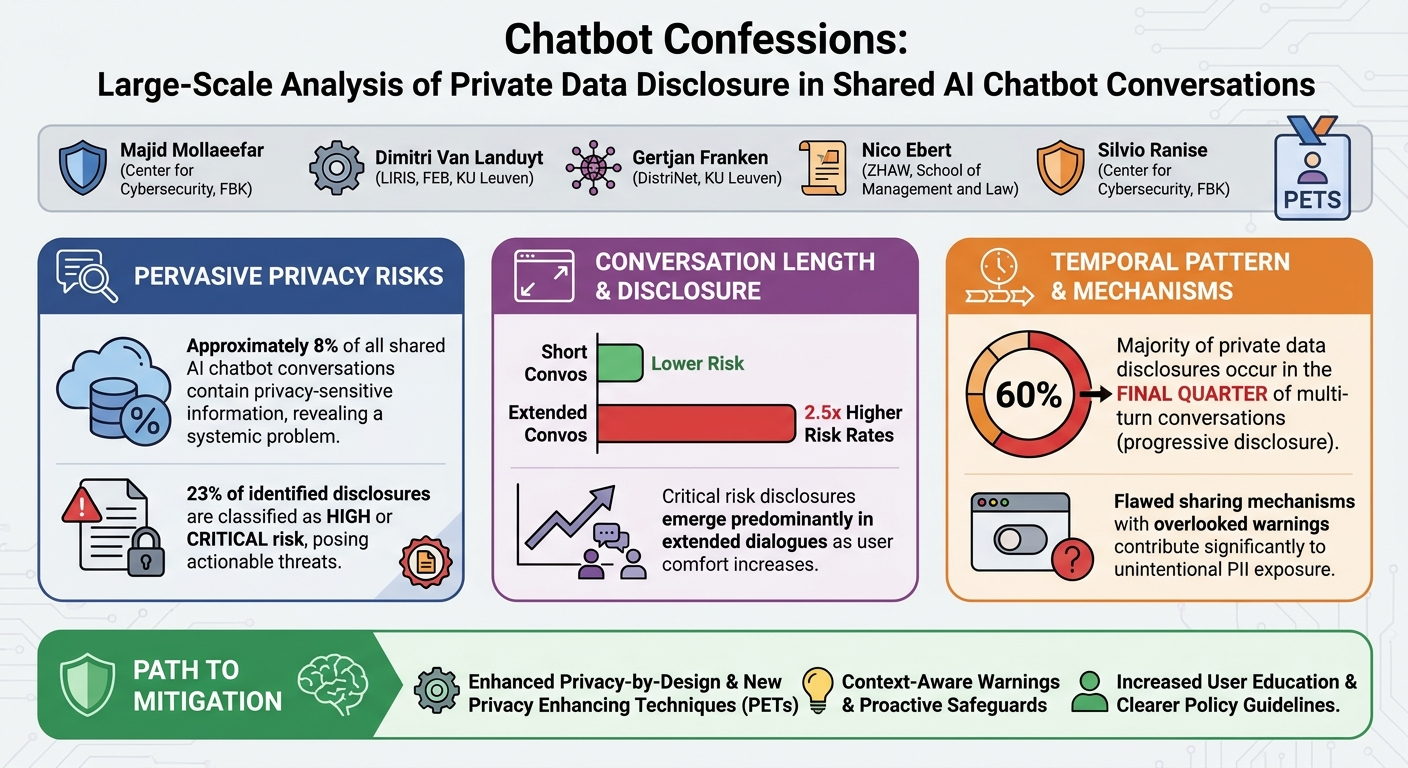
Beyond mere presence, the severity of these disclosures was a major concern. The analysis showed that a significant portion, 23% of all identified privacy issues, were categorized as high and/or critical risk. This finding underscores that these disclosures are not just minor inconveniences but represent real and actionable threats to individuals' privacy. The underlying causes were often attributed to user unawareness or underestimation of several factors: the persistence of shared content, its indexability by search engines, and the technical possibility of cross-platform linkability—where information from one shared chat could potentially be combined with other public data to identify an individual.
Disclosure Patterns (Research Question 3):
The study examined disclosure patterns through two complementary lenses: conversation length and temporal variations within conversations.
- Conversation Length:
- Out of the dataset, 2,036 conversations were identified as sufficiently long for this specific analysis.
- A striking 20% of these longer conversations contained privacy issues.
- Conversations exhibiting privacy issues were, on average, 90% longer than those without issues, with a mean of 8.77 chunks compared to 4.46 chunks.
- The severity of risk was strongly associated with conversation length. Critical risk issues emerged almost exclusively in the longest conversations, and high-risk conversations were substantially longer than those with low or no risk.
- The key takeaway here is that extended conversations appear to create compounding disclosure opportunities. As users become more comfortable and engaged over time, they tend to share increasingly specific and sensitive content, inadvertently escalating their privacy risk.
- Temporal Pattern:
- To understand where within a conversation disclosures occur, the researchers analyzed 407 multi-turn conversations containing privacy issues, yielding 1,182 individual findings.
- Each issue was mapped to its relative position, divided into four quartiles (Q1, Q2, Q3, Q4).
- The distribution was highly non-uniform: Q1 and Q2 each accounted for 12% of disclosures, Q3 for 15%, but Q4 (the last quarter of the conversation) accounted for a staggering 60% of all disclosures.
- This finding is particularly insightful, suggesting a phenomenon of progressive disclosure. Users are most likely to reveal private information towards the end of longer, more involved dialogues, likely due to increased trust, comfort, or simply a deeper engagement with the chatbot.
In conclusion, the findings unequivocally demonstrate that the issue of private data disclosure in AI chatbot conversations is real, systematic, and directly correlated with conversation length. Roughly 8% of all shared conversations contain privacy-sensitive information, with extended conversations exhibiting 2.5 times higher privacy risk rates. The most severe risks are concentrated in lengthy dialogues, and critically, the majority of disclosures occur late in the conversation lifecycle. These results provide a robust empirical foundation for addressing these vulnerabilities.
Technical Deep Dive
▶ Watch: Key findings: prevalence and severity of disclosures (6:00)
The core of the research's technical contribution lies in its sophisticated privacy risk assessment framework and the innovative hybrid detection pipeline designed to systematically identify and quantify private data disclosure.
The Privacy Risk Assessment Framework was built to move from raw conversational text to a structured, quantifiable privacy risk score. It comprises three interconnected components:
- Privacy Taxonomy: This component serves as the foundational structured enumeration of "what counts as private" within the context of chatbot interactions. It defines 12 broad categories of private information, further broken down into 44 fine-grained PII codes. This taxonomy is meticulously aligned with established privacy regulations and standards, including GDPR (General Data Protection Regulation), NIST (National Institute of Standards and Technology) guidelines, HIPAA (Health Insurance Portability and Accountability Act), and PCI DSS (Payment Card Industry Data Security Standard). This multi-standard alignment ensures a comprehensive and globally relevant classification of sensitive data. Examples of categories might include personal identifiers, financial details, health information, location data, or employment specifics, each with specific PII codes.
- Linden Framework Mapping: To contextualize the potential harm of disclosed information, the taxonomy categories are mapped to the Linden framework, a well-established privacy threat framework. This mapping connects specific types of disclosed data (from the taxonomy) to the concrete privacy harms they could cause. For instance, disclosing a home address might map to threats like "physical tracking" or "identity theft," while revealing medical conditions could map to "discrimination" or "reputational harm." This step provides a standardized way to understand the real-world implications of data exposure.
- Risk Scoring Rubric: The final component quantifies the severity of each identified disclosure. This rubric assesses risk along three critical dimensions:
- Sensitivity: How inherently sensitive is the disclosed information (e.g., a credit card number is highly sensitive, a first name less so)?
- Identifiability: How easily can the disclosed information be linked back to a specific individual (e.g., a full name and address are highly identifiable, a vague job title less so)?
- Exposure: What is the scope and potential reach of the disclosure (e.g., publicly indexed by search engines has high exposure, a private message has lower exposure)?
By combining these dimensions, the rubric assigns a quantifiable risk score, allowing for categorization into low, medium, high, or critical risk levels.
The Hybrid Detection Pipeline is the operational engine that leverages this framework. It operates in three distinct phases:
- Data Collection: The initial phase involved crawling publicly shared conversation URLs from three prominent AI chatbot platforms: ChatGPT, Co-pilot, and Gemini. The researchers intentionally did not disclose the specific methods used for crawling these URLs, citing ethical concerns about preventing potential misuse. This phase focused on gathering the raw conversational data made publicly available by user actions.
- Data Preparation: This crucial phase transforms the raw collected data into an analysis-ready format while implementing critical privacy safeguards. Key steps include:
- User Content Extraction: Isolating the actual conversational text from the platform's UI elements and metadata.
- Chunking: For longer conversations, the text was divided into smaller, manageable chunks. This is particularly important for LLM processing, which often has token limits and performs better with focused contexts.
- Pseudonymization of PII: This was a paramount step. Before any LLM processed the text, all detected PII was replaced with cryptographic placeholders. This ensures that the analytical models never directly interact with sensitive user data, maintaining privacy throughout the evaluation process. This deterministic step acts as an initial filter and anonymizer.
- LLM-based Evaluation: The final phase applies the sophisticated analytical capabilities to the prepared, pseudonymized data.
- Local Hosted Model: Each prepared snippet (chunk) was sent to a locally hosted LLM. The choice of a local model is critical for privacy, as it avoids sending potentially sensitive (even if pseudonymized) data to external, third-party APIs, which was a core ethical safeguard.
- Structured Prompt Embedding: The LLM was provided with a carefully constructed, structured prompt. This prompt not only contained the conversation snippet but also embedded the full privacy taxonomy, the Linden threat framework, and the risk scoring rubric. This contextual information guides the LLM to perform specific analytical tasks.
- JSON Object Output: The LLM's output for each evaluation was a structured JSON object. This object detailed the detected privacy category (from the taxonomy), the assigned risk score (from the rubric), the corresponding Linden mapping (linking disclosure to harm), and a reasoning and rationales section explaining the LLM's decision for the evaluation. This structured output ensures consistency, interpretability, and facilitates automated aggregation and analysis of findings.
The hybrid nature of the pipeline, combining deterministic pseudonymization with the nuanced contextual reasoning of a local LLM, validated at 77.5% accuracy against human expert annotations with substantial inter-annotator agreement, represents a significant technical advancement in automated privacy detection. It demonstrates how advanced AI can be ethically deployed to analyze privacy risks at scale, providing a robust methodology for future research and platform development.
Demo / Proof of Concept
▶ Watch: Disclosure patterns: conversation length correlates with risk (8:00)
While the talk did not feature a traditional live demonstration of a software tool or an exploit, the research itself serves as a comprehensive proof of concept for its novel methodology and the efficacy of its findings. The core contribution is the hybrid detection pipeline, which combines deterministic PII detection and pseudonymization with the nuanced contextual understanding of a locally hosted Large Language Model.
The researchers' validation process, achieving a 77.5% accuracy against human expert annotations with substantial inter-annotator agreement, effectively demonstrates the pipeline's capability to accurately identify, categorize, and score privacy risks in chatbot conversations at scale. This rigorous validation, applied to 200 conversations manually reviewed by human experts, acts as the empirical proof of the system's viability and reliability. The pipeline's ability to process over 100,000 real-world conversations and systematically extract quantifiable privacy risks stands as a testament to its practical application and effectiveness in addressing the research questions posed. Therefore, the "proof of concept" is the successful execution and validation of this analytical methodology, rather than a user-facing tool demonstration.
Defensive Implications
▶ Watch: Conclusion and multi-faceted recommendations for mitigation (10:00)
The findings from "Chatbot Confessions" carry profound implications for various stakeholders involved in the AI chatbot ecosystem, necessitating a multi-faceted approach to enhance privacy and security.
For AI Chatbot Platform Designers and Developers:
The research highlights critical vulnerabilities inherent in current sharing mechanisms. Platforms must move beyond superficial warnings and implement more robust privacy-by-design principles.
- Persistent Vulnerability in Sharing Mechanisms: The core issue is that sharing options, even with disclaimers, are easily misunderstood. Platform designers must rethink the default settings and user interface for sharing. Opt-in sharing with clear, prominent, and easily understandable explanations of privacy implications should be the standard.
- Anticipate Progressive Disclosure: The finding that 60% of disclosures occur in the last quartile of conversations indicates that user comfort leads to increased sharing. Platforms should implement proactive, context-aware privacy warnings that trigger as conversations extend or as users begin to input information that the system identifies as potentially sensitive. These warnings could prompt users to reconsider sharing or suggest anonymization options.
- New Class of Privacy Enhancing Techniques (PETs): There's a clear call for the development and integration of novel PETs. This could include:
- Automated PII Redaction/Pseudonymization: Before a chat is shared, the platform could offer to automatically redact or pseudonymize detected PII, giving users an easy way to protect sensitive data.
- Ephemeral Sharing Options: Introduce options for time-limited sharing, where links expire after a set period, reducing the persistence of public data.
- Granular Sharing Controls: Allow users to select specific parts of a conversation to share, rather than the entire dialogue, or to selectively redact sections.
- Privacy Dashboards: Provide users with clear dashboards showing what conversations they have shared, their privacy settings, and the potential risks associated with each.
- Stronger Default Privacy Settings: The default should always be the most private option. Public discoverability should never be a default or easily overlooked setting.
For Users of AI Chatbots:
The study serves as a stark reminder of the personal responsibility required when interacting with and sharing AI chatbot conversations.
- Increased Awareness: Users must be educated about the "make this chat discoverable" and similar options. Understanding the implications of persistence, indexability, and cross-platform linkability is crucial.
- Caution with Extended Conversations: The research clearly shows that longer conversations are riskier. Users should be particularly cautious about the information they share as dialogues progress and they become more comfortable.
- Review Before Sharing: Always review the entire conversation for sensitive information before clicking "share," even if you believe you haven't disclosed anything critical.
- Assume Public Visibility: Treat any shared conversation as potentially public and permanent, even if de-indexed, given the possibility of archival copies.
For Policy Makers and Researchers:
The systematic nature of the problem calls for coordinated efforts.
- Policy Guidelines: Governments and regulatory bodies should develop clearer guidelines for AI chatbot platforms regarding privacy settings, data sharing, and user education. This could include requirements for prominent privacy warnings and standardized consent mechanisms.
- Further Research: Researchers should continue to explore advanced PETs, develop more sophisticated PII detection models, and investigate user privacy perceptions and behaviors in AI interactions. The development of a common framework for risk assessment and reporting would also be beneficial.
In essence, mitigating these risks requires a collaborative effort. Platform developers must prioritize privacy in design, users must exercise informed caution, and policymakers must establish clear regulatory frameworks to ensure that the convenience of AI chatbots does not come at the cost of personal privacy.
Key Takeaways
- Pervasive Disclosure: Approximately 8% of all shared AI chatbot conversations contain privacy-sensitive information, indicating a systemic problem rather than isolated incidents.
- Significant Risk Severity: A substantial portion, 23%, of identified privacy issues are classified as high or critical risk, posing real and actionable threats to individuals' privacy.
- Conversation Length is a Major Risk Factor: Longer conversations are significantly riskier, exhibiting 2.5 times higher privacy risk rates. Critical risk disclosures emerge almost exclusively in extended dialogues, as users become more comfortable and share more specific content.
- Progressive Disclosure Within Conversations: The majority of private data disclosures (60%) occur in the last quarter of multi-turn conversations, highlighting a temporal pattern where users progressively reveal more sensitive information over time.
- Flawed Sharing Mechanisms: Current AI chatbot sharing mechanisms, often with subtle or easily overlooked privacy warnings, contribute significantly to user unawareness and unintentional PII exposure.
- Need for Enhanced Safeguards: Addressing these risks requires a multi-faceted approach, including platform designers implementing stronger privacy-by-design principles, context-aware warnings, and new Privacy Enhancing Techniques (PETs), alongside increased user education and clearer policy guidelines.
About the Speaker(s)
The research presented in "Chatbot Confessions: Large-Scale Analysis of Private Data Disclosure in Shared AI Chatbot Conversations" was a collaborative effort by a team of distinguished academics. The presentation was delivered by Majid Mollaeefar, who is listed as a paper author affiliated with the Center for Cybersecurity at Fondazione Bruno Kessler (FBK).
His co-authors include:
- Dimitri Van Landuyt, affiliated with LIRIS, Faculty of Economics (FEB), KU Leuven.
- Gertjan Franken, affiliated with DistriNet, KU Leuven.
- Nico Ebert, affiliated with ZHAW, School of Management and Law.
- Silvio Ranise, also affiliated with the Center for Cybersecurity at Fondazione Bruno Kessler (FBK).
Collectively, their expertise spans cybersecurity, economics, distributed systems, and management, bringing a comprehensive interdisciplinary perspective to the complex problem of privacy in AI chatbot interactions. Their affiliation with prominent research institutions like Fondazione Bruno Kessler and KU Leuven underscores the academic rigor and depth of their work.
Reviews
Dr. Zero (Offensive Security Researcher) — STRONG ACCEPT
We all knew users were eagerly feeding their PII to ChatGPT, but Mollaeefar’s team actually brought the receipts. This is a massive 100,000-chat measurement study that proves exactly when and how the oversharing happens. Solid methodology, strict data opsec, and a rare academic paper that gives defenders actionable metrics for tuning AI guardrails.
Heather Calloway (CISO) — STRONG ACCEPT
This research puts hard numbers to our biggest GenAI fear: users treat chatbots like confidants and inadvertently expose sensitive data. It proves that the longer a session goes, the more likely an employee is to leak critical information, justifying strict enterprise AI controls.
→ Top-rated talks at Privacy Enhancing Technologies Symposium (PETS) 2026
All talks from Privacy Enhancing Technologies Symposium (PETS) 2026