Gaze3P: Gaze-Based Prediction of User-Perceived Privacy
Mayar Elfares (Paper author · University of Stuttgart, Germany), Pascal Reisert (Paper author · University of Stuttgart, Germany), Ralf Küsters (Paper author · University of Stuttgart, Germany), Andreas Bulling (Paper author · University of Stuttgart, Germany)
Privacy Enhancing Technologies Symposium (PETS) 2026 · Remote
Overview
The digital age has ushered in an era where personal data is constantly collected, processed, and shared, making privacy a paramount concern. However, the very concept of privacy is deeply subjective and highly dynamic, varying significantly across individuals, contexts, and even over time for the same individual. Traditional methods for assessing user-perceived privacy, such as explicit questionnaires or surveys, often fall short. They are static, prone to cognitive biases, and frequently fail to align with users' actual satisfaction or evolving privacy expectations. This disconnect poses a significant challenge for designing effective, user-aligned privacy mechanisms and optimizing privacy-preserving technologies.
Key moments
- 0:00 Introduction: Gaze as implicit privacy indicator
- 1:50 User perception variability and gaze patterns
- 3:00 Learning effects from repeated attribute exposure
- 3:50 Machine learning predicts privacy from gaze
- 4:50 Optimizing differential privacy with gaze data
- 6:00 Conclusion: Implicit, dynamic privacy prediction
Gaze3P: Gaze-Based Prediction of User-Perceived Privacy
Speakers: Mayar Elfares, Paper author, University of Stuttgart, Germany; Pascal Reisert, Paper author, University of Stuttgart, Germany; Ralf Küsters, Paper author, University of Stuttgart, Germany; Andreas Bulling, Paper author, University of Stuttgart, Germany
Conference: PETS
YouTube: https://www.youtube.com/watch?v=XVpNFxDty04
Overview
The digital age has ushered in an era where personal data is constantly collected, processed, and shared, making privacy a paramount concern. However, the very concept of privacy is deeply subjective and highly dynamic, varying significantly across individuals, contexts, and even over time for the same individual. Traditional methods for assessing user-perceived privacy, such as explicit questionnaires or surveys, often fall short. They are static, prone to cognitive biases, and frequently fail to align with users' actual satisfaction or evolving privacy expectations. This disconnect poses a significant challenge for designing effective, user-aligned privacy mechanisms and optimizing privacy-preserving technologies.
Addressing this critical gap, the Gaze3P project, presented by Mayar Elfares and her colleagues from the University of Stuttgart at PETS, introduces a novel approach: leveraging human eye gaze as an implicit and dynamic indicator of user-perceived privacy. The research demonstrates that by analyzing gaze patterns, machine learning models can accurately predict an individual's privacy perceptions without requiring explicit feedback. This breakthrough enables privacy-preserving techniques to adapt in real-time to user behavior and context, offering a path toward more personalized and effective privacy protection.
The core contribution of Gaze3P lies in its ability to not only predict privacy perceptions from gaze data but also to integrate these predictions into sophisticated privacy-preserving frameworks, such as Differential Privacy. By dynamically adjusting parameters like the privacy budget (epsilon) based on implicit user feedback, the system can achieve a superior balance between data utility and privacy guarantees. This work represents a significant step forward in making privacy protection more intuitive, responsive, and aligned with individual user needs, moving beyond the limitations of one-size-fits-all or explicitly-defined privacy policies.
Background
▶ Watch: Introduction: Gaze as implicit privacy indicator (0:00)
The pervasive nature of data collection in modern society has brought the concept of personal privacy to the forefront of technological and ethical discussions. Yet, defining and quantifying privacy remains an elusive goal, primarily because it is inherently a subjective construct. What one individual considers highly private, another might deem public information. This subjectivity is further complicated by the fact that privacy perceptions are not static; they can change based on the specific context, an individual's current behavior, their level of knowledge about data practices, and even their emotional state.
Prior research attempting to quantify user-perceived privacy has largely relied on explicit user feedback mechanisms, such as surveys, questionnaires, or direct preference elicitation. While these methods offer direct insights into stated preferences, they suffer from several well-documented limitations. Users may provide socially desirable answers rather than their true feelings, their stated preferences might not align with their actual behavior (the "privacy paradox"), and the act of constantly interrupting a user for feedback can lead to privacy fatigue and a degraded user experience. Moreover, explicit feedback struggles to capture the dynamic, moment-to-moment shifts in privacy perception that occur as users interact with digital content.
This challenge extends directly to the design and optimization of privacy-preserving techniques (PPTs). Many PPTs, such as k-anonymity or differential privacy, rely on configurable parameters (e.g., the k in k-anonymity or the epsilon in differential privacy) that dictate the trade-off between privacy protection and data utility. Setting these parameters optimally is crucial: too much privacy can render data useless, while too little exposes individuals to risk. Without a robust, dynamic, and user-aligned understanding of perceived privacy, these parameters are often set based on expert heuristics or static assumptions, leading to suboptimal outcomes that either over-protect (reducing utility) or under-protect (compromising privacy) relative to actual user expectations. The Gaze3P project sought to overcome these limitations by exploring an implicit, continuous, and user-centric approach to understanding privacy.
Key Findings
▶ Watch: Learning effects from repeated attribute exposure (3:00)
The Gaze3P research unveiled several profound insights into the nature of user-perceived privacy and the utility of eye gaze as its implicit indicator:
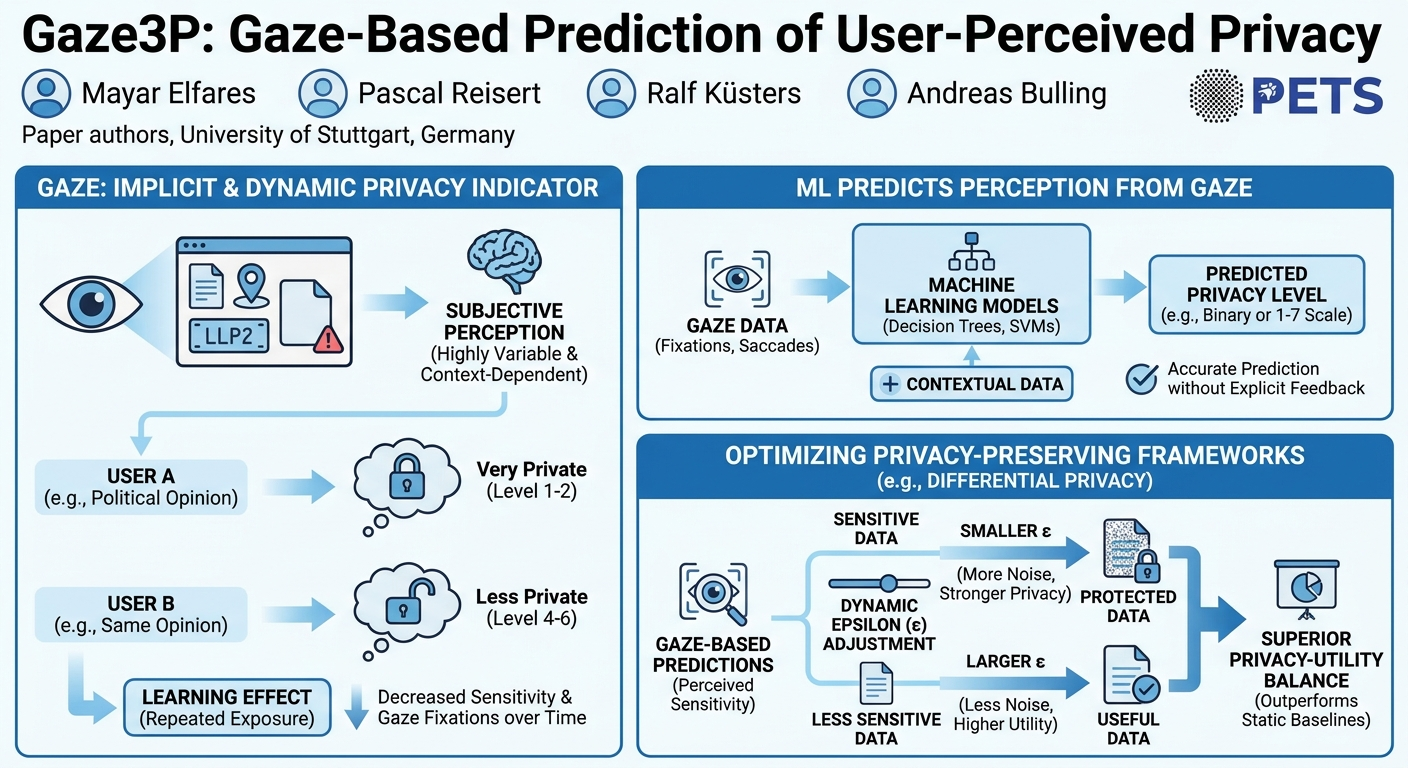
- Profound Subjectivity and Dynamic Nature of Privacy: The study unequivocally demonstrated that privacy is a deeply personal and variable concept. The same attribute, such as a car's license plate, could be perceived as "very private" (level 1 on a 1-7 scale) by one user and "not private at all" (level 7) by another. This inherent variability underscores the inadequacy of static, one-size-fits-all privacy policies. Furthermore, privacy perception is dynamic, continuously adapting as a user interacts with new stimuli.
- Significant Social and Contextual Influence: Participants' privacy perceptions were found to be significantly influenced by their social background. Stimuli more closely associated with or frequently encountered within an individual's social context were often perceived differently, likely due to their personal significance or cultural norms. This highlights the socio-cultural embedding of privacy. The research also confirmed that adding context to the analysis significantly increases the accuracy of privacy prediction, reinforcing the concept of contextual privacy.
- Inter- and Intra-User Variations in Gaze Patterns: While privacy levels were generally consistent for an individual participant across similar stimuli (intra-user consistency), they varied considerably across different participants (inter-user variability). For instance, a political opinion might be consistently rated as highly private (levels 1-2) by one user, but as less private (levels 4-6) by another. Crucially, the study observed that gaze fixations were notably denser on regions of interest that participants deemed more private, such as the faces of politicians when political opinions were considered sensitive. This provides a direct, observable link between visual attention and perceived privacy.
- Learning Effects and Decreased Sensitivity: The research identified a learning effect when participants were repeatedly exposed to stimuli related to a specific attribute (e.g., driver's license or political opinion). After initial exposure, the number of gaze fixations, the response time to rate privacy, and the overall privacy sensitivity decreased. This suggests that familiarity with certain types of information or attributes can desensitize users over time, influencing their subsequent privacy judgments.
- Predictive Power of Machine Learning from Gaze: A central finding was that machine learning (ML) models can indeed predict privacy perceptions solely from gaze data. Even relatively simple models, such as Decision Trees and Support Vector Machines (SVMs), were effective in predicting both binary perceptions (private/not private) and fine-grained privacy levels (on a 1-7 scale). This validates the core hypothesis that gaze serves as a reliable implicit indicator.
- Prediction of User-Specific Attributes (but not User Identification): Beyond stimuli-based predictions, the gaze data allowed the models to predict certain user-specific attributes, such as whether a user was a "privacy expert" or not. However, the researchers explicitly noted that they could not identify individual users from their gaze patterns. This limitation was attributed to the experimental setup, which involved simulated data collection without genuine emotional or personal attachment, suggesting that real-world, emotionally charged data might yield different results for identification.
- Enhanced Utility of Privacy-Preserving Frameworks: Perhaps the most impactful finding for practical applications was the successful integration of gaze-based predictions into privacy-preserving frameworks, specifically Differential Privacy (DP). The study demonstrated that gaze-based epsilon values consistently outperformed static baselines (using a single epsilon value) and random baselines (not gaze-informed). By dynamically assigning more noise to private attributes and less noise to less private ones, the gaze-informed DP protocols achieved results "closer to the plain text accuracy," meaning they offered significantly improved data utility while still aligning with users' perceived privacy expectations.
Technical Deep Dive
▶ Watch: Machine learning predicts privacy from gaze (3:50)
The Gaze3P project employed a rigorous experimental methodology to collect and analyze gaze data, subsequently integrating these insights into machine learning models and a robust privacy-preserving framework. The technical core of the research revolves around three main components: data collection and observation, machine learning for prediction, and integration with Differential Privacy.
Data Collection and Observational Analysis
The foundation of Gaze3P was an extensive user study involving 100 participants. Each participant was exposed to 1,000 different stimuli, which were likely images or short text snippets designed to elicit varying privacy perceptions. For each stimulus, participants were asked to explicitly rate how private they considered the information on a 1-7 Likert scale, where 1 indicated "very private" and 7 indicated "not private at all." Simultaneously, an eye-tracking system implicitly recorded their gaze behavior. The setup relies on an eye tracker measuring gaze fixations (where the eye pauses) and potentially saccades (rapid eye movements).
The initial analysis of this rich dataset revealed critical patterns:
- Gaze Density: It was observed that gaze fixations were significantly denser on "private regions of interest" within a stimulus. For example, when an image of a politician was shown and the political opinion was deemed private, participants' gaze lingered more on the politician's face. This established a direct correlation between visual attention and perceived sensitivity.
- Response Time and Fixation Count: The study also tracked response times for privacy ratings and the total number of fixations. These metrics, particularly in the context of "learning effects," showed that repeated exposure to similar attributes led to a decrease in both response time and the number of fixations, indicating reduced cognitive effort and potentially decreased privacy sensitivity over time.
Machine Learning for Privacy Perception Prediction
With the gaze data and explicit privacy ratings, the researchers developed machine learning models to predict perceived privacy implicitly. The goal was to train models that could infer privacy levels solely from gaze features, without requiring direct user input.
- Model Types: The talk mentions "very simple machine learning models such as Decision Trees, SVMs (Support Vector Machines), and so on." This suggests that the predictive power is robust enough to be captured by foundational ML algorithms, rather than requiring highly complex deep learning architectures.
- Input Features: The input to these models would consist of various gaze features extracted from the eye-tracking data. These typically include:
- Fixation duration: How long the eye pauses on a particular area.
- Fixation count: Number of times the eye fixates on a region.
- Saccade length and velocity: Characteristics of eye movements between fixations.
- Pupil dilation: Often correlated with cognitive load or emotional response.
- Area of Interest (AOI) metrics: Aggregated gaze data over predefined or dynamically identified sensitive regions.
- Prediction Targets: The models were trained to predict two main types of privacy perception:
- Binary Perception: Whether a stimulus is "private" or "not private."
- Scaled Perception: The specific privacy level on the 1-7 scale.
- Contextual Enhancement: A significant technical detail was the finding that "when adding context, the prediction accuracy increases." This implies that alongside gaze features, the models also incorporated contextual information about the stimuli (e.g., category of information, source, recipient, user's social background). This aligns with the well-established concept of contextual privacy, where the sensitivity of information is not absolute but depends heavily on its surrounding circumstances.
Integration with Personalized Differential Privacy
The most advanced technical application of Gaze3P's findings was its integration into privacy-preserving frameworks, specifically Differential Privacy (DP). Differential Privacy is a strong, mathematical guarantee of privacy that works by adding carefully calibrated noise to data queries or analyses, making it difficult to infer individual records while still allowing for aggregate statistical insights. The core parameter in DP is epsilon (ε), also known as the privacy budget. A smaller epsilon provides stronger privacy (more noise), but at the cost of reduced data utility. Conversely, a larger epsilon yields higher utility but weaker privacy.
Gaze3P leveraged the predicted privacy perceptions to dynamically adjust epsilon values for different data attributes.
- Personalized Epsilon: Instead of using a single, static epsilon for all data or all users, the system would use gaze-based predictions to determine the perceived privacy level of specific attributes or regions of interest.
- Adaptive Noise Injection: If a user's gaze indicated that an attribute was highly private, a smaller, more stringent epsilon (meaning more noise) would be applied to that attribute. If an attribute was perceived as less private, a larger, more permissive epsilon (less noise) could be used.
- Outperforming Baselines: The researchers ran "state-of-the-art personalized differential privacy protocols for data analysis and learning" with their gaze-based epsilon values. They compared these against:
- Static Baselines: Protocols using a single, fixed epsilon value for all data.
- Random Baselines: Protocols where epsilon values were varied randomly, without gaze information.
The results were conclusive: the gaze-based epsilon values consistently outperformed both static and random baselines. The key metric was achieving results "closer to the plain text accuracy," which means the data processed with gaze-informed DP maintained significantly higher utility (was more accurate and useful for analysis) compared to the baselines, all while aligning with the user's dynamic, perceived privacy levels. This demonstrates a sophisticated feedback loop where implicit user signals directly optimize a fundamental privacy-preserving mechanism.
Demo / Proof of Concept
▶ Watch: Optimizing differential privacy with gaze data (4:50)
While the presentation did not feature a live software demonstration of a real-time gaze-tracking system actively adjusting privacy settings, the entire experimental setup and its conclusive results served as a robust proof of concept for the Gaze3P methodology. The researchers systematically designed and executed a comprehensive study involving 100 participants, 1,000 stimuli, and the collection of extensive gaze data alongside explicit privacy ratings.
The demonstration of the concept's viability lies in the successful execution of each stage of their proposed framework: from the initial observation of a correlation between gaze patterns and perceived privacy, through the development of machine learning models capable of predicting these perceptions from gaze data, to the final integration of these predictions into a state-of-the-art privacy-preserving protocol like Differential Privacy. The comparison of gaze-based epsilon values against static and random baselines, showing superior data utility while maintaining perceived privacy, acted as the empirical validation of their approach. This experimental validation, documented through their findings, effectively demonstrated that gaze-based prediction is not only feasible but also offers tangible improvements in privacy-utility trade-offs.
Defensive Implications
▶ Watch: Conclusion: Implicit, dynamic privacy prediction (6:00)
The Gaze3P research offers profound implications for how individuals and organizations can approach privacy defense in a data-driven world. By shifting from explicit, static privacy controls to implicit, dynamic, and personalized mechanisms, defenders can significantly enhance the effectiveness and usability of privacy protection.
- Personalized and Dynamic Privacy Controls: The most direct implication is the ability to develop systems that automatically adapt their privacy settings based on a user's real-time, implicit perception of sensitivity. Instead of a user having to manually configure privacy preferences for every piece of information or context, a system equipped with Gaze3P's principles could identify sensitive areas (e.g., specific fields in a document, parts of an image, or types of data) based on the user's gaze and automatically apply appropriate protection. This moves towards truly user-centric privacy.
- Enhanced Utility of Privacy-Preserving Technologies (PPTs): Gaze3P demonstrates a concrete method for optimizing the parameters of PPTs like Differential Privacy. By allowing the privacy budget (epsilon) to be dynamically adjusted based on the perceived sensitivity of individual data attributes, organizations can achieve a more favorable privacy-utility trade-off. This means sensitive data receives stronger protection (smaller epsilon, more noise), while less sensitive data can be shared with higher fidelity (larger epsilon, less noise), making the overall dataset more useful for analysis without compromising the user's perceived privacy. This mitigates the common problem of over-protection or under-protection inherent in static parameter settings.
- Reduced Privacy Fatigue and Improved User Experience: Constantly prompting users for explicit privacy feedback ("Do you want to share this?", "Is this private?") leads to privacy fatigue, where users become desensitized and often default to accepting broad privacy settings without careful consideration. Gaze3P's implicit approach eliminates the need for constant interruptions, making privacy protection seamless and intuitive. This fosters a better user experience by allowing individuals to interact with digital content naturally, while the system intelligently manages privacy in the background.
- Proactive Identification of Sensitive Information: The ability to predict perceived privacy from gaze patterns allows systems to proactively identify what an individual considers sensitive. This could be invaluable for applications handling diverse data, enabling them to automatically flag information that warrants additional scrutiny or protection before it is stored, processed, or shared. For example, a content management system could automatically blur or encrypt sections of an image that a user's gaze indicates as highly private.
- Informing Privacy-Aware Interface Design: Understanding how gaze patterns correlate with privacy perception can directly inform the design of more intuitive and privacy-aware user interfaces (UI/UX). Designers could strategically place privacy controls, warnings, or information disclosures in areas where user gaze is naturally drawn when encountering sensitive content. This ensures that users are aware of their options and the privacy implications at the most relevant moments, without being intrusive.
- Contextual Awareness in Data Handling: The emphasis on contextual privacy in Gaze3P reinforces the need for data handling policies and systems to be context-aware. Organizations should move beyond generic privacy statements and implement mechanisms that understand and react to the specific context in which data is being accessed or processed, dynamically adjusting protections accordingly, potentially guided by implicit user signals.
In essence, Gaze3P provides a blueprint for building a more intelligent, adaptive, and human-centric privacy defense ecosystem, where protection is not a burden but an integrated, responsive element of the user's digital experience.
Key Takeaways
- Gaze as an Implicit Indicator: Human eye gaze is a powerful, implicit, and dynamic indicator of user-perceived privacy, offering a significant improvement over traditional explicit feedback methods.
- Privacy is Subjective and Dynamic: Perceived privacy is highly individualistic, varies significantly across contexts, and changes over time, influenced by social background and repeated exposure.
- Machine Learning Predicts Perception: Even simple machine learning models (e.g., Decision Trees, SVMs) can accurately predict both binary and scaled privacy perceptions solely from gaze data, with accuracy further improved by incorporating contextual information.
- Optimized Privacy-Preserving Technologies: Gaze-based predictions can be seamlessly integrated into frameworks like Differential Privacy to dynamically adjust privacy parameters (epsilon), leading to superior data utility while maintaining alignment with user expectations.
- Towards Personalized Privacy: This research paves the way for more personalized, adaptive, and user-aligned privacy mechanisms that reduce privacy fatigue and enhance the overall user experience by implicitly responding to individual sensitivities.
- Learning Effects on Sensitivity: Repeated exposure to specific attributes can lead to a decrease in gaze fixations, response time, and overall privacy sensitivity, highlighting the adaptive nature of privacy perception.
About the Speaker(s)
The research presented in Gaze3P was a collaborative effort by Mayar Elfares, Pascal Reisert, Ralf Küsters, and Andreas Bulling, all affiliated with the University of Stuttgart, Germany. Mayar Elfares delivered the presentation at PETS, representing the team as a paper author. Their collective work focuses on advancing our understanding of user-perceived privacy and developing innovative, implicit methods for its measurement and integration into privacy-preserving technologies.
Reviews
Dr. Zero (Offensive Security Researcher) — SOLID
They track your eyeballs to guess what you find sensitive, then use your fixation density to dynamically tune a differential privacy budget. It's a mathematically clever bridge between HCI and cryptography, even if deploying it requires installing a surveillance apparatus to protect your privacy.
Heather Calloway (CISO) — SOLID
This is academic research demonstrating how eye-tracking can dynamically tune Differential Privacy budgets based on user sensitivity. For the vast majority of enterprise security programs, this is science fiction, but for companies building or regulating spatial computing, it's a preview of how implicit biometric data will soon govern data privacy.
→ Top-rated talks at Privacy Enhancing Technologies Symposium (PETS) 2026
All talks from Privacy Enhancing Technologies Symposium (PETS) 2026