Linguistic Hooks: Investigating The Role of Language Triggers in Phishing Emails Targeting African Refugees and Students
Mythili Menon (Paper author · Wichita State University), Nisha Vinayaga-Sureshkanth (Paper author · University of Texas at San Antonio), Alec Schon (Paper author · Wichita State University), Kaitlyn Hemberger (Paper author · University of Kansas), Murtuza Jadliwala (Paper author · University of Texas at San Antonio)
Privacy Enhancing Technologies Symposium (PETS) 2026 · Remote
Overview
Phishing remains one of the most pervasive and damaging cyber threats, yet research often overlooks the unique vulnerabilities of specific demographic groups. This talk, "Linguistic Hooks: Investigating The Role of Language Triggers in Phishing Emails Targeting African Refugees and Students," presented by Mythili Menon and her co-authors at PETS 2026, delves into this critical gap. The research sheds light on how linguistic, cultural, and digital literacy factors influence the susceptibility of recently resettled African refugees and African immigrant students in the United States to phishing attacks, comparing their responses to a control group of US-born English speakers.
Key moments
- 0:00 Introduction: Phishing's impact on understudied populations
- 2:10 Multi-phase study design across diverse groups
- 4:02 Finding: Digital literacy training improved refugee cybersecurity
- 4:45 Finding: Specific linguistic cues trigger phishing clicks
- 5:40 Counter-intuitive: Lower literacy protected against phishing
- 6:40 Implications: Language-appropriate digital literacy is crucial
- 7:40 Key takeaway: Trust and personal relevance drive phishing success
Linguistic Hooks: Investigating The Role of Language Triggers in Phishing Emails Targeting African Refugees and Students
Speakers: Mythili Menon (Paper author, Wichita State University); Nisha Vinayaga-Sureshkanth (Paper author, University of Texas at San Antonio); Alec Schon (Paper author, Wichita State University); Kaitlyn Hemberger (Paper author, University of Kansas); Murtuza Jadliwala (Paper author, University of Texas at San Antonio)
Conference: PETS
YouTube: https://www.youtube.com/watch?v=_g3hOgYe78o
Overview
Phishing remains one of the most pervasive and damaging cyber threats, yet research often overlooks the unique vulnerabilities of specific demographic groups. This talk, "Linguistic Hooks: Investigating The Role of Language Triggers in Phishing Emails Targeting African Refugees and Students," presented by Mythili Menon and her co-authors at PETS 2026, delves into this critical gap. The research sheds light on how linguistic, cultural, and digital literacy factors influence the susceptibility of recently resettled African refugees and African immigrant students in the United States to phishing attacks, comparing their responses to a control group of US-born English speakers.
The study introduces a novel psycholinguistic study design to systematically manipulate phishing email content, exploring the interplay between linguistic cues and user behavior. By conducting a real-world deception study across diverse populations, the researchers uncover counter-intuitive findings, challenging conventional assumptions about the protective role of digital literacy. The implications extend far beyond these specific groups, advocating for more inclusive, culturally sensitive, and language-appropriate cybersecurity education and policy development to protect all underserved populations from sophisticated social engineering tactics.
Background
▶ Watch: Introduction: Phishing's impact on understudied populations (0:00)
Phishing attacks, characterized by deceptive emails designed to trick recipients into revealing sensitive information or clicking malicious links, are a well-studied area within cybersecurity. Traditional research has extensively documented the technical mechanisms and common lures employed by attackers, such as fake login pages and urgent financial requests. However, a significant blind spot persists concerning the varying susceptibility of diverse demographic populations, particularly those who are recent immigrants, refugees, or individuals whose first language is not English.
The problem is exacerbated for groups like recently resettled African refugees and African immigrant students in the United States. These individuals often navigate new digital environments, cultural norms, and linguistic contexts, which can inadvertently create unique vulnerabilities that standard cybersecurity awareness training fails to address. Existing phishing research often operates under the assumption of a digitally native, English-speaking user base, neglecting the critical role that cultural expectations, trust in institutions, and language proficiency play in interpreting digital communications. This oversight leads to generic cybersecurity advice that may be ineffective or even counterproductive for populations with different socio-technical backgrounds. The research presented here aims to bridge this gap by meticulously investigating how these factors interact with phishing attempts, moving beyond a purely technical understanding to incorporate a deeper appreciation of human psychology and cultural context.
Key Findings
▶ Watch: Finding: Digital literacy training improved refugee cybersecurity (4:02)
The research yielded several significant findings across its four primary research questions, providing nuanced insights into phishing susceptibility:
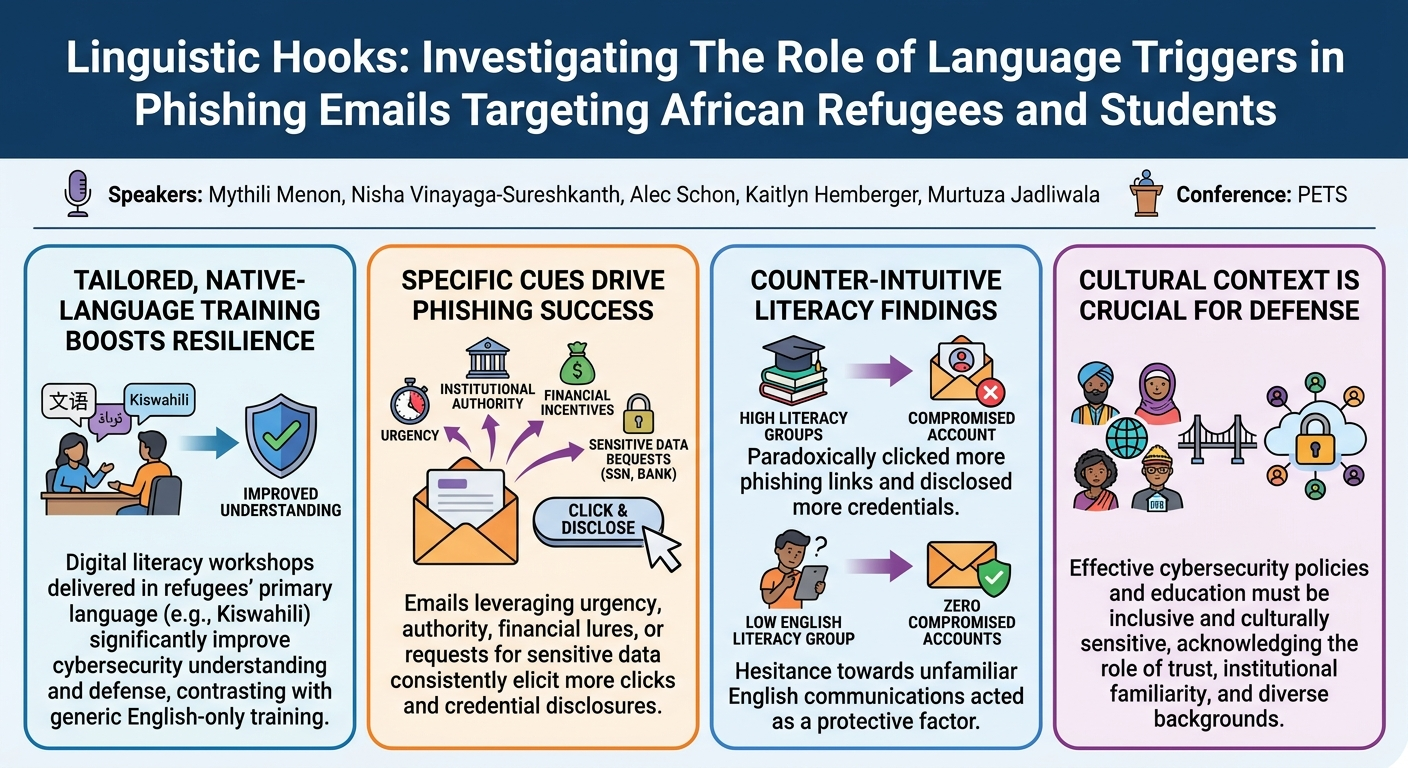
- Impact of Digital Literacy Training for Refugees (RQ1): The study found that providing digital literacy training workshops in the refugees' first language, Kiswahili, significantly improved their cybersecurity understanding. Post-assessment means showed an increase in their ability to create stronger passwords, protect personal information, and recognize the dangers of disclosing credentials to unfamiliar entities. This highlights the crucial role of language-appropriate and culturally sensitive education.
- Influence of Linguistic Cues (RQ2): Through a systematically manipulated linguistic database, the study identified specific email characteristics that consistently elicited more clicks and credential disclosures across all three target populations. Emails containing cues of urgency, leveraging institutional authority, offering financial incentives, or directly requesting sensitive information like Social Security numbers, bank details, or tuition/payroll information were highly effective in prompting user interaction. The most successful emails in terms of credential disclosure combined composite language cues with definitely suspicious cues, indicating a potent blend of subtle and overt manipulation.
- Correlation of Literacy with Detection (RQ3): Counter-intuitively, the study found that higher literacy groups (African immigrant students and US-born students) tended to click more phishing links, open more phishing emails, and were more likely to disclose credentials. In stark contrast, the low literacy group (the refugee population, with an average education level of second grade in English) exhibited zero compromised accounts and were less likely to click on unfamiliar emails. This suggests that low general and digital literacy skills, particularly in English, paradoxically acted as a "blessing in disguise," protecting them from sophisticated phishing attempts by fostering a greater hesitance towards unfamiliar digital communications. This finding challenges the direct correlation often assumed between higher literacy and improved cybersecurity practices.
- Role of Demographic and Cultural Factors (RQ4): The research confirmed that demographic and cultural factors significantly influence how individuals perceive and respond to phishing emails. Key factors identified included trust, familiarity with institutions, adherence to cultural expectations, and prior personal experiences. These elements collectively played a decisive role in determining whether an email was deemed legitimate or a phishing attempt, underscoring that human behavior in the face of phishing is deeply contextual and culturally ingrained.
Technical Deep Dive
▶ Watch: Finding: Specific linguistic cues trigger phishing clicks (4:45)
The methodology employed in this study was meticulously designed to explore the complex interplay of linguistic, cultural, and digital literacy factors in phishing susceptibility. It involved a three-phase study design encompassing participant recruitment, a real-world deception study, and comprehensive debriefing.
Target Populations and Recruitment:
The study focused on three distinct groups:
- Group A: Recently resettled African refugees in the United States, who received digital literacy training.
- African immigrant students currently studying in the US.
- US-born first-language speakers of English (control group).
Participants were recruited through partnerships, notably with the International Rescue Committee of Wichita, which assisted in reaching the refugee population. All participants were assigned an Outlook email account specifically for the purposes of the study, ensuring a controlled environment for email delivery and tracking.
Psycholinguistic Study Design and Linguistic Database:
At the core of the investigation was a 2x2 psycholinguistic study design used to create a comprehensive linguistic database of phishing emails. This design systematically manipulated two key linguistic factors:
- Factor 1: Personal Concern vs. Composite Phrases: This involved varying the emotional and psychological appeal of the email's language. "Personal concern" phrases aimed to directly engage the recipient's personal well-being or immediate needs, while "composite phrases" might combine various persuasive elements.
- Factor 2: Mildly Suspicious vs. Definitely Suspicious Cues: This manipulated the overtness of phishing indicators. "Mildly suspicious" cues might include subtle grammatical errors or slightly unusual sender addresses, whereas "definitely suspicious" cues would feature more obvious red flags like urgent, threatening language or requests for highly sensitive information.
From these manipulations, a database of all possible permutations and combinations of emails was generated, allowing for a granular analysis of which linguistic elements contributed to successful phishing.
Real-World Deception Study:
The deception study constituted Phase 2, where participants received daily emails generated from the linguistic database.
- Refugee Population: Participated in a 14-day study, receiving one random email every day. Crucially, before this, they underwent digital literacy training workshops conducted in Kiswahili, their first language. Pre-assessments and post-assessments were administered to measure the workshops' effectiveness in improving cybersecurity understanding (RQ1).
- African Immigrant Students and US-born Students: Participated in a longer, 1-month study, also receiving one email daily. These groups did not initially receive mandatory digital literacy workshops but had optional access to educational workshops and structured focus group interviews in Phase 3.
Data Collection and Analysis:
Throughout the deception study, the researchers meticulously tracked user interactions, specifically:
- Click-through rates: How many participants clicked on suspicious links.
- Credential disclosure rates: How many participants provided sensitive information (e.g., Social Security numbers, bank details, login credentials) in response to phishing requests.
- Pre- and Post-assessment scores: For the refugee group, these were used to quantify the improvement in cybersecurity understanding due to the Kiswahili workshops.
- Demographic and Digital Device Questionnaires: Collected at the outset to capture relevant background information for RQ4, including factors like trust, familiarity with institutions, cultural expectations, and personal experiences.
The analysis of these metrics allowed the researchers to correlate specific linguistic manipulations with user behavior (RQ2), assess the impact of literacy levels on detection (RQ3), and understand the role of demographic and cultural factors (RQ4). For instance, specific linguistic cues like urgency, appeals to institutional authority, offers of financial incentives, and direct requests for sensitive data (e.g., "asking for the social security number, bank details, or tuition and payroll") were found to significantly increase click rates. Furthermore, the combination of "composite language cues with definitely suspicious cues" was identified as particularly effective in eliciting credential disclosure. The observation that the low-literacy refugee group had "zero compromised accounts" while high-literacy groups clicked and disclosed more provided a critical, counter-intuitive insight into the complexity of phishing defense.
Demo / Proof of Concept
▶ Watch: Implications: Language-appropriate digital literacy is crucial (6:40)
While this talk did not feature a live software demonstration or a specific proof-of-concept tool in the traditional cybersecurity sense, the core of its methodology involved a meticulously designed real-world deception study that served as a robust experimental proof of concept. The "demo" was, in essence, the controlled deployment of the phishing emails themselves, tailored to investigate specific linguistic and cultural triggers.
The researchers demonstrated the efficacy of their 2x2 psycholinguistic study design by showing how systematically varied email content could elicit predictable, and often vulnerable, responses from different user groups. The linguistic database of phishing emails, generated through permutations of "personal concern phrases" versus "composite phrases" and "mildly suspicious cues" versus "definitely suspicious cues," was the central artifact. This database allowed the researchers to practically demonstrate how specific combinations of language—such as those conveying urgency, leveraging institutional authority, promising financial incentives, or requesting sensitive details like Social Security numbers or bank details—could successfully trick recipients into clicking links and disclosing credentials.
The "proof" lay in the observed behavioral outcomes: the measurable click rates, the instances of credential disclosure, and the differential responses across the refugee, immigrant student, and US-born control groups. For example, the finding that emails combining "composite language cues with definitely suspicious cues" resulted in the most credential disclosures provided a tangible demonstration of how specific linguistic constructions directly translated into successful phishing attacks in a controlled, yet realistic, environment. This experimental setup effectively served as a proof of concept for the power of linguistic manipulation in social engineering.
Defensive Implications
▶ Watch: Key takeaway: Trust and personal relevance drive phishing success (7:40)
The findings from "Linguistic Hooks" offer critical, actionable insights for cybersecurity defenders, necessitating a re-evaluation of current phishing defense strategies.
- Tailored, Language-Appropriate Digital Literacy Training: The success of Kiswahili-based workshops for refugees underscores that generic, English-centric cybersecurity training is insufficient. Defenders must invest in developing and delivering digital literacy programs that are culturally adapted and delivered in the native languages of diverse user populations. This includes not just translation, but also contextualization of threats and best practices to resonate with their unique experiences and technological familiarity.
- Beyond "High Literacy" Assumptions: The counter-intuitive finding that high-literacy groups were more susceptible challenges the assumption that education or digital fluency inherently protects against phishing. Defenders should avoid complacency with highly educated or digitally native users. Instead, training should focus less on basic digital skills and more on critical thinking, contextual analysis of emails, and recognizing psychological manipulation tactics (e.g., urgency, authority, financial lures) regardless of the recipient's perceived digital sophistication.
- Understanding and Counteracting Trust Vectors: Attackers exploit trust in familiar institutions, cultural expectations, and personal experiences. Defenders need to educate users not just about malicious links, but about how these psychological levers are used. Training should include examples of how attackers impersonate trusted entities (banks, universities, government agencies) and exploit cultural norms (e.g., deference to authority). Organizations should also establish clear, out-of-band communication protocols for sensitive requests (e.g., "If you receive an urgent financial request, call us directly using a known number, do not reply to the email").
- Enhanced Email Security Solutions with Linguistic Analysis: Current email security gateways primarily focus on malicious links, attachments, and sender reputation. This research highlights the need for advanced content analysis capabilities that can identify specific linguistic cues associated with phishing success. This includes detecting phrases related to urgency, institutional authority, financial incentives, and requests for sensitive data (SSN, bank details, tuition). Such systems could flag emails based on their psychological triggers, not just technical indicators.
- Culturally Adapted Incident Response: When a phishing incident occurs, the response should also be culturally sensitive. For instance, when communicating about a breach or advising on recovery steps, organizations should consider language barriers and cultural contexts to ensure the message is understood and acted upon effectively by all affected groups.
- Emphasize Verification over Reaction: The "blessing in disguise" for low-literacy groups—their hesitance to interact with unfamiliar emails—can be leveraged. Encourage all users, regardless of literacy, to adopt a default skeptical posture towards unsolicited emails, especially those demanding immediate action or sensitive information. Promote a "verify, then act" mindset, encouraging users to independently confirm requests through official channels rather than clicking links or replying directly. Implementing multi-factor authentication (MFA) is also a crucial technical defense against credential theft, regardless of how credentials are initially compromised.
Key Takeaways
- Digital literacy training is vital, but it must be language-appropriate and culturally adapted to be truly effective, particularly for underserved and understudied populations.
- Higher general or digital literacy does not inherently guarantee immunity to phishing. Context, content, and psychological triggers play a more significant role in driving user behavior.
- Phishing attacks heavily exploit human trust, cultural expectations, and perceived institutional authority. Messages that feel personally relevant or trustworthy are more likely to succeed.
- Inclusive cybersecurity policies and education are essential to protect all populations, acknowledging diverse linguistic and cultural backgrounds.
- Low English literacy can, in certain contexts, act as an unexpected protective factor against sophisticated phishing by fostering a default skepticism towards unfamiliar digital communications.
- Defenders must shift focus from generic "don't click" advice to context-aware education that highlights specific linguistic and psychological manipulation tactics used by phishers.
About the Speaker(s)
The research presented in this talk was a collaborative effort by multiple authors from various academic institutions. Mythili Menon, affiliated with Wichita State University, served as the primary presenter for the video presentation, embodying the collective voice of the research team. Her co-authors include Nisha Vinayaga-Sureshkanth from the University of Texas at San Antonio, Alec Schon also from Wichita State University, Kaitlyn Hemberger from the University of Kansas, and Murtuza Jadliwala from the University of Texas at San Antonio. Together, their expertise spans various areas of cybersecurity, privacy, and human-computer interaction, contributing to the interdisciplinary nature of this significant study on linguistic triggers in phishing.
Reviews
Dr. Zero (Offensive Security Researcher) — SOLID
Most phishing research is recycled awareness-training garbage, but Menon and the PETS crew actually ran a real-world deception study that challenges core assumptions. They proved that higher digital literacy made targets significantly more likely to cough up credentials, giving defenders concrete data that standard corporate anti-phishing paradigms are built on a broken threat model.
Heather Calloway (CISO) — STRONG ACCEPT
This research fundamentally upends how we should allocate security awareness budgets. By proving that higher digital literacy can correlate with higher phishing susceptibility, it forces a rewrite of how we model human risk. Worth your time if you manage a global workforce or are tired of generic training modules that fail to reduce credential theft.
→ Top-rated talks at Privacy Enhancing Technologies Symposium (PETS) 2026
All talks from Privacy Enhancing Technologies Symposium (PETS) 2026