GAN-Invert: Unveiling Vulnerabilities in Privacy-Preserving Facial Transformations
Umesh Kashyap (Paper author · Indian Institute of Technology Bhilai), Sk. Subidh Ali (Paper author · Indian Institute of Technology Bhilai)
Privacy Enhancing Technologies Symposium (PETS) 2026 · Remote
Overview
In an era where digital privacy is paramount, the proliferation of deep learning-based privacy-preserving (DLPP) facial transformation methods offers a promising solution for individuals to share images online without exposing their identity. These methods aim to transform original facial images into "protected" versions, where personal identity is obscured, yet utility-preserving information—such as facial attributes, expressions, or age—remains accessible for downstream tasks like attribute classification or age estimation. However, a critical security question has largely remained unanswered: are these DLPP methods truly secure against sophisticated reconstruction attacks? If an adversary gains access to a protected image, can they reverse the transformation and recover the original identity?
Key moments
- 0:00 Introduction: Vulnerability of privacy-preserving facial transformations
- 3:26 GAN Invert's working mechanism for reconstruction
- 5:37 Standardized evaluation: achieving fair comparison
- 6:17 GAN Invert's strong visual and quantitative reconstruction
- 6:56 Reconstructed images recover original identity
- 8:00 GAN Invert outperforms existing reconstruction methods
- 9:00 Conclusion: DLTP methods vulnerable, focus on semantic discretion
GAN-Invert: Unveiling Vulnerabilities in Privacy-Preserving Facial Transformations
Speakers: Umesh Kashyap (Paper author, Indian Institute of Technology Bhilai); Sk. Subidh Ali (Paper author, Indian Institute of Technology Bhilai)
Conference: PETS
YouTube: https://www.youtube.com/watch?v=0x2X3u2PQ3M
Overview
In an era where digital privacy is paramount, the proliferation of deep learning-based privacy-preserving (DLPP) facial transformation methods offers a promising solution for individuals to share images online without exposing their identity. These methods aim to transform original facial images into "protected" versions, where personal identity is obscured, yet utility-preserving information—such as facial attributes, expressions, or age—remains accessible for downstream tasks like attribute classification or age estimation. However, a critical security question has largely remained unanswered: are these DLPP methods truly secure against sophisticated reconstruction attacks? If an adversary gains access to a protected image, can they reverse the transformation and recover the original identity?
This talk, presented by Umesh Kashyap and Sk. Subidh Ali from the Indian Institute of Technology Bhilai, addresses this fundamental security gap. Their work introduces GAN-Invert, a novel generative reconstruction framework designed to evaluate the robustness of state-of-the-art DLPP methods. By demonstrating GAN-Invert's ability to reconstruct original facial identities from protected images, the researchers unveil significant vulnerabilities in widely adopted privacy-preserving techniques.
The significance of this research lies in its comprehensive security evaluation and the development of a powerful attack framework that exposes the limitations of current privacy safeguards. The findings highlight that many DLPP methods, while successfully preventing direct facial recognition, often achieve privacy through mere identity obfuscation rather than complete identity removal. This work provides crucial insights for developers and users of privacy-preserving technologies, urging a re-evaluation of current approaches and a shift towards more robust, semantically discreet privacy mechanisms.
Background
▶ Watch: Introduction: Vulnerability of privacy-preserving facial transformations (0:00)
The motivation for deep learning-based privacy-preserving (DLPP) facial transformation methods stems from the increasing need to protect personal identity when sharing images on public platforms. The core concept behind these methods is to modify an original facial image into a "protected image" where the individual's identity is hidden, but other useful information—such as gender, presence of eyeglasses, smile, or age—is preserved. This allows for various downstream tasks like attribute classification, expression recognition, and age estimation to function accurately, even with the transformed images. For instance, a protected image of Bill Gates might still allow an attribute classifier to correctly identify his gender and the presence of eyeglasses, while simultaneously causing a facial recognition system to fail in identifying him. This illustrates the intended dual goal: maintaining utility while obscuring identity.
Despite the intent, a critical security question has persisted: if a user uploads a protected image to the internet, and an adversary obtains this image, can the adversary reconstruct and recover the true, original identity? This fundamental challenge, where the effectiveness of existing privacy methods against reconstruction attacks was largely unevaluated, directly motivated the development of GAN-Invert.
The researchers defined a threat model to frame their investigation. They considered a practical scenario where users upload protected facial images to public platforms like social media or cloud services for specific tasks. The adversary's objective is clear: to recover the original facial identity from these protected images. The model assumes a strong, yet realistic, Oracle setting for the attacker. This means the attacker is presumed to know the specific DLPP transformation method that was deployed (e.g., the algorithm or model used to protect the image). Crucially, however, the attacker does not have access to the original, private image. Instead, the attacker can leverage publicly available protected images and utilize large-scale public face datasets to train a surrogate reconstruction model. With this information, the attacker's goal is to learn the inverse mapping—effectively, how to transform a protected image back into its original, identifiable form. This threat model underscores the real-world implications of such an attack, where publicly available data and knowledge of common algorithms could be weaponized to compromise privacy.
Key Findings
▶ Watch: Standardized evaluation: achieving fair comparison (5:37)
The comprehensive evaluation conducted using the GAN-Invert framework revealed several critical insights into the security posture of deep learning-based privacy-preserving (DLPP) methods:
- Widespread Vulnerability: The most significant finding is that a substantial number of existing DLPP methods, despite their design to protect identity, remain highly vulnerable to reconstruction attacks. While these methods successfully prevent direct facial recognition by standard systems, GAN-Invert demonstrated a strong capability to recover the original identity.
- Effective Identity Recovery: GAN-Invert consistently achieved high identity recognition performance on reconstructed images across various privacy protection methods. For instance, while protected images drastically reduced recognition accuracy, images reconstructed by GAN-Invert achieved significantly higher recognition rates using state-of-the-art face recognition models like ArcFace and CosFace. This directly proves that identity information, though obfuscated, was not entirely removed.
- High Reconstruction Quality: Beyond identity recovery, GAN-Invert produced reconstructed images with high visual quality. Quantitative metrics such as PSNR (Peak Signal-to-Noise Ratio), SSIM (Structural Similarity Index Measure), and LPIPS (Learned Perceptual Image Patch Similarity) consistently indicated a strong visual similarity between the reconstructed images and their original counterparts. This suggests that important facial structures and visual appearances were largely preserved or recoverable.
- Varying Protection Levels: The study revealed that different DLPP methods offer varying levels of protection. Among the evaluated approaches, methods based on feature disentanglement, particularly those that replace identity information rather than merely obfuscating partial facial features (e.g., "disentangle ID riddle"), provided a stronger defense against reconstruction attacks. This highlights a crucial distinction between identity obfuscation and true identity removal.
- Optimal Generator Architecture: Through architectural analysis, the research identified the U-Net architecture as providing the best reconstruction performance for GAN-Invert. The U-Net's effectiveness is attributed to its skip connections, which enable the network to preserve fine-grained facial details during the reconstruction process, critical for high-fidelity output.
- Impact of Training Data: As anticipated, increasing the size of the training dataset consistently improved the reconstruction quality and reduced the convergence time of the GAN-Invert model. This underscores the importance of data availability for sophisticated adversarial attacks.
- Superiority over Existing Methods: GAN-Invert demonstrated superior performance compared to existing reconstruction approaches. For example, against Master Key GAN (designed for the AVIH privacy method), GAN-Invert achieved better identity recovery. More notably, against Phantomas, a more generalized reconstruction framework, GAN-Invert achieved approximately 87% recognition accuracy under the standardized evaluation setup, significantly outperforming Phantomas's mere 10% accuracy. Even when specifically designed to target a "Phantomas target defense," GAN-Invert still achieved a remarkable 93.6% recognition accuracy, showcasing its robustness and effectiveness.
These findings collectively underscore the urgent need for more robust privacy-preserving techniques that genuinely remove or replace identity information, rather than simply hiding it through obfuscation.
Technical Deep Dive
▶ Watch: GAN Invert's strong visual and quantitative reconstruction (6:17)
The core of this research is the GAN-Invert framework, a generative reconstruction model specifically designed to learn the inverse mapping from a protected image back to its original facial identity. The framework operates within a strong, yet realistic, threat model where the attacker knows the deployed DLPP method but lacks access to the original private images.
The training process for GAN-Invert begins with the creation of a surrogate training dataset. This dataset consists of paired original and protected images. The protected images are generated by applying the known DLPP method to a large-scale public face dataset. This surrogate dataset is crucial because it allows the GAN-Invert model to learn the specific transformations characteristic of the target DLPP method.
GAN-Invert itself comprises several key components and loss functions, optimized to achieve high-fidelity identity reconstruction:
- Generator (G): This is the central component responsible for the reconstruction. It takes a protected image as input and attempts to produce a reconstructed face image that closely resembles the original. The research explored different generator architectures, including standard CNN, encoder-decoder, and U-Net. The U-Net architecture was found to yield the best performance, primarily due to its skip connections. These connections directly link early layers to later layers, allowing the network to preserve fine-grained facial details that might otherwise be lost during the downsampling and upsampling processes, which is critical for accurate facial reconstruction.
- Pre-trained Face Recognition Model: To ensure the reconstructed image truly recovers identity information, a pre-trained state-of-the-art face recognition model (e.g., ArcFace or CosFace) is utilized. This model extracts identity features from both the reconstructed image produced by the generator and the corresponding original image from the training pair. The difference between these feature vectors forms the basis for the feature-level identity loss. This loss is crucial for guiding the generator to preserve identity-specific information, ensuring that the reconstructed face is not just visually similar but also recognized as the same individual.
- Discriminator (D): To encourage the generator to produce realistic and natural-looking facial images, an adversarial training approach is employed, similar to a standard Generative Adversarial Network (GAN). The discriminator receives both real original images and reconstructed images from the generator. Its task is to distinguish between them. The feedback from the discriminator (the adversarial loss) helps the generator refine its outputs, making them increasingly indistinguishable from real faces.
- Attribute Feature Extractor: To maintain semantic consistency and ensure that the reconstructed image preserves relevant facial attributes (like gender, age, expression), an attribute feature extractor is used. This component extracts attribute features from both the reconstructed and original images. The attribute consistency loss measures the difference between these attribute features, guiding the generator to ensure the semantic transformation is preserved during reconstruction.
Loss Functions: The optimization of the generator parameters involves a combination of four distinct loss functions:
- Feature-level Identity Loss: Calculated from the identity features extracted by the face recognition model, this loss minimizes the identity difference between the reconstructed and original images.
- Pixel-level Reconstruction Loss: Typically implemented using Mean Square Error (MSE), this loss measures the pixel-wise difference between the reconstructed image and the original image, ensuring visual fidelity.
- Adversarial Loss: Derived from the discriminator, this loss pushes the generator to produce outputs that are realistic enough to fool the discriminator.
- Attribute Consistency Loss: This loss ensures that the semantic attributes of the reconstructed face align with those of the original face.
These four losses are combined to create a comprehensive objective function that guides the generator to learn an effective inverse mapping, recovering both visual appearance and identity information. The training continues until the model converges and demonstrates robust reconstruction capabilities.
Evaluation Methodology:
To conduct a fair and comprehensive security evaluation, the researchers meticulously designed their methodology:
- Datasets: GAN-Invert was evaluated on three widely used facial datasets: CelebA HQ, FFHQ, and LFW.
- DLPP Methods: Ten representative DLPP methods were selected, covering four major categories: pixel-level manipulation, GAN-based adversarial makeup, feature disentanglement, and reversible encryption-based methods. This broad selection ensured a thorough assessment across different privacy strategies.
- Standardization for Fair Comparison: A crucial step was to standardize the evaluation conditions. Different privacy methods naturally introduce varying levels of distortion. To ensure a fair comparison of privacy vulnerability under similar utility conditions, each DLPP method's parameters were adjusted to achieve the same downstream task accuracy of 89%. This standardization accounted for differences in pixel distortion (represented by delta) and semantic distortion (represented by epsilon), preventing bias towards methods that simply introduced more visual noise.
- Metrics:
- Identity Leakage: Measured using recognition accuracy from two state-of-the-art face recognition models: ArcFace and CosFace.
- Reconstruction Quality: Assessed using standard image quality metrics: PSNR, SSIM, and LPIPS.
The rigorous evaluation setup and the multi-component GAN-Invert framework allowed the researchers to quantify the privacy leakage of DLPP methods effectively and demonstrate the potent capabilities of reconstruction attacks.
Demo / Proof of Concept
▶ Watch: GAN Invert outperforms existing reconstruction methods (8:00)
While the talk did not feature a live, interactive demonstration, the researchers presented compelling quantitative and qualitative results that served as a powerful proof of concept for GAN-Invert's capabilities. The presented figures and tables visually and numerically validated the framework's ability to reconstruct original facial identities from protected images.
Qualitatively, the research showed examples of reconstructed images alongside their original and protected counterparts. These visual comparisons clearly illustrated that even when DLPP methods significantly altered the original face's appearance, GAN-Invert was capable of recovering important facial characteristics, structures, and identity-related features. For weaker privacy methods, the reconstructed images were visually strikingly similar to the original faces, providing undeniable evidence of privacy leakage.
Quantitatively, the consistently high PSNR, SSIM, and low LPIPS values across CelebA HQ, FFHQ, and LFW datasets demonstrated that the reconstructed images maintained a strong visual resemblance to the originals. Furthermore, the significant increase in recognition accuracy when applying ArcFace and CosFace to GAN-Invert's reconstructed images, compared to the protected images, unequivocally proved the recovery of identity information. The comparison against existing reconstruction approaches like Master Key GAN and Phantomas, showing GAN-Invert's superior performance (e.g., 87% vs 10% recognition accuracy against Phantomas), further solidified its efficacy as a robust attack framework. These detailed results, presented through the talk's slides and discussion, collectively served as the demonstration of GAN-Invert's proof of concept.
Defensive Implications
▶ Watch: Conclusion: DLTP methods vulnerable, focus on semantic discretion (9:00)
The findings from the GAN-Invert research carry significant implications for developers, researchers, and users of privacy-preserving facial transformation methods. The demonstrated vulnerabilities highlight critical shortcomings in current DLPP approaches and necessitate a paradigm shift in how facial privacy is conceived and implemented.
- Re-evaluate Current DLPP Methods: Organizations and individuals relying on existing DLPP solutions for privacy protection must re-evaluate their security posture. The research clearly shows that many methods, while appearing to obfuscate identity, are not robust against sophisticated reconstruction attacks like GAN-Invert. A false sense of security could lead to unintended privacy breaches.
- Shift from Obfuscation to Identity Removal/Replacement: The core issue identified is that many DLPP methods achieve privacy through mere identity obfuscation rather than complete identity removal or replacement. Defenders should prioritize methods that truly disentangle and replace identity-specific features with generic or synthetic ones, rather than simply distorting existing features. The talk specifically highlighted that disentanglement-based methods that replace identity information (e.g., "disentangle ID riddle") offered stronger protection, indicating a promising direction.
- Focus on Semantic Discretion: Future privacy preservation methods should aim for higher semantic discretion while maintaining low pixel distortion. This means the method should effectively alter the underlying semantic representation of identity (making it unrecognizable to a recognition system) without introducing excessive visual noise that would degrade utility. Achieving a balance where identity features are meaningfully changed at a semantic level, rather than just visually obscured, is crucial for robust privacy guarantees.
- Adversarial Robustness Testing: Developers of new DLPP methods should proactively test their solutions against state-of-the-art reconstruction attacks, including frameworks like GAN-Invert. Building in adversarial robustness from the ground up, rather than treating privacy as a superficial layer, is essential. Regular security audits and red-teaming exercises using advanced reconstruction techniques should become standard practice.
- Transparency and User Education: Users of privacy-preserving technologies need to be educated about the inherent risks and limitations. It is vital to communicate that no method offers absolute anonymity and that sophisticated attacks can potentially recover identity. Transparency about the level of protection offered and the potential vulnerabilities is crucial for informed decision-making.
- Research into Provably Secure Methods: The findings underscore the need for continued research into DLPP methods that can offer stronger, potentially provable, guarantees against inversion attacks. This might involve exploring novel cryptographic techniques, more advanced disentanglement architectures, or entirely new paradigms for privacy preservation that do not rely on easily invertible transformations.
In essence, the GAN-Invert research serves as a wake-up call, emphasizing that the current landscape of deep learning-based facial privacy methods is far from secure against determined adversaries. A fundamental re-thinking of privacy mechanisms is required to ensure truly robust protection in the digital age.
Key Takeaways
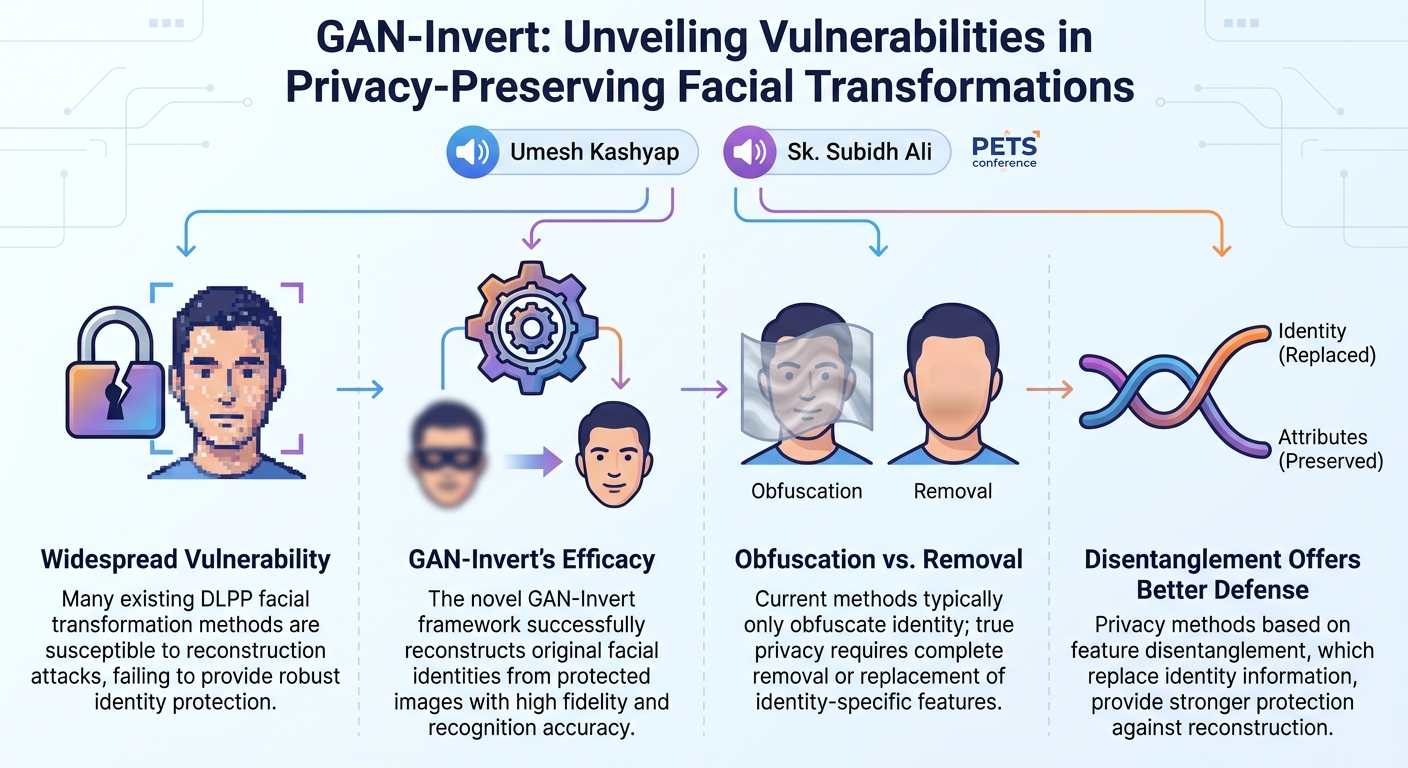
- Vulnerability of DLPP Methods: Many existing deep learning-based privacy-preserving (DLPP) facial transformation methods are vulnerable to reconstruction attacks, meaning original identities can be recovered.
- GAN-Invert's Efficacy: The GAN-Invert framework is highly effective at reconstructing original facial identities from protected images, achieving both high visual quality and significant identity recognition accuracy.
- Obfuscation vs. Removal: Most current DLPP methods achieve identity obfuscation rather than true identity removal, leaving sufficient information for sophisticated reconstruction techniques to succeed.
- Superiority of Disentanglement: DLPP methods based on feature disentanglement, particularly those that replace identity information, offer stronger protection compared to pixel-level manipulation or GAN-based adversarial makeup.
- Importance of Semantic Discretion: Future privacy-preserving methods should prioritize higher semantic discretion—fundamentally altering identity at a feature level—while maintaining low pixel distortion to ensure both privacy and utility.
- Architectural Significance: The U-Net architecture, with its skip connections, proved most effective for reconstruction due to its ability to preserve fine-grained facial details.
About the Speaker(s)
Umesh Kashyap and Sk. Subidh Ali are researchers associated with the Indian Institute of Technology Bhilai. Their work, as presented in this talk, focuses on critical areas of deep learning security and privacy, specifically investigating the vulnerabilities of AI-driven facial privacy technologies. Their contribution through the GAN-Invert framework highlights their expertise in adversarial machine learning and their commitment to enhancing the understanding and robustness of privacy-preserving systems.
Reviews
Dr. Zero (Offensive Security Researcher) — STRONG ACCEPT
This is a necessary tear-down of the academic snake oil that is deep learning privacy filters. Kashyap and Ali proved mathematically what practitioners already suspected: adding noise or warping pixels doesn't delete identity, it just hides it. Excellent offensive ML research that permanently burns ten different privacy methods.
Heather Calloway (CISO) — SOLID
The researchers prove that AI-based facial 'anonymization' tools don't actually destroy identity—they just hide it from standard recognition systems. For enterprise security and privacy teams, this means data sanitized by these deep learning methods is still recoverable biometric data, not legally anonymous safe harbor data. If your business relies on these tools to bypass privacy regulations for analytics or ML training, your compliance strategy is broken.
→ Top-rated talks at Privacy Enhancing Technologies Symposium (PETS) 2026
All talks from Privacy Enhancing Technologies Symposium (PETS) 2026