Keynote: A Brief History of Crime[ware]
Paul Melson (VP of Cybersecurity · Capital One)
SLEUTHCON 2025 · Day 1 · Main Stage
Overview
In this keynote address at SLEUTHCON, Paul Melson, VP of Cybersecurity at Capital One, takes the audience on a fascinating journey through the evolution of crimeware. Melson, a veteran with over two decades in the cybersecurity trenches, defines crimeware as software specifically designed to monetize an attack, distinguishing it from broader categories like malware, espionage, or activism. His talk serves as both a nostalgic retrospective and a critical analysis, aiming to identify enduring patterns that can inform and improve current defensive strategies.
Key moments
- 0:00 Introduction and the power of professional networking
- 4:07 Defining crimeware: financially motivated software attacks
- 7:50 Early crimeware: the 900 dialer scam
- 14:26 Zeus and the rise of banking Trojans
- 19:50 CryptoLocker: the beginning of ransomware
- 22:15 The 'Redux': how past crimeware types were disrupted
- 27:30 Future disruption strategies and collaborative call to action
Keynote: A Brief History of Crime[ware]
Speakers: Paul Melson, VP of Cybersecurity, Capital One
Conference: SLEUTHCON
YouTube: https://www.youtube.com/watch?v=9FvBwgj6NHo
Overview
In this keynote address at SLEUTHCON, Paul Melson, VP of Cybersecurity at Capital One, takes the audience on a fascinating journey through the evolution of crimeware. Melson, a veteran with over two decades in the cybersecurity trenches, defines crimeware as software specifically designed to monetize an attack, distinguishing it from broader categories like malware, espionage, or activism. His talk serves as both a nostalgic retrospective and a critical analysis, aiming to identify enduring patterns that can inform and improve current defensive strategies.
Melson's core thesis is that while the specific forms of crimeware change, driven by technological shifts and market forces, the underlying financially motivated criminal intent remains constant. He meticulously traces the rise and fall of several prominent crimeware types, from early 900 dialers and IRC botnets to sophisticated banking Trojans, Point-of-Sale (POS) malware, and the current reign of ransomware. By examining how these threats emerged, operated, and were ultimately disrupted, Melson provides a compelling argument for the power of collective defense and the strategic importance of targeting the monetization mechanisms of cybercriminals.
Beyond the technical history, Melson emphasizes the critical role of professional networking and collaboration in the fight against cybercrime. He shares personal anecdotes and insights, urging attendees to connect, share knowledge, and work together. This call to action underscores a recurring theme: no single entity possesses all the data, skills, or ideas necessary to disrupt large-scale cybercriminal activity. The article will delve into the specific examples Melson uses to illustrate these points, offering a detailed look at the technical underpinnings and the eventual demise of various crimeware eras, culminating in a discussion of today's ransomware landscape and future defensive strategies.
Background
▶ Watch: Introduction and the power of professional networking (0:00)
Paul Melson, with a career spanning over 23 years in the technology industry and more than 20 years specifically in information security, offers a unique perspective on the historical trajectory of cyber threats. His interest in computer and network security dates back to his early high school days, immersed in dial-up bulletin board systems, foreshadowing a career dedicated to combating digital adversaries. This extensive experience provides the foundation for his retrospective on crimeware.
Melson begins by establishing a precise definition for crimeware, a portmanteau of "crime" and "software." For the purpose of his talk, crimeware refers exclusively to software designed with the explicit goal of monetizing an attack. This is a crucial distinction from malware, which is a broader term for malicious software that might be used for espionage, piracy, activism, or simple defacement without direct financial gain for the attacker. He clarifies that crimeware is not generic attack tools, viruses, worms, or exploits unless they are directly instrumental in generating money for the attacker. This narrow definition allows Melson to focus on the evolution of financially motivated cybercrime, rather than a general history of all malicious software.
He acknowledges that the first malicious software likely appeared shortly after the first programming language, but his scope is specific: "firsts" in crimeware, where novel capabilities and money-making schemes emerged. Melson briefly mentions the AIDS Trojan of 1989 as a "dishonorable mention" for being technically the first recorded ransomware attack. However, he dismisses it as true crimeware by his definition due to its "skiddyware" nature (written in DOS batch) and its cumbersome monetization scheme (mailing a personal check to a P.O. box in Panama), which led to the perpetrator's swift arrest. This sets the stage for a journey starting in 2001, focusing on sophisticated, scalable, and financially successful criminal enterprises. Before diving into the history, Melson delivers a powerful message about the value of professional networking in threat hunting, highlighting how collaboration among security professionals has led to the tracking, unmasking, disruption, and even prosecution of cybercriminals – a rare but incredibly satisfying outcome.
Key Findings
▶ Watch: Early crimeware: the 900 dialer scam (7:50)
Melson's comprehensive review of crimeware history reveals several critical patterns and findings that are highly relevant for contemporary cybersecurity defense. First and foremost, crimeware is relentlessly driven by monetization. Each iteration, from 900 dialers to ransomware, represents an attempt by criminals to optimize their financial returns. The success and longevity of a particular crimeware type are directly tied to its profitability and the ease with which illicit gains can be laundered or converted into usable currency.
A significant finding is that successful crimeware types are not immortal; they eventually face disruption and decline. However, this disruption rarely eradicates the underlying criminal intent. Instead, the threat actors adapt, pivoting to new technologies, attack surfaces, or monetization models. Melson illustrates this with the demise of 900 dialers due to regulatory changes and telco refunds, the decline of banking Trojans impacted by anti-fraud efforts and lawsuits against money transfer services, and the obsolescence of POS malware following the widespread adoption of EMV chips and DUKPT encryption. In each case, the attack surface or the cash-out mechanism was fundamentally altered or made unprofitable.
Another key insight is that cybercriminals, particularly those engaged in crimeware, often prioritize perfection over invention. Melson notes that groups like FIN6 don't necessarily create groundbreaking new technologies but rather refine and combine existing tools and techniques into highly effective attack chains. The evolution of ransomware, for instance, leverages established methods like PowerShell and PowerShell Empire for lateral movement and privilege escalation, demonstrating a focus on operational efficiency and proven tactics. This suggests that defenders must not only anticipate novel threats but also be prepared for the persistent and refined application of known attack vectors.
Finally, Melson underscores the paramount importance of collective defense. He repeatedly emphasizes that no single organization or individual possesses the complete picture or sufficient resources to combat cybercrime at scale. The successful disruptions cited throughout his talk – from tracking down 900 dialer operators to impacting banking Trojan networks – were the result of information sharing, collaboration, and coordinated efforts across industry, law enforcement, and regulatory bodies. The talk concludes with a powerful call for continued collaboration, encapsulated by the Luo proverb: "If you want to go fast, go alone. If you want to go far, go together." This principle remains a cornerstone for building resilient defenses against an ever-evolving threat landscape.
Technical Deep Dive
▶ Watch: Zeus and the rise of banking Trojans (14:26)
Melson meticulously chronicles the technical evolution of crimeware, highlighting key innovations and the methods used for monetization.
900 Dialers (2001): The Dawn of Direct Monetization
The first true crimeware Melson details were 900 dialers, emerging around 2001. These were typically Trojan horses, often disguised as legitimate software or copy protection cracks for popular games like Max Payne or Grand Theft Auto 3. They targeted Windows systems equipped with modems and active phone lines. Once installed, the dialer would establish persistence, then wait for system inactivity before silently dialing out to premium-rate 900 numbers. These numbers could charge upwards of $9.99 per minute, often connecting to adult content sites, generating revenue for the criminal operators. Melson recounts his first paid reverse engineering gig, investigating a 900 dialer campaign that used a valid VeriSign code signing certificate to impersonate a legitimate company, underscoring the early sophistication and brand reputation risks involved. The operators were eventually traced to a front company in Las Vegas, Nevada, making this an early example of "made in America" cybercrime.
IRC Botnets (Circa 2007): Infrastructure Theft and Scale
Fast-forwarding to 2007, Melson introduces IRC botnets, exemplified by Marina and Torpig. These botnets primarily targeted Linux and Unix systems (including Solaris, AIX, and IRIX), exploiting default credentials and publicly available exploits to compromise hosts. They installed backdoors that connected to private IRC channels for Command and Control (C2), leveraging stolen infrastructure rather than building their own. Monetization primarily involved sending spam and engaging in ad-click fraud. The ad-click fraud was rudimentary, often involving simple curl commands to specific URLs with fake referrer and user-agent strings to generate affiliate revenue. These bots also possessed DDoS capabilities, famously used in "criminal-on-criminal" flame wars between botnets like Bagel and NetSky. Despite their widespread activity, Melson notes that DDoS for extortion didn't become prevalent until later, with the emergence of Russian actors.
Storm Worm / Peacomm Botnet (2007): Encrypted P2P C2 and Botnet-as-a-Service
The Storm Worm, also known as the Peacomm botnet, emerged in 2007, spreading predominantly via email attachments disguised as e-cards or news headlines. Unlike the IRC botnets, Storm targeted Windows hosts. A significant technical innovation was its use of an encrypted peer-to-peer (P2P) protocol for C2, a novel capability at the time. This botnet was developed and operated by the notorious Russian Business Network (RBN), marking their first major outing. At its peak in 2007, Storm boasted over a million infected hosts. The RBN monetized Peacomm by renting it out for DDoS attacks, spam campaigns, and phishing operations, establishing an early "botnet-as-a-service" model akin to modern-day stresser services. Melson humorously notes that one of its inventors, Leo Kavayv, is currently serving time in a Moscow prison for unrelated crimes.
Zeus Banking Trojan (Circa 2007): The Rise of Financial Fraud Ecosystems
Arriving concurrently in 2007, the Zeus banking Trojan represents a pivotal moment in crimeware history. Zeus was not just malware; it was a commercially available product, fostering an entire ecosystem. It was spread through various means, including email attachments and drive-by downloads facilitated by exploit kits such as Sweet Orange, Rig, Angler, and Blackhole. Zeus pioneered the class of highly successful Windows banking Trojans, with modern infostealers like Lumac 2 and Formbook tracing their roots back to Azeralt and Pony, which themselves evolved from banking Trojans.
Zeus and its successors (e.g., Gameover, SpyEye, Naame, Dridex, Trickbot, VAR) were characterized by rapid feature development and a modular nature, unlocking a flood of capabilities. Monetization centered on direct financial transfers out of bank accounts. Techniques included form hijacking and the sophisticated man-in-the-browser (MITB) attack, where the malware maintained a proxy connection to a victim's bank session even after they thought they had logged out, allowing criminals to initiate transfers. Melson highlights the surprising longevity of these techniques, noting that the MITB feature is over 15 years old. The source code for Zeus was intentionally leaked, leading to its widespread proliferation; snippets of Zeus code can still be found in malware samples submitted to VirusTotal even today.
POS Malware (2008-2017): RAM Scraping and Card Fraud
The period between 2013 and 2017 is often considered the "golden era" for Point-of-Sale (POS) malware, though its origins trace back to 2008 with groups like FIN5 and Raw POS. While not the first to target credit card data, FIN5 is credited with developing and deploying the first novel RAM scraper specifically for this purpose. These malware strains ran on Windows-based POS register systems, using regular expressions (regex) to scan memory buffers (e.g., keyboard and serial buffers) for Track 2 data from credit card swipes. The stolen data, known as "dumps" or "FOS," was then sold to other criminals who would clone cards and commit fraud. Groups like FIN6 and FIN7 also heavily engaged in this activity, demonstrating increasingly advanced and complex operations, all aimed at the same end goal: selling stolen credit card data.
CryptoLocker (2013): Bitcoin Extortion and the Ransomware Boom
In 2013, CryptoLocker marked a significant advancement in crimeware, pioneering the use of Bitcoin for extortion. It was spread via paid spam campaigns (e.g., the Cutwail botnet) and directly dropped by Gameover Zeus. Initially, the decryption fee was relatively modest at $400. Despite often encrypting seemingly innocuous files like homework or vacation photos, CryptoLocker amassed nearly $27 million in just over two months. Its immense success immediately spawned numerous clones, particularly from Russian-speaking operators, including CryptoWall, TorrentLocker, Peta, and Locky. This period saw criminals experimenting with and ultimately embracing Bitcoin as a favored method for anonymous, international money transfer, laying the groundwork for the modern ransomware landscape.
Big Game Ransomware (2017+): Targeting Enterprises for Maximum Profit
The year 2017 ushered in the era of big game ransomware, exemplified by BitPaymer (attributed to Indri Spider, FIN6, and Evil Corp). This shift involved targeting large organizations for significantly higher ransoms. The attack chain for these operations became highly sophisticated, often starting with malware like Dridex, leading to PowerShell for execution, then PowerShell Empire for post-exploitation and lateral movement, culminating in domain admin privileges and the deployment of ransomware across the network. Melson notes that FIN6 was using similar attack chains to deploy Framework POS as far back as 2014, highlighting the criminal tendency to perfect rather than invent. The revenue generated by big game ransomware is unprecedented, comparable only to the spam botnet boom of two decades prior, making it the most lucrative crimeware type discussed.
Demo / Proof of Concept
▶ Watch: The 'Redux': how past crimeware types were disrupted (22:15)
This keynote address is a historical and analytical overview of crimeware rather than a demonstration of specific tools or vulnerabilities. Paul Melson did not perform any live demos or present a proof of concept during his talk. Instead, he relied on his extensive experience and knowledge to describe the technical mechanisms and operational strategies of various crimeware families.
Defensive Implications
▶ Watch: Future disruption strategies and collaborative call to action (27:30)
Melson's historical analysis provides crucial insights for modern cybersecurity defenders, highlighting effective strategies that have led to the disruption of past crimeware and offering guidance for current and future threats.
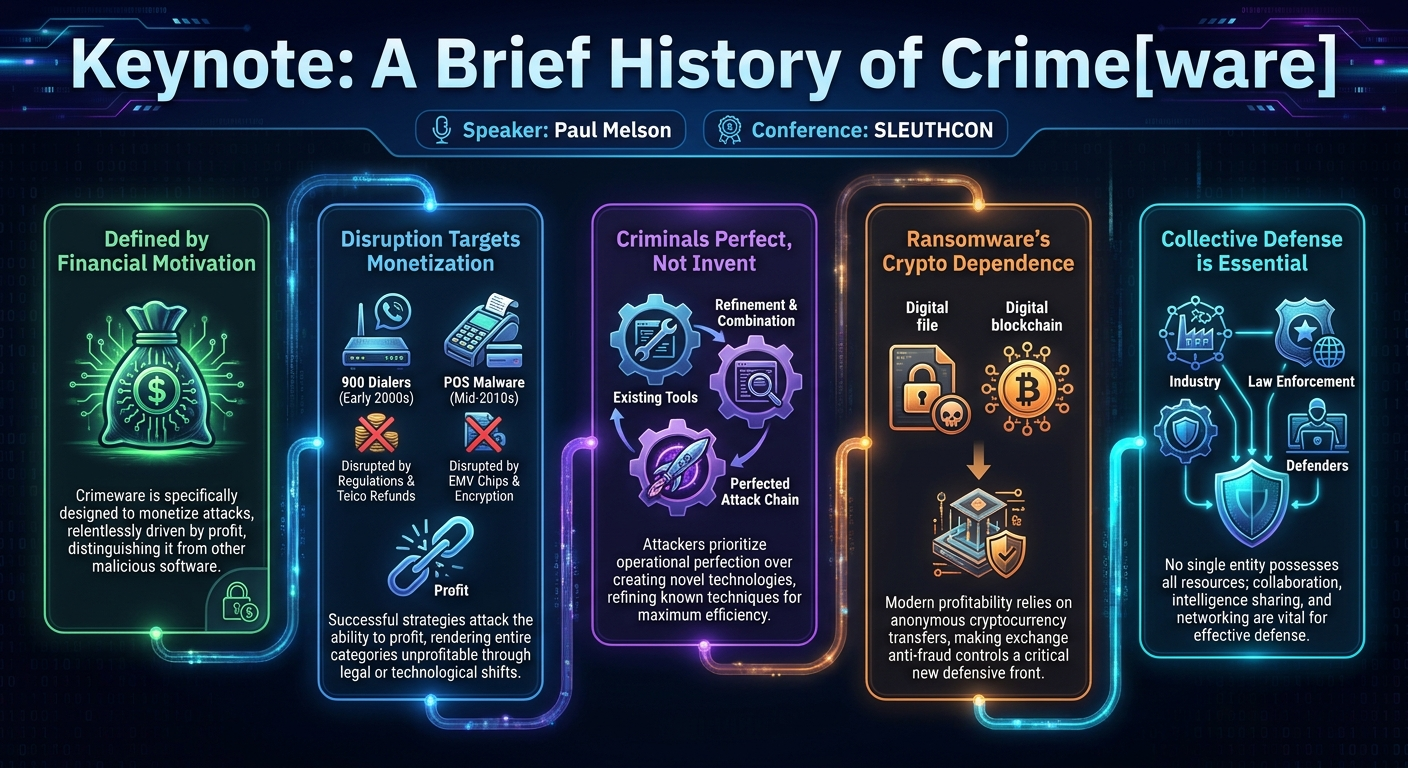
1. Target the Monetization Mechanism: The most consistent theme in crimeware disruption is attacking the criminal's ability to profit.
- 900 Dialers: Their demise was accelerated by US law, a Supreme Court case, and FCC regulations in the early 1990s. These mandates required telcos to immediately refund fraudulent toll number charges, shifting the financial burden and administrative headache to the toll number operators. This led telcos to automate abuse detection, kick off abusers, and raise the bar for obtaining 900 numbers, effectively making the scheme unprofitable and accelerating the death of 900 numbers altogether.
- Banking Trojans: The scale and profitability of banking Trojans were severely impacted by a 2016 lawsuit brought by 49 US states and the District of Columbia against Western Union for massive wire fraud. The 2017 settlement compelled Western Union to revamp its anti-fraud program and collaborate more actively with law enforcement. This focus on disrupting extra-national money exfiltration dramatically increased the likelihood of stopping fraudulent wires and burning mule accounts, making it harder and less profitable to maintain the cash-out networks.
- POS Malware: The shift from magnetic stripe cards to EMV chips (Europay, MasterCard, and Visa) and the implementation of DUKPT (Derived Unique Key Per Transaction) encryption over the last decade fundamentally removed cleartext Track 2 data from memory. Without this data, RAM scrapers became ineffective. Melson cites a 2018 FIN7 compromise of a Midwest grocery chain where they only managed to steal data from gas stations, which still used older magstripe readers on pumps and car washes – a perfect field test demonstrating the effectiveness of EMV. This technological shift directly removed the primary attack surface for POS malware, leading to its demise.
2. Adapt to C2 Evolution:
- IRC Botnets: The decline of IRC as a C2 protocol was primarily due to its cleartext nature, making it easy to monitor, detect, and disrupt. However, the underlying botnet problem persists, with criminals shifting to social media and SMS for C2 in newer iterations. Defenders must anticipate these shifts and focus on detecting anomalous C2 patterns across diverse communication channels.
3. Leverage Professional Networking and Collaboration: Melson stresses that no single entity has all the data or skills to disrupt cybercrime at scale.
- Information Sharing: The success stories of disruption often involve sharing intelligence about abusing companies, attack techniques, and infrastructure.
- Law Enforcement Partnership: Active collaboration with law enforcement (as seen with Western Union) is crucial for prosecuting criminals and dismantling their operations.
- Community Defense: Melson's call to action for attendees to connect, share findings, and ask questions reinforces the idea that collective intelligence is a powerful defensive tool.
4. Address Cryptocurrency as the New Frontier:
- Ransomware's Dependence: Today's ransomware is heavily reliant on cryptocurrency for anonymous, international money transfers. While crypto's perceived feature of non-interference is attractive to criminals, it also presents a new opportunity for intervention.
- Anti-Fraud at Exchanges: Defenders should advocate for and implement robust anti-fraud controls at cryptocurrency exchanges and retailers that accept crypto.
- Regulation and Sanctions: Melson identifies the need for laws, lawsuits, international resolutions, or other regulatory actions to sanction and isolate businesses that refuse to comply with anti-money laundering and anti-fraud requirements for crypto. This is the current "cash-out" challenge that needs to be tackled to disrupt the profitability of ransomware.
5. Recognize Criminal Persistence and Adaptability: Criminals "don't actually know how to invent much, but they definitely know how to perfect it." This means defenders must continuously evolve their defenses, anticipating that existing techniques will be refined and reapplied to new contexts and technologies. The fight is ongoing, and past successes demonstrate that with persistent, collaborative, and strategically targeted efforts, cybercrime can be pushed back.
Key Takeaways
- Crimeware is defined by its explicit financial motivation: Unlike broader malware, crimeware's primary objective is direct monetization of attacks, driving its evolution and adaptation.
- Disruption often targets the monetization mechanism: The most effective strategies for combating crimeware involve disrupting the criminal's ability to turn illicit gains into usable currency, whether through legal/regulatory action, technological shifts, or anti-fraud controls.
- Technological and regulatory changes can fundamentally alter the threat landscape: The demise of 900 dialers (due to FCC refunds), POS malware (due to EMV/DUKPT encryption), and the challenge to banking Trojans (due to anti-fraud efforts against wire services) illustrate how infrastructure changes and legal frameworks can make entire crimeware categories unprofitable.
- Criminals perfect, rather than invent: Cybercriminals often reuse and refine existing attack chains and tools, adapting them to new targets and environments, underscoring the importance of robust, adaptive defenses against known techniques.
- Ransomware's reliance on cryptocurrency is a key vulnerability: Modern ransomware's profitability hinges on the ability to convert cryptocurrency to cash without interference. This presents a critical opportunity for defenders to implement anti-fraud controls at crypto exchanges and push for regulatory action.
- Collaboration and professional networking are essential for success: No single entity can solve the cybercrime problem alone. Sharing intelligence, collaborating across organizations, and partnering with law enforcement are vital for tracking, disrupting, and prosecuting cybercriminals.
About the Speaker(s)
Paul Melson is the Vice President of Cybersecurity at Capital One. With over 23 years in the technology industry and more than two decades specifically dedicated to information security, Melson brings a wealth of experience and historical perspective to the field. His interest in computer and network security began in his early high school days, immersing himself in dial-up bulletin board systems. He transitioned into a full-time cybersecurity role in 2001, experiencing firsthand the evolution of threats and defensive strategies. Melson is recognized for his deep understanding of the dynamic and challenging cybersecurity landscape, having navigated various roles under the evolving nomenclature of computer security, network security, and information security throughout his extensive career.
Reviews
Dr. Zero (Offensive Security Researcher) — SOLID
Melson delivers a 20-year history lesson on crimeware that gets the core thesis exactly right: follow the money and break the cash-out pipeline. It's Nostalgia 101 for anyone who lived through the Zeus days, but as a table-setting keynote, it fills the slot competently. No novel research, but zero vendor bullshit.
Heather Calloway (CISO) — SOLID
Paul Melson delivers a clear-eyed history of crimeware through the lens of attacker economics and cash-out mechanisms. He correctly argues that we don't defeat threat actors with better technical mousetraps; we defeat them by destroying their monetization models. This is highly recommended viewing for any security leader trying to understand the actual business model of our adversaries.