Up the Garden Path: Applying Cyber Deception to the Attack Lifecycle
Tim Pappa (Incident Response Engineer · Walmart Global Tech), Skylar Simmons (Walmart)
SLEUTHCON 2025 · Day 1 · Main Stage
Overview
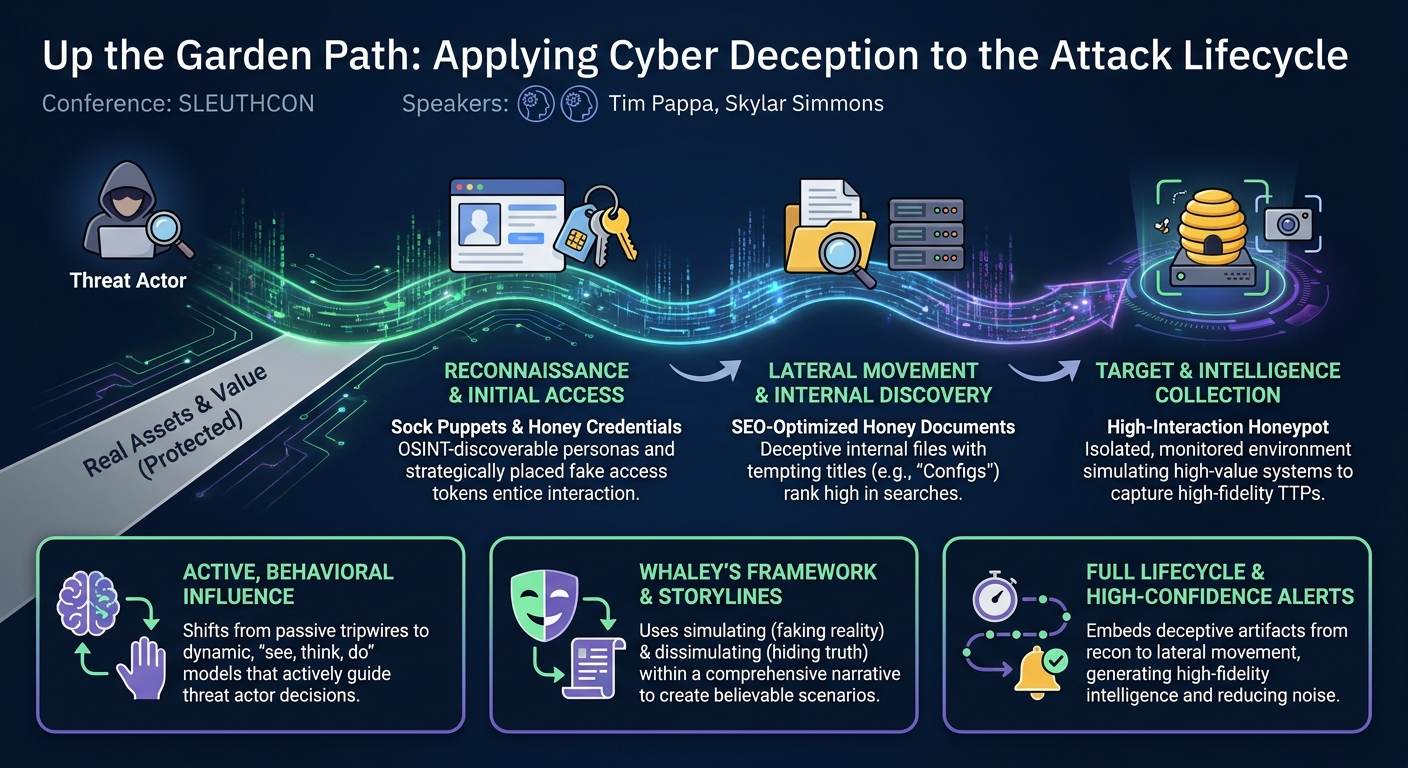
In "Up the Garden Path: Applying Cyber Deception to the Attack Lifecycle," Tim Pappa and Skylar Simmons from Walmart Global Tech present a compelling case for a dynamic, behaviorally-based approach to cyber deception. Moving beyond static tripwires and passive honeypots, their methodology focuses on actively influencing the decision-making and subsequent behaviors of financially motivated threat actors. The core premise is to observe actual threat actor behaviors, then design and deploy deceptive artifacts and infrastructure that guide adversaries down a predetermined "garden path," away from valuable assets and into controlled environments where their actions can be meticulously monitored.
Key moments
- 0:00 Introduction: Influencing threat actor decisions and behaviors
- 0:40 Applying Whaley's Deception Framework: Simulating and Dissimulating
- 2:05 The critical role of comprehensive narratives and storylines
- 2:40 Deception tactics for Recon and Initial Access phases
- 3:45 Honey documents leading threat actors to honeypots
- 4:05 Case Study: Operation Hungry Dog - Targetable sock puppet
- 5:00 SEO optimizing honey documents for internal discoverability
- 5:55 Key benefit: Increasing fidelity of security alerts
Up the Garden Path: Applying Cyber Deception to the Attack Lifecycle
Speakers: Tim Pappa (Incident Response Engineer, Walmart Global Tech); Skylar Simmons (Walmart)
Conference: SLEUTHCON
YouTube: https://www.youtube.com/watch?v=vEHg9hRyJ9c
Overview
In "Up the Garden Path: Applying Cyber Deception to the Attack Lifecycle," Tim Pappa and Skylar Simmons from Walmart Global Tech present a compelling case for a dynamic, behaviorally-based approach to cyber deception. Moving beyond static tripwires and passive honeypots, their methodology focuses on actively influencing the decision-making and subsequent behaviors of financially motivated threat actors. The core premise is to observe actual threat actor behaviors, then design and deploy deceptive artifacts and infrastructure that guide adversaries down a predetermined "garden path," away from valuable assets and into controlled environments where their actions can be meticulously monitored.
The talk introduces a structured framework for cyber deception, integrating principles from Barton Whaley, a renowned American deception scholar. This framework emphasizes simulating (making something fake appear real) and dissimulating (hiding the true nature of a deceptive artifact) to create believable scenarios. Crucially, the speakers highlight the necessity of a comprehensive narrative or storyline to tie together various deceptive elements, a component they frequently observe missing in industry and government programs. This holistic approach aims not just to detect but to deter, deny, and ultimately gain superior intelligence on threat actor tactics, techniques, and procedures (TTPs), significantly increasing the fidelity of security alerts.
Background
▶ Watch: Introduction: Influencing threat actor decisions and behaviors (0:00)
The landscape of cyber security has long been characterized by a reactive posture, where defenders primarily focus on detection and response after a breach has occurred. Traditional deception strategies, often limited to static honeypots or simple tripwires, frequently fall short against sophisticated and financially motivated threat actors. These passive defenses can be easily identified, bypassed, or simply ignored, failing to provide meaningful engagement or actionable intelligence. The problem persists because adversaries are not merely seeking vulnerabilities; they are making calculated decisions based on perceived information and acting upon those decisions within a network. Existing deception often lacks the dynamism and psychological depth to truly influence an attacker's thought process.
This talk addresses this gap by advocating for a paradigm shift: from passive observation to active influence. The speakers introduce Barton Whaley's expanded deception framework, a concept with deep roots in military research, which provides a structured methodology for designing and implementing effective deception. Whaley's framework differentiates between simulating (creating a false reality, e.g., making a fake server look real) and dissimulating (hiding the true nature of something, e.g., concealing a honeypot's identity). This nuanced approach allows for the construction of more believable and resilient deceptive environments. Furthermore, drawing on Whaley's background as a communication scholar, the talk stresses the often-overlooked importance of a comprehensive storyline or narrative. Without a cohesive narrative, individual deceptive artifacts remain isolated and less convincing, failing to effectively guide an adversary through the attack lifecycle. This problem exists because many organizations deploy deception tools without a strategic, human-centric understanding of how an attacker perceives and interacts with their environment.
Key Findings
▶ Watch: The critical role of comprehensive narratives and storylines (2:05)
The central finding of this presentation is that effective cyber deception is an active, dynamic, and behaviorally-driven process, fundamentally distinct from static security controls. The speakers articulate a "see, think, do" model, where the objective is to control what a threat actor "sees," thereby influencing what they "think," and ultimately dictating what they "do." This model is a direct response to observed threat actor behaviors, ensuring that deception efforts are relevant and impactful.
A significant contribution is the integration of Barton Whaley's deception framework into cyber security design. By categorizing deception techniques into simulating (making something appear to be what it is not) and dissimulating (hiding what something truly is), the framework provides a common language and a structured approach for building every deceptive artifact, piece of content, and infrastructure. This structured approach matures the design and build process, ensuring consistency and effectiveness.
Another key finding emphasizes the critical role of narratives and storylines. The speakers assert that a deception function cannot be effective without a comprehensive story that links various deceptive elements together into a believable path. This is identified as a common missing element in many existing deception programs. The talk demonstrates how a well-crafted narrative enhances the discoverability and credibility of deceptive assets, making them more appealing targets for adversaries.
Finally, the presentation highlights the practical benefits of this advanced deception strategy: a significant increase in the fidelity of security alerts. By guiding threat actors to interact specifically with deceptive assets, organizations can generate high-confidence alerts, distinguishing genuine malicious activity from background noise (like legitimate scans or accidental interactions). This not only reduces alert fatigue but also allows incident response teams to focus their efforts on confirmed threats, leading to more efficient and effective defensive actions.
Technical Deep Dive
▶ Watch: Honey documents leading threat actors to honeypots (3:45)
The technical approach to cyber deception outlined by Pappa and Simmons is deeply integrated with the phases of a typical attack lifecycle, demonstrating how deception can be applied at each stage to influence adversary behavior. This methodology moves beyond simple tripwires, focusing on creating a believable, interactive environment designed to misdirect and gather intelligence.
Reconnaissance Phase
The initial stage of any attack involves reconnaissance, where threat actors gather information about their target. Here, the deception strategy focuses on creating sock puppet accounts. These are fake personas designed to be discoverable and appealing to an adversary. As the speakers explain, these sock puppets can exist externally on social media platforms (e.g., LinkedIn) or internally within the network. The crucial aspect is discoverability. To ensure a sock puppet is found by a threat actor, defenders must actively use OSINT (Open-Source Intelligence) tools that an attacker would employ. For instance, creating a sock puppet profile for a "CIS admin" and ensuring it appears in relevant search results or public data aggregators makes it a plausible target. The profile would be enriched with details that make it seem like a legitimate, albeit potentially "sloppy," employee, such as public posts about their work, hobbies, or even political views, as seen in the "Operation Hungry Dog" example.
Initial Access Phase
Once an attacker has identified a target, they seek initial access. The deception strategy here involves deploying honey credentials. These are fake credentials strategically placed where a threat actor might look for them. A common scenario involves a sock puppet account, like the aforementioned CIS admin, having a personal GitHub repository. Within this repository, deceptive credentials (e.g., API keys, passwords) could be publicly posted, perhaps as part of a seemingly innocuous project. The key is that these credentials, while fake, appear to be legitimate and potentially grant access to a part of the network, or at least lead to further deceptive elements. The goal is to entice the attacker to use these credentials, triggering an alert when they interact with a controlled system.
Lateral Movement and Internal Reconnaissance Phase
After gaining initial access, threat actors typically perform internal reconnaissance and lateral movement to escalate privileges and find valuable assets. This is where the deception strategy becomes particularly sophisticated, leveraging honey documents and honeypots.
- Honey Documents: The speakers highlight the prevalence of threat actors searching internal knowledge portals like SharePoint and Confluence for sensitive information (passwords, API keys, network diagrams). To counter this, organizations can create deceptive documents that mimic legitimate internal resources. These documents would contain information that aligns with typical threat actor objectives, such as "ESXi server configurations," "network architecture diagrams," or "critical project passwords." Crucially, these documents are SEO-optimized within the internal search functionality of platforms like SharePoint and Confluence. This ensures they rank highly and are easily discovered when an attacker performs internal searches, making them more appealing than actual sensitive data. The content within these documents is crafted to lead the adversary towards specific deceptive infrastructure.
- Honeypots: The ultimate destination for an attacker following the deceptive trail is a honeypot. These are systems designed to appear as high-value targets but are in fact isolated, monitored environments. For example, honey documents discussing "ESXi servers" would contain references or links that lead directly to an ESXi honeypot. This honeypot simulates a real ESXi host, complete with plausible services and data, but is entirely controlled by the defenders. Any interaction with this honeypot, from scanning to attempted login or data exfiltration, immediately triggers a high-fidelity alert, confirming malicious intent and providing detailed intelligence on the attacker's TTPs without risking real assets.
Throughout these phases, the principles of simulating and dissimulating from Whaley's framework are paramount. Sock puppets simulate real employees, honey credentials simulate valid access, honey documents simulate legitimate internal knowledge, and honeypots simulate critical production systems. Simultaneously, the entire deceptive environment dissimulates its true nature, hiding the fact that it is a carefully constructed trap. The unifying force behind all these elements is the comprehensive storyline. This narrative ensures that each deceptive artifact logically connects to the next, creating a believable and compelling path that an adversary is likely to follow, guiding them "up the garden path" away from true value and into the defender's controlled environment.
Demo / Proof of Concept
▶ Watch: Case Study: Operation Hungry Dog - Targetable sock puppet (4:05)
The speakers illustrate their advanced deception methodology with a practical example dubbed "Operation Hungry Dog." This scenario provides a clear, step-by-step demonstration of how the framework is applied in practice to achieve the goals of deterring, denying, and detecting a specific threat.
The scenario posits that credible threat intelligence indicates an actor is specifically targeting the company's "dog food recipe" – a metaphor for highly sensitive intellectual property or critical business data. To protect this asset, a multi-layered deception campaign is deployed.
The first component of Operation Hungry Dog involves the creation of a sock puppet account named "James Fake Person." James is carefully crafted to be a plausible, yet somewhat vulnerable, target. His profile on LinkedIn describes him as a "dog food optimization engineer," indicating a direct connection to the target asset. To enhance his discoverability and targetability, James is made "vocal" about various personal interests, such as politics or football teams, and is portrayed as a "sloppy dev" who maintains a personal GitHub repository. This external presence is designed to attract the attention of a reconnaissance-minded threat actor.
The next layer of deception unfolds as James Fake Person exists within the internal network. The narrative dictates that James, as an "assist admin on the dog food servers," would naturally create and interact with relevant documents. These honey documents are strategically placed on internal platforms like SharePoint. Their titles, such as "dog food recipe optimization servers," are specifically designed to align with the threat actor's objective. Crucially, these documents are SEO-optimized within SharePoint, ensuring they appear prominently in internal searches. This technique leverages the fact that internal search engines often have configurable SEO rankings, which defenders can manipulate to prioritize their deceptive content.
The storyline culminates when a threat actor, having potentially identified James Fake Person through OSINT, gains initial access and begins internal reconnaissance. They might search for James's work or for terms related to "dog food recipe optimization." The SEO-optimized honey documents would then be discovered. These documents are engineered to contain references or links that guide the adversary directly to the dog food optimization honeypot. This honeypot is an isolated, monitored system designed to perfectly mimic the appearance and functionality of a legitimate server hosting the "dog food recipe."
The benefits of Operation Hungry Dog are multi-fold:
- Deterrence: By presenting a believable, yet ultimately fruitless, path, the operation aims to deter the actor from pursuing the actual sensitive data.
- Denial: The actor is denied access to the real dog food recipe, as their efforts are redirected to the honeypot.
- Detection: Any interaction with James Fake Person's external profile, his honey credentials, the honey documents, or especially the honeypot itself, triggers a high-fidelity alert. This alert signifies confirmed malicious activity, providing clear indicators of compromise (IOCs) and detailed TTPs of the adversary without the noise often associated with traditional deception systems (e.g., VM scanners). This proof of concept effectively demonstrates how a coherent narrative, combined with discoverable and integrated deceptive artifacts, can successfully misdirect and detect financially motivated threat actors.
Defensive Implications
▶ Watch: Key benefit: Increasing fidelity of security alerts (5:55)
The advanced cyber deception strategy presented by Tim Pappa and Skylar Simmons offers profound implications for defenders, shifting the defensive posture from purely reactive to proactively influencing adversary behavior. Implementing this approach can significantly enhance an organization's security posture and threat intelligence capabilities.
Firstly, this methodology advocates for a fundamental shift towards active defense. Rather than merely waiting for an attack to occur and then reacting, defenders actively construct environments designed to misdirect and engage adversaries on their terms. This proactive stance allows organizations to control the battlefield, guiding threat actors away from critical assets and into controlled environments.
A major benefit is the increased fidelity of security alerts. Traditional security tools often generate a high volume of alerts, many of which are false positives or low-priority events. By designing deception to attract specific, malicious interactions, any alert generated by an adversary engaging with a deceptive artifact (sock puppet, honey document, honeypot) carries a very high degree of confidence. This significantly reduces alert fatigue for security operations centers (SOCs) and allows incident response teams to focus their resources on verified threats, leading to more efficient and effective response actions. The speakers explicitly mention that while general deception strategies can be noisy (e.g., from VM scanners), their approach focuses on interactions with specific, carefully placed artifacts, thereby filtering out much of that noise.
Furthermore, this deception framework is a powerful tool for threat intelligence gathering. When adversaries interact with honey assets, defenders gain invaluable insights into their TTPs (Tactics, Techniques, and Procedures). This includes understanding their reconnaissance methods, initial access vectors, lateral movement techniques, preferred tools, and ultimate objectives. This intelligence can then be used to strengthen real defenses, predict future attacks, and develop more targeted countermeasures. It allows defenders to "see, think, and do" as the adversary does, turning their own methods against them.
The emphasis on Barton Whaley's framework provides a structured, repeatable methodology for designing deception. This means that deception is not a haphazard collection of tools but a thoughtfully engineered system. Organizations can use this framework to ensure that their deceptive artifacts are consistent, believable, and effectively contribute to a larger strategic goal. This structured approach ensures that deception efforts are scalable and maintainable, even in large and complex environments like Walmart's.
The critical role of narratives and storylines means that defenders must think creatively and empathetically about how an attacker perceives their target environment. Security teams need to move beyond purely technical considerations and develop a deeper understanding of adversary psychology and motivation. This involves creating believable personas, crafting compelling internal documents, and designing network paths that logically lead to deceptive targets. Investing in this narrative development ensures the effectiveness and longevity of deception campaigns.
Finally, implementing this strategy requires defenders to:
- Create believable sock puppet accounts (internal and external) and actively ensure their discoverability using OSINT techniques.
- Develop honey credentials and strategically place them in public or internal repositories.
- Craft SEO-optimized honey documents for internal knowledge portals that align with likely adversary search terms.
- Deploy sophisticated honeypots that mimic high-value production systems and are linked seamlessly to the narrative.
- Continuously monitor and adapt deception campaigns based on observed threat actor interactions and evolving TTPs.
By embracing these implications, organizations can transform their security posture from a passive target to an active participant in influencing and disrupting the cyber attack lifecycle.
Key Takeaways
- Dynamic, Behaviorally-Based Deception: Effective cyber deception moves beyond static tripwires, actively influencing threat actor decisions and behaviors through a "see, think, do" model based on observed adversary actions.
- Structured Deception Frameworks: Utilizing established methodologies like Barton Whaley's framework (simulating and dissimulating) provides a consistent and mature approach to designing and deploying deceptive artifacts and infrastructure.
- Crucial Role of Narratives: A comprehensive storyline or narrative is essential to connect disparate deceptive elements into a believable path, guiding adversaries away from real assets and into controlled environments.
- Integrated Attack Lifecycle Coverage: Deception should be applied across the entire attack lifecycle, from reconnaissance (sock puppets, OSINT discoverability) and initial access (honey credentials) to lateral movement and internal recon (honey documents, honeypots).
- High-Fidelity Alerting and Threat Intelligence: This advanced deception strategy significantly increases the fidelity of security alerts, reducing noise and providing invaluable, confirmed threat intelligence on adversary TTPs.
- Proactive Influence, Not Just Detection: The ultimate goal is to deter, deny, and detect by actively influencing adversary choices, directing their efforts towards meaningless targets, and gaining a strategic advantage.
About the Speaker(s)
Tim Pappa is an Incident Response Engineer at Walmart Global Tech. His expertise lies in developing and implementing advanced security strategies, including the cyber deception techniques discussed in this talk.
Skylar Simmons is also affiliated with Walmart. While a specific title was not provided in the transcript, her involvement in this presentation highlights Walmart's commitment to cutting-edge cybersecurity research and defense mechanisms.
Reviews
Dr. Zero (Offensive Security Researcher) — SOLID
Pappa and Simmons give a highly pragmatic playbook for making honeypots actually work by treating them like a psychological operation instead of a neglected script. Manipulating internal SharePoint SEO to feed ransomware operators fake ESXi credentials is a beautifully evil touch. It's not dropping zero-days, but it’s a deployable defensive doctrine that will absolutely ruin an initial access broker's week.
Heather Calloway (CISO) — SOLID
Deception is usually a vendor buzzword that consumes budget and delivers nothing. This talk rescues the concept by framing it as a highly operational tool to generate high-fidelity alerts and cut SOC noise. It is required reading for your detection and response leads.