Victims Beware: Threat Actors Are Monitoring Your Communications Strategy
Allie Bohan (Senior Director · FTI Consulting)
SLEUTHCON 2025 · Day 1 · Main Stage
Overview
In a revealing talk at SLEUTHCON, Allie Bohan, a Senior Director on the cyber and data privacy communications team at FTI Consulting, shed light on a critical, yet often overlooked, dimension of modern cyber incident response: the active monitoring and weaponization of victim communications by threat actors. Titled "Victims Beware: Threat Actors Are Monitoring Your Communications Strategy," Bohan's presentation unveiled how sophisticated extortionists are not merely exfiltrating data or encrypting systems, but are now meticulously scrutinizing public and stakeholder communications issued by compromised organizations. This intelligence is then leveraged to escalate pressure, re-extort victims, and even initiate physical threats.
Key moments
- 0:00 Introduction and speaker's role in cyber communications
- 1:00 How communication strategy can provoke threat actors
- 1:30 New aggressive extortion tactics: high-volume CEO outreach
- 2:10 Bone-chilling tactics: death threats and physical harm
- 4:40 Threat actors now actively monitoring victim communications
- 5:50 Messaging that provokes re-extortion: mentioning law enforcement
- 6:50 Messaging that provokes re-extortion: implying data deletion
- 7:50 Conclusion: extreme care needed in all communications
Victims Beware: Threat Actors Are Monitoring Your Communications Strategy
Speakers: Allie Bohan, Senior Director on the cyber and data privacy communications team, FTI Consulting
Conference: SLEUTHCON
YouTube: https://www.youtube.com/watch?v=VNDYDmAzPGo
Overview
In a revealing talk at SLEUTHCON, Allie Bohan, a Senior Director on the cyber and data privacy communications team at FTI Consulting, shed light on a critical, yet often overlooked, dimension of modern cyber incident response: the active monitoring and weaponization of victim communications by threat actors. Titled "Victims Beware: Threat Actors Are Monitoring Your Communications Strategy," Bohan's presentation unveiled how sophisticated extortionists are not merely exfiltrating data or encrypting systems, but are now meticulously scrutinizing public and stakeholder communications issued by compromised organizations. This intelligence is then leveraged to escalate pressure, re-extort victims, and even initiate physical threats.
Bohan’s insights underscore a significant shift in the adversary's playbook, moving beyond purely technical exploitation to incorporate psychological and strategic warfare. For incident response (IR) professionals, legal counsel, and corporate communications teams, this presents a formidable new challenge. The talk emphasized that every public statement, customer advisory, or employee communication during a cyber incident can be interpreted and used against the victim, potentially provoking further aggression or financial demands. This paradigm shift necessitates a complete re-evaluation of communication strategies during a breach, placing the potential reaction of the threat actor at the forefront of planning.
The implications of this trend are profound, impacting not only the financial and reputational fallout of an incident but also the personal safety of executives and their families. Bohan detailed how increasingly aggressive tactics, including overwhelming communication barrages and explicit death threats, are becoming more common. This talk serves as a stark warning and a call to action for organizations to integrate threat intelligence into their communication decision-making, recognizing that the adversary is always listening, watching, and strategizing.
Background
▶ Watch: Introduction and speaker's role in cyber communications (0:00)
For years, cyber extortion, particularly through ransomware, has been a dominant threat vector. Initially, threat actors focused on encrypting systems and demanding payment for decryption keys. This evolved into double extortion, where attackers not only encrypted data but also exfiltrated it, threatening public release if a ransom wasn't paid. As organizations became more resilient to encryption, the emphasis shifted increasingly towards data exfiltration and the threat of public disclosure, often accompanied by Distributed Denial of Service (DDoS) attacks or direct outreach to customers and partners.
Threat actors have long engaged in due diligence on their victims. This typically involved passive intelligence gathering, such as monitoring media reports, reviewing regulatory disclosures (e.g., SEC filings for public companies), and analyzing financial statements. This information helped them understand a victim's financial capacity, public image, and regulatory obligations, informing their ransom demands and negotiation strategies. Direct outreach to CEOs and leadership teams, while disruptive, is also not entirely new, serving as a tactic to bypass internal incident response teams and pressure decision-makers directly.
However, Allie Bohan highlights a critical escalation in these tactics. The problem now stems from threat actors moving beyond passive background research to active, real-time monitoring and analysis of an organization's incident-specific communications. This means that the carefully crafted messages intended for employees, customers, business partners, or the media are now being scrutinized by the very attackers they are designed to address or inform. This evolution creates a new attack surface: the organization's communication strategy itself. The underlying reason for this shift is the threat actors' relentless pursuit of leverage and their increasing sophistication in psychological manipulation, aiming to maximize their chances of payment and minimize any perceived damage to their own "reputation" within the cybercriminal ecosystem. This new frontier in extortion exploits the victim's need for transparency and stakeholder reassurance, turning these necessary communications into potential vulnerabilities.
Key Findings
▶ Watch: New aggressive extortion tactics: high-volume CEO outreach (1:30)
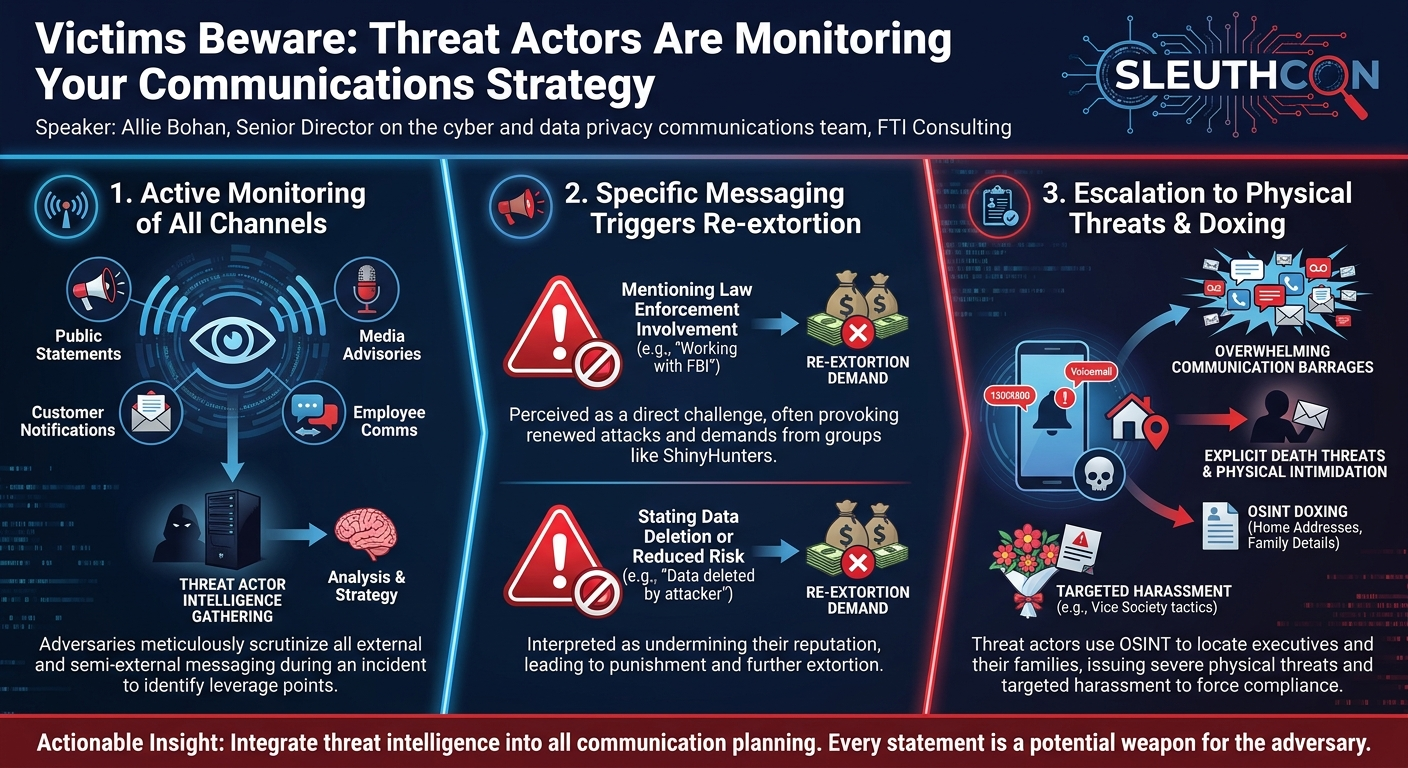
Allie Bohan’s presentation unveiled several critical findings that redefine the landscape of cyber extortion and incident response communications. The central revelation is that threat actors are no longer just observing victims from afar; they are actively and meticulously monitoring all forms of external and semi-external communications issued by compromised organizations during an active incident. This includes public statements, media advisories, customer notifications, and internal communications that might become externally visible.
The primary objective of this monitoring is to identify specific messaging that can be leveraged for re-extortion or to escalate pressure. Bohan identified two particularly problematic types of messaging that consistently provoke threat actors, leading to increased demands or renewed attacks:
- Mentioning Law Enforcement Involvement: When an organization communicates to its stakeholders that it is "working with law enforcement" (e.g., FBI, federal government agencies) to investigate an incident, threat actors, particularly aggressive groups like ShinyHunters, often react negatively. This line of communication is perceived as a direct challenge or a threat to their operations, prompting them to re-engage the victim with further extortion demands, even if an initial payment has already been made. Bohan cited instances where clients who had already paid a ransom were re-extorted by ShinyHunters specifically because they mentioned law enforcement collaboration in their public statements.
- Stating Data Deletion or Reduced Risk: Messaging that implies the exfiltrated data has been "deleted" or is "no longer at risk of misuse" is another major trigger. While intended to reassure stakeholders, this statement is often interpreted by threat actors as a public acknowledgment of a settlement or payment, implying that the attacker has fulfilled their end of a bargain (i.e., deleting the data). Groups like ShinyHunters dislike this messaging because they believe it publicly impacts their "reputation" within the cybercriminal community, potentially signaling that they are willing to delete data upon payment. This can lead to re-extortion, as they seek to punish the victim for undermining their perceived leverage or to demonstrate their continued control over the situation.
Beyond communication monitoring, Bohan highlighted a disturbing escalation in overall extortion tactics:
- Overwhelming Communication Attacks: Threat actors are employing tactics akin to a Distributed Denial of Service (DDoS) attack, but instead of targeting network infrastructure, they target individuals. CEOs and other leadership figures are receiving "upwards of several thousand texts or voicemails or emails" daily. This relentless barrage is designed to be highly disruptive, forcing executives to the negotiating table by making their day-to-day work impossible.
- Explicit Death Threats and Physical Intimidation: This represents one of the most "bone-chilling tactics." Bohan noted multiple clients receiving direct death threats, sometimes referencing specific public events like the United Healthcare CEO's death in 2024. More alarmingly, threat actors are leveraging Open Source Intelligence (OSINT) to obtain personal information, including executives' home addresses and details about their relatives. In one egregious case involving Vice Society, the threat actor sent a bouquet of flowers and a condolence note to a CEO's home address, accompanied by messages like, "We know where you live. We have the address of all your relatives. At the end of the period, we advise you to keep a better eye on your family." This tactic not only generates immense fear but also raises serious considerations around swatting and other forms of physical harm.
These findings collectively paint a picture of an adversary that is increasingly aggressive, sophisticated, and willing to cross traditional boundaries of cybercrime into direct psychological and physical intimidation. The "end" of an incident, even after payment, is no longer a certainty, as re-extortion based on communication strategy becomes a tangible risk.
Technical Deep Dive
▶ Watch: Threat actors now actively monitoring victim communications (4:40)
While the core subject of Allie Bohan's talk centered on communication strategy, the underlying "technical" aspects lie in the methodologies and tools threat actors employ to achieve their objectives. This isn't about exploiting software vulnerabilities, but rather exploiting information flows and human psychology using increasingly sophisticated digital and open-source intelligence techniques.
The primary "technical deep dive" here revolves around the threat actors' information reconnaissance and monitoring capabilities. Traditionally, threat actors have leveraged Open Source Intelligence (OSINT) to gather background information on victim organizations. This includes:
- Public Media Monitoring: Tracking news articles, press releases, and industry reports related to the victim.
- Regulatory Filings: Analyzing public documents from regulatory bodies (e.g., SEC filings for publicly traded companies) to understand financial health, legal obligations, and prior incidents.
- Social Media Monitoring: Observing corporate social media accounts and, increasingly, professional profiles of executives.
What Bohan highlights as a significant evolution is the active and real-time monitoring of incident-specific communications. This implies a dedicated effort to ingest and analyze all public-facing statements an organization makes during an active cyber incident. This could involve automated scraping of corporate newsrooms, real-time monitoring of major news outlets, and even tracking of customer-facing portals or employee communication platforms if they are publicly accessible or become leaked. The "technical" aspect here is the establishment of a robust intelligence gathering operation by the threat actors to ensure they don't miss any relevant communication.
The "technical" application of this intelligence manifests in several ways:
- Automated Communication Barrages: To achieve the "thousands of texts or voicemails or emails" described, threat actors likely employ automated or semi-automated tools. This is akin to a spam botnet or a social engineering toolkit scaled for individual targeting.
- Email & SMS Gateways: Utilizing compromised accounts, bulk email services, or SMS gateways to send high volumes of messages.
- Voicemail Drops: Leveraging Voice over IP (VoIP) services or automated dialers to leave pre-recorded messages directly in voicemails, bypassing the need for a live call.
- Contact Information Acquisition: This requires extensive OSINT to gather personal phone numbers, email addresses, and even home addresses of executives and their families. Sources include public records, data brokers, leaked databases, and social media profiles.
- Targeted Psychological Warfare: The precision of threats, such as referencing the United Healthcare CEO's death or sending a bouquet of flowers to a specific home address, demonstrates a high level of operational security and intelligence gathering.
- Advanced OSINT for Doxing: Threat actors like Vice Society are performing deep dives into public and semi-public records to uncover sensitive personal information. This can involve cross-referencing data from various breaches, social media profiles, property records, and even voter registrations.
- Psychological Profiling: Understanding the impact of specific threats (e.g., targeting family members, invoking recent traumatic events) to maximize distress and pressure. This is a non-technical skill but relies on the technical capability to gather the necessary personal data.
- Re-extortion Triggers: The identification of specific phrases like "working with law enforcement" or "data deleted" indicates that threat actors like ShinyHunters are using keyword monitoring or natural language processing (NLP) techniques, possibly even manual review, to parse victim communications for these specific triggers. Their rapid response suggests a continuous monitoring loop. The "technical" challenge for them is to efficiently process a potentially large volume of text and identify these critical phrases in real-time.
In essence, the "technical deep dive" reveals that modern cyber extortion extends far beyond malware and network intrusions. It encompasses advanced information gathering, automation of communication attacks, and sophisticated OSINT capabilities to enable highly targeted and psychologically damaging extortion tactics. The architecture here is one of information flow and analysis, where the victim's own attempts at transparency become weaponized data points for the adversary.
Demo / Proof of Concept
▶ Watch: Messaging that provokes re-extortion: mentioning law enforcement (5:50)
While Allie Bohan's presentation did not include a live technical demonstration of threat actor tools or exploits, it powerfully conveyed the "proof of concept" through compelling real-world evidence in the form of screenshots and vivid anecdotes from actual incidents. These examples served as irrefutable validation of the aggressive and sophisticated tactics being employed by modern extortion groups.
Bohan presented several screenshots that illustrated the overwhelming nature of the communication barrages:
- Mass Text Message Barrage: One screenshot depicted a conversation from a CEO who reported receiving "almost 2,000 texts" from the threat actor overnight, noting, "They're not backing off. In fact, it's heavier." This visual evidence highlighted the sheer volume and relentless nature of these digital assaults, which continued for days, effectively ambushing the CEO with texts, voicemails, and emails. This demonstrated how threat actors aim to disrupt and overwhelm leadership, forcing engagement through sheer exhaustion and pressure.
Even more chilling were the examples demonstrating the shift towards physical intimidation and doxing:
- Ominous Note from Vice Society: A screenshot of a message from the threat actor group Vice Society to a CEO contained the chilling lines: "We know where you live. We have the address of all your relatives. At the end of the period, we advise you to keep a better eye on your family." This concrete example underscored the threat actors' capabilities in Open Source Intelligence (OSINT) and their willingness to use highly personal information for intimidation.
- Physical Intimidation: Complementing the Vice Society screenshot, Bohan recounted an incident where this particular threat actor went beyond digital messages, physically sending "a bouquet of flowers and a condolence note to the CEO" at their home address. This disturbing detail provided undeniable proof of the tangible, real-world impact of these threats, transforming cyber extortion into a direct physical security concern for executives and their families.
Furthermore, Bohan described the "proof of concept" for re-extortion based on communication content, though without direct screenshots of the re-extortion notes themselves. She specifically detailed how the group ShinyHunters had re-extorted clients who had either mentioned "working with law enforcement" or stated that "exfiltrated data has since been deleted or perhaps is no longer at risk of misuse" in their communications to stakeholders. These narratives, drawn from FTI Consulting's direct client experiences, served as powerful anecdotal evidence of how specific messaging choices directly provoked renewed attacks and demands, even after initial payments had been made.
These examples, while not traditional technical demonstrations, served as critical real-world "proof points" for Bohan's central thesis, illustrating the severity, specificity, and evolving nature of threat actor tactics in the current cyber threat landscape.
Defensive Implications
▶ Watch: Conclusion: extreme care needed in all communications (7:50)
The insights presented by Allie Bohan necessitate a fundamental re-evaluation of incident response (IR) strategies, particularly concerning stakeholder communications. Organizations must adopt a proactive and highly cautious approach, recognizing that every public utterance can be scrutinized and weaponized by threat actors.
- Integrate Threat Intelligence into Communications Planning: Communication teams can no longer operate in a silo. They must work hand-in-hand with IR, legal, and threat intelligence teams. Before any statement is released, it should be vetted not only for legal and reputational risk but also for potential interpretation and exploitation by the threat actor. This includes understanding the specific tactics and sensitivities of known threat groups.
- Strategic Messaging Review: Organizations must carefully scrutinize their communications for "trigger phrases" that are known to provoke threat actors. Specifically, avoid:
- Directly stating collaboration with law enforcement: While the intent is to reassure, it can be seen as a challenge. If law enforcement is involved, consider more ambiguous phrasing or omitting this detail in public statements unless legally required.
- Announcing data deletion or reduced risk post-negotiation: This can signal a settlement and potentially damage the threat actor's "reputation," leading to re-extortion. Focus on ongoing monitoring and protective measures instead.
- Assume All Communications Are Monitored: This extends beyond official press releases to include customer advisories, employee memos, social media posts, and even internal communications that might be leaked or accessed. Organizations should operate under the assumption that threat actors have a complete view of their communication strategy.
- Prepare for Multi-Vector Extortion and Harassment: IR plans must account for overwhelming communication attacks (thousands of texts, emails, voicemails) against executives. This requires:
- Executive Protection Protocols: Implement robust measures to protect executives and their families from doxing, physical threats, and swatting. This includes reviewing personal information available online, enhancing physical security, and providing training on managing personal digital footprints.
- Crisis Communication Channels: Establish secure, alternative communication channels for leadership that can withstand digital barrages.
- Reconsider the "End" of an Incident: The concept of an incident concluding after an initial payment or data recovery is increasingly outdated. Organizations must be prepared for the possibility of re-extortion, especially if their subsequent communications inadvertently provoke the adversary. Post-incident monitoring for threat actor activity and continued vigilance are paramount.
- Enhance OSINT Capabilities for Defense: Organizations should proactively conduct OSINT on their own executives and critical personnel to identify and mitigate publicly available personal information that could be used for doxing or physical threats. This "adversary emulation" helps understand potential attack vectors.
- Legal and Regulatory Nuances: Balancing transparency requirements (e.g., GDPR, CCPA, SEC disclosure rules) with the need to avoid provoking threat actors is a complex challenge. Legal counsel must be deeply integrated into the communication strategy, helping to craft statements that meet regulatory obligations without unnecessarily escalating the threat.
By integrating these defensive implications into their incident response frameworks, organizations can better protect themselves from the evolving and increasingly aggressive tactics of cyber extortionists, moving beyond purely technical defenses to encompass strategic communication and executive safety.
Key Takeaways
- Threat actors are actively monitoring and analyzing all forms of victim communications during a cyber incident, leveraging this intelligence for further extortion.
- Certain messaging choices, specifically mentioning law enforcement involvement or the deletion of exfiltrated data, can provoke re-extortion, even after an initial payment has been made.
- Extortion tactics are escalating to include overwhelming communication barrages (thousands of texts/emails) and severe physical threats, including doxing of executives' home addresses, death threats, and physical intimidation (e.g., sending condolence notes).
- Groups like ShinyHunters are particularly known for re-extortion based on communication content, while Vice Society has been linked to physical intimidation tactics.
- Incident response communication strategies must be completely re-evaluated, with every statement vetted for its potential impact on threat actor behavior.
- Organizations must enhance executive protection measures and integrate threat intelligence deeply into their IR and communication planning, recognizing that the "end" of an incident is increasingly fluid and unpredictable.
About the Speaker(s)
Allie Bohan is a Senior Director on the cyber and data privacy communications team at FTI Consulting. In her role, she specializes in advising clients navigating active cyber incidents. Her expertise lies in guiding organizations on how to effectively engage and communicate with a diverse range of stakeholders, including customers, employees, business partners, media, and regulators, throughout the lifecycle of a cyber crisis. Her work directly addresses the complex interplay between technical incident response and strategic public relations in the face of evolving cyber threats.
Reviews
Dr. Zero (Offensive Security Researcher) — STRONG ACCEPT
Comms talks are usually a waste of a conference slot, but Bohan brought actual receipts from the IR trenches. Showing exactly how groups like ShinyHunters and Vice Society weaponize corporate PR to re-extort or swat executives is pure, actionable signal. It’s a mandatory reality check for any CISO who lets legal draft breach notifications in a vacuum.
Heather Calloway (CISO) — STRONG ACCEPT
A stark, highly actionable briefing on how extortion groups weaponize our own incident communications against us. It forces a direct confrontation between what our crisis comms teams want to say, what regulators require us to say, and what will trigger a second extortion demand.