The Watched Watching Back: North Korean Threat Actors Investigate Public Threat Intelligence
Sreekar Madabushi (Founding Engineer · Validin), Aleksandar Milenkoski (Senior Threat Researcher · SentinelLABS)
SLEUTHCON 2025 · Day 1 · Main Stage
Overview
In a revealing talk at SLEUTHCON, Sreekar Madabushi of Validin and Aleksandar Milenkoski of SentinelLABS unveiled a fascinating case study demonstrating how North Korean threat actors are actively and systematically investigating public threat intelligence. Titled "The Watched Watching Back," the presentation detailed an unprecedented level of visibility into the operational security (OpSec) and infrastructure lifecycle management practices of Contagious Interview, a notorious North Korean state-sponsored group. This talk is crucial for the cybersecurity community, offering a rare glimpse into the adversary's perspective: how they leverage publicly available information, adapt their tactics, and even make observable mistakes in their efforts to maintain persistent operations.
Key moments
- 0:00 Introduction: North Korean actors sign up
- 2:00 Attributing sign-ups to North Korean threat actors
- 3:37 Valadin's response and actors' persistent return
- 5:30 Discovering North Korean actors' Slack collaboration
- 7:10 Why actors don't make widespread infrastructure changes
- 8:20 Tracking infrastructure lifecycle from actor searches
- 10:00 North Korean OpSec mistakes: open directories
- 10:40 Key takeaways: monitoring, collaboration, and infra management
The Watched Watching Back: North Korean Threat Actors Investigate Public Threat Intelligence
Speakers: Sreekar Madabushi (Founding Engineer, Validin); Aleksandar Milenkoski (Senior Threat Researcher, SentinelLABS)
Conference: SLEUTHCON
YouTube: https://www.youtube.com/watch?v=UxRQIPWFfok
Overview
In a revealing talk at SLEUTHCON, Sreekar Madabushi of Validin and Aleksandar Milenkoski of SentinelLABS unveiled a fascinating case study demonstrating how North Korean threat actors are actively and systematically investigating public threat intelligence. Titled "The Watched Watching Back," the presentation detailed an unprecedented level of visibility into the operational security (OpSec) and infrastructure lifecycle management practices of Contagious Interview, a notorious North Korean state-sponsored group. This talk is crucial for the cybersecurity community, offering a rare glimpse into the adversary's perspective: how they leverage publicly available information, adapt their tactics, and even make observable mistakes in their efforts to maintain persistent operations.
The investigation began on March 11th when Kenneth, Validin's founder, published a blog post detailing infrastructure used by the Lazarus Group in the lead-up to the Bybit heist. The very next day, Validin's community platform experienced an unusual surge of sign-ups from numerous Gmail accounts. What initially appeared to be a simple influx quickly escalated into a high-stakes intelligence operation when researchers recognized the email addresses as belonging to known North Korean threat actors associated with Contagious Interview. This incident provided Validin with a unique opportunity to observe, track, and analyze the adversary's direct interaction with a threat intelligence platform, shedding light on their methodologies for scouting new infrastructure, monitoring for detection, and collaborating internally.
The insights gained from this observation period are invaluable for defenders. By understanding how groups like Contagious Interview consume and react to threat intelligence, security professionals can refine their own strategies, enhance their OpSec, and develop more effective detection and disruption capabilities. The talk not only exposed specific adversary behaviors but also highlighted critical vulnerabilities in their operational processes, particularly during the initial phases of infrastructure acquisition and deployment. This direct observation challenges conventional assumptions about adversary sophistication, revealing that even state-sponsored groups are prone to significant OpSec errors that can be exploited for defensive advantage.
Background
▶ Watch: Introduction: North Korean actors sign up (0:00)
The context for this unique investigation is rooted in the ongoing cat-and-mouse game between threat actors and the cybersecurity community. North Korean state-sponsored groups, such as the Lazarus Group and Contagious Interview, are known for their sophisticated and persistent campaigns aimed at espionage, financial gain, and disruptive attacks. The Lazarus Group, in particular, has been implicated in high-profile incidents like the Bybit heist, a cryptocurrency theft, demonstrating their focus on financial illicit activities to fund regime operations. Validin, as a threat intelligence platform, serves as a repository for indicators of compromise (IOCs) and attribution information, making it a natural target for adversaries seeking to understand what intelligence the community holds about them.
Contagious Interview, the primary focus of this talk, is a North Korean threat actor infamous for its social engineering tactics. Their modus operandi typically involves posting fake job openings to entice potential candidates. Once an individual engages with the fake recruitment process, they are prompted to download and install malicious scripts, ultimately granting the actors unauthorized access to their devices for espionage or financial exploitation. This talk provided evidence that Contagious Interview's operations extend beyond direct victim interaction to actively monitoring the public threat intelligence landscape.
A critical element of the attribution process for Validin involved prior work by a researcher in the audience, who had been tracking Contagious Interview activity. This previous research revealed that the threat actors frequently left a JavaScript web application, app.js, publicly accessible on their malware staging servers. These app.js files were not intended for victims but rather for the operators themselves, containing JSON objects with lists of email addresses used by Contagious Interview operators to receive notifications about victim interactions. Validin had been assisting the researcher in collecting these files, leading to a pre-existing database of known Contagious Interview email addresses. This "cheat sheet" proved instrumental when the suspicious Gmail accounts began signing up for Validin's platform, allowing for rapid and definitive attribution to the North Korean group. The combination of this prior intelligence with real-time observation created an unparalleled opportunity to study adversary behavior.
Key Findings
▶ Watch: Valadin's response and actors' persistent return (3:37)
The investigation yielded several pivotal findings that illuminate the operational methodologies and strategic thinking of North Korean threat actors, specifically Contagious Interview:
- Rapid and Definitive Attribution: The initial influx of sign-ups was quickly attributed to Contagious Interview through a combination of factors:
- Email Pivoting: The newly registered Gmail accounts were linked to known Contagious Interview domains via registration records.
- VPN Usage: The vast majority of the actors' activity on Validin originated from Astrill VPN, a virtual private network service widely recognized as a preferred tool for North Korean threat actors.
- Pre-existing Intelligence: Validin had previously collected known Contagious Interview email addresses from publicly exposed
app.jsfiles on their staging servers, allowing for immediate recognition.
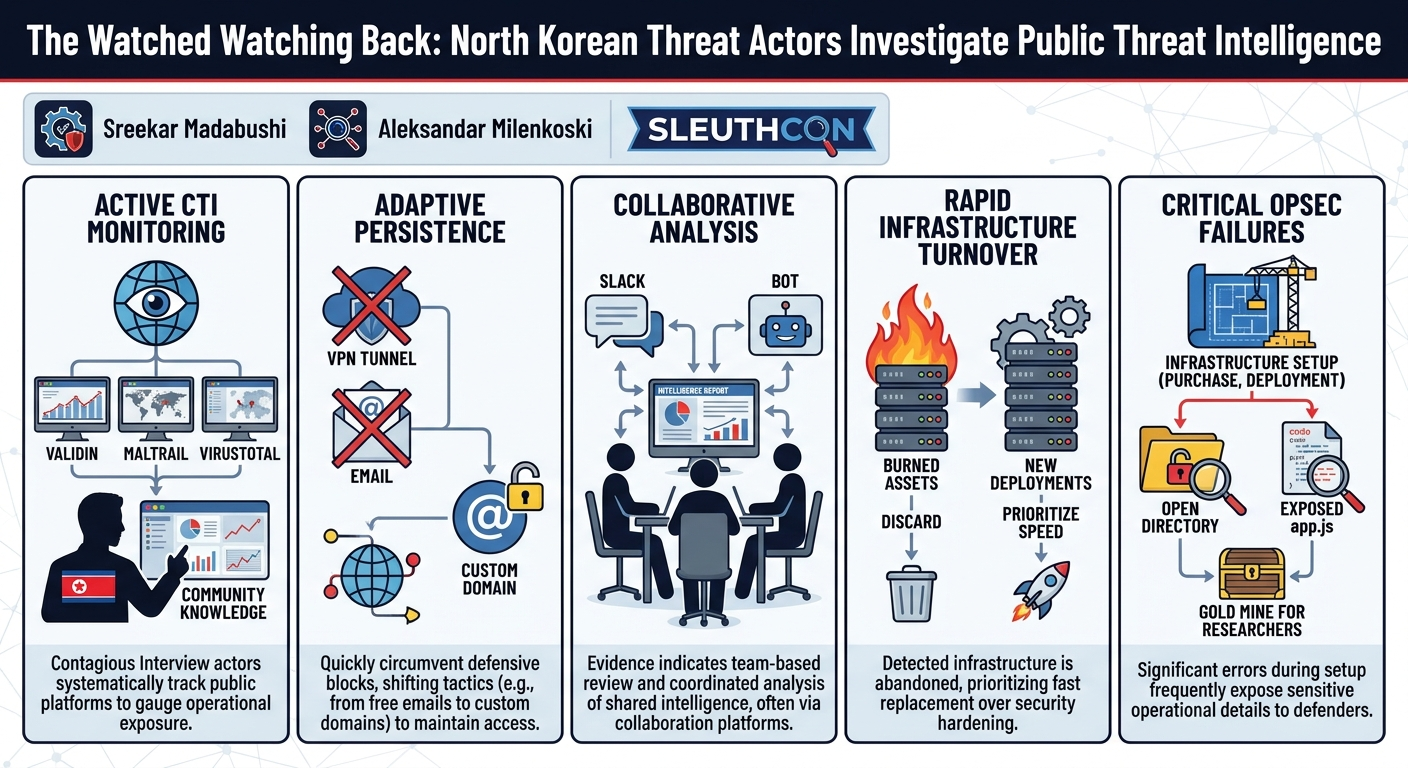
- Adversary Adaptability and Persistence: Following Validin's immediate defensive actions (banning emails, blocking Astrill VPN, restricting free email sign-ups), the actors demonstrated persistence. Two weeks later, they attempted to re-register, this time utilizing emails associated with their own infrastructure, circumventing the initial blocks. This adaptive behavior highlights their determination to access threat intelligence.
- Systematic CTI Monitoring: Contagious Interview actively integrates public CTI platforms like Validin, MalTrail, and VirusTotal into their daily routines. They performed 57 unique searches on Validin, including IP addresses, domains, and hashes. Crucially, they never searched for IOCs related to the Lazarus Group or the Bybit heist from the original blog post that likely alerted them to Validin. Instead, their searches focused exclusively on their own Contagious Interview infrastructure, indicating a proactive effort to identify public intelligence about their operations.
- Collaborative Operations: Evidence from web server logs strongly suggested that the actors used Slack for internal collaboration and coordination. When a Validin search URL was shared in Slack, Slackbot robots would make requests to preview the link, followed by distinct requests from multiple Contagious Interview accounts using the same URL. This illustrates a structured, collaborative approach to CTI investigation.
- Limited but Targeted Infrastructure Changes: Despite actively monitoring CTI, the actors did not implement widespread or systematic changes to their infrastructure. Instead, they made specific, targeted adjustments. For example, after the "skill_master" HTML title was published as an IOC, they changed the title on only a few of their websites. This suggests a reactive, rather than a proactive, approach to OpSec hardening post-detection.
- "Burned" Infrastructure Mentality: The speakers concluded that Contagious Interview likely considers any infrastructure flagged or detected by the community as "burned." Their strategy then shifts not to securing the compromised infrastructure, but to immediately planning and scaling up new infrastructure to compensate for losses and sustain operations.
- Unique Visibility into Infrastructure Lifecycle and OpSec Flaws: Validin's unique access to its own logs provided an unparalleled view into the entire lifecycle of Contagious Interview's infrastructure, from scouting and vetting to deployment and monitoring. This revealed frequent and significant OpSec mistakes, particularly in the early stages. Examples included open directories and publicly accessible
app.jspaths that exposed sensitive internal files and timestamps, presenting a "gold mine" for researchers. This visibility allowed researchers to map specific searches to the purchase and deployment of new infrastructure, offering concrete timelines of their activities.
Technical Deep Dive
▶ Watch: Why actors don't make widespread infrastructure changes (7:10)
The technical depth of this investigation stems from Validin's ability to combine multiple intelligence sources and internal platform logs to reconstruct adversary activity. The attribution process itself was a multi-layered technical exercise:
Firstly, the initial surge of Gmail sign-ups on March 12th immediately raised suspicion. Validin's team performed pivot analysis on the registration records associated with these Gmail accounts. This revealed that the same email addresses had been used to register a number of domains previously identified as belonging to Contagious Interview. This cross-referencing provided the first strong indicator of North Korean involvement.
Secondly, the network telemetry played a crucial role. Validin observed that the vast majority of the suspicious activity on its platform originated from IP addresses associated with Astrill VPN. This VPN service has a documented history of being favored by North Korean threat actors for obfuscating their true origin, further solidifying the attribution.
However, the most definitive attribution came from a "cheat" — prior intelligence collected in collaboration with researcher the researcher. As part of tracking Contagious Interview's operations, Validin had helped identify and collect numerous app.js files from the actors' publicly accessible malware staging servers. These JavaScript files, intended for internal operator notifications, contained JSON objects that explicitly listed the email addresses used by Contagious Interview operators. Having a pre-existing database of these known North Korean email addresses allowed Validin to immediately confirm the identity of the new sign-ups.
Upon confirming the adversary's presence, Validin implemented a series of rapid defensive measures within 30 minutes:
- All identified Contagious Interview email accounts were banned from the Validin platform.
- IP addresses associated with Astrill VPN were blocked at the firewall level.
- A policy was instituted to prevent sign-ups using free email services (e.g., Gmail, Proton Mail) without specific administrative intervention, adding a layer of friction for anonymous registrations.
Despite these measures, the Contagious Interview actors demonstrated sophisticated persistence. Two weeks later, they reappeared, attempting to sign up again. This time, however, they had adapted their approach, using email addresses tied to their own infrastructure rather than generic free email services. This adaptation allowed Validin to make a strategic decision: instead of immediately banning them again, they allowed these accounts to operate. This provided an unprecedented opportunity to monitor their search patterns and discover additional Contagious Interview infrastructure by pivoting off these new domain-associated emails.
The detailed technical analysis of their CTI consumption revealed several insights:
- Search Behavior: The actors conducted 57 unique searches, targeting IP addresses, domains, and hashes. Critically, their searches were not for the IOCs published in the original Validin blog post about Lazarus/Bybit, but exclusively for indicators related to their own Contagious Interview operations. This suggests a direct interest in understanding what the public intelligence community knows about them.
- Click Flow Reconstruction: Validin's internal log data allowed researchers to reconstruct the actors' click flow within the platform. They observed a consistent pattern where, after inputting a search term, the actors would immediately pivot to "reputation factors," which are external links within Validin providing attribution information about a given IOC. This indicates a clear investigative intent to gather context and attribution data.
- Collaboration via Slack: Web server logs provided compelling evidence of internal collaboration. The observed sequence involved an account, dubbed "Jim," searching for a domain (e.g.,
webcamixer.online) on Validin and then pasting the Validin search URL into a Slack channel. The subsequent appearance of requests from Slackbot robots (Slack's web agents that generate thumbnail previews for URLs) confirmed the use of Slack. Crucially, these Slackbot requests were then followed by four distinct requests for the same URL from different IP addresses, mapped to known Contagious Interview accounts. This demonstrated a coordinated, collaborative review of the shared CTI.
Perhaps the most significant technical finding was the unique visibility into the entire infrastructure lifecycle of Contagious Interview. Validin’s logs allowed researchers to map specific searches to the actual purchasing and deployment of new infrastructure:
- Scouting Phase: The actors were observed searching for similarly themed domains, such as
hiring,assessment, andhireassessment. This activity occurred before these domains were registered, indicating a scouting and vetting process for new infrastructure. - Deployment Timeline: A specific example highlighted a domain being searched on March 25th at 5:33. Less than 8 minutes later, the domain was registered. Content was subsequently deployed on this domain by April 22nd, and it was last observed resolving on May 13th. This timeline provides concrete evidence of rapid infrastructure acquisition and deployment following a perceived need.
- OpSec Failures: Throughout this lifecycle, the actors frequently made OpSec mistakes. These included leaving open directories accessible and, critically, exposing the
app.jspath on second-stage domains. These publicly accessibleapp.jsfiles, identical to those identified in the initial attribution, allowed researchers to pull sensitive internal files and observe timestamps that should never have been public. This phase of infrastructure purchasing, deployment, and management was described as a "gold mine" for researchers due to the abundance of observable OpSec flaws.
Demo / Proof of Concept
▶ Watch: Tracking infrastructure lifecycle from actor searches (8:20)
While the talk did not feature a live demonstration of a tool or a traditional proof-of-concept exploit, the speakers effectively presented their findings by meticulously reconstructing the adversary's actions and interactions with the Validin platform. The "demonstration" in this context was the comprehensive presentation of log data analysis, network telemetry, and observed adversary behavior that collectively served as empirical proof of their claims.
The speakers utilized screenshots of Validin's platform interface to illustrate the search terms used by the North Korean actors and their subsequent click paths, such as pivoting to "reputation factors." They visually represented the web server log data to show the sequence of events, from an actor's search query to the sharing of a URL in Slack, followed by the distinctive requests from Slackbot and multiple Contagious Interview accounts. This reconstruction provided a clear "walkthrough" of the adversary's digital footprint.
Furthermore, the presentation included timelines and diagrams mapping the observed searches to the actual registration and deployment of new Contagious Interview infrastructure. This visual evidence demonstrated the unique visibility Validin had into the adversary's infrastructure lifecycle, effectively showcasing how their internal data provided an unparalleled "proof of concept" for tracking and understanding the threat actors' real-world operations and OpSec failures. The exposure of publicly accessible app.js files and open directories served as tangible evidence of the OpSec mistakes described, allowing the audience to understand the direct consequences of these errors.
Defensive Implications
▶ Watch: Key takeaways: monitoring, collaboration, and infra management (10:40)
The insights gleaned from "The Watched Watching Back" carry significant defensive implications for organizations and the broader cybersecurity community. Understanding how North Korean threat actors operate, adapt, and make mistakes when consuming threat intelligence can directly inform more robust defensive strategies.
- Proactive Monitoring of Adversary CTI Consumption: Organizations publishing threat intelligence should actively monitor their platforms for signs of adversary access. This includes tracking suspicious sign-ups, unusual IP sources (e.g., known VPNs used by state actors like Astrill VPN), and search patterns. Identifying when adversaries are "watching back" provides a unique opportunity to gather intelligence on their current priorities and infrastructure.
- Enhance Threat Intelligence Platform Security: Developers of CTI platforms should implement robust security measures beyond basic authentication. This includes stricter controls on free email sign-ups, IP reputation checks, and potentially multi-factor authentication for higher-tier access. The ability to detect and adapt to adversary attempts to circumvent blocks (e.g., switching from free emails to custom domains) is crucial.
- Leverage Adversary OpSec Mistakes: The talk highlighted frequent OpSec mistakes by Contagious Interview, particularly during the infrastructure acquisition and deployment phases (e.g., open directories, exposed
app.jsfiles). Defenders should actively hunt for these types of flaws on newly registered or observed adversary infrastructure. This "gold mine" of information can reveal internal operational details, C2 infrastructure, and even operator identities. Focusing intelligence collection efforts on the early stages of the adversary's infrastructure lifecycle can yield significant dividends.
- Understand Adversary Prioritization of Infrastructure: The "burned" infrastructure mentality of Contagious Interview suggests that investing heavily in hardening already-detected infrastructure may not be their priority. Instead, defenders should anticipate rapid shifts to new infrastructure. This implies that takedown efforts, while valuable, must be coupled with continuous monitoring for new deployments and an understanding of their rapid compensation strategies. Defensive efforts should focus on early detection of new infrastructure rather than prolonged engagement with compromised assets.
- Focus on Collaborative Intelligence Sharing: The evidence of Contagious Interview using Slack for internal coordination underscores the value of collaborative intelligence. Defenders should foster strong internal and external collaboration channels to rapidly share new IOCs, TTPs, and observed adversary behaviors. The faster intelligence is shared, the quicker the adversary's operational window can be closed.
- Refine Attribution Techniques: The multi-faceted attribution approach (email pivoting, VPN correlation, pre-existing intelligence) demonstrated in this talk serves as a model for robust threat actor identification. Defenders should integrate various data points, including network telemetry, open-source intelligence, and historical adversary data, to build comprehensive attribution dossiers.
- Consider the "Why" Behind Adversary Searches: The fact that Contagious Interview exclusively searched for their own infrastructure, rather than the original Lazarus IOCs, is a critical insight. It suggests a defensive posture on their part—an attempt to gauge the public's knowledge of their operations. Defenders can use this to infer adversary priorities and adjust their intelligence dissemination strategies accordingly, potentially baiting or misleading adversaries with specific intelligence drops.
Key Takeaways
- North Korean threat actors (Contagious Interview) actively monitor public threat intelligence platforms like Validin, MalTrail, and VirusTotal to track community knowledge about their operations.
- They exhibit adaptive and persistent behavior, quickly circumventing initial defensive blocks by changing their methods (e.g., switching from free email services to their own infrastructure-linked emails).
- Collaboration is key to their CTI investigation process, with evidence suggesting the use of platforms like Slack for sharing intelligence and coordinating analysis among operators.
- Contagious Interview prioritizes rapid infrastructure replacement over extensive hardening, viewing detected infrastructure as "burned" and immediately initiating plans for new deployments to sustain operations.
- Significant OpSec mistakes are common, particularly in the infrastructure acquisition and deployment phases, offering a "gold mine" for researchers to gain unique insights into their operational practices.
- Unique visibility into the adversary's infrastructure lifecycle provides invaluable intelligence, allowing researchers to map specific searches to the actual purchasing, deployment, and monitoring of new threat infrastructure.
About the Speaker(s)
Sreekar Madabushi is a Founding Engineer at Validin. His work involves developing platforms and systems that provide insights into threat intelligence, as demonstrated by the unique visibility Validin offered into the North Korean threat actor activity.
Aleksandar Milenkoski is a Senior Threat Researcher at SentinelLABS (part of SentinelOne). His expertise lies in analyzing sophisticated threat actors and their tactics, techniques, and procedures (TTPs), contributing to the deep analytical insights presented in this talk.
Reviews
Dr. Zero (Offensive Security Researcher) — STRONG ACCEPT
Validin and SentinelLABS caught DPRK's Contagious Interview operators snooping on their threat intel platform and tracked them via their own server logs. It's a rare, empirical look at how nation-state actors do—and completely fuck up—their own infrastructure scouting and OpSec.
Heather Calloway (CISO) — SOLID
This research proves our threat intelligence feeds are a two-way mirror. The speakers caught North Korean actors actively querying a CTI platform to see if their infrastructure was burned, giving defenders a real-time map of adversary procurement lifecycles. It’s required reading for anyone managing a threat intel budget or relying on IOCs for primary defense.