Bulletproof Hoster or Proxy Provider? Wrong — It's Both, or Even More.
Thibault Seret (Researcher · Team Cymru)
SLEUTHCON 2025 · Day 1 · Main Stage
Overview
In this insightful talk titled "Bulletproof Hoster or Proxy Provider? Wrong — It's Both, or Even More," Thibault Seret, a threat researcher at Team Cymru, delves into the intricate and often overlapping world of cybercriminal infrastructure. Seret, a seasoned investigator with a focus on botnets and stealers, sheds light on the sophisticated methods employed by malicious actors to maintain anonymity and operational resilience. He argues that the traditional distinction between bulletproof hosting and proxy provision is increasingly blurred, with many entities offering a hybrid of services designed to evade law enforcement and security researchers.
Key moments
- 0:00 Introduction: "Lessons for Bad Guys"
- 2:00 Three Types of Bulletproof Hosters Identified
- 3:00 Case Study: PSB Hosting, a Known Broadposter
- 3:45 OSINT Techniques to Identify PSB Owner
- 5:30 PSB Hosting's Proxy Infrastructure and Providers
- 6:50 Challenges Distinguishing Legit vs. Malicious Proxy Traffic
- 8:30 Bonus: Analyzing Emails from Proxy Service Trials
- 9:45 Conclusion: It's a Mess, Collaboration is Key
Bulletproof Hoster or Proxy Provider? Wrong — It's Both, or Even More.
Speakers: Thibault Seret, Researcher, Team Cymru
Conference: SLEUTHCON
YouTube: https://www.youtube.com/watch?v=A1_YbCEg7tg
Overview
In this insightful talk titled "Bulletproof Hoster or Proxy Provider? Wrong — It's Both, or Even More," Thibault Seret, a threat researcher at Team Cymru, delves into the intricate and often overlapping world of cybercriminal infrastructure. Seret, a seasoned investigator with a focus on botnets and stealers, sheds light on the sophisticated methods employed by malicious actors to maintain anonymity and operational resilience. He argues that the traditional distinction between bulletproof hosting and proxy provision is increasingly blurred, with many entities offering a hybrid of services designed to evade law enforcement and security researchers.
Seret's presentation meticulously dissects the operational tactics of these providers, demonstrating how they leverage legal loopholes, offshore registrations, and a complex web of interconnected services to support illicit activities. Through a compelling case study of a prominent Russian-based bulletproof hoster, PSB Hosting, he illustrates the practical steps involved in de-anonymizing these operators. This talk is crucial for understanding the evolving landscape of cybercrime infrastructure, offering practical insights into the investigative techniques required to expose the individuals behind these seemingly impenetrable services.
The significance of this research lies in its direct applicability to threat intelligence and defensive strategies. By revealing the investigative methodologies for tracking and identifying operators of bulletproof services, Seret empowers security professionals to better understand and counter the infrastructure supporting ransomware, botnets, and other forms of cybercrime. His work underscores the critical need for collaborative intelligence sharing and advanced analytical tools to navigate the complex and often legally ambiguous environments exploited by these malicious service providers.
Background
▶ Watch: Introduction: "Lessons for Bad Guys" (0:00)
The landscape of cybercrime is heavily reliant on infrastructure that can withstand scrutiny and takedown attempts. This necessity has given rise to bulletproof hosting and proxy services, two fundamental pillars that enable malicious operations to persist. Bulletproof hosters are specialized hosting providers that knowingly or unknowingly tolerate illicit content and activities on their networks. They often operate from jurisdictions with lax cybercrime laws or provide services designed to obscure the true identity and location of their clients, such as ignoring abuse reports or offering rapid re-hosting. Their primary appeal to cybercriminals lies in their resilience against takedown requests, allowing command-and-control (C2) servers, phishing sites, and malware distribution points to remain online for extended periods.
Historically, bulletproof hosting emerged as a direct response to law enforcement and security industry efforts to disrupt cybercriminal operations. As legitimate hosting providers became more responsive to abuse complaints, malicious actors sought out services that would intentionally overlook or actively facilitate their activities. These providers often advertise their services on underground forums, explicitly marketing their tolerance for "grey area" or outright illegal content. They might boast about their ability to quickly migrate infrastructure, their refusal to cooperate with foreign law enforcement, or their use of complex corporate structures to obscure ownership.
Proxy services, especially residential proxies and rotating proxies, form another critical layer of cybercriminal infrastructure. Proxies act as intermediaries, routing internet traffic through different IP addresses to mask the origin of a connection. For cybercriminals, proxies are invaluable for a variety of tasks:
- Anonymity: Obscuring their true IP address during reconnaissance, attacks, or C2 communication.
- Evading IP-based blocks: Bypassing firewalls or blacklists that block known malicious IP ranges.
- Geographical spoofing: Making it appear as though traffic originates from a specific country or region, useful for bypassing geo-restrictions or targeting specific regions.
- Automated attacks: Facilitating large-scale automated tasks like credential stuffing, spamming, or account creation by distributing traffic across thousands of unique IP addresses.
The problem of distinguishing legitimate proxy traffic from malicious traffic is a significant challenge for defenders. Many legitimate businesses use proxies for market research, content delivery, or cybersecurity testing. However, the same services are readily abused by threat actors, making it difficult for automated systems to differentiate between legitimate and illicit use. This ambiguity is further compounded by the existence of "free proxy lists" which, while ostensibly available for public use, are frequently exploited by malicious actors due to their low cost and ease of access. The speaker highlights this challenge, noting the overwhelming volume of proxy IPs (16 million new IPs tagged as proxy in just one week) that security teams must sift through to identify malicious activity. The convergence of bulletproof hosting and proxy services into a single, integrated offering represents an evolution in cybercriminal strategy, providing a more robust and resilient ecosystem for their operations.
Key Findings
▶ Watch: Case Study: PSB Hosting, a Known Broadposter (3:00)
Thibault Seret's investigation reveals several critical findings regarding the operational model and de-anonymization of bulletproof hosters and proxy providers:
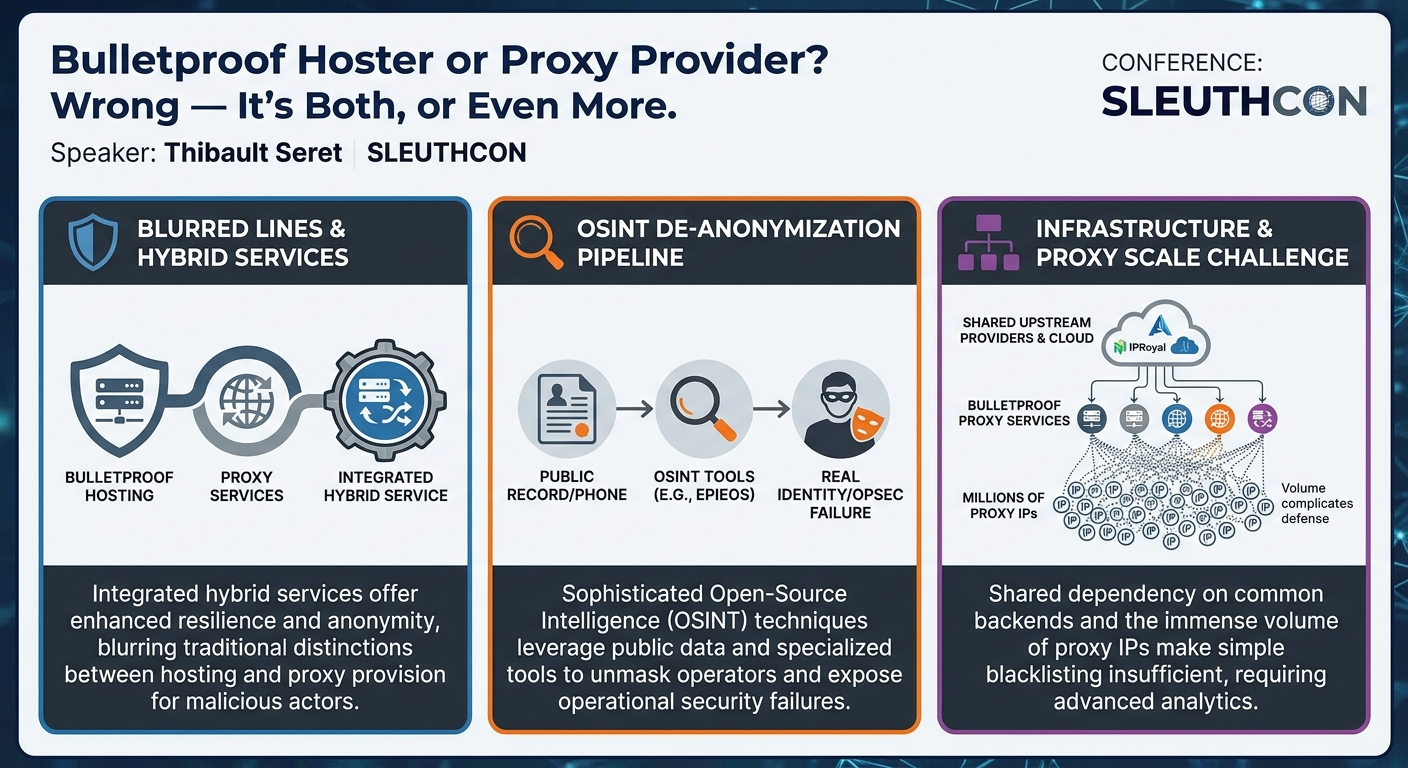
- Hybridization of Services: The talk's central premise is that bulletproof hosters and proxy providers are increasingly one and the same, or at least operate in extremely close conjunction. Malicious actors no longer rely on distinct services but seek integrated solutions that offer both resilient hosting and robust anonymity through proxy networks. This convergence creates a more formidable infrastructure for cybercrime, making it harder for defenders to dismantle by targeting a single point of failure.
- Exploitation of Legal and Corporate Loopholes: Operators of these services frequently incorporate their businesses in jurisdictions known for less stringent regulations or slower international legal cooperation. The case study of PSB Hosting, officially incorporated in the UK, demonstrates how malicious actors abuse legitimate mechanisms like virtual office addresses to establish a veneer of legitimacy while concealing their true operational base and identity. This sophisticated use of corporate structures adds layers of obfuscation, complicating efforts to trace ownership.
- Vulnerability Through OSINT and OpSec Failures: Despite their attempts at anonymity, operators often make operational security (OpSec) mistakes that can be exploited through Open-Source Intelligence (OSINT). Seret showcases how a seemingly innocuous detail—a phone number mistakenly used for official registration—can unravel an entire persona. By cross-referencing this data with specialized OSINT tools like Epieos, researchers can pivot to old account names, social media profiles (Discord, Telegram), and even personal hobbies, effectively doxxing the operator. This underscores that even sophisticated cybercriminals are susceptible to human error.
- Interconnected Infrastructure and Service Dependence: The research highlights that many bulletproof proxy services, despite appearing distinct, rely on a common set of backend providers. Seret specifically mentions IPRoyal and other well-known residential proxy services as frequently used underlying services. Furthermore, a significant portion of this infrastructure is hosted on major cloud provider backends. This shared dependency presents potential choke points for disruption if action can be taken against these foundational services or cloud providers. The identification of specific ASNs (e.g., those linked to Leaseweb NL) also provides concrete targets for network-level blocking.
- The Scale of the Proxy Problem: The sheer volume of proxy IP addresses poses a significant challenge for threat detection. Seret notes that in just one week, 16 million new IPs were tagged as "proxy" by Team Cymru's systems, without distinction between legitimate and malicious use. This massive scale necessitates advanced analytical capabilities to filter and identify truly malicious traffic, emphasizing the need for robust threat intelligence and anomaly detection rather than simple IP blacklisting.
- Abuse of Publicly Available Resources: Even "free proxy lists" and other publicly available proxy resources are routinely abused by threat actors, as exemplified by their use in campaigns like those by Agent Tesla. This highlights that not all malicious proxy traffic originates from dedicated bulletproof services; common, easily accessible resources are also weaponized, broadening the scope of the defensive challenge.
Technical Deep Dive
▶ Watch: PSB Hosting's Proxy Infrastructure and Providers (5:30)
The technical core of Seret's talk revolves around the methodology for identifying and de-anonymizing operators of bulletproof hosting and proxy services, leveraging a combination of OSINT techniques and specialized network analysis tools.
The investigation begins with the identification of a target: PSB Hosting, a known Russian-based bulletproof hoster officially incorporated in the UK in April 2024. PSB Hosting advertises its services on various underground forums using nicknames like PSBON and PSB Offshore, operating three distinct websites to cater to different service offerings. A key technical detail exploited by these entities is the use of virtual office addresses for company registration. This allows them to establish a legal presence in a favorable jurisdiction (like the UK) without having a physical footprint, making it harder to link them to their actual operational location.
Seret demonstrates how public records, specifically the UK's gov.uk portal for company registrations, can be a goldmine for initial leads. By accessing the public filings for PSB Hosting, he extracted the name of the director: Vladislav Skipin. This initial piece of information is crucial for subsequent OSINT pivoting.
The next technical step involves leveraging a powerful OSINT tool called Epieos. Epieos, described as performing "black magic," is a specialized service designed to trace digital footprints linked to personal identifiers like phone numbers or email addresses. In this case, a phone number associated with Vladislav Skipin from the company registration was fed into Epieos. The tool successfully correlated this phone number with old account names, specifically identifying the Discord nickname PSB offshore and activity dating back to 2022, predating the official company incorporation. This indicates a longer operational history under a different guise.
Further analysis with Epieos and subsequent manual OSINT on the found nicknames revealed a Telegram username and the initials "VS," leading Seret to confidently link these to Vladislav Skipin. By hunting on this Telegram username, Seret was able to uncover personal details about Skipin, including his interests in crypto and biking in Russia, complete with locations and preferred routes. This level of detail, achieved through public and semi-public data correlation, effectively doxxes the operator, demonstrating a significant OpSec failure.
Beyond the individual, Seret delves into the technical infrastructure. PSB Hosting also offers dedicated proxy services, acknowledging the convergence of these two illicit capabilities. Team Cymru's internal tools were then used to analyze the Autonomous System (AS) numbers associated with PSB Hosting LTD. An AS is a collection of IP networks operated by one or more network operators that presents a common, clearly defined routing policy to the Internet. By examining the net blocks (ranges of IP addresses) registered under PSB Hosting's AS, Seret identified over 10,000 IPs specifically tagged as proxy infrastructure.
A significant finding was the connection between these proxy boxes and Rapid Seedbox, a rotating residential proxy service. The screenshot provided in the talk reveals that part of this infrastructure is linked to Leaseweb NL (Leaseweb Netherlands), an infrastructure provider known for offering collocation and rack services. This geographical and provider-specific detail is critical for understanding where parts of the malicious infrastructure are physically located and hosted. The speaker also mentioned that the backend for these proxy services commonly relies on well-known providers such as IPRoyal and other well-known residential proxy services, along with approximately ten other providers. This indicates a shared dependency on a relatively small number of upstream services, which could be potential points of intervention.
Team Cymru's methodology for tagging bulletproof hosters and proxy services involves a sophisticated system. They categorize risk nets as "proffers connecting to proxy" services. A specific search query for "proxy IP" within their systems revealed an astonishing 16 million new IPs tagged as proxy within just one week. This highlights the sheer scale of the challenge in distinguishing legitimate proxy traffic from malicious usage. The talk also touched upon the abuse of "free proxy lists" by threat actors, citing Agent Tesla as an example of malware leveraging these publicly available resources for proxying traffic, further complicating defensive efforts.
Finally, Seret uncovered a critical OpSec flaw related to PSB Proxy IO, one of Skipin's proxy offerings. To get a trial, users were instructed to "PM on the forum, thread your email." This led to a public thread containing numerous email addresses, some of which were real, allowing Seret to analyze them for location and even identify potential clients, such as "GMO." This demonstrates how seemingly minor requests for engagement can expose valuable intelligence about the user base of these illicit services.
Demo / Proof of Concept
▶ Watch: Challenges Distinguishing Legit vs. Malicious Proxy Traffic (6:50)
While the talk did not feature a live software demonstration in the traditional sense, Thibault Seret provided a compelling proof of concept for his investigative methodology, effectively demonstrating how security researchers can de-anonymize operators of bulletproof hosting and proxy services. This "demo" was a step-by-step walkthrough of his process, showcasing the tools and techniques used to connect disparate pieces of information.
The demonstration began with the public identification of PSB Hosting as a suspected bulletproof hoster. Seret navigated to the official UK government company registration portal (gov.uk) to access public records for PSB Hosting. This step revealed the company's registration details, including the name of its director, Vladislav Skipin, and a contact phone number. This initial data extraction from a legitimate public source formed the bedrock of the investigation.
The core of the de-anonymization process was then demonstrated using Epieos, a specialized OSINT tool. Seret explained how he input the extracted phone number into Epieos. The tool's output, displayed as a screenshot, showed correlations to older online accounts and nicknames, most notably the Discord handle PSB offshore. This vividly illustrated Epieos's capability to bridge the gap between official registration data and online persona.
Building on the Epieos findings, Seret demonstrated how he then manually pivoted from the Discord nickname. This led to the discovery of a Telegram nickname and the initials "VS," which, when combined with the known name Vladislav Skipin, provided a strong confirmation of identity. Further OSINT on the Telegram username was shown to reveal personal details about Skipin, including his hobbies (biking in Russia) and precise locations, effectively illustrating how a digital trail can lead to real-world identification.
The second part of the proof of concept shifted to the network infrastructure. Seret used Team Cymru's internal tools to analyze the Autonomous System (AS) numbers associated with PSB Hosting LTD. Screenshots from these tools displayed net blocks and IP addresses tagged as proxy infrastructure, linking them to specific providers like Rapid Seedbox and physical locations such as Leaseweb NL. This visual evidence demonstrated how network analysis can reveal the underlying technical framework supporting these services.
Finally, the talk highlighted an operational security flaw observed on an underground forum thread for PSB Proxy IO. Seret showed how the operator's request for trial users to "PM [their] email on the forum" inadvertently created a public repository of potential client email addresses. He explained how he analyzed these emails to infer user locations and even identify specific individuals (e.g., "GMO"), showcasing how seemingly minor details can yield significant intelligence about a service's user base.
Through this detailed walkthrough, Seret effectively demonstrated a repeatable methodology for linking bulletproof hosting and proxy infrastructure back to specific individuals, providing a powerful proof of concept for intelligence gathering and threat actor attribution.
Defensive Implications
▶ Watch: Conclusion: It's a Mess, Collaboration is Key (9:45)
The detailed insights from Thibault Seret's talk offer several crucial defensive implications for organizations and security professionals battling cybercrime:
- Enhanced Threat Intelligence Gathering: Defenders must move beyond simple IP blacklisting and embrace more sophisticated threat intelligence that focuses on the providers and infrastructure used by malicious actors. This includes tracking ASNs, network blocks, and upstream hosting/proxy providers (like Leaseweb NL, IPRoyal). Understanding these underlying dependencies allows for more strategic disruption efforts, potentially impacting multiple threat actors simultaneously.
- Proactive OSINT for Attribution: Security teams should integrate OSINT methodologies, similar to those demonstrated by Seret, into their investigative workflows. This means actively monitoring underground forums, public company registries, and leveraging specialized tools like Epieos to connect seemingly disparate pieces of information. By understanding how threat actors are de-anonymized, defenders can proactively identify and track the individuals behind critical infrastructure, rather than just reacting to attacks.
- Challenges in Distinguishing Legitimate vs. Malicious Proxy Traffic: The sheer volume of proxy IPs (16 million new IPs tagged in a week) underscores the difficulty in distinguishing legitimate corporate use from malicious activity. Defenders need to invest in advanced analytics, behavioral detection, and contextual threat intelligence to identify anomalous patterns within proxy traffic. Simply blocking all proxy traffic is often not feasible for organizations with legitimate global operations. Techniques like analyzing user agent strings, connection patterns, and known threat actor TTPs become critical.
- Collaboration with Upstream Providers: The reliance of bulletproof services on legitimate cloud providers and infrastructure (e.g., Leaseweb NL, major cloud backends) presents an opportunity for defensive action. Security teams and law enforcement should foster stronger relationships with these upstream providers to encourage faster response to abuse reports and facilitate the takedown of malicious infrastructure at its source. Highlighting the reputational and legal risks associated with enabling cybercrime can be a powerful motivator.
- Monitoring for Virtual Office Abuse: The use of virtual office addresses for company registration by malicious entities like PSB Hosting is a common tactic. Organizations involved in business registration, domain registration, or financial services should implement enhanced vetting processes for entities using virtual offices, looking for red flags that might indicate illicit intent.
- Focus on OpSec Failures: The talk highlights how even sophisticated operators make OpSec mistakes (e.g., using personal phone numbers, public email threads for trials). Defenders should understand these common failure points and develop strategies to exploit them for intelligence gathering. This could involve active monitoring of underground forums for such slips or developing specific indicators of compromise (IoCs) related to observed OpSec errors.
- Understanding the "Proxy as a Service" Ecosystem: The fact that many bulletproof proxy services rely on a common set of backend providers (such as IPRoyal) suggests a consolidated ecosystem. Defenders should map out this ecosystem to identify key players and potential points of disruption. Intelligence on the pricing, features, and client base of these services can also provide valuable insights into threat actor capabilities and motivations.
Key Takeaways
- Blurred Lines: The traditional distinction between bulletproof hosting and proxy services is increasingly obsolete, with malicious actors leveraging integrated hybrid services for enhanced resilience and anonymity.
- OSINT as a Weapon: Sophisticated Open-Source Intelligence (OSINT) techniques, leveraging tools like Epieos and public records, can effectively de-anonymize operators of illicit services, exposing their real-world identities and operational security failures.
- Infrastructure Interdependencies: Many bulletproof proxy services rely on a shared ecosystem of upstream providers (e.g., IPRoyal) and legitimate cloud infrastructure, offering potential choke points for disruption.
- Scale of the Proxy Problem: The sheer volume of proxy IP addresses (millions weekly) necessitates advanced analytical methods to distinguish legitimate proxy traffic from malicious activity, making simple IP blacklisting insufficient.
- Exploiting OpSec Flaws: Malicious operators frequently make operational security (OpSec) mistakes, such as using personal contact information or public forums for service trials, which can be exploited for intelligence gathering and attribution.
- Defensive Collaboration: Effective defense requires proactive threat intelligence, collaboration with upstream infrastructure providers, and a deep understanding of the cybercriminal ecosystem, moving beyond reactive measures.
About the Speaker(s)
Thibault Seret is a dedicated Threat Researcher at Team Cymru, where he has been contributing his expertise for three years. Based in the Netherlands, Seret's research primarily focuses on understanding and combating sophisticated cybercriminal activities, specifically delving into bulletproof hosting operations. He also conducts extensive research into botnets and stealer activity, unraveling the intricate networks and tactics employed by malicious actors. Seret is known for his hands-on approach to threat intelligence, often diving into the complex world of cybercrime infrastructure to expose the individuals behind it. He is accessible to the security community through his nickname "glacius" on Twitter and Keybase, and is open to collaboration with fellow researchers.
Reviews
Dr. Zero (Offensive Security Researcher) — SOLID
Seret did the legwork to burn PSB Hosting and Vladislav Skipin, and I respect the public name-and-shame. But pulling a phone number from UK Companies House and dumping it into Epieos to find a Discord handle is standard OSINT 101, not groundbreaking research. It's a highly competent threat intel briefing that proves the proxy and bulletproof hosting markets have entirely merged.
Heather Calloway (CISO) — SOLID
Seret provides a precise teardown of modern cybercriminal infrastructure, proving that the line between bulletproof hosting and proxy networks has vanished. For leadership, the takeaway isn't the OSINT methodology—it's the mathematically proven death of IP-based blocking. This is required viewing for your threat intel team and a necessary reality check for your detection strategy.