RADIANT SPIDER Unveiled: Insights into a Chinese eCrime Actor's Tradecraft, from Exploitation to Formjacking
Eric Loui (Principal Intelligence Analyst · CrowdStrike)
SLEUTHCON 2025 · Day 1 · Main Stage
Overview
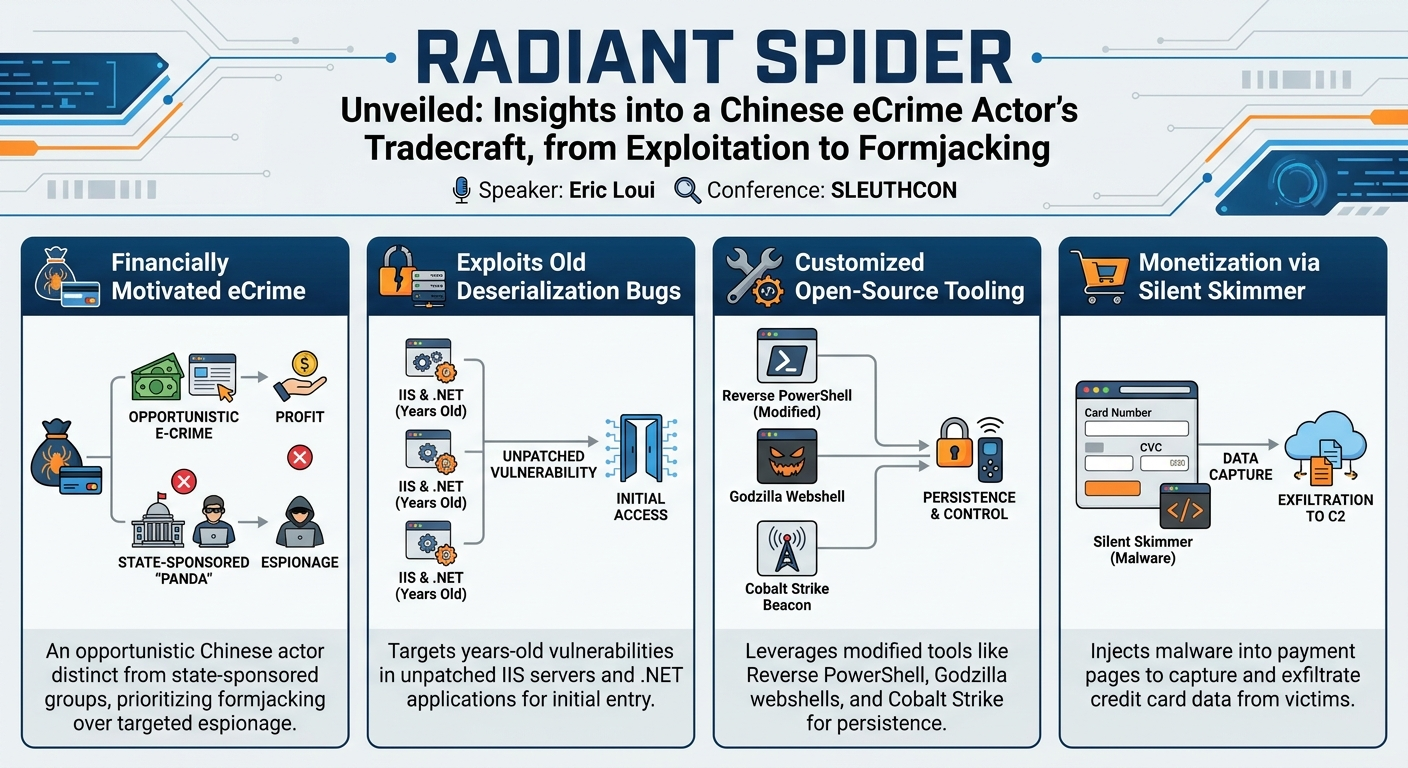
In this insightful talk at SLEUTHCON, Eric Loui, a Principal Intelligence Analyst at CrowdStrike, peeled back the layers on Radiant Spider, an opportunistic Chinese e-crime actor. Loui meticulously detailed the group's sophisticated yet pragmatic tradecraft, which spans initial access through deserialization vulnerabilities, persistent access via custom PowerShell backdoors and webshells, and ultimately, monetization through formjacking using the Silent Skimmer malware family. The presentation provided a comprehensive breakdown of Radiant Spider's Tactics, Techniques, and Procedures (TTPs), offering critical intelligence for defenders.
Key moments
- 0:00 Introduction to Radiant Spider and its key TTPs
- 1:50 Explaining ViewState deserialization for initial access
- 6:35 Radiant Spider's modified Reverse PowerShell backdoor capabilities
- 11:00 Silent Skimmer: How Radiant Spider monetizes breaches
- 12:15 Key Chinese characteristics for Radiant Spider attribution
- 14:40 Distinguishing Radiant Spider as a Chinese e-crime actor
- 19:50 Practical detection opportunities for Radiant Spider's TTPs
- 22:00 Intelligence tradecraft lessons from analyzing Radiant Spider
RADIANT SPIDER Unveiled: Insights into a Chinese eCrime Actor's Tradecraft, from Exploitation to Formjacking
Speakers: Eric Loui, Principal Intelligence Analyst, CrowdStrike
Conference: SLEUTHCON
YouTube: https://www.youtube.com/watch?v=5rSJf36XT2g
Overview
In this insightful talk at SLEUTHCON, Eric Loui, a Principal Intelligence Analyst at CrowdStrike, peeled back the layers on Radiant Spider, an opportunistic Chinese e-crime actor. Loui meticulously detailed the group's sophisticated yet pragmatic tradecraft, which spans initial access through deserialization vulnerabilities, persistent access via custom PowerShell backdoors and webshells, and ultimately, monetization through formjacking using the Silent Skimmer malware family. The presentation provided a comprehensive breakdown of Radiant Spider's Tactics, Techniques, and Procedures (TTPs), offering critical intelligence for defenders.
The significance of this research lies not only in exposing the operational intricacies of a prolific e-crime group but also in contributing to the nuanced understanding of the evolving Chinese threat landscape. Loui highlighted the crucial distinction between Radiant Spider's financially motivated, opportunistic approach and the more targeted, data exfiltration-focused operations typically associated with state-sponsored Chinese actors (often referred to as "Panda" adversaries). This differentiation helps security professionals better categorize and respond to diverse threats originating from the region, moving beyond simplistic blanket attributions.
Loui's presentation was a deep dive into the adversary's methods, from how they exploit readily available vulnerabilities in Internet Information Services (IIS) servers and .NET applications to their use of modified open-source tools and bespoke malware. It concluded with actionable defensive recommendations and valuable lessons on intelligence research tradecraft, underscoring the importance of meticulous documentation and the aggregation of low-confidence indicators for robust attribution.
Background
▶ Watch: Introduction to Radiant Spider and its key TTPs (0:00)
The problem of web application vulnerabilities, particularly those related to deserialization, has been a persistent challenge for defenders. Web applications, especially those built on frameworks like ASP.NET, often need to maintain "state" across stateless HTTP requests. ViewState is a mechanism used by ASP.NET to serialize data (a dictionary of information) into a Base64-encoded string, which is then embedded in a hidden field (__VIEWSTATE) within a web page. This allows the server to restore the page's state upon subsequent requests.
While convenient, ViewState deserialization has been identified as a significant attack vector. Researchers discovered that if an attacker could forge a valid ViewState payload, they could inject arbitrary code that would be deserialized and executed by the server. Tools like YSO_SERIAL simplify the creation of such malicious payloads. Modern ASP.NET applications attempt to mitigate this by using a Message Authentication Code (MAC), where the ViewState content is "signed" with a validation key stored in the server's machineKey configuration. However, attackers can bypass this if they obtain a valid machineKey (e.g., through prior compromise) or by exploiting instances where machineKey values are reused across different IIS servers, a known quirk in IIS deployments.
Beyond ViewState, other deserialization vulnerabilities exist in various .NET components and applications. Radiant Spider has demonstrated a consistent pattern of exploiting such vulnerabilities, often targeting end-day vulnerabilities – those for which patches have been available for years. This highlights a critical and ongoing issue in enterprise security: the failure to promptly apply security updates, leaving organizations exposed to well-known attack techniques. The formjacking technique, where payment card data is stolen directly from web forms, is another long-standing e-crime tactic, and Radiant Spider's use of Silent Skimmer represents a current iteration of this threat.
Key Findings
▶ Watch: Radiant Spider's modified Reverse PowerShell backdoor capabilities (6:35)
Radiant Spider is characterized as an opportunistic Chinese e-crime actor with a clear financial motivation, primarily engaging in formjacking. Their operational methodology reveals several key findings:
- Initial Access Specialization: The group consistently gains initial access to Windows IIS servers by exploiting deserialization vulnerabilities. This includes ViewState deserialization (leveraging stolen or reused
machineKeyvalues) and end-day deserialization vulnerabilities in popular .NET-based products such as DotNetNuke (DNN) CMS (observed October 2022), Progress Telerik UI (May 2023), and Sitecore CMS (February 2024). These vulnerabilities were often multiple years old, underscoring the adversary's reliance on unpatched systems. - Multi-stage Persistence and Backdoors: Once initial access is achieved, Radiant Spider establishes persistence using a variety of tools. They frequently deploy a custom-modified version of the open-source Reverse PowerShell backdoor, which includes added functionalities like privilege checking, time stomping, file operations, and event log clearing, along with distinctive Chinese language comments and non-idiomatic English phrases. They also utilize webshells (predominantly variants of Godzilla), Cobalt Strike Beacon (via XC or PowerShell loaders), and the FRP reverse proxy.
- Standard and Distinctive Discovery: For internal reconnaissance and privilege escalation, they employ common tools like
whoami,nslookup,ping,systeminfo,ipconfig,netstat, andtasklist. More specifically, they use exploit binaries like GodPotato and BadPotato for privilege escalation, and the LaZagne tool for credential harvesting. A distinctive command observed isfsutil fs info drives, which lists drives on a machine. They also test connectivity to specific domains like1433.eu.org,dnslog.cn, anddnslog.mmyfw.us, and occasionally use network scanners such as fscan or netspy. - Monetization via Silent Skimmer: The primary method of monetization is formjacking credit card data using the Silent Skimmer family. This involves modifying victim e-commerce pages to load a remote, obfuscated
payment.jsscript that captures credit card numbers, expiration dates, CVCs, and customer names upon payment button clicks, then exfiltrates the data to adversary-controlled C2 infrastructure. - Nuanced Attribution to Chinese eCrime: Attribution to a Chinese origin is based on a confluence of low-confidence indicators, which, when combined and lacking contradictory evidence, form a high-confidence assessment. These indicators include Chinese comments in their modified Reverse PowerShell, use of open-source tools popular among Chinese actors (Godzilla, FRP, FScan, NetSpy), connectivity testing to Chinese-associated domains, and operational hours aligning with China Standard Time (4-8 UTC, or 12:00-16:00 China time). Crucially, the talk emphasizes that Radiant Spider is distinct from state-sponsored "Panda" actors due to its opportunistic victimology, focus on formjacking (rather than targeted data exfiltration), and different infrastructure choices.
Technical Deep Dive
▶ Watch: Key Chinese characteristics for Radiant Spider attribution (12:15)
Radiant Spider's technical operations are characterized by a blend of exploiting well-understood vulnerabilities and leveraging customized open-source tools.
Initial Access Mechanisms:
The group's entry point almost exclusively targets IIS servers. One primary method involves ViewState deserialization. When an ASP.NET application processes a client's POST request containing the __VIEWSTATE hidden field, the server deserializes its content. If an attacker can forge a valid, malicious __VIEWSTATE string, they can execute arbitrary code. Modern ASP.NET uses a Message Authentication Code (MAC), which requires the __VIEWSTATE payload to be signed with a validation key derived from the server's machineKey. Radiant Spider overcomes this by either:
- Stolen Keys: Acquiring a valid
machineKeyfrom a previously compromised system within the victim's environment. - Reused Keys: Exploiting instances where different IIS servers within an enterprise, or even across different organizations, share identical
machineKeyvalues due to configuration quirks. Attackers can then use publicly documented lists of these known shared keys with tools like YSO_SERIAL to craft and sign their malicious payloads.
Beyond ViewState, Radiant Spider actively exploits end-day deserialization vulnerabilities in widely used .NET applications. Specific campaigns highlighted include:
- October 2022: Exploitation of a vulnerability in DotNetNuke (DNN) CMS.
- May 2023: Exploitation of a popular vulnerability in Progress Telerik UI.
- February 2024: Exploitation of two related vulnerabilities in the Sitecore CMS framework.
The consistent theme across these is that patches for these vulnerabilities had been available for years, yet organizations failed to apply them.
Execution Paths for Backdoor Deployment:
Upon gaining a command shell, Radiant Spider uses several methods to execute their PowerShell backdoor:
- MSHTA Execution: They invoke the
MSHTAutility with a single argument specifying a remote URL (e.g.,http://<IP>/file.hta). This remote HTA file is typically simple, spawning PowerShell withNoProfile,HiddenWindow, andEncodedCommandflags, where the encoded content is the Reverse PowerShell backdoor. - Remote PowerShell File Download & Execution: They use the
Invoke-WebRequestcmdlet (IWR) to download a PowerShell file toC:\Users\Publicand then execute it withExecutionPolicy Bypass. - .NET WebClient Object: They instantiate a
New-Object System.Net.WebClientto download and execute a remote PowerShell script. - Direct Command Line: In some instances, they simply run an unobfuscated, stripped-down version of the backdoor directly on the command line, indicating a lack of concern for detection in certain scenarios.
Reverse PowerShell Backdoor Modifications:
The Reverse PowerShell backdoor, an open-source project (typically ~65 lines of code), is a basic reverse shell. Radiant Spider's modifications are noteworthy:
- Chinese Language Comments: The added code includes comments in Chinese, which are absent in the base version.
- Non-Idiomatic English: Print statements added by the adversary contain non-idiomatic English phrases, such as "upload continue."
- Extended Functionality:
- Privilege Checking: Integration of
whoamifor privilege assessment. - Time Stomping: Modification of file last access, creation, and write timestamps to hinder forensic analysis.
- SQL Server Interaction: Capabilities for interacting with SQL databases.
- File Operations: Uploading files from the compromised host to the C2, and downloading files (including using
certutil). - File System Search: Enhanced capabilities to search the file system.
- Event Log Clearing: Ability to clear event logs upon exit, aiding in stealth.
Additional Persistence Mechanisms:
- Webshells: Deployed via the compromised
W3WPprocess, often downloaded in encoded form and decoded usingcertutil. Godzilla webshell variants are common, alongside some custom web proxies. - Cobalt Strike Beacon: Frequently deployed via XC loaders or PowerShell loaders. The adversary has been observed using a specific, high-prevalence Cobalt Strike campaign ID, which, while not exclusive to China, is often seen in Chinese origin intrusions.
- FRP Reverse Proxy: Utilization of the open-source FRP (Fast Reverse Proxy) tool.
- New User Creation: Creation of new local users, specifically favoring the username
asp.net$.
Privilege Escalation, Credential Access, and Discovery:
- Exploit Binaries: GodPotato and BadPotato are used for local privilege escalation.
- Credential Harvesting: The LaZagne tool is employed to extract credentials.
- Connectivity Testing:
nslookupandpingcommands are used, often targeting subdomains of1433.eu.org,dnslog.cn,dnslog.mmyfw.us, and sometimesburpcollaborator.net(indicating use of Burp Suite). - Information Gathering: Standard utilities like
systeminfo,ipconfig,netstat, andtasklistare used. A unique command observed isfsutil fs info drives, which lists available drives. - Network Scanners: They sometimes download and use open-source network scanners such as fscan or netspy.
Demo / Proof of Concept
▶ Watch: Distinguishing Radiant Spider as a Chinese e-crime actor (14:40)
The talk did not feature a live demonstration by the speaker. Instead, it detailed the adversary's operational methodology for their monetization phase, which effectively serves as their "proof of concept" for formjacking. Radiant Spider's primary monetization strategy involves Silent Skimmer, a formjacking malware family.
The mechanism works as follows:
- Page Modification: The adversary modifies a victim's e-commerce webpage to load a remote, obfuscated
payment.jsscript from an adversary-controlled domain. - Button Monitoring: The
payment.jsscript, once loaded, continuously checks (every 200 milliseconds) for the presence of a specific payment button on the page. - Event Listener: If the payment button is detected, Silent Skimmer attaches an event listener to it.
- Data Capture: When a user clicks the payment button, the script intercepts and captures the contents of sensitive input fields, specifically the credit card number, expiration date, CVC (Card Verification Code), and the customer's name.
- Exfiltration: This captured data is then concatenated with a unique identifier (UID) for the victim site, Base64 encoded, and transmitted to the adversary's command-and-control (C2) server. This demonstrates a clear, targeted approach to credit card theft directly at the point of entry on compromised e-commerce sites.
Defensive Implications
▶ Watch: Intelligence tradecraft lessons from analyzing Radiant Spider (22:00)
Protecting enterprises from Radiant Spider requires a multi-faceted approach, focusing on foundational security hygiene, specific detection capabilities, and hardening measures.
1. Patch Management and Vulnerability Remediation:
- Prioritize Patching: The most critical defense is to patch and update web applications immediately. Radiant Spider consistently exploits vulnerabilities that are multiple years old (e.g., DotNetNuke (DNN) CMS, Progress Telerik UI, Sitecore CMS). A robust patch management program is essential to eliminate these known entry points.
2. IIS and .NET ViewState Hardening:
- Analyze IIS Log Files: Implement robust logging for IIS and .NET, sending logs to a SIEM or other analysis tools to detect general abuse of .NET deserialization vulnerabilities, or ViewState-specific exploitation attempts.
- Audit
machineKeyValues: Conduct regular audits of IIS servers and their build images to identify instances of hard-codedmachineKeyvalues. Where feasible, consider auto-generation of these keys. This reduces the attack surface, as a stolenmachineKeyfrom one server cannot then be used to compromise others that use a unique, auto-generated key. - Change
machineKeyAfter Compromise: If an IIS server is compromised, even after patching and remediation (e.g., disk wipes, credential resets), it is crucial to change hard-codedmachineKeyvalues. Adversaries may capture these keys, allowing them trivial re-entry using tools like YSO_SERIAL if the key remains unchanged. Always backup and test changes tomachineKeyas it can impact application compatibility.
3. Detection Opportunities for Radiant Spider TTPs:
Implement detection rules based on the adversary's characteristic command-line patterns and behaviors:
- MSHTA Execution: Look for
MSHTAexecuted with a single argument specifying a remote URL (e.g.,http://<IP>/file.hta). - PowerShell Activity:
Invoke-WebRequest(IWR) used with theOutFileparameter to write files toC:\Users\Public.- PowerShell executed with
ExecutionPolicy Bypass. MSHTAspawning PowerShell child processes with flags likeNoProfile,HiddenWindow, andEncodedCommand.- PowerShell instantiating
New-Object System.Net.WebClientto access external resources. - Webshell Indicators:
certutilexecuted with thedecodeflag pointing to.aspor.aspxfiles in unusual locations.- Web server processes (
W3WP) writing.aspor.aspxfiles to unexpected directories. - Network Utilities for C2:
nslookuporpingcommands originating from IIS servers and targeting subdomains of1433.eu.org,dnslog.cn, ordnslog.mmyfw.us.- Distinctive Info Gathering:
fsutil fs info drivescommands. While benign, its low prevalence on web servers can make it a useful indicator when combined with other suspicious activities.- New User Creation:
- Detection of
netcommands creating new users with the nameasp.net$. - Formjacking Protection:
- Implement File Integrity Monitoring (FIM) on web servers, especially for e-commerce pages. This will alert to any unauthorized modifications to JavaScript files or HTML pages, which is how Silent Skimmer is typically injected.
4. Intelligence Research Tradecraft Lessons:
- Document Everything: Maintain meticulous records of every security incident and observation. Attribution often requires correlating data points across multiple cases and years.
- Accessible Information: Ensure all threat intelligence, case data, and notes are easily accessible (e.g., via Elastic Search, Google Drive, Jira). Unfindable data is useless data.
- Hunt Characteristic Patterns: Develop detection rules (e.g., YARA rules) for even seemingly benign or low-sophistication command-line patterns. While individual commands might not be high-fidelity, their combination within a process tree or short timeframe can be highly indicative of specific adversaries.
- Aggregate Low-Confidence Indicators: A strong attribution assessment can be built from many individually low-confidence indicators, especially when there is no contradictory evidence. This was key to confidently attributing Radiant Spider to a Chinese e-crime actor.
Key Takeaways
- Distinct Chinese e-Crime Actor: Radiant Spider is a financially motivated, opportunistic Chinese e-crime actor focusing on formjacking, distinct from state-sponsored "Panda" groups that typically engage in targeted data exfiltration.
- Reliance on End-Day Vulnerabilities: The group's primary initial access vector is the exploitation of deserialization vulnerabilities in IIS and .NET applications, often targeting vulnerabilities that are multiple years old and for which patches have long been available.
- Customized Open-Source Tooling: Radiant Spider leverages and modifies readily available open-source tools like Reverse PowerShell, Godzilla webshell, and Cobalt Strike Beacon, demonstrating a practical and adaptable approach to their operations.
- Aggregated Attribution: Confident attribution relies on the accumulation of multiple low-confidence indicators (e.g., Chinese comments in code, specific C2 domains, operational hours, popular Chinese tools), rather than relying on any single high-fidelity artifact.
- Proactive Defense is Paramount: Effective defense against Radiant Spider mandates rigorous patch management, specific monitoring for deserialization abuse and C2 communication patterns, hardening of IIS configurations (especially
machineKeyvalues), and File Integrity Monitoring for web pages. - Intelligence Tradecraft Matters: The ability to identify and track such adversaries is significantly enhanced by diligent documentation, accessible data, and the analytical skill to combine diverse data points into a coherent threat picture.
About the Speaker(s)
Eric Loui is a Principal Intelligence Analyst at CrowdStrike, a leading cybersecurity technology company. With over a decade of experience in the field of threat intelligence, Eric specializes in emerging threats research. Prior to his role at CrowdStrike, he contributed his expertise at Deloitte and the Department of State. Eric is a recognized speaker in the cybersecurity community, having presented at notable conferences such as the SNCTI summit, Virus Bulletin, and previous editions of Sleuthcon. His work focuses on providing actionable intelligence to help organizations defend against sophisticated adversaries.
Reviews
Dr. Zero (Offensive Security Researcher) — SOLID
Loui delivers a competent, grounded threat intel briefing on Radiant Spider's IIS exploitation and formjacking campaigns. It doesn't drop any zero-days or novel exploit primitives, but it provides a clean operational picture of how Chinese eCrime operates differently from state-sponsored APTs. Good intelligence tradecraft, even if the underlying attacks are ancient.
Heather Calloway (CISO) — SOLID
This is a clean, highly actionable intelligence briefing on how Chinese e-crime groups are monetizing corporate technical debt. Loui clearly separates this opportunistic formjacking threat from state-sponsored espionage, giving defenders exactly what they need to adjust their external attack surface priorities.