Navigating Shifts in Ransomware TTPs Through the Minds of Basta Actors
Bavi Sadayappan (Senior Threat Intelligence Analyst · Google Threat Intelligence Group), Zach Riddle (Principal Threat Intelligence Analyst · Google Threat Intelligence Group)
SLEUTHCON 2025 · Day 1 · Main Stage
Overview
In an insightful talk at SLEUTHCON, Bavi Sadayappan and Zach Riddle, Senior and Principal Threat Intelligence Analysts respectively at the Google Threat Intelligence Group, delved into the evolving landscape of ransomware tactics, techniques, and procedures (TTPs). Their presentation, "Navigating Shifts in Ransomware TTPs Through the Minds of Basta Actors," offered a unique perspective by leveraging the unprecedented visibility provided by the leaked internal communications of the Black Basta ransomware group, tracked by Mandiant as UNC4393. This deep dive moved beyond merely observing what ransomware actors do, to understanding why they make specific tactical decisions, adapt their tooling, and react to defensive measures and law enforcement pressure.
Key moments
- 0:00 Talk introduction: using Basta chats to understand TTP shifts
- 2:55 Why chat leaks reveal actor decision-making
- 7:00 Voice phishing and VPNs for initial access
- 12:00 Cobalt Strike Beacon's struggles and decline
- 19:30 Ransomware negotiation tactics and psychological pricing
- 23:00 Law enforcement pressure causes tactical shifts
- 27:30 Q&A: Do ransomware groups fear OFAC sanctions?
Navigating Shifts in Ransomware TTPs Through the Minds of Basta Actors
Speakers: Bavi Sadayappan (Senior Threat Intelligence Analyst, Google Threat Intelligence Group); Zach Riddle (Principal Threat Intelligence Analyst, Google Threat Intelligence Group)
Conference: SLEUTHCON
YouTube: https://www.youtube.com/watch?v=PMLpaykMWfY
Overview
In an insightful talk at SLEUTHCON, Bavi Sadayappan and Zach Riddle, Senior and Principal Threat Intelligence Analysts respectively at the Google Threat Intelligence Group, delved into the evolving landscape of ransomware tactics, techniques, and procedures (TTPs). Their presentation, "Navigating Shifts in Ransomware TTPs Through the Minds of Basta Actors," offered a unique perspective by leveraging the unprecedented visibility provided by the leaked internal communications of the Black Basta ransomware group, tracked by Mandiant as UNC4393. This deep dive moved beyond merely observing what ransomware actors do, to understanding why they make specific tactical decisions, adapt their tooling, and react to defensive measures and law enforcement pressure.
The core of their analysis hinged on a trove of approximately 200,000 Telegram messages, spanning a 12-month period from September 2023 through September 2024, involving around 50 unique user handles. These chats, leaked by a Telegram user known as "exploit whispers" in February 2024, allegedly due to Black Basta's targeting of Russian banks, provided a rare and invaluable lens into the day-to-day operations, struggles, and strategic thinking of a prominent ransomware group. Rather than simply reviewing the chat contents, Sadayappan and Riddle meticulously correlated these internal discussions with observed intrusion data from Mandiant's incident response investigations, bridging the gap between external observations and internal adversary motivations.
This talk is crucial for the cybersecurity community as it illuminates the often-opaque decision-making processes of ransomware actors. By understanding the rationale behind their TTP shifts – from initial access methods to post-compromise activities and even negotiation strategies – defenders can anticipate future threats, refine their defensive postures, and develop more effective counter-measures. The speakers underscored that while intel analysts often know the "what" and "how" of ransomware intrusions, the "why" remains elusive, a critical piece of the puzzle that these chat leaks uniquely provided.
Background
▶ Watch: Talk introduction: using Basta chats to understand TTP shifts (0:00)
For threat intelligence analysts, understanding ransomware intrusions typically involves piecing together the "what" and the "how." Analysts can identify that ransomware was deployed, which systems were encrypted, and often reconstruct the sequence of events leading to the compromise—from initial access vectors to lateral movement techniques and the tools used to deploy payloads. By analyzing multiple intrusions attributed to the same threat cluster, such as UNC4393, Mandiant and Google's threat intelligence teams can map out tooling gaps and track activity over time. Extending this analysis across numerous threat groups allows for a broader understanding of TTPs within the ransomware ecosystem.
However, a persistent challenge in threat intelligence is answering the "why." Why do actors choose specific TTPs? Why do they adapt their methods? While analysts can speculate on motivations like maximizing profit or evading detections, direct evidence of the underlying decision-making process is scarce from intrusion data alone. Log files might show a failed attempt, suggesting an actor tried something and it didn't work, but they rarely reveal the thought process behind the attempt or the subsequent adaptation. This leaves intelligence analysts with significant analytical gaps that direct observation of network activity cannot concretely fill.
This is where resources like the Black Basta chat leaks become transformative. These messages offer an unprecedented window into the threat actor's thought process, decision-making calculus, and even the daily struggles and obstacles they face. The speakers structured their talk around two primary components: first, examining four major trends observed in ransomware attack life cycles over the past few years (initial access, RMM usage, Cobalt Strike Beacon, and hypervisor targeting); and second, delving into the mindset of a ransomware actor, specifically their negotiation philosophies and the impact of law enforcement actions on their risk assessment. The goal was not to present groundbreaking trends but to use the chat messages to provide a deeper understanding of why these shifts are occurring.
Key Findings
▶ Watch: Voice phishing and VPNs for initial access (7:00)
The talk highlighted several significant shifts in ransomware TTPs, providing invaluable context from the Black Basta chats:
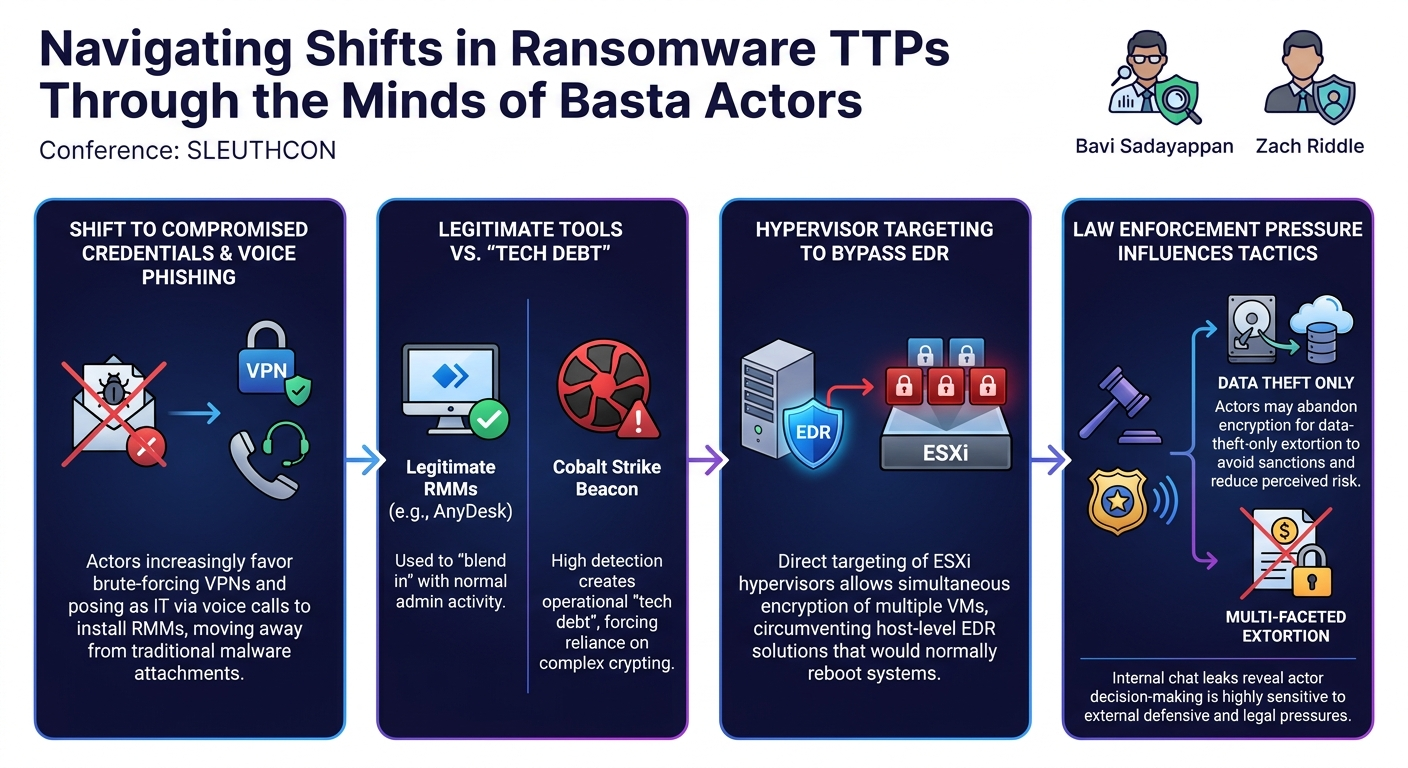
1. Initial Access Shifts: From Phishing to Compromised Credentials and VPNs
- Observed Trend: A marked decrease in traditional phishing (especially malware attachments) and a corresponding increase in the use of compromised credentials. In 2024, compromised credentials became the most common initial access vector, largely fueled by brute-force attacks. A significant 37% of ransomware intrusions in 2024 involved the first observed malicious activity being authentication to a VPN device.
- Chat Insights: Actors explicitly discussed the advantages of VPNs, viewing them as a more stable and reliable connection compared to malware bots, and noting fewer detection issues than with Cobalt Strike Beacon. They detailed their methods for acquiring credentials, including brute-forcing VPNs (aligning with observed trends) and credential phishing targeting VPN infrastructure.
- Emerging TTP: Call Center/Voice Phishing: The chats revealed a highly successful technique where actors collected contact information, pre-screened targets, and then called employees posing as IT help desk personnel to trick them into installing Remote Monitoring and Management (RMM) tools. One actor boasted a conversion rate of nearly one in five calls. This technique, discussed in mid-2024, is now being observed more broadly across different threat clusters in early 2025, suggesting it's becoming a prominent future vector.
2. The Rise and Potential Decline of RMM Usage
- Observed Trend: In 2023, approximately 40% of ransomware intrusions utilized at least one legitimate RMM tool (e.g., AnyDesk, TeamViewer). However, 2024 saw a decline to around 28%, with a nearly 50% decrease in AnyDesk usage and a slight reduction in incidents involving multiple RMMs.
- Chat Insights: Actors preferred RMMs over "malware bots" due to their perceived stability and legitimacy, making them less likely to be detected. Interestingly, they discussed using multiple RMMs for two strategic reasons: to blend in by matching the RMM already used by the victim's IT administrators, and as fallbacks when one RMM was detected or blocked. The chats also indicated struggles with RMMs like AnyDesk and TeamViewer getting blocked, suggesting improved organizational defenses might be contributing to the observed decline.
3. Cobalt Strike Beacon's Precipitous Decline, Except for UNC4393
- Observed Trend: A dramatic drop in Cobalt Strike Beacon usage, from 60% of ransomware intrusions in 2022 to just 10% in 2023. Fortra, the vendor, reported an 80% decrease in unauthorized Cobalt Strike copies in the wild.
- UNC4393 Anomaly: Black Basta (UNC4393) bucked this trend, consistently using Beacon in over 80% of their 2024 intrusions.
- Chat Insights: Despite their continued use, the chats revealed constant complaints from Black Basta actors about Beacon's struggles: frequent troubleshooting, detection issues, and dropped connections. They invested significant effort in crypting payloads to evade detection, often only for these efforts to be nullified by detection later the same day. Actors made dynamic decisions on whether to use crypted payloads based on the victim's identified EDR/AV solutions. The group acknowledged considering alternatives like Brute Ratel but cited a lack of experience and a "sunk cost" or "tech debt" associated with their familiarity with Cobalt Strike, highlighting the friction involved in changing established tooling.
4. Increased Targeting of Hypervisors
- Observed Trend: A shift towards targeting virtualized infrastructure, with ~21% of ransomware intrusions involving hypervisors like ESXi in 2023, rising to ~29% in 2024. Incidents included encryption of both Windows hosts and hypervisors, and sometimes hypervisors exclusively. The percentage of newly identified ransomware families tailored for ESXi systems also grew from 2% in 2022 to 10% in 2024.
- Chat Insights: Actors revealed a key rationale: bypassing EDR solutions on Windows hosts that would reboot systems during encryption. In such cases, they would skip Windows hosts and directly target ESXi systems for greater efficiency and impact. This broader discussion highlighted actors actively purchasing and testing various EDR and AV products (both directly from vendors and via third parties) to develop bypass techniques, demonstrating a significant pre-attack effort to maximize operational impact.
5. Sophisticated Negotiation Philosophies and Law Enforcement Impact
- Negotiation Tactics: Actors employed common negotiation strategies like aiming high (e.g., asking for $2 million to achieve a desired $1.5 million settlement) and psychological pricing (e.g., asking for $900,000 instead of $1 million to avoid "sticker shock" and increase the likelihood of payment).
- Monitoring External Factors: Black Basta actors closely monitored Western news, Reddit, and even congressional testimony related to ransomware incidents. They used this intelligence, such as identifying a victim's incident response company, in their negotiations. They also leveraged information like a CEO's testimony about $870 million in damages from an unrelated incident to justify their own high ransom demands.
- Impact of Law Enforcement: The chats clearly showed actors' fear of sanctions, seizures, and takedowns, viewing "a day spent not working" as "money lost." In one specific scenario involving a North American healthcare company, actors shifted from multi-faceted extortion (ransomware plus data theft) to data theft alone to avoid perceived law enforcement pressures and potential sanctions.
Technical Deep Dive
▶ Watch: Cobalt Strike Beacon's struggles and decline (12:00)
The Black Basta chats provided a granular view into the technical decisions and challenges faced by a sophisticated ransomware group, offering insights that go beyond simple log analysis.
Initial Access and Persistence:
The shift away from mass malware distribution underscores an increasing reliance on social engineering and credential exploitation. Brute-forcing of corporate VPN infrastructure is a primary method for gaining initial access, as actors perceive VPNs to offer more stable and less detectable command-and-control (C2) channels compared to malware bots or even Cobalt Strike Beacon. This preference highlights a strategic move towards legitimate access mechanisms that are harder to distinguish from legitimate user activity. The emergence of call center/voice phishing as a highly effective initial access technique demonstrates a sophisticated blend of social engineering and technical execution. Actors meticulously gather contact information, pre-screen targets, and impersonate IT help desk staff to persuade employees to install Remote Monitoring and Management (RMM) tools. Once installed, these legitimate tools provide a persistent foothold, often leading to credential phishing for domain administrator accounts, which are then used for lateral movement.
Remote Monitoring and Management (RMM) Tools:
Ransomware actors, including Black Basta, actively leverage legitimate RMM software such as AnyDesk and TeamViewer. Their rationale is multi-faceted:
- Legitimacy: RMM tools are standard in enterprise environments, making their presence less suspicious to security teams and potentially bypassing basic detection rules.
- Stability: They offer reliable remote access and control, crucial for maintaining persistence and executing follow-on activities.
- Evasion: Actors strategize the use of multiple RMMs. One notable technique involves identifying the RMM already used by the victim organization's IT administrators and then installing the same RMM, further blending in with the legitimate network environment. Additionally, multiple RMMs serve as fallbacks: if one RMM is detected and blocked, actors can pivot to another already installed or newly deployed RMM. The increasing detection and blocking of popular RMMs like AnyDesk and TeamViewer, as noted in the chats, suggests that defensive measures against these legitimate-but-abused tools are improving.
Cobalt Strike Beacon and Payload Crypting:
Despite its widespread decline in the broader ransomware ecosystem, Cobalt Strike Beacon remains a staple for UNC4393. However, the chats reveal that this reliance comes with significant operational overhead. Actors constantly struggle with:
- Detection: Payloads, even after extensive crypting, are frequently detected by EDR and AV solutions, sometimes within hours of deployment.
- Troubleshooting: Maintaining stable C2 connections and dealing with dropped sessions is a persistent challenge.
- Resource Allocation: Actors make tactical decisions on the fly, opting to use crypted payloads only when necessary, based on their reconnaissance of the victim's EDR/AV stack. This suggests a form of "resource rationing" for crypting efforts.
The group's reluctance to switch to alternative frameworks like Brute Ratel, despite the issues with Beacon, illustrates the concept of tech debt or sunk cost. Their familiarity and established workflows with Cobalt Strike, even with its inherent challenges, outweigh the perceived learning curve and effort required to adopt new tooling. This demonstrates that disruption efforts, by making existing tools harder to use, impose a tangible cost on threat actors.
Hypervisor Targeting (ESXi):
The increasing focus on virtualized environments, particularly ESXi hypervisors, reveals a calculated move towards maximizing impact and bypassing specific defensive controls. The primary technical rationale articulated in the chats is to circumvent EDR solutions on Windows hosts that are configured to reboot systems upon detecting ransomware encryption activity. By directly targeting the hypervisor, actors can encrypt multiple virtual machines simultaneously from a single point of compromise, achieving a broader and more efficient impact without triggering host-level EDR reboots.
The chats also unveiled the extensive pre-attack reconnaissance and testing performed by Black Basta. Actors actively purchase various EDR and AV products, both directly from vendors and through third parties, to develop and test bypass techniques. This proactive approach to defense evasion ensures that their chosen TTPs and payloads have the highest probability of success against specific security products deployed in target environments, highlighting their commitment to operational effectiveness.
Demo / Proof of Concept
▶ Watch: Law enforcement pressure causes tactical shifts (23:00)
This talk did not feature a traditional live demo or proof of concept in the sense of demonstrating a technical exploit or a tool in action. Instead, the speakers presented a deep dive into the observed tactics, techniques, and procedures of ransomware actors, particularly Black Basta (UNC4393), augmented by direct insights gleaned from their leaked internal communications. The "proof" of their findings came from the direct quotes and discussions extracted from the Telegram chats, which served as empirical evidence for the observed TTP shifts and the underlying motivations of the threat actors.
Defensive Implications
▶ Watch: Q&A: Do ransomware groups fear OFAC sanctions? (27:30)
The insights gleaned from the Black Basta chats offer critical guidance for defenders looking to strengthen their security postures against evolving ransomware threats.
1. Bolster Initial Access Defenses:
- VPN Security: Given the heavy reliance on compromised VPN credentials, organizations must enforce Multi-Factor Authentication (MFA) on all VPN access, implement strong password policies, and monitor VPN logs for suspicious brute-force attempts or unusual login patterns.
- Social Engineering Awareness: The success of call center/voice phishing campaigns underscores the need for continuous, realistic employee training against social engineering tactics. Employees should be educated on verifying identities, questioning unsolicited requests for software installation, and reporting suspicious calls or emails.
- Credential Hygiene: Implement robust credential management practices, including least privilege, regular password rotations, and monitoring for credential stuffing or sales on underground forums.
2. Enhance RMM Monitoring and Control:
- Unauthorized RMM Detection: Organizations should have mechanisms to detect and alert on the installation or use of unauthorized RMM tools.
- Legitimate RMM Oversight: Even legitimate RMM usage should be closely monitored for anomalous activity, such as connections from unusual IP addresses, off-hours usage, or commands executed by non-IT personnel. Be aware of actors' tactic to "blend in" by using the same RMM as the organization's IT, and implement stringent access controls and audit logging for these tools.
- Blocking Known Malicious Infrastructure: Continuously update threat intelligence feeds to block known C2 infrastructure associated with RMM abuse.
3. Improve Endpoint Detection and Response (EDR) Efficacy:
- Advanced Payload Detection: The struggles of Black Basta with Cobalt Strike Beacon detections, even after extensive crypting, highlight that current EDR/AV solutions are effective. Defenders should continue to invest in advanced EDR capabilities that can detect sophisticated, obfuscated payloads and identify C2 communications.
- Disruption as a Strategy: The "tech debt" experienced by actors when faced with detection challenges demonstrates that aggressive disruption efforts by vendors and law enforcement are effective. Organizations should support these efforts and leverage the intelligence derived from them to improve their own defenses.
4. Secure Virtualized Environments (ESXi):
- Hypervisor Hardening: Prioritize the security of ESXi and other hypervisor platforms. This includes regular patching, strong access controls, network segmentation of management interfaces, and implementing dedicated security solutions for virtualized environments.
- Monitor Hypervisor Activity: Implement monitoring solutions that can detect unusual activity on hypervisors, such as unexpected configuration changes, new virtual machine deployments, or mass encryption attempts. Understand that these systems are now prime targets due to their broad impact potential and ability to bypass host-level EDR.
5. Leverage Threat Intelligence and Understand Adversary Mindset:
- Proactive Defense: Assume that adversaries are actively testing your defenses. Continuously evaluate and improve security controls, recognizing that threat actors are purchasing and testing against various EDR/AV products.
- Impact of Disruption: The fear of sanctions and the shift from multi-faceted extortion to data theft alone due to law enforcement pressure confirm that disruptive efforts work. This validates the importance of collaboration between public and private sectors.
- "Pain in the Ass" Defenses: The talk humorously concluded with a "pain in the ass lightning round," where actors complained about security software, MFA, and threat intelligence analysts. This reinforces that the work done by the cybersecurity community—implementing strong security controls and sharing intelligence—is indeed making a tangible impact, increasing the cost and effort for ransomware groups.
Key Takeaways
- Chat leaks provide invaluable context: Direct access to threat actor communications significantly enhances the understanding of why TTPs shift, going beyond observational data to reveal decision-making, struggles, and motivations.
- Ransomware actors are highly adaptive: They continuously evolve their initial access methods, favoring compromised credentials via VPNs and sophisticated voice phishing over traditional malware attachments.
- Legitimate tools remain a double-edged sword: RMM tools are favored for stability and perceived legitimacy but are increasingly detected and blocked, prompting actors to use multiple RMMs strategically (e.g., matching victim's RMM, using fallbacks).
- "Tech debt" impacts adversaries: Even sophisticated groups like Black Basta face significant operational challenges with widely detected tools like Cobalt Strike Beacon, demonstrating that disruption efforts impose a tangible cost and learning curve.
- Hypervisors are critical targets: The increasing focus on ESXi highlights actors' pursuit of efficiency and evasion, directly targeting virtualized environments to bypass host-level EDR and maximize impact.
- Adversaries are strategic and sensitive to external pressures: They employ psychological tactics in negotiations, closely monitor Western news and public sentiment, and adjust their TTPs (e.g., shifting from multi-faceted extortion to data theft only) in response to law enforcement actions and the threat of sanctions.
- Defensive efforts are working: The frustrations expressed by actors regarding MFA, security software, and threat intelligence analysts underscore that current cybersecurity measures and intelligence sharing are effectively raising the cost and difficulty for ransomware operations.
About the Speaker(s)
Bavi Sadayappan is a Senior Threat Intelligence Analyst at the Google Threat Intelligence Group.
Zach Riddle is a Principal Threat Intelligence Analyst at the Google Threat Intelligence Group.
Both Bavi and Zach are integral members of Google's threat intelligence efforts, specifically leading annual deep-dive analyses into Mandiant-led incident response investigations that involve ransomware. Their work focuses on identifying and understanding trends and shifts in the tactics, techniques, and procedures (TTPs) utilized by ransomware actors year after year. Their expertise in correlating observed intrusion data with insights from leaked threat actor communications provides a comprehensive view of the evolving cyber threat landscape.
Reviews
Dr. Zero (Offensive Security Researcher) — STRONG ACCEPT
Sadayappan and Riddle didn't just scrape the Black Basta leaks for IOCs. They mapped 200,000 Telegram messages against Mandiant's incident response telemetry to prove exactly why UNC4393 makes the tactical choices they do. It’s rare to get hard proof of adversary tech debt, making this an essential watch for defenders tuning their stack.
Heather Calloway (CISO) — MUST SEE
This is required viewing for anyone leading an incident response program or briefing a board on extortion risk. By correlating intrusion data with 200,000 leaked chat messages from Black Basta, Google's analysts strip away the myth of the omnipotent attacker and reveal an adversary constrained by tech debt, EDR friction, and fear of sanctions. It provides the exact empirical ground truth needed to justify infrastructure hardening and overhaul executive tabletop scenarios.