Is It Ransomware: The Gameshow!
Allan Liska, Jon DiMaggio (Chief Security Strategist · Analyst1)
SLEUTHCON 2025 · Day 1 · Main Stage
Overview
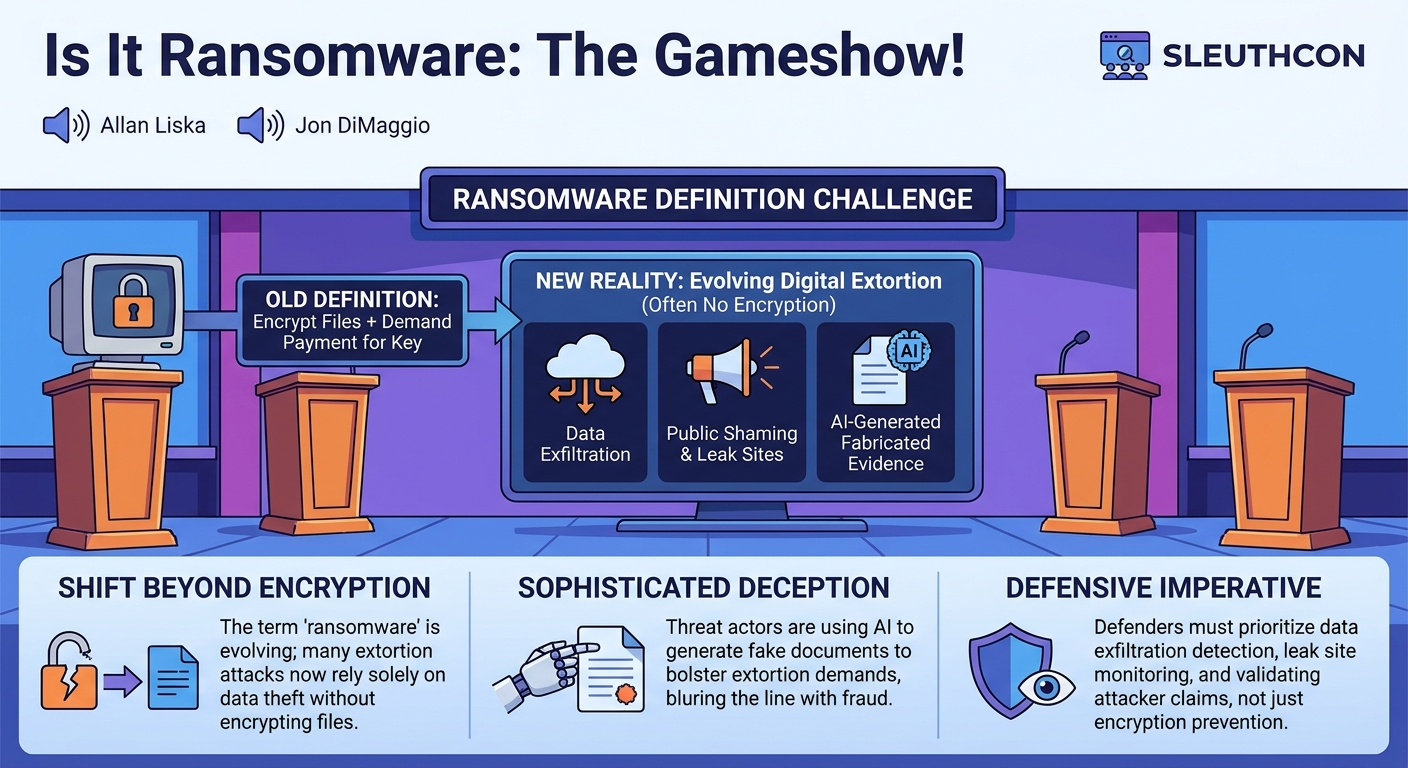
In an engaging and thought-provoking "game show" format, Allan Liska and Jon DiMaggio challenged the audience at SLEUTHCON to redefine one of the most pervasive threats in cybersecurity: ransomware. The talk, aptly titled "Is It Ransomware: The Gameshow!", delved into the evolving tactics of malicious actors, questioning whether the traditional definition—encrypting files and demanding payment for a decryption key—still holds true in an era dominated by data exfiltration, public shaming, and even fabricated evidence. With the assistance of a ransomware research intern from Recorded Future, and active audience participation, the speakers presented three distinct scenarios that pushed the boundaries of what constitutes ransomware, sparking a critical discussion on the need for updated terminology and defensive strategies.
Key moments
- 0:00 Welcome to 'Is It Ransomware: The Gameshow!'
- 1:50 The evolving historical definition of ransomware
- 2:30 Scenario 1: Cl0p campaign with no encryption
- 3:50 Scenario 2: Pay2Key, nation-state data exfiltration
- 5:30 Scenario 3: RansomedVC, AI-generated fake data
- 7:00 the ransomware intern on the branding and 'grandeur' of extortion sites
- 8:00 John advocates for new terminology for digital extortion
- 9:00 The challenge of finding an adoptable new term
Is It Ransomware: The Gameshow!
Speakers: Allan Liska; Jon DiMaggio (Chief Security Strategist, Analyst1)
Conference: SLEUTHCON
YouTube: https://www.youtube.com/watch?v=5feTlEt79ZE
Overview
In an engaging and thought-provoking "game show" format, Allan Liska and Jon DiMaggio challenged the audience at SLEUTHCON to redefine one of the most pervasive threats in cybersecurity: ransomware. The talk, aptly titled "Is It Ransomware: The Gameshow!", delved into the evolving tactics of malicious actors, questioning whether the traditional definition—encrypting files and demanding payment for a decryption key—still holds true in an era dominated by data exfiltration, public shaming, and even fabricated evidence. With the assistance of a ransomware research intern from Recorded Future, and active audience participation, the speakers presented three distinct scenarios that pushed the boundaries of what constitutes ransomware, sparking a critical discussion on the need for updated terminology and defensive strategies.
The core premise of the presentation was to highlight a critical disconnect: the term "ransomware" is widely used to describe a broad spectrum of digital extortion activities, many of which no longer involve encryption. This semantic ambiguity carries significant implications for threat intelligence, incident response, and legal frameworks. By dissecting real-world (or plausible) attack scenarios, Liska and DiMaggio underscored the urgency for the cybersecurity community to align on a more precise vocabulary that accurately reflects the complex and multifaceted nature of modern cyber threats, moving beyond a historical definition that is increasingly outdated.
This talk is particularly relevant in today's threat landscape, where organizations face not only the risk of data encryption but also the equally damaging consequences of data leaks, reputational harm, and regulatory fines stemming from pure extortion tactics. Understanding the nuances of these evolving threats is paramount for defenders to allocate resources effectively, implement appropriate controls, and communicate risks clearly to stakeholders. The "game show" format, while entertaining, served as a powerful vehicle to expose these complex definitional challenges in a memorable way, prompting a much-needed re-evaluation of how we categorize and combat cyber extortion.
Background
▶ Watch: Welcome to 'Is It Ransomware: The Gameshow!' (0:00)
The concept of ransomware has undergone several significant transformations since its inception. Allan Liska traced this evolution back to 2009, when ransomware primarily involved encrypting files and demanding payment for the decryption key. This initial wave established the fundamental extortion model that would come to define the threat. However, as early as 2012, the definition began to shift. Liska referenced a seminal report from Symantec (now part of Broadcom) titled "Ransomware: A Growing Menace," which highlighted the emergence of screen locker ransomware. These variants didn't encrypt files but instead locked access to the operating system, demanding payment to restore functionality. This marked the first major expansion of the ransomware definition beyond mere file encryption, demonstrating that the core element was the denial of access or functionality for ransom, regardless of the technical mechanism.
Today, the cybersecurity landscape presents an even more complex picture, necessitating another re-evaluation of what constitutes ransomware. The problem arises because threat actors are continually innovating their extortion methodologies. Driven by the success of initial ransomware campaigns, many groups realized that the "ransom" component could be achieved through means other than encryption. The rise of data exfiltration as a primary extortion tool, often accompanied by threats of public shaming or sale of sensitive information on leak sites, has become commonplace. This double extortion tactic, where data is both encrypted and exfiltrated, quickly evolved into pure extortion or hack-and-leak operations where encryption is entirely omitted.
The challenge is exacerbated by the sticky nature of the term "ransomware." It has become a widely recognized and easily understood catch-all phrase for any cyberattack involving a demand for payment under duress. As Jon DiMaggio noted, "digital extortion is adopting that name because it's being deployed by people that used to use ransomware." This linguistic inertia, combined with the lack of a universally adopted, concise alternative term, leads to confusion. While researchers like Brett Callow and others have advocated for new terminology, no single phrase has gained sufficient traction to replace "ransomware" in common parlance. This semantic ambiguity hinders accurate threat intelligence sharing, complicates legal and insurance interpretations, and can misdirect defensive efforts by focusing solely on encryption detection when other equally damaging extortion vectors are at play. The talk aimed to highlight this definitional crisis and prompt a deeper consideration of its implications.
Key Findings
▶ Watch: Scenario 1: Cl0p campaign with no encryption (2:30)
The central and most critical finding of the "Is It Ransomware: The Gameshow!" talk is that the traditional, encryption-centric definition of ransomware is no longer adequate to describe the full spectrum of digital extortion threats organizations face today. The talk unequivocally demonstrated that the term has evolved significantly, encompassing a broader array of tactics that often omit the act of encrypting data.
Specifically, the key findings included:
- Encryption is no longer a prerequisite for "ransomware" (in common usage): The discussion around the Cl0p campaign, which involved data exfiltration but no encryption, highlighted that many practitioners and the public struggle with labeling such attacks. While the expert panel initially leaned towards "not ransomware" without encryption, the very debate underscored the definitional tension. Many operations are now purely data exfiltration and extortion, leveraging public shaming or data leaks rather than encryption keys.
- Digital extortion is a more accurate, albeit less adopted, umbrella term: Both speakers, particularly Jon DiMaggio, advocated for differentiating between true ransomware (involving encryption) and broader digital extortion. DiMaggio explicitly stated, "If we're going to look at the actual definition of what it is, we should probably give that a different name... when it is just data theft and there is no ransomware, there is no encryption, why are we still calling it that?" This highlights the community's struggle to find a concise, universally accepted alternative.
- Nation-state actors blur the lines between cybercrime and espionage: The Pay2Key example demonstrated that groups with potential nation-state affiliations can utilize tactics strikingly similar to traditional ransomware, including encryption and data exfiltration, even if their primary motivation isn't direct financial gain for "yachts," but rather funding state programs or achieving geopolitical objectives. This complicates attribution and response, as the technical execution mirrors cybercrime, but the intent aligns with state-sponsored activity.
- Threat actors are leveraging sophisticated deception, including AI: The RansomedVC case was a stark revelation, showcasing a "hack-and-leak" operation that used Artificial Intelligence (AI) to create fake documents posted to leak sites. This represents a significant escalation in attacker tactics, moving beyond simply stealing and leaking data to fabricating evidence for extortion. This blurs the line between cybercrime and outright fraud, creating new challenges for victim verification and incident response.
- "Branding" and public perception are increasingly important for extortion groups: the ransomware intern's observations from monitoring extortion sites revealed a growing emphasis on "branding" and "grandeur" among these groups. This suggests that the psychological aspect of extortion, including establishing infamy and projecting a powerful image, is becoming as critical as the technical execution of the attack.
- The need for new, clear terminology is paramount: The entire talk served as an argument for the cybersecurity community to develop and adopt more precise terminology. The ease with which "ransomware" rolls off the tongue, as Allan Liska noted, makes it difficult to replace, yet the ambiguity it creates is detrimental to effective defense and intelligence.
These findings collectively paint a picture of a threat landscape where the lines between different types of cyberattacks are increasingly blurred, demanding a more nuanced and dynamic understanding from defenders and researchers alike.
Technical Deep Dive
▶ Watch: Scenario 3: RansomedVC, AI-generated fake data (5:30)
The game show format of "Is It Ransomware?" provided a structured technical deep dive into three distinct scenarios, each designed to challenge the audience's preconceived notions about ransomware. These cases highlight the technical evolution of extortion tactics, moving beyond simple encryption.
Scenario 1: The Cl0p Campaign (Targeting Cleo File Transfer Server)
The first scenario focused on a recent campaign attributed to the Cl0p ransomware group, specifically targeting the Cleo file transfer server. This case presented a stark departure from traditional ransomware:
- No Encryption: Crucially, the campaign did not involve encryption of files on the target systems. This immediately challenged the foundational technical definition of ransomware.
- No Local Network Infiltration: The attack did not necessitate deep lateral movement or widespread infiltration within the victim's local network. The focus was on exploiting a specific vulnerability in the file transfer server to exfiltrate data.
- Low Monetary Gain: The speakers noted that the threat actors complained to reporters about not getting significant attention or financial returns from the campaign. This suggests that even without encryption, the goal remained financial extortion through data theft.
Jon DiMaggio firmly asserted that this was not ransomware because "there's no ransomware involved. There's no encryption." He argued that "ransomware as a portmanteau of the words ransom and software, it doesn't meet that definition" if the software component doesn't perform encryption. the ransomware intern concurred. The audience predominantly agreed, underscoring a collective understanding that encryption remains a core technical identifier for many. This scenario technically represents pure data exfiltration and extortion, where the leverage is the stolen data itself, not the denial of access to it.
Scenario 2: Pay2Key
The second scenario introduced Pay2Key, a group whose operations exhibited a more complex mix of traditional and evolving tactics:
- Targeted Countries of Interest to Iran: This immediately brought up the question of nation-state affiliation or motivation, suggesting geopolitical rather than purely financial drivers.
- Sometimes Encrypts, but Always Steals and Publishes Data: This is a crucial technical detail. While encryption could be involved, data exfiltration and subsequent publication were a consistent feature. This aligns with the double extortion model, where encryption is one lever, and public shaming via data leaks is another.
- Ridiculously Low Ransom Demands, Often Doesn't Accept Payments: The low demands and frequent refusal of payment further complicated the purely financial motivation, strengthening the argument for a non-traditional, potentially state-sponsored objective.
DiMaggio initially classified Pay2Key as ransomware due to the potential for encryption and the act of "blocking or destroying data," even if carried out by a nation-state. He argued that "ransomware doesn't see politics or colors or boundaries." the ransomware intern agreed, emphasizing the presence of "encryption and some sort of exfiltration." However, the audience largely disagreed, seemingly swayed by the nation-state angle and the non-traditional financial motivations. This scenario highlighted the technical overlap between cybercrime and state-sponsored operations, where the tools (encryption, exfiltration) might be the same, but the intent and ultimate beneficiary differ. It forces a technical debate on whether the presence of encryption alone is sufficient, or if motivation also plays a role in classification.
Scenario 3: RansomedVC (RansomedVC)
The third scenario presented RansomedVC (RansomedVC), pushing the boundaries of deception and technical sophistication:
- Hack-and-Leak Operation with No Encryptor: Like Cl0p, this operation explicitly did not use an encryptor. Its primary technical mechanism was data exfiltration followed by public disclosure.
- PR Firm Disguised as a Ransomware Group: This revealed a significant shift in operational tactics. The group was not just cybercriminals but effectively a public relations firm leveraging cybersecurity attack narratives.
- Used AI to Create Fake Documents Posted to Their Leak Sites: This was the most technically alarming aspect. Instead of merely leaking stolen data, RansomedVC actively used Artificial Intelligence (AI) to generate fabricated documents, which were then posted on their data leak sites to bolster their extortion claims. This represents a novel and dangerous technical capability, blurring the line between data breach and disinformation.
- Extortion Based on Fabricated Evidence: The entire extortion attempt was predicated on the psychological impact of publicly "leaked" (but potentially fake) information, rather than the technical impact of encrypted files or genuinely stolen data.
DiMaggio unequivocally stated, "It 100% is not ransomware. It's a con... an attempt at fraud," due to the lack of actual data theft and the use of AI to create fake evidence. the ransomware intern concurred, and the audience overwhelmingly agreed. This scenario demonstrated a profound technical evolution: from encryption to exfiltration, and now to AI-powered disinformation as a primary extortion tool. It fundamentally challenges incident response, as organizations must now not only verify data integrity but also the authenticity of attacker claims and "leaked" documents.
The Broader Technical Implications
The discussions around these scenarios underscored a crucial technical shift: the focus of extortion has moved from data integrity/availability (via encryption) to data confidentiality/privacy (via exfiltration and public disclosure), and now even to data authenticity (via AI fabrication). The "game show" format effectively illustrated that while the common term "ransomware" persists, the underlying technical mechanisms and the nature of the "ransom" being demanded have diversified dramatically. This necessitates a technical understanding that goes beyond just looking for encryptors, to include sophisticated data exfiltration techniques, monitoring of dark web leak sites, and the challenging task of detecting AI-generated fraudulent content.
Demo / Proof of Concept
▶ Watch: the ransomware intern on the branding and 'grandeur' of extortion sites (7:00)
This talk, designed as an interactive "game show," did not feature a traditional technical demonstration or proof of concept. Instead, the "game" itself served as the primary vehicle for illustrating the evolving definitions and scenarios. The speakers presented hypothetical (but based on real-world trends) case studies to the audience and an expert panel, allowing for a conceptual "demonstration" of the definitional challenges rather than a live technical one.
Defensive Implications
▶ Watch: The challenge of finding an adoptable new term (9:00)
The evolving definition of ransomware, as highlighted by Liska and DiMaggio, carries profound defensive implications for organizations. A narrow focus on preventing file encryption is no longer sufficient; defenders must adapt their strategies to counter the broader spectrum of digital extortion tactics.
- Prioritize Data Exfiltration Prevention and Detection: The Cl0p and Pay2Key scenarios underscore that data exfiltration is now a primary, and often sole, vector of extortion. Organizations must invest heavily in robust Data Loss Prevention (DLP) solutions, network egress monitoring, and endpoint detection and response (EDR) capabilities specifically tuned to detect unauthorized data movement. This includes monitoring for unusual data volumes leaving the network, suspicious file types being accessed, and abnormal user behavior.
- Monitor Extortion and Leak Sites: With the rise of "hack-and-leak" operations and the "branding" efforts of extortion groups, organizations must proactively monitor the dark web, public leak sites, and relevant forums for mentions of their company or the appearance of their data. Threat intelligence services that specialize in dark web monitoring are becoming indispensable. Early detection of a data leak can significantly reduce its impact, even if encryption was not involved.
- Implement Robust Data Governance and Classification: Knowing what data is critical and where it resides is fundamental. Organizations need to classify their data, apply appropriate access controls, and ensure that highly sensitive information is segmented and protected more rigorously. This helps in understanding the potential impact if specific datasets are exfiltrated and aids in prioritizing defensive efforts.
- Prepare for AI-Generated Disinformation: The RansomedVC scenario introduces a new layer of complexity: attackers using AI to create fake documents for extortion. Defenders must develop capabilities to verify the authenticity of "leaked" data. This may involve sophisticated forensic analysis, digital watermarking of sensitive documents, and a critical skepticism towards any claims made by extortionists. Incident response plans should include steps for validating the veracity of attacker claims, rather than assuming all "evidence" is legitimate.
- Broaden Incident Response Playbooks: Traditional ransomware playbooks often center around decryption, system restoration, and eradication of encryptors. These need to be expanded to address scenarios where no encryption occurs. New playbooks must include steps for:
- Containment of data exfiltration.
- Assessment of data compromise (what was stolen, not just what was encrypted).
- Notification requirements for data breaches (even without encryption).
- Crisis communication strategies for public shaming or data leaks.
- Legal and regulatory counsel for extortion demands based on exfiltrated or fabricated data.
- Educate Employees on Social Engineering and Phishing: While not explicitly detailed in the technical deep dive, the "con" aspect of RansomedVC and the initial compromise vectors for many data exfiltration attacks often involve social engineering. Employee training on recognizing phishing attempts, suspicious links, and verifying requests for sensitive information remains a foundational defense.
- Re-evaluate Threat Intelligence and Terminology: Security teams should critically evaluate how they define and categorize threats internally. Adopting more precise terminology, such as "digital extortion" for non-encrypting attacks, can improve communication, enable more accurate threat modeling, and ensure that defensive measures are appropriately aligned with the actual attack vectors. This also impacts how incidents are reported and understood by leadership and regulatory bodies.
- Understand Varied Attacker Motivations: Recognizing that threat actors may be motivated by more than just direct financial gain (e.g., nation-state objectives, reputational damage, or even a "con") helps in anticipating tactics and tailoring responses. This influences decisions on whether to engage with attackers, pay a ransom, or focus purely on remediation and law enforcement coordination.
By adopting a more holistic and dynamic view of digital extortion, organizations can build more resilient defenses capable of countering the rapidly evolving tactics of malicious actors, regardless of whether they deploy an encryptor.
Key Takeaways
- The traditional definition of ransomware, centered on encryption for ransom, is rapidly becoming outdated due to evolving attacker tactics.
- Digital extortion encompasses a broader range of threats, including pure data exfiltration, public shaming, and hack-and-leak operations, often without any encryption.
- Threat actors are increasingly leveraging Artificial Intelligence (AI) to create fake documents and evidence to bolster their extortion demands, complicating victim verification and incident response.
- Nation-state actors can employ ransomware-like tactics (e.g., encryption, exfiltration) for geopolitical objectives, blurring the lines between cybercrime and state-sponsored activity.
- Defenders must shift their focus from solely preventing encryption to robust data exfiltration prevention and detection, proactive monitoring of leak sites, and validating the authenticity of attacker claims.
- There is an urgent need for the cybersecurity community to adopt new, precise terminology to accurately describe non-encrypting extortion methods, improving threat intelligence and defensive strategies.
About the Speaker(s)
Allan Liska is a well-known figure in the cybersecurity community, frequently sharing insights on ransomware and threat intelligence. While his specific title was not detailed in the metadata, his role in co-hosting this talk and his deep historical knowledge of ransomware trends underscore his expertise as a security researcher and analyst.
Jon DiMaggio serves as the Chief Security Strategist at Analyst1. With extensive experience in threat intelligence and analysis, DiMaggio provided the expert perspective on the game show panel, offering nuanced insights into the classification of various cyber extortion scenarios. His contributions highlighted the complexities of defining ransomware in the face of evolving threat actor methodologies.
The talk also featured the ransomware intern, a ransomware research intern at Recorded Future, who contributed valuable insights derived from her direct experience monitoring dark web extortion sites and observing the evolving "branding" strategies of these groups.
Reviews
Dr. Zero (Offensive Security Researcher) — WEAK
This is a 45-minute bullshit semantic debate about taxonomy dressed up in gameshow gimmicks. We've known extortion groups stopped bothering with encryptors for years, making this premise completely beaten to death. Call it whatever you want, you still have to patch your edge appliances.
Heather Calloway (CISO) — STRONG ACCEPT
Liska and DiMaggio use a game show format to prove a critical point: extortion has decoupled from encryption. For security leadership, this means our incident response playbooks, cyber insurance triggers, and regulatory disclosure processes must account for data exfiltration and fabrication. This is required viewing for anyone managing corporate risk.