Slop Engagement Operations - The Weird Web of an AI-Fueled SEO Spambot
Alex Delamotte (Senior Threat Researcher · SentinelLabs), Jim Walter (Senior Threat Researcher · SentinelOne)
SLEUTHCON 2025 · Day 1 · Main Stage
Overview
This talk, "Slop Engagement Operations - The Weird Web of an AI-Fueled SEO Spambot," delivered by Alex Delamotte and Jim Walter from SentinelLabs, delves into the sophisticated operations of an SEO spam framework dubbed AkiraBot. The presentation meticulously uncovers how this framework leverages large language models (LLMs) to generate highly customized, low-quality content, targeting small business websites across ubiquitous hosting platforms. The speakers highlight the unprecedented level of automation and the intricate methods employed to bypass security measures like CAPTCHAs, marking a significant evolution in the landscape of online spam.
Key moments
- 0:33 What is AkiraBot? AI-fueled SEO spambot framework
- 2:00 Targeted web platforms and service name themes
- 4:00 LLM prompt template and example spam message
- 4:50 Multiple operators and bot variations discovered
- 6:00 Telegram bot tracking with unusual Middle East theming
- 8:00 AkiraBot operations ceased, but expected to return
- 8:50 Conclusion: AI + automation is the current spam reality
Slop Engagement Operations - The Weird Web of an AI-Fueled SEO Spambot
Speakers: Alex Delamotte (Senior Threat Researcher, SentinelLabs); Jim Walter (Senior Threat Researcher, SentinelOne)
Conference: SLEUTHCON
YouTube: https://www.youtube.com/watch?v=U0LaLFjrS2s
Overview
This talk, "Slop Engagement Operations - The Weird Web of an AI-Fueled SEO Spambot," delivered by Alex Delamotte and Jim Walter from SentinelLabs, delves into the sophisticated operations of an SEO spam framework dubbed AkiraBot. The presentation meticulously uncovers how this framework leverages large language models (LLMs) to generate highly customized, low-quality content, targeting small business websites across ubiquitous hosting platforms. The speakers highlight the unprecedented level of automation and the intricate methods employed to bypass security measures like CAPTCHAs, marking a significant evolution in the landscape of online spam.
The core of AkiraBot's innovation lies in its ability to scrape website content, understand a business's model, and then use OpenAI's API to craft tailored spam messages. This personalized approach distinguishes AkiraBot from traditional, generic spam campaigns, making it a more insidious and potentially effective threat. Delamotte and Walter emphasize that AI-fueled spam is no longer a theoretical future concern but a present reality, escalating in scale and sophistication, and requiring immediate attention from the cybersecurity community.
The research not only exposes the technical intricacies of the AkiraBot framework but also raises critical questions about the ethical boundaries of "gray hat" SEO practices and their potential overlap with more overtly malicious activities. By shedding light on these operations, SentinelLabs aims to deter actors engaged in questionable practices and to underscore the importance of ongoing research in the adtech and SEO spaces, which often serve as gateways or testing grounds for broader cyber threats.
Background
▶ Watch: What is AkiraBot? AI-fueled SEO spambot framework (0:33)
The problem addressed by the AkiraBot framework is rooted in the persistent demand for search engine optimization (SEO) services, particularly among small businesses seeking to improve their online visibility. However, the market is also rife with low-quality, unsolicited, and often unethical SEO providers. The AkiraBot framework represents an automated evolution of these "slop engagement operations," designed to spam websites with the promise of SEO benefits, often without delivering real value. This problem is exacerbated by the accessibility of ubiquitous web hosting platforms like GoDaddy, Shopify, Squarespace, and Wix, which are popular among small businesses but can also become targets for automated abuse due to their standardized structures.
Prior to the discovery of the AkiraBot framework, SentinelLabs identified older, similarly themed related services. These services, now deprecated, suggest a long-standing operation, with customer dissatisfaction dating back as early as 2017, as evidenced by a Trustpilot review shared during the talk. This history indicates that the actors behind AkiraBot have been refining their techniques for years, culminating in the current, more sophisticated LLM-powered iteration. The underlying motivation remains consistent: to automate the outreach for low-quality SEO services, bypassing manual effort and scaling operations far beyond human capabilities.
The existence of this problem stems from several factors: the economic incentive for actors to offer cheap, automated SEO, the ease of access to tools like OpenAI's API, and the inherent challenges in distinguishing legitimate business outreach from sophisticated spam. The "gray area" nature of many adtech and SEO practices further complicates detection and deterrence, allowing actors to operate under the guise of legitimate business services while violating terms of service and potentially engaging in activities that border on or overlap with cybercrime. The talk underscores that this ecosystem is vast and interconnected, necessitating a broader investigative effort from the security community.
Key Findings
▶ Watch: LLM prompt template and example spam message (4:00)
The SentinelLabs research uncovered several pivotal findings regarding the AkiraBot framework and its operations:
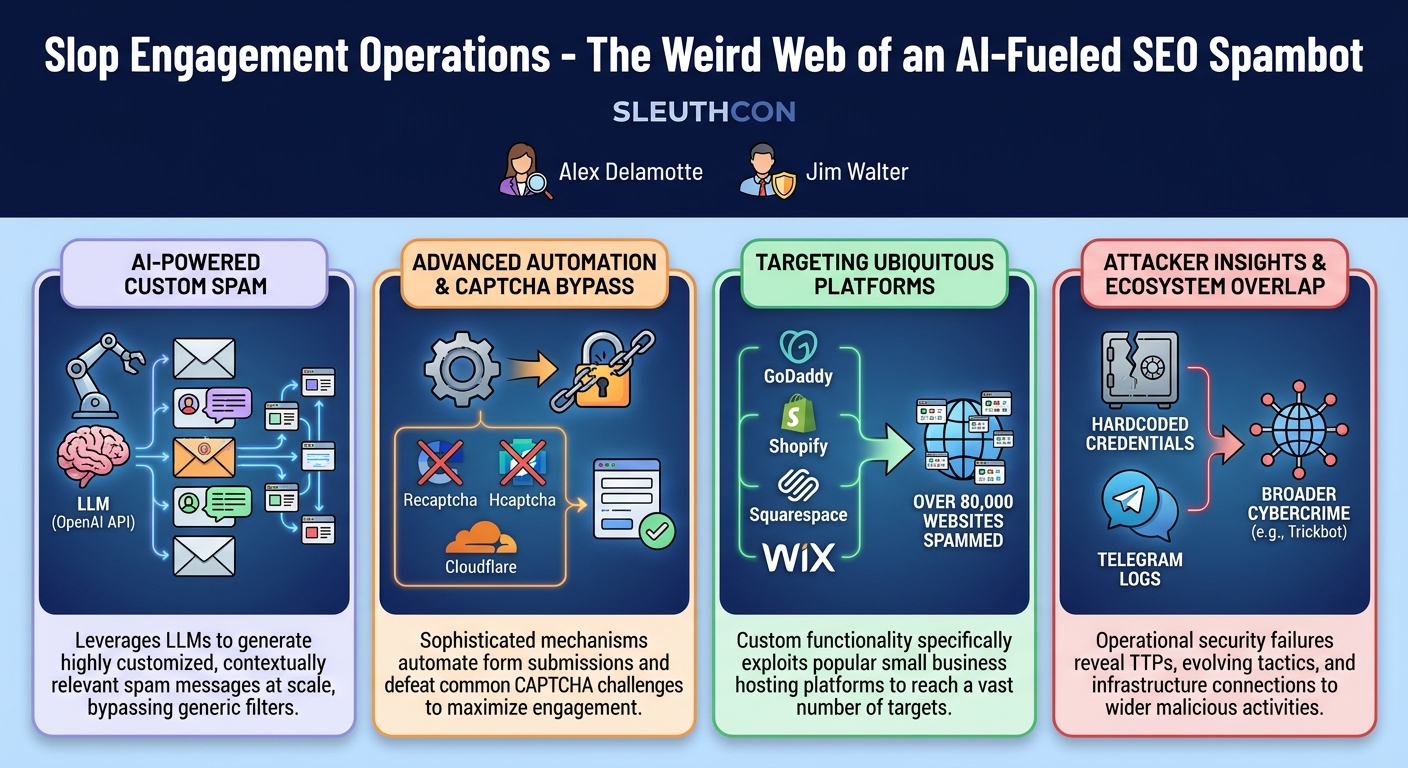
- LLM-Powered Custom Content Generation: The most significant discovery is AkiraBot's innovative use of OpenAI's chat completions API to generate highly customized spam messages. Instead of generic templates, AkiraBot scrapes target websites, identifies their business model and content, and then feeds this information into a meticulously crafted prompt to produce tailored spam, significantly increasing its perceived relevance and potentially its success rate.
- Advanced Automation and CAPTCHA Bypassing: The framework demonstrates a high degree of automation, encompassing the entire spamming process from website scraping to content generation and submission. Crucially, AkiraBot incorporates sophisticated mechanisms to bypass common CAPTCHA services, including Recaptcha, Hcaptcha, and their Cloudflare implementations, illustrating a substantial investment in overcoming anti-bot defenses.
- Targeted Platform Exploitation: AkiraBot specifically targets widely used small business hosting platforms such as GoDaddy, Shopify, Squarespace, and Wix. The framework includes custom functionality tailored to these platforms, suggesting an understanding of their submission processes and an effort to maximize engagement on these popular services.
- Multiple Operators and Evolving Functionality: Analysis revealed multiple versions and variants of the AkiraBot bot, suggesting the involvement of several operators or groups. These variants often included enhanced or additional functionalities, such as the ability to interact with Wix chat bubbles, indicating continuous development and adaptation.
- Hardcoded Credentials as Pivots: A critical security oversight by the operators was the hardcoding of credentials (e.g., for CAPTCHA services) in plain text within the Python scripts. This allowed researchers to pivot and gain further insight into the operators' infrastructure and activities.
- Telegram Bot for Operational Logging: Some variants of the AkiraBot framework integrated with a Telegram bot for real-time status logging. This bot was used to track success and failure metrics, CAPTCHA defeats, form submissions, and proxy rotations, providing operators with immediate feedback on their campaigns.
- "Edgy" Operator Theming: A particularly striking finding was the discovery of a unique Telegram bot associated with one operator, which featured metadata and naming conventions themed around Middle Eastern terrorism. While not conclusive of extremist ties, it highlights a potentially "edgy" or provocative aspect of one operator's persona.
- Vast Scale of Operations: The framework achieved significant reach, successfully spamming over 80,000 websites and attempting to spam more than 400,000 in other observed logs, demonstrating the immense scale enabled by LLM-powered automation.
- Post-Publication Cessation of Operations: Following the publication of SentinelLabs' report on April 9th, the AkiraBot websites reportedly ceased serving content on April 21st, and uploads of project files to multi-scanner tools stopped, indicating a temporary halt in operations.
- Overlap with Broader Malicious Ecosystems: The research identified curious overlaps between the IPs and domains used by AkiraBot and those tied to monetization services previously associated with actors deploying Trickbot. While not a definitive link, it suggests a shared infrastructure or a crossover in techniques within the larger cybercriminal ecosystem.
Technical Deep Dive
▶ Watch: Multiple operators and bot variations discovered (4:50)
The AkiraBot framework is a sprawling collection of Python scripts designed for automated, LLM-driven SEO spam. Its architecture is modular, allowing for various functionalities to be integrated and updated by different operators. At its core, the framework's intelligence lies in its ability to dynamically generate relevant content.
The process begins with website scraping. AkiraBot's Python scripts are engineered to visit target websites, analyze their content, and identify key information about the business model and services offered. This scraped data is then fed into the OpenAI API, specifically utilizing the chat completions endpoint. The speakers highlighted a crucial prompt structure embedded within the core Python scripts: "Replace the website name with the name of the actual website name. And then it says that I see that you your website specializes in this." This template, combined with the scraped website data, instructs the LLM to generate a custom spam message that appears to be specifically tailored to the recipient's business, making it more convincing than generic spam.
Beyond content generation, a significant technical challenge addressed by AkiraBot is CAPTCHA bypassing. The framework integrates with services capable of solving various CAPTCHA types, including Recaptcha and Hcaptcha, which notably includes the Cloudflare implementation. This capability is critical for automating form submissions and other interactive elements on target websites, demonstrating a sophisticated understanding of common web security measures. The Python scripts for these bypasses, along with proxy services, were found to have hardcoded credentials in plain text, a significant operational security blunder that provided researchers with valuable insights.
AkiraBot's targeting is not indiscriminate. The framework includes custom functionality specifically designed to interact with popular web hosting platforms like GoDaddy, Shopify, Squarespace, and Wix. This platform-specific code suggests that the actors invested time in understanding the unique submission forms, APIs, or interaction points of these services, further enhancing their automation capabilities. For instance, some variants were equipped to interact with Wix chat bubbles, allowing the bot to engage in simulated conversations if a Wix site utilized this feature.
The operational backbone of AkiraBot also involves robust logging and monitoring. The framework uses CSV files, such as submissions.csv, to log its activities, including successful and attempted spam submissions. In more advanced variants, operators integrated a Telegram bot for real-time status updates. This bot would receive messages detailing success and failure statuses, CAPTCHA defeats, form submissions, and proxy rotations. This integration provided operators with immediate feedback on their campaigns, allowing for rapid adjustments or troubleshooting.
A notable technical and behavioral observation was the theming of one specific Telegram bot. All customizable metadata and naming within this bot were filled with Middle East-based or extreme terrorism references, such as "leader of al-Qaeda." While the speakers cautioned against drawing definitive conclusions about the operator's ideology, this unique theming served as a distinct identifier for a particular set of operations within the broader AkiraBot ecosystem. This level of customization and the clear operational security failings (like hardcoded credentials) allowed SentinelLabs to track different operator groups and their evolving tactics. The use of unique API keys for OpenAI and specific LLM prompts were also identified as crucial Indicators of Compromise (IoCs) for tracking future iterations of such AI-powered spam campaigns.
Demo / Proof of Concept
▶ Watch: AkiraBot operations ceased, but expected to return (8:00)
While the talk did not feature a live, interactive demonstration of the AkiraBot framework being deployed, the speakers effectively presented a "proof of concept" through their analytical findings and artifacts. They showed how they were able to pull a spam message directly from the logs generated by the AkiraBot tool, illustrating the output of the LLM-driven content generation.
The researchers gained access to the actual tools used by the actors, which had been uploaded to a fileshare site. This provided them with direct insight into how the actors were operating the framework. By analyzing these tools and their log files, SentinelLabs was able to reconstruct the operational flow and showcase concrete examples of the custom content generated. The example spam message displayed on screen, clearly tailored to a hypothetical website, served as a tangible proof point of the framework's core capability: using the OpenAI API to generate personalized, contextually relevant spam based on scraped website data. This provided the audience with a clear understanding of the threat without requiring a live, potentially risky, demonstration.
Defensive Implications
▶ Watch: Conclusion: AI + automation is the current spam reality (8:50)
The rise of AI-fueled SEO spam, as exemplified by the AkiraBot framework, presents several critical defensive implications for businesses, web hosting providers, and the cybersecurity community at large:
- Enhanced Spam Detection: Traditional spam filters often rely on keyword matching or sender reputation. AkiraBot's use of LLMs to generate unique, contextually relevant messages bypasses these defenses. Defenders must develop more sophisticated detection mechanisms that can identify AI-generated content, potentially through linguistic analysis, behavioral patterns (e.g., rapid submissions from new accounts), or anomaly detection in form submissions.
- Robust CAPTCHA Alternatives: While AkiraBot invested heavily in bypassing common CAPTCHAs, this highlights the need for web services to explore more advanced bot detection and human verification methods. This could include behavioral biometrics, multi-factor authentication for sensitive actions, or more dynamic and adaptive challenge-response systems that are harder for automated tools to solve.
- Strict Enforcement of Terms of Service (ToS): Web hosting platforms (GoDaddy, Shopify, Squarespace, Wix) and AI service providers (OpenAI) must rigorously enforce their ToS against spamming and LLM abuse. This involves proactive monitoring for violations and swift action against offending accounts or services. The speakers noted AkiraBot's operations ceased after their report, suggesting that public exposure and potential pressure can be a deterrent.
- Monitoring LLM Prompts and API Keys: For organizations using or monitoring LLM interactions, the speakers identified prompts as one of the most valuable Indicators of Compromise (IoCs) for detecting LLM abuse. Organizations should monitor for unusual or suspicious prompt patterns, especially those designed for content generation at scale. Similarly, compromised or abused API keys for LLM services should be a high-priority alert.
- Small Business Education: Small businesses, often the primary targets, need to be educated about the evolving nature of spam and unsolicited SEO services. They should be wary of offers that seem too good to be true, verify the legitimacy of SEO providers, and understand the risks associated with engaging with unverified third parties.
- Threat Intelligence Sharing: The observed overlaps between AkiraBot's infrastructure (IPs, domains) and those linked to other malicious activities like Trickbot underscore the interconnectedness of cybercrime. Enhanced threat intelligence sharing between security researchers, law enforcement, and industry players is crucial to identify these connections and disrupt broader malicious ecosystems.
- Proactive Research in Gray-Hat Areas: The talk emphasizes the importance of cybersecurity research in "gray-hat" areas like adtech and SEO. By shining a light on questionable practices that violate ToS, researchers can deter actors and prevent these areas from becoming breeding grounds or testing grounds for more severe cyberattacks. This research can help bridge the gap between seemingly innocuous spam and more dangerous threats.
- Automated Security for Web Forms: Websites, particularly those catering to small businesses, should implement robust backend validation and rate-limiting for all web forms to prevent automated submission floods, regardless of CAPTCHA effectiveness.
Key Takeaways
- AI-powered automation is the new reality of spam: The AkiraBot framework demonstrates that large language models are actively being leveraged to generate highly customized and scalable spam content, fundamentally changing the landscape of unsolicited communications.
- LLM prompts are critical Indicators of Compromise (IoCs): Beyond traditional network indicators, the specific prompts used to instruct LLMs for malicious purposes are invaluable for detection and tracking of AI abuse.
- Sophisticated automation targets ubiquitous platforms: AkiraBot's ability to bypass advanced CAPTCHAs and develop custom functionality for popular hosting services like GoDaddy, Shopify, Squarespace, and Wix highlights the need for enhanced defenses on these platforms.
- Operational security failures reveal attacker TTPs: Hardcoded credentials and detailed Telegram bot logging provided crucial insights into the operators' methods, enabling researchers to understand their scale, success metrics, and even their individual theming preferences.
- Gray-hat SEO overlaps with broader cybercrime: The observed connections between AkiraBot's infrastructure and monetization services linked to threats like Trickbot underscore that seemingly "low-level" spam operations can be part of or intersect with more significant malicious ecosystems.
- Research in "gray areas" is crucial for deterrence: Investigating and exposing questionable adtech and SEO practices can deter actors who violate terms of service, raising awareness and potentially preventing the escalation of these activities into more severe cyber threats.
About the Speaker(s)
Alex Delamotte is a Senior Threat Researcher with SentinelLabs, a division of SentinelOne. Her work focuses on uncovering and analyzing emerging threats, with a particular interest in the evolving landscape of AI abuse and automated malicious operations. Her expertise was central to dissecting the intricate mechanisms of the AkiraBot framework and its reliance on large language models.
Jim Walter is also a Senior Threat Researcher with SentinelLabs. He brings extensive experience in threat intelligence and malware analysis to the team. Jim's contributions to the AkiraBot research involved deep dives into the bot's various versions and functionalities, including the discovery of the hardcoded credentials and the unique Telegram bot integrations, providing critical insights into the operators' tradecraft.
Reviews
Dr. Zero (Offensive Security Researcher) — SOLID
Delamotte and Walter bring the receipts on what 'AI-powered threats' actually look like in the trenches: Python scripts gluing OpenAI APIs to CAPTCHA-solving services. It’s a competent threat intel briefing that strips away the terminator-hype to show the mundane, high-volume reality of automated slop. Nothing groundbreaking technically, but a necessary reality check on the current state of LLM abuse.
Heather Calloway (CISO) — SOLID
This is a clear, evidence-based look at how attackers are operationalizing LLMs today—not for exotic exploits, but for scalable web form abuse. It doesn't require a board briefing, but it is required viewing for whoever manages your WAF and edge defenses.