How Does "The Com" Work?
Allison Nixon (Chief Research Officer · Unit 221B), Ben Coon (Chief Intelligence Officer · Unit 221B)
SLEUTHCON 2025 · Day 1 · Main Stage
Overview
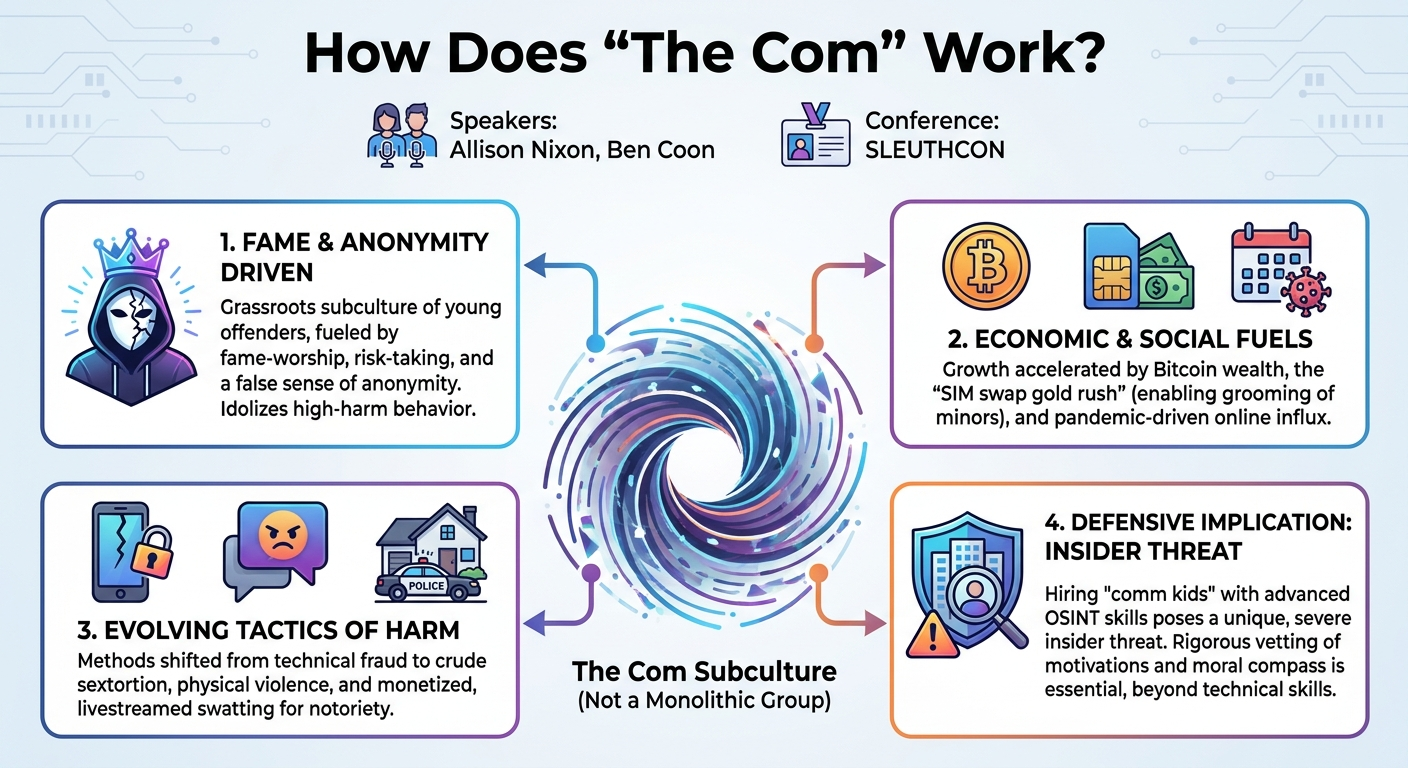
In this insightful SLEUTHCON presentation, Allison Nixon, Chief Research Officer, and Ben Coon, Chief Intelligence Officer at Unit 221B, peel back the layers of a complex and increasingly dangerous online phenomenon: The Com. Far from being a monolithic group, The Com is presented as a dynamic, grassroots subculture, a "bottom-up social phenomenon" that has profoundly reshaped the criminal underground. The speakers aim to provide a structural understanding of how this culture operates, recruits new members, and grows, ultimately guiding defensive strategies towards more productive outcomes.
Key moments
- 0:00 Introduction: Defining 'The Com' subculture
- 6:00 Real-world example: Swatting and extreme harm
- 8:00 Historical pivot points shaping 'The Com'
- 12:10 Evolution of sextortion: Four generations identified
- 17:20 Analyzing 'The Com' as a recruitment sales funnel
- 21:00 Call to action: Understanding insider threat risks
- 28:40 Q&A: Interrupting the funnel; addressing economic incentives
How Does "The Com" Work?
Speakers: Allison Nixon (Chief Research Officer, Unit 221B); Ben Coon (Chief Intelligence Officer, Unit 221B)
Conference: SLEUTHCON
YouTube: https://www.youtube.com/watch?v=TydZRumQUj8
Overview
In this insightful SLEUTHCON presentation, Allison Nixon, Chief Research Officer, and Ben Coon, Chief Intelligence Officer at Unit 221B, peel back the layers of a complex and increasingly dangerous online phenomenon: The Com. Far from being a monolithic group, The Com is presented as a dynamic, grassroots subculture, a "bottom-up social phenomenon" that has profoundly reshaped the criminal underground. The speakers aim to provide a structural understanding of how this culture operates, recruits new members, and grows, ultimately guiding defensive strategies towards more productive outcomes.
Nixon and Coon highlight that The Com is characterized by fame-worship, risk-taking behavior driven by a false sense of anonymity, and a disturbing overlap with the glorification of extreme violence seen in other online subcultures. Unlike the traditional "hacker spirit" of the 80s and 90s, The Com is populated primarily by young offenders, often minors, who are drawn in by the allure of quick wealth and internet notoriety. The talk meticulously traces the evolution of this subculture, from its roots in petty crime to its current involvement in high-dollar fraud, extreme violence, and even murder, offering critical insights for law enforcement, industry, and the public grappling with its pervasive impact.
Background
▶ Watch: Introduction: Defining 'The Com' subculture (0:00)
The evolution of the criminal underground into "The Com" is a story of significant pivot points, driven by technological shifts, economic incentives, and changing social dynamics. Tracing its ancestry, Nixon notes a direct line from old-school hackers to the current state, yet emphasizes how dramatically the culture has transformed.
The most consequential shift occurred around 2018 with the explosion of Bitcoin prices. This financial revolution transformed the criminal underground from a "scene of petty thieves" into a landscape of "overnight millionaires." Esoteric hacking techniques suddenly became vectors for immense wealth, attracting a new generation of participants, often young individuals, lured by media reports of lavish parties and seemingly easy money. It was around this time that the "scene" began to self-identify as "The Com," reflecting a new cultural identity centered on financial gain and fame-seeking.
Following the Bitcoin boom, the period for several years became known as the SIM swap era. Companies were slow to address vulnerabilities, leading to a "gold rush" that pumped enormous sums of money into The Com. Ben Coon elaborated on how this era fostered a sinister form of recruitment: grooming of minors. In one particular case, a gang leader infiltrated a mobile store as a manager, systematically hiring and then "firing" his gang members after they performed SIM swaps, exploiting them for illegal gains. This demonstrated a sophisticated, organized approach to leveraging internal access points.
The years 2020-2021 marked another critical juncture, coinciding with the global pandemic. The forced migration of children online led to a massive influx of young people onto internet platforms. Crucially, many of these children were not interested in technology but were simply present due to circumstances. This period, Nixon suggests, was "possibly not coincidentally" the beginning of a significant increase in violence and extortion within The Com, with growing overlap between high-dollar fraud and sextortion.
Most recently, The Com has entered the ransomware era. As companies finally began to crack down on SIM swap fraud, threat actors pivoted to ransomware. Nixon explains that these actors always possessed the capability for ransomware but preferred SIM swapping due to its relative ease and higher immediate returns. The shift underscores the adaptability and purely financial motivation of many within The Com.
A particularly disturbing aspect of The Com's evolution is the multi-generational development of sextortion. Nixon categorizes this into four distinct generations:
- First Generation: Emerged from skilled SIM swap communities. These actors leveraged their "esoteric hacking techniques" to coerce young girls into self-harm and other depraved acts, gaining fame within The Com for their "art."
- Second Generation: Less technically skilled, these actors, including notorious groups like the "original 764," realized similar results could be achieved through crude threats alone.
- Third Generation: Characterized by a focus on physical violence and extreme acts as a recruitment technique. Troubled teenagers would perform depraved acts to join groups, often for internet fame, leading to situations so severe that governments began prioritizing them as acts of terrorism.
- Fourth Generation: Comprises self-described "anti-extortion" groups, paradoxically founded by members of the first generation. Driven by a twisted "resentment" towards the "primitive" second generation, these groups engage in chaotic, self-described vigilante activity, which Nixon warns should never be trusted.
Demographically, The Com skews heavily towards young offenders, many under 18. This is partly due to young people seeking a sense of belonging, but also because legal systems are more lenient towards minors, incentivizing criminal gangs to recruit children for "dirty work." The subculture is predominantly English-speaking, meaning most participants hail from Five Eyes countries and Europe, with language acting as a de facto border online. Crucially, Nixon emphasizes that these individuals do not embody the "stereotypical old school hacker" spirit; the culture has fundamentally changed, and industry assumptions based on past archetypes are often incorrect.
Key Findings
▶ Watch: Historical pivot points shaping 'The Com' (8:00)
The talk presents several critical findings that redefine our understanding of contemporary cybercrime and online malicious subcultures:
- "The Com" as a Culture, Not a Group: This is the foundational insight. Unlike a hierarchical organization, The Com is a fluid, grassroots social phenomenon. It's a "bottom-up" movement where diverse, often warring, groups coexist within a shared culture of fame-worship, high harm, and perceived anonymity. This distinction is vital for developing effective defensive strategies.
- Fame, Harm, and Anonymity as Core Drivers: Participants in The Com idolize those who cause the most harm, drawing parallels to the glorification of school shooters. This perverse incentive structure, combined with a widespread but false belief in anonymity, encourages increasingly risky and depraved behavior, leading to prolonged criminal activity and the accumulation of more fame.
- The "Sales Funnel" of Radicalization: The Com recruits and develops offenders through a gradual process likened to a sales funnel. Casual participants, initially not offending, are exposed to the culture in social spaces. Prolonged immersion normalizes extreme behavior, leading to gang initiation and participation. While many drop out, a significant minority progresses to higher levels of offending, culminating in "high volume activity" and posing the greatest risk.
- Economic Motivation and Rational Decision-Making: Contrary to assumptions of mental illness, Nixon argues that for many young participants, joining The Com is a "rational financial decision." Faced with limited opportunities and low wages in entry-level legitimate jobs, the allure of significant, easily acquired wealth through fraud becomes a compelling alternative, often viewed as "cooler."
- The Rapid Effectiveness of Law Enforcement: A significant positive finding is the dramatic improvement in law enforcement's response time to high-harm Com actors. Turnaround times for arrests have shrunk from typical cyber case durations (e.g., a year) to "days, weeks," proving that aggressive, prioritized arrests can "throw them all in jail" and effectively deter activity by demonstrating consequences.
- Insider Threat Evolution: The talk highlights a critical shift in the nature of insider threats. Hiring a "comm kid" – someone with advanced OSINT (Open Source Intelligence) skills honed through malicious activities like tracking people for swatting or sextortion – is fundamentally different from hiring a traditional hacker. Their motivations and moral compass can pose severe risks to organizations, necessitating rigorous vetting and robust accountability structures.
Technical Deep Dive
▶ Watch: Evolution of sextortion: Four generations identified (12:10)
While "The Com" is a cultural phenomenon, its impact is felt through a range of sophisticated and disturbing technical and social engineering tactics. The talk details several key areas of operation:
SIM Swapping
This was a primary source of wealth during The Com's "gold rush" era. SIM swapping involves transferring a victim's phone number to a SIM card controlled by the attacker. This is typically achieved through a combination of:
- Social Engineering: Manipulating mobile carrier employees into performing the swap, often by impersonating the victim or using false pretenses.
- Insider Threats: As described by Ben Coon, this involves grooming or recruiting employees within mobile stores. A gang leader, for instance, would become a manager, hire gang members, facilitate their SIM swapping activities, and then "fire" them to maintain plausible deniability. This direct infiltration provides privileged access, bypassing many external security measures.
- Exploitation of Carrier Vulnerabilities: The speakers note that companies were slow to fix the underlying problems that enabled SIM swaps for several years, indicating systemic weaknesses in identity verification and account transfer protocols.
Social Engineering & Pretexting
These are foundational skills for many Com activities. Threat actors employ various techniques to gather information and manipulate individuals:
- Phishing and Smishing: Malicious emails (phishing) and SMS messages (smishing) are used to trick victims into divulging credentials, personal information, or clicking malicious links. These are often precursors to SIM swapping or other account takeovers.
- Grooming: A particularly insidious tactic, especially targeting minors. This involves building trust and rapport with victims or potential recruits over time, often in online gaming or social media environments, to manipulate them into performing actions that serve the attacker's agenda, whether it's providing personal data, engaging in self-harm for sextortion, or even acting as an insider.
Sextortion Methods
The evolution of sextortion within The Com demonstrates a shift from technical prowess to psychological manipulation and physical threats:
- First Generation (Technical Coercion): Early sextortionists used "esoteric hacking techniques" (likely including SIM swapping, account compromise, and data exfiltration) to gain leverage over victims. This technical access allowed them to obtain compromising material or force actions.
- Second Generation (Crude Threats): As the practice spread, less technically skilled actors realized that direct, crude threats (e.g., threatening to release private photos or videos) could achieve similar, if not "better," results without complex hacking.
- Third Generation (Physical Violence & Depraved Acts): This generation escalated threats to include actual physical violence, often used as a recruitment tool where aspiring members had to commit or facilitate depraved acts to join. This highlights a move beyond purely digital harm to real-world physical and psychological trauma.
Swatting
This dangerous practice involves making false reports to emergency services (e.g., bomb threats, hostage situations) to trigger a heavily armed police response at a victim's address. The talk provided stark examples:
- Richmond High Schools Swatting: A 14-year-old from Manchester, UK, swatted 13-14 schools in the Richmond, Virginia, area in a single phone call. This incident was live-streamed by the perpetrators, allowing Unit 221B to track it in real-time and notify the FBI.
- Serial Swatting and Sextortion: The same individual was responsible for nine swatting attacks in a 3-4 day period. One particularly egregious instance involved swatting a male victim while simultaneously sextorting his minor girlfriend on the phone, leading to her hospitalization due to self-harm.
- Sandy Hook Swatting: The audacity to target Sandy Hook Elementary, a site of immense tragedy, underscores the extreme depravity and lack of empathy within this subculture.
- Monetization of Harm: The speaker noted that the 14-year-old swatting perpetrator eventually began charging "$3 a SWAT," indicating a direct monetization of this high-harm activity.
OSINT (Open Source Intelligence)
The talk emphasizes that "comm kids" often develop highly sophisticated OSINT skills. While these skills are invaluable in legitimate cybersecurity roles, in the hands of Com actors, they are used for:
- Victim Identification and Profiling: Gathering extensive personal information about targets to facilitate social engineering, swatting, or sextortion.
- Tracking and Harassment: Locating individuals, their families, and associates for targeted attacks.
- Recruitment: Identifying vulnerable individuals or those seeking fame/belonging to draw them into the subculture.
The concern raised by Nixon is that these individuals, despite their malicious past, often apply for legitimate infosec jobs, posing a significant insider threat due to their advanced tracking capabilities and potentially twisted motivations.
Demo / Proof of Concept
▶ Watch: Call to action: Understanding insider threat risks (21:00)
While the speakers did not conduct a live technical demonstration or proof of concept, they extensively referenced and analyzed real-world incidents and observations that served as compelling evidence of The Com's operations. Notably, Ben Coon described how Unit 221B's team was able to monitor and react to live swatting events.
Specifically, the team was "live streaming this" (referring to the swatting of Richmond High Schools) and "actually able to get on the live stream and follow this and notify FBI in real time as this was going on." This direct observation of threat actors' live operations, including witnessing a 14-year-old perpetrator being groomed during a swatting incident and later advertising "$3 a SWAT," served as a powerful, real-time "proof of concept" of The Com's methods, motivations, and the immediate, devastating impact of their actions. These observations underscore the public nature of some of these attacks and the perverse pride taken by perpetrators in their "work."
Defensive Implications
▶ Watch: Q&A: Interrupting the funnel; addressing economic incentives (28:40)
Understanding the structure and motivations of The Com is paramount for crafting effective defensive strategies across government, industry, and society. The speakers outlined several critical implications:
For Governments and Law Enforcement:
- Prioritize High-Harm Com Actors for Arrest: Nixon strongly advocates for aggressive law enforcement action against the relatively small number of high-harm Com perpetrators. She notes that rapid arrests, often within "days, weeks," are highly effective. "It turns out that we actually can just throw them all in jail," she states, observing that groups "calm down after they understand that there's consequences to behavior." This shift in law enforcement strategy, treating these acts with the urgency of terrorism, is yielding impressive results.
- Address Grooming and Legal Loopholes: The legal leniency afforded to minors is explicitly exploited by Com gangs for recruitment. Law enforcement and policymakers need to re-evaluate how these laws are applied to online criminal activity involving children, and how to better protect minors from being groomed into these roles.
For the Private Sector and Industry:
- Re-evaluate Insider Threat Models for "Comm Kids": This is a crucial warning. The stereotype of the "misunderstood computer genius" hacker who just needs a "pat on the back and a hug" is dangerously outdated. "Hiring a comm kid is not the same as hiring a hacker," Nixon emphasizes. These individuals, often with advanced OSINT skills honed through malicious activities like tracking people for swatting or sextortion, pose a unique and severe insider threat. Companies must implement:
- Rigorous Vetting: Beyond technical skills, vetting processes must deeply probe motivations, past online behavior, and moral compass, especially for young applicants with a history of online "hacking" activity.
- Robust Accountability Structures: Given the extensive data access often granted to security teams, strong internal controls, monitoring, and accountability frameworks are essential to prevent abuse by potentially compromised insiders. The example of the BreachForums owner, initially defended as charismatic but later charged with CSAM, starkly illustrates this danger.
- Strengthen Platform Defenses Against Grooming: While the core of The Com operates on independent sites, its activities "leak out onto commercial platforms, commercial social media." Companies must move beyond simply reacting to public pressure and understand that the problem is a "social phenomenon where children are willfully joining violent street gangs on the internet." This requires proactive measures to detect and disrupt grooming, recruitment, and malicious content, rather than merely addressing surface-level infractions.
- Improve Information Sharing and Collaboration: Ben Coon's anecdote about working a parallel SIM swap case with Allison Nixon without realizing it highlights the need for greater collaboration. "Collaborate with each other, work with each other, share information to try and move this along," he urges. This includes sharing threat intelligence, indicators of compromise, and insights into actor tactics.
Societal and Proactive Measures:
- Interrupt the "Sales Funnel" with Legitimate Opportunities: To combat the "rational financial decision" that draws many young people into fraud, society needs to provide compelling alternatives. Nixon points to the historical success of:
- Professionalization of Infosec: Making cybersecurity a well-paid, respected profession.
- Bug Bounty Programs: Offering legal, ethical avenues for skilled individuals to apply their talents and earn money.
- Improved Career Paths for Youth: Addressing systemic issues that make entry-level jobs unattractive or inaccessible for young people, reducing the economic incentive for crime.
- Educate and Raise Awareness: The talk itself serves as a crucial defensive measure by educating the audience on "how the comm works, what motivates these people and what kind of responses will be effective." A broader understanding of this subculture can inform parents, educators, and community leaders on how to identify and intervene in grooming and recruitment.
- Avoid Blanket Bans on Child Communication: Nixon cautions against extreme measures like banning children from the internet. She argues that high-harm actors are a small minority (a few hundred to a few thousand), and blanket bans will not stop victimization if children are allowed to communicate at all. The focus should be on understanding and addressing the specific mechanisms of The Com, rather than broad censorship.
Key Takeaways
- The Com is a high-harm, fame-driven subculture, not a unified group: It's a grassroots movement where individual groups, often at odds, contribute to a broader culture of depravity and notoriety, primarily composed of young, English-speaking individuals.
- Economic incentives and social factors fuel its growth: The Bitcoin explosion, slow corporate response to SIM swapping, and the pandemic's impact on youth internet usage created a "gold rush" and a fertile ground for recruitment through a "sales funnel" model.
- Sextortion and swatting have evolved into extreme, monetized forms of violence: From technical coercion to crude threats, and now to physical violence and even charging "$3 a SWAT," The Com's activities inflict severe real-world harm, often targeting minors.
- Law enforcement's rapid response is effectively disrupting high-harm actors: Prioritizing arrests of key Com figures, with turnaround times in "days or weeks," is proving highly effective in deterring activity and demonstrating consequences.
- Industry must re-evaluate insider threat models and vet "comm kids" rigorously: Individuals with advanced OSINT skills honed through malicious activities pose a significant risk if hired into cybersecurity roles; their moral compass and motivations must be scrutinized alongside technical prowess.
- Combating The Com requires a multi-faceted approach: This includes aggressive law enforcement, industry collaboration, robust insider threat mitigation, platform responsibility, and societal efforts to provide legitimate, attractive career paths for youth, thereby interrupting the "sales funnel" of radicalization.
About the Speaker(s)
Allison Nixon is the Chief Research Officer at Unit 221B. Throughout her distinguished career, she has dedicated her efforts to "chasing script kitties," though she humorously notes her repeated failure to work on "things that are not important," indicating her consistent involvement in high-impact security investigations. Her deep expertise in understanding the nuances of the criminal underground and its evolving subcultures is evident in her detailed analysis of The Com.
Ben Coon serves as the Chief Intelligence Officer at Unit 221B, having recently joined the organization. With a background primarily in mobile technology, he brings significant experience in combating cybercrime, particularly in areas like fishing and smishing. Coon provided key insights into the practical aspects of investigating The Com, including his personal experience working parallel SIM swapping cases with Allison Nixon and his team's real-time monitoring of swatting incidents.
Reviews
Dr. Zero (Offensive Security Researcher) — STRONG ACCEPT
Nixon and Coon aren't dropping zero-days here, but they are dropping absolute ground truth on the most chaotic threat actors burning down networks today. If your insider threat model still assumes a misunderstood 90s hacker instead of a violent sociopath doing it for Discord clout, you're going to get breached. Mandatory viewing for anyone doing threat intel or hiring junior analysts.
Heather Calloway (CISO) — MUST SEE
Nixon and Coon map the evolution of 'The Com,' a hyper-violent, youth-driven cybercriminal subculture that has replaced the traditional hacker underground. This isn't just threat intelligence; it is a structural warning about the death of the 'reformed hacker' talent pipeline. If your insider threat program and HR screening processes haven't accounted for this demographic shift, your organization is carrying unquantified risk.