Opening Keynote: Between Headlines and Incidents: Keeping Mission and Morale Aligned
Mark Barwinski
Swiss Cyber Storm 2025 · Day 1 · Arena
Overview
In his opening keynote at Swiss Cyber Storm, Mark Barwinski delivered a compelling and deeply personal address titled "Between Headlines and Incidents: Keeping Mission and Morale Aligned." Barwinski, whose career spans intelligence analysis in war zones to leading cyber operations for a major Swiss bank, drew upon his unique background to illuminate the critical, often overlooked, human elements of cybersecurity resilience. His talk transcended typical technical discussions, offering a poignant exploration of leadership, trust, purpose, and stress management in an increasingly volatile global landscape.
Key moments
- 2:30 Our world today: a state of hybrid warfare
- 5:50 Thermite grenades: Step one in incident response
- 10:45 Micro resets: Injecting humor for team resilience
- 17:20 Trusting your team: Calm in corporate chaos
- 23:40 Purpose: The key difference in work satisfaction
- 27:30 Resilience is holistic: People, process, technology
- 34:15 Q&A: Cultivating purpose in corporate banking
Opening Keynote: Between Headlines and Incidents: Keeping Mission and Morale Aligned
Speakers: Mark Barwinski, Former Head of Cyber Operations and Advanced Analytics at UBS
Conference: Swiss Cyber Storm
YouTube: https://www.youtube.com/watch?v=i_QIrLtOTn8
Overview
In his opening keynote at Swiss Cyber Storm, Mark Barwinski delivered a compelling and deeply personal address titled "Between Headlines and Incidents: Keeping Mission and Morale Aligned." Barwinski, whose career spans intelligence analysis in war zones to leading cyber operations for a major Swiss bank, drew upon his unique background to illuminate the critical, often overlooked, human elements of cybersecurity resilience. His talk transcended typical technical discussions, offering a poignant exploration of leadership, trust, purpose, and stress management in an increasingly volatile global landscape.
The core of Barwinski's message revolved around the idea that true resilience in cybersecurity, particularly in what he terms a state of hybrid warfare, hinges not just on technology and processes, but fundamentally on people. Through vivid anecdotes from his year as an intelligence analyst in Afghanistan, he meticulously unpacked how seemingly simple human factors—like humor, trust in one's team, and a clear sense of purpose—are paramount to maintaining operational effectiveness and morale under extreme pressure. He then skillfully translated these battlefield lessons into actionable insights for cybersecurity professionals navigating the constant threats and high-stakes environment of the corporate world.
This keynote serves as a vital reminder for CISOs, security researchers, and practitioners alike that while technical prowess is essential, the human element—our ability to cope with stress, foster strong team dynamics, and understand the impact of our work—ultimately dictates our collective strength against sophisticated adversaries. Barwinski’s narrative powerfully advocates for a holistic approach to resilience, emphasizing that neglecting the well-being and motivation of cybersecurity teams is a direct path to failure, regardless of the sophistication of deployed technologies.
Background
▶ Watch: Our world today: a state of hybrid warfare (2:30)
The contemporary cybersecurity landscape, as framed by Barwinski, is no longer merely a domain of isolated incidents but a continuous state of hybrid warfare. Citing figures like Mark Rutte and Ursula von der Leyen, Barwinski underscored that the world operates in a precarious zone "not war and not peace either." This environment is characterized by a relentless barrage of headlines detailing cyberattacks against critical infrastructure—from shipping ports in Germany to airport check-in systems across Europe—alongside physical disruptions like drone sightings and GPS jamming in the Baltics. These multifaceted threats highlight a pervasive state of uncertainty that demands a fundamental re-evaluation of how organizations approach security.
Barwinski argued that this constant state of flux and the pervasive nature of advanced persistent threats create immense stress within cybersecurity teams. Traditional approaches to resilience, often narrowly focused on technological redundancies or rigid processes, fail to account for the human cost of operating under sustained pressure. The problem, as he articulated, is that while we invest heavily in technical controls, we often neglect the psychological and sociological factors that underpin a team's ability to perform effectively when it matters most. His personal experiences in a combat zone offered a stark parallel to the high-stakes, information-incomplete environments that cybersecurity professionals routinely face, revealing why conventional "peace-time" organizational strategies often fall short in an era of continuous digital conflict. The talk implicitly positions human resilience as the foundational layer upon which all other security controls ultimately depend, making it a critical, yet often overlooked, component of a robust defensive posture.
Key Findings
▶ Watch: Micro resets: Injecting humor for team resilience (10:45)
Barwinski's talk distilled several profound insights into building resilience, drawing directly from his experiences in Afghanistan and translating them into the corporate cybersecurity context:
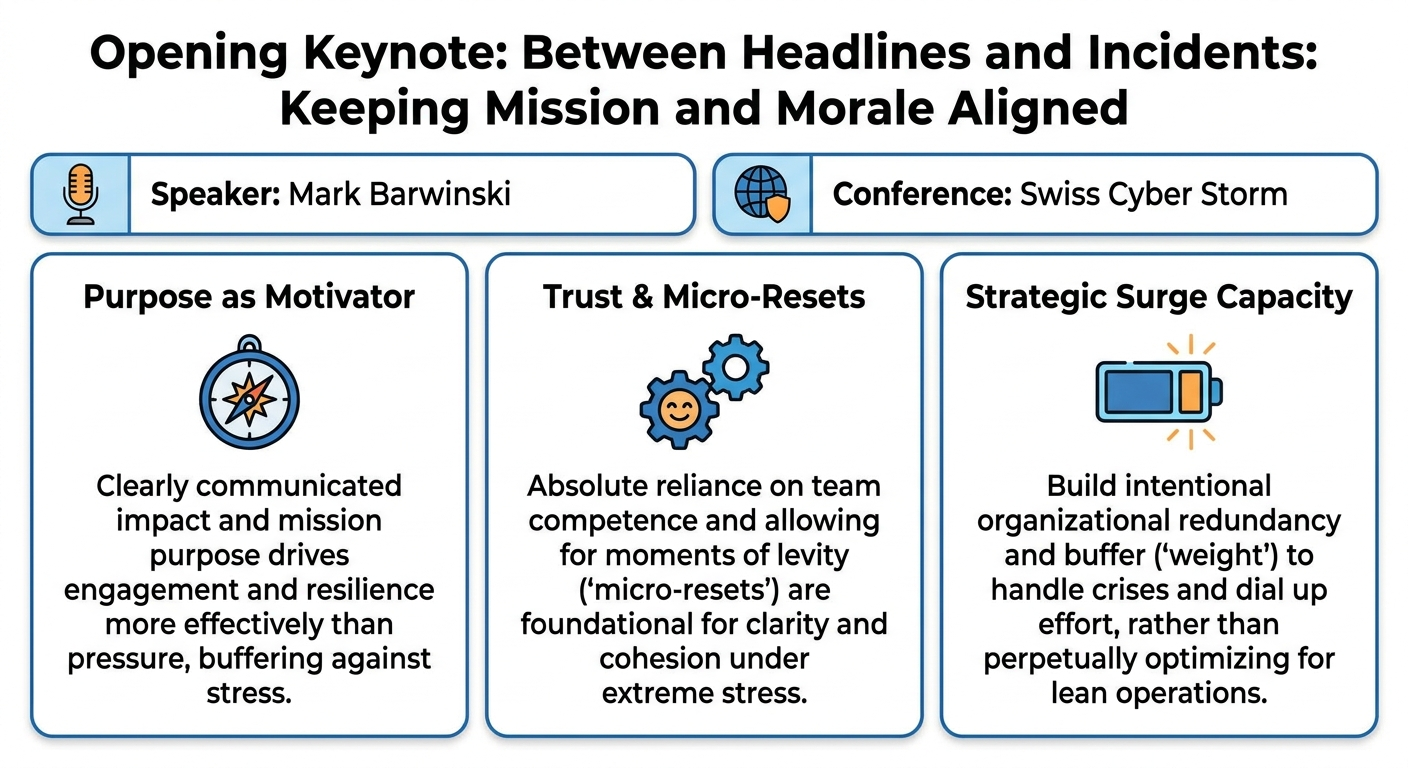
- The Power of Micro-Resets and Humor: Operating under immense stress, Barwinski and his colleague Jeff discovered the organic power of humor and "micro-resets" to diffuse tension and strengthen team bonds. The anecdote of the thermite grenades—designed for data incineration in case of base overrun—and the playful flashlight pranks underscored that finding moments of levity, even in dire circumstances, is crucial for humanizing the experience and preventing burnout. This finding suggests that fostering a culture where teams can momentarily step back from the intensity, laugh, and reconnect is vital for sustained performance.
- Trust as the Foundation of Action in Chaos: Barwinski's harrowing experience aboard a C17 Globe Master 3 military cargo plane, carrying 5,000 gallons of jet fuel into a war zone, highlighted the paramount importance of trust. In situations of "fast-moving situations with incomplete information and no windows to look out," the ability to trust the training and skills of one's team members (or pilots, in his analogy) is not just comforting, but essential for clarity of thought and effective operation. This translates to leaders trusting their teams to execute their roles without micromanagement, and team members trusting each other's competence.
- Purpose as the Ultimate Motivator: Contrasting his 105-108 hour work weeks in Afghanistan, driven by a clear sense of purpose in protecting lives, with the stress experienced by corporate teams working standard 42-hour weeks, Barwinski identified a fundamental disconnect. He asserted that a transparent understanding of the purpose and tangible impact of one's work is a more powerful stress buffer than any other factor. The leaked itinerary incident, where his team's swift action prevented a potential ambush, vividly illustrated how seeing the direct effect of one's efforts fuels engagement and resilience. A Deloitte survey further supported this, indicating that 90% of Gen Z and millennials correlate purpose with job satisfaction and well-being, a sentiment Barwinski believes is universal.
- Holistic Resilience: Beyond Silos: Barwinski argued against viewing resilience through isolated lenses of people, process, and technology. He emphasized that these pillars are interconnected and must be considered holistically. Perfect processes or advanced technology will fail if people are exhausted, and strong people cannot compensate for inadequate plans or technical vulnerabilities. True resilience requires optimizing all three in concert.
- Strategic Resilience and "Surge Capacity" over Lean Optimization: In times of "hybrid warfare," Barwinski challenged the conventional business wisdom of "lean" processes and "maximum utilization." Instead, he advocated for building strategic resilience and surge capacity—the organizational equivalent of an athlete gaining weight for a cold-water swim or a sumo wrestler building mass for stability. This means intentionally building redundancies, allowing for periods of lower utilization, and having the ability to "dial up the effort" when crisis strikes, rather than running at 100% capacity all the time.
Technical Deep Dive
▶ Watch: Trusting your team: Calm in corporate chaos (17:20)
While Mark Barwinski's keynote did not present a traditional technical deep dive into specific vulnerabilities, code, or protocols, its insights are profoundly relevant to the operational effectiveness and sustainability of technical cybersecurity teams. The talk implicitly dives deep into the human architecture that underpins all technical defenses and incident response capabilities.
Barwinski's experiences underscore that even the most robust Security Information and Event Management (SIEM) systems, Intrusion Detection/Prevention Systems (IDPS), Endpoint Detection and Response (EDR) solutions, or Threat Intelligence Platforms (TIPs) are only as effective as the human analysts and engineers operating them. The "Technical Deep Dive" in this context shifts from examining circuit boards and software to understanding the psychological and organizational circuits that enable or hinder technical performance.
For instance, his discussion of the thermite grenade scenario, a stark example of a physical "self-destruct mechanism," highlights the extreme pressure under which technical teams sometimes operate. While corporate environments rarely involve physical incineration, the concept of a "wipe-and-rebuild" strategy or the need to quickly decommission compromised systems in a ransomware attack carries similar weight. The ability of a Security Operations Center (SOC) analyst to maintain focus and execute complex incident response playbooks under the stress of a live attack, potentially working 108-hour weeks as Barwinski did, is directly impacted by their morale, trust in their team, and understanding of the mission's purpose.
The C17 Globe Master 3 analogy, with its emphasis on trust in the pilots' training and skills, translates directly to DevSecOps teams, cloud architects, or network engineers. In complex, interconnected systems, trusting that each component (and the team responsible for it) is performing its job correctly is critical. A lack of trust can lead to excessive micromanagement, redundant checks, and slower response times, ultimately undermining the agility and security of a distributed system architecture. Similarly, in a zero-trust environment, while technical controls enforce strict authentication and authorization, the underlying human trust in the integrity of the system and the competence of colleagues remains essential for collaborative problem-solving and rapid remediation during a breach.
Furthermore, Barwinski's call for strategic resilience and surge capacity directly challenges the lean principles often applied to IT infrastructure and cybersecurity operations. While cloud elasticity and automation offer technical means to scale, true surge capacity requires human teams that are not perpetually exhausted. This means designing redundant staffing models, investing in cross-training, and maintaining a buffer capacity in terms of human resources, rather than optimizing for maximum utilization at all times. This "weight gain" approach applies to technical infrastructure too, suggesting that some level of over-provisioning or maintaining diverse vendor relationships (e.g., multi-cloud strategies) might be strategically more resilient than a hyper-optimized, single-vendor approach.
In essence, Barwinski's "Technical Deep Dive" is into the human operating system that runs our technical defenses. It argues that neglecting the psychological, social, and motivational aspects of technical personnel will inevitably lead to systemic vulnerabilities, regardless of how advanced the hardware or software may be.
Demo / Proof of Concept
▶ Watch: Resilience is holistic: People, process, technology (27:30)
As an opening keynote, Mark Barwinski's presentation was conceptual and experiential, focusing on leadership principles and human resilience rather than demonstrating specific tools, exploits, or technical solutions. Therefore, there was no live demo or proof of concept presented during the talk. The "proof" of his concepts lay in the vivid, personal anecdotes and the compelling parallels drawn between high-stakes military operations and the challenges faced by cybersecurity professionals in the corporate world.
Defensive Implications
▶ Watch: Q&A: Cultivating purpose in corporate banking (34:15)
Mark Barwinski's insights offer crucial defensive implications for cybersecurity leaders and practitioners, emphasizing a shift from purely technical concerns to a more holistic, human-centric approach to security.
- Prioritize Team Well-being and Morale: Defenders must actively foster environments that allow for stress release and micro-resets. This means encouraging work-life balance, recognizing the psychological toll of constant threat monitoring, and promoting a culture where humor and camaraderie are seen as vital components of team resilience, not distractions. Leaders should be attuned to signs of burnout and proactively implement strategies to mitigate it.
- Cultivate Trust Across the Organization: Build strong bonds of trust within cybersecurity teams and between security and other departments. Leaders must trust their teams to perform their roles effectively, avoiding micromanagement, especially during incidents. Conversely, teams need to trust leadership's decisions and support. This foundational trust is critical for efficient incident response, rapid decision-making in chaotic situations, and effective collaboration on security architecture and risk management.
- Articulate and Transparently Communicate Purpose: Cybersecurity teams need to understand the tangible impact of their work. Leaders should regularly communicate how their efforts protect the organization, its customers, and its mission, making the connection between daily tasks and overarching strategic goals explicit. This transparency, as demonstrated by the UBS bank example, transforms routine tasks into meaningful contributions, significantly boosting morale and performance.
- Implement Holistic Resilience Strategies: Move beyond siloed approaches to people, process, and technology resilience. Develop integrated strategies where each pillar supports the others. This involves not only robust technical controls and documented incident response plans but also comprehensive training programs, cross-functional exercises, and a strong focus on team cohesion and individual well-being. A weakness in one area will undermine the others.
- Build Strategic Resilience and Surge Capacity: Challenge the lean optimization mindset in cybersecurity. Organizations should intentionally build redundancy and surge capacity into their security operations. This includes having sufficient staffing buffers, cross-training personnel for multiple roles, and potentially diversifying technology vendors or cloud providers to avoid single points of failure. The goal is to be able to "dial up the effort" during crises without immediately exhausting resources, ensuring the organization can absorb and recover from significant attacks.
- Empower Pilots to Fly the Plane: Leaders should empower their expert teams (the "pilots") to execute their specialized roles. This means providing them with the necessary resources, authority, and trust to make decisions and implement solutions, rather than attempting to micromanage technical details from a leadership position. Effective leadership in cybersecurity involves setting the strategic direction and fostering the environment for success, not dictating every tactical maneuver.
Key Takeaways
- Human Resilience is Paramount: Effective cybersecurity resilience fundamentally depends on the well-being, morale, and intrinsic motivation of the people involved, not just technology or processes.
- Humor and Micro-Resets are Essential: In high-stress environments, fostering a culture that allows for moments of levity and stress relief ("micro-resets") is crucial for maintaining team cohesion and preventing burnout.
- Trust is Foundational: Absolute trust in colleagues' competence and leadership's decisions is vital for navigating chaotic situations effectively and enabling clarity of thought under pressure.
- Purpose Drives Performance: Transparently communicating the tangible impact and purpose of cybersecurity work significantly enhances job satisfaction, resilience, and performance, even during demanding periods.
- Holistic Approach to Resilience: People, process, and technology must be considered as interconnected pillars of resilience; neglecting any one will undermine the others.
- Strategic Capacity Over Lean Optimization: In an era of "hybrid warfare," organizations should prioritize building "surge capacity" and strategic redundancies over strict lean optimization to ensure they can effectively respond to and recover from significant cyber incidents.
About the Speaker(s)
Mark Barwinski is a distinguished cybersecurity professional with a diverse and intriguing background that spans both military intelligence and corporate finance. He is an individual who has made the unique transition from a US passport to a Swiss passport, bringing a wealth of international experience to his work. Barwinski served as an intelligence analyst and a representative of the National Security Agency (NSA) in Afghanistan for a year, where he was responsible for consuming and producing classified intelligence, monitoring communications, and investigating incidents against military networks, including being the cyber security liaison officer. This experience involved operating in a high-stress, war-zone environment, where his "incident response plan" included the physical destruction of classified equipment.
Following his impactful tenure in Afghanistan, Barwinski applied his expertise to the financial sector. He previously held the position of Head of Cyber Operations and Advanced Analytics for UBS bank, overseeing their Security Operations Center (SOC) and advanced analytics teams. In this role, he was responsible for protecting the bank's assets and ensuring its cybersecurity posture, drawing direct parallels between the challenges faced in a war zone and those in a demanding corporate environment. Mark Barwinski has been a frequent speaker at Swiss Cyber Storm since 2016, known for his ability to translate complex, high-stakes experiences into actionable insights for a diverse audience of cybersecurity professionals.
Reviews
Dr. Zero (Offensive Security Researcher) — SOLID
Barwinski is a former NSA operator who ran UBS's SOC, so he actually has the scars to give a leadership keynote. He makes a compelling, concrete argument against running security teams on MBA-style 'lean optimization,' which alone makes this worth a listen if you manage people.
Heather Calloway (CISO) — STRONG ACCEPT
Barwinski makes the operational case against running security teams at maximum utilization. It's the exact argument you need in your back pocket the next time finance tries to lean out your SOC headcount.