Swiss Hacking Challenge
Marc Bollhalder (Co-organizer Team Lead · Swiss Cyberstorm), Manuel Bürge (Co-organizer Team Lead · Swiss Cyberstorm)
Swiss Cyber Storm 2025 · Day 1 · Arena
Overview
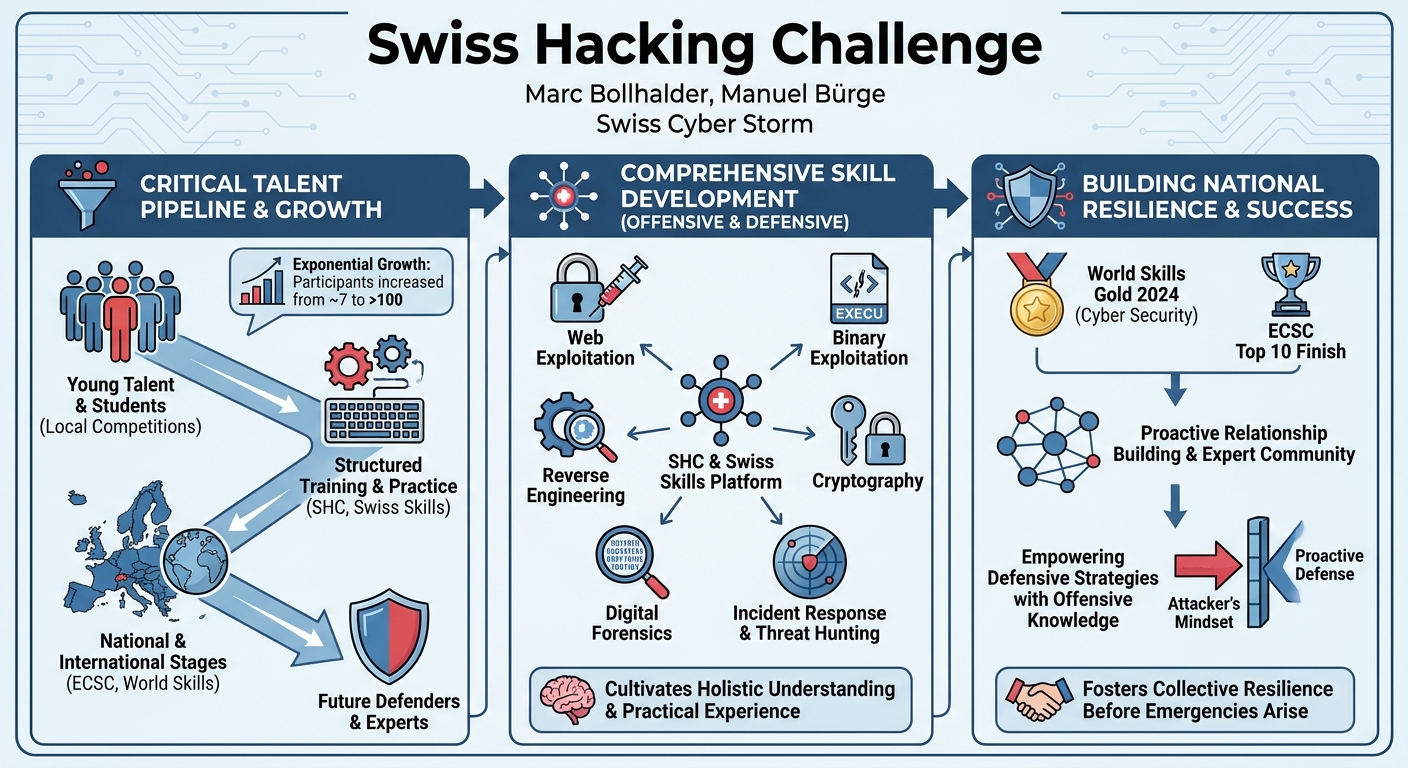
This talk, presented by Marc Bollhalder and Manuel Bürge from Swiss Cyberstorm, delves into the critical role of the Swiss Hacking Challenge (SHC) and Swiss Skills in cultivating the next generation of cybersecurity professionals in Switzerland. Far from being a mere academic exercise, these initiatives serve as a vital pipeline for identifying, training, and empowering young talent, preparing them for national and international cybersecurity competitions, and ultimately, for real-world defensive roles. The speakers highlight the journey from local competitions to global stages like the European Cyber Security Challenge (ECSC) and World Skills, showcasing Switzerland's impressive achievements in these arenas.
Key moments
- 0:30 What is the Swiss Hacking Challenge?
- 2:00 Swiss Hacking Challenge path to European competition
- 4:00 Personal journey and community growth in cyber security
- 6:15 Swiss Skills: competing at World Skills 2024
- 8:30 Switzerland wins World Skills Cyber Security gold medal
- 9:30 Future challenges and inspiring new cyber talents
Swiss Hacking Challenge
Speakers: Marc Bollhalder (Co-organizer Team Lead, Swiss Cyberstorm), Manuel Bürge (Co-organizer Team Lead, Swiss Cyberstorm)
Conference: Swiss Cyber Storm
YouTube: https://www.youtube.com/watch?v=E5JwAvaktOY
Overview
This talk, presented by Marc Bollhalder and Manuel Bürge from Swiss Cyberstorm, delves into the critical role of the Swiss Hacking Challenge (SHC) and Swiss Skills in cultivating the next generation of cybersecurity professionals in Switzerland. Far from being a mere academic exercise, these initiatives serve as a vital pipeline for identifying, training, and empowering young talent, preparing them for national and international cybersecurity competitions, and ultimately, for real-world defensive roles. The speakers highlight the journey from local competitions to global stages like the European Cyber Security Challenge (ECSC) and World Skills, showcasing Switzerland's impressive achievements in these arenas.
The core mission of the SHC and Swiss Skills is multifaceted: to educate and motivate young individuals to pursue careers in cybersecurity, to provide a legal and ethical environment for honing hacking skills, and to foster a strong community of like-minded experts. This collaborative ecosystem is presented as a cornerstone of national cybersecurity resilience, emphasizing that robust relationships and talent networks must be built proactively, long before emergencies arise. The talk underscores the strategic importance of these programs in strengthening Switzerland's digital defenses and contributing to a broader European talent pool.
The significance of this talk extends beyond national pride; it offers a blueprint for how nations can proactively address the growing cybersecurity talent gap. By creating engaging, challenging, and supportive environments, organizations like Swiss Cyberstorm are not only shaping individual careers but also bolstering national security postures. The success stories shared, particularly Switzerland's gold medal win at World Skills 2024, serve as powerful testaments to the efficacy of these programs and the potential they unlock in young, aspiring cybersecurity experts.
Background
▶ Watch: What is the Swiss Hacking Challenge? (0:30)
The genesis of the Swiss Hacking Challenge and its associated programs lies in a recognition of a pervasive challenge: the difficulty in attracting young talent to cybersecurity and providing them with practical, engaging learning opportunities. As Marc Bollhalder recounts from his own experience, traditional educational settings often fail to ignite interest in IT, let alone the specialized field of cybersecurity. This void led to the creation of platforms where individuals could legally and ethically explore their passion for hacking, transforming curiosity into concrete skills. The initiative was championed by pioneers like Joe from Austria and Bernhard, the president of Swiss Cyberstorm, who envisioned a structured pathway for talent development.
The Swiss Hacking Challenge functions primarily as a Capture The Flag (CTF) competition. CTFs are a popular form of cybersecurity competition where participants solve challenges by finding "flags"—specific pieces of text or information hidden within vulnerable systems. These systems can range from web applications and custom cryptographic protocols to binary executables and hardware setups. The process of finding flags often involves exploiting vulnerabilities, reverse engineering code, or breaking cryptographic schemes. Points are awarded for each flag captured, fostering a competitive yet educational environment.
The SHC is structured with multiple stages, starting with an open-to-all online qualifier. This initial phase serves as a broad net, identifying promising individuals who then progress to the Swiss Hacking Challenge finals, an onsite team-based event. Success in the SHC finals can lead to selection for the prestigious Swiss national team, which competes in the European Cyber Security Challenge (ECSC). The ECSC itself is a multi-day, pan-European competition involving over 34 official teams and 340 participants, highlighting the scale and importance of these events. Parallel to the SHC, the Swiss Skills program focuses on vocational training, culminating in competitions that feed into the global World Skills event, where cybersecurity is recognized as a distinct profession or "skill." This layered approach ensures that talent is nurtured from foundational understanding through to advanced, specialized expertise, addressing the critical need for skilled professionals across various cybersecurity domains.
Key Findings
▶ Watch: Personal journey and community growth in cyber security (4:00)
The talk reveals several compelling outcomes and achievements stemming from the Swiss Hacking Challenge and Swiss Skills initiatives, demonstrating their significant impact on Switzerland's cybersecurity landscape:
- Explosive Growth in Participation: The SHC has witnessed remarkable growth, evolving from a competition attracting only seven participants in Marc Bollhalder's early days to over 100 competitors today. This exponential increase underscores the program's success in attracting and engaging young talent in cybersecurity.
- International Collaboration in CTF Development: The Swiss Cyberstorm organization actively collaborates with counterparts across Europe, including Germany, Austria, Iceland, Estonia, Norway, Slovakia, and Kosovo, to create diverse and challenging CTF events. This cross-border cooperation not only enriches the competition experience but also strengthens international cybersecurity ties and knowledge exchange.
- Strong Performance at the European Cyber Security Challenge (ECSC): The Swiss national team has consistently demonstrated high proficiency, securing a top 10 finish at the ECSC in Warsaw, Poland. This achievement highlights the effectiveness of the SHC in preparing participants for advanced, multi-day international competitions.
- World Champion Status in Cyber Security: A crowning achievement was the gold medal awarded to Edward and Philip, representing Switzerland, in the cyber security category at World Skills 2024. This prestigious recognition signifies Switzerland's global leadership in developing top-tier cybersecurity talent.
- Best of Nation Award and Overall National Ranking: In addition to individual gold, Edward and Philip received the "Best of Nation" award, further cementing Switzerland's elite standing. Overall, Switzerland was ranked the third-best nation at World Skills, a testament to the broad excellence fostered across various skills, with cybersecurity playing a significant role.
- Emphasis on Community, Networking, and Resilience: Beyond technical skills, the programs actively cultivate a strong community, promoting networking among participants from different nations. The talk stresses the importance of "quality relationships" for preparing for future emergencies, aligning with the concept of collective resilience. Mental resilience and discipline are also identified as crucial attributes for success in high-pressure competitive environments.
Technical Deep Dive
▶ Watch: Swiss Skills: competing at World Skills 2024 (6:15)
The Swiss Hacking Challenge and Swiss Skills competitions, while presented at a high level in the talk, implicitly cover a vast array of technical cybersecurity domains. Participants are exposed to and expected to master various offensive and defensive techniques, reflecting the multifaceted nature of real-world cybersecurity.
The CTF events, foundational to the Swiss Hacking Challenge, are categorized into distinct technical disciplines:
- Web Challenges: These focus on exploiting vulnerabilities in web applications. Participants encounter common flaws such as SQL Injection (SQLi), where malicious SQL queries are injected to manipulate database commands; Cross-Site Scripting (XSS), which allows attackers to inject client-side scripts into web pages viewed by other users; Remote Code Execution (RCE), enabling the execution of arbitrary code on the server; and various forms of authentication bypass and insecure direct object references. Solving these often requires understanding HTTP protocols, web server configurations, and knowledge of frameworks like the OWASP Top 10 vulnerabilities.
- Reverse Engineering: This category involves analyzing compiled software to understand its functionality, identify hidden features, or uncover vulnerabilities without access to the source code. Participants use tools like disassemblers (e.g., IDA Pro, Ghidra) to convert machine code back into assembly language and decompilers to approximate source code. Challenges might involve understanding obfuscated code, cracking license checks, or extracting embedded secrets.
- Binary Exploitation: Often considered one of the more challenging CTF categories, binary exploitation focuses on discovering and leveraging vulnerabilities in compiled executables. This typically involves exploiting memory corruption bugs such as buffer overflows (writing past the end of a buffer to overwrite adjacent memory), format string bugs, and use-after-free vulnerabilities. Advanced techniques include crafting Return-Oriented Programming (ROP) chains to bypass modern exploit mitigations like Data Execution Prevention (DEP) and Address Space Layout Randomization (ASLR), ultimately leading to arbitrary code execution or privilege escalation.
- Cryptography: These challenges test participants' understanding of cryptographic principles and their ability to break or analyze cryptographic systems. This can range from identifying weaknesses in classical ciphers (e.g., Caesar, Vigenère) to exploiting flaws in modern symmetric (e.g., AES, DES) and asymmetric (e.g., RSA, ECC) encryption schemes. Challenges might involve cryptanalysis, recovering keys, understanding hashing algorithms, or breaking custom, often flawed, cryptographic protocols designed by the organizers.
- Hardware Challenges: When competitions are held onsite, hardware challenges introduce a physical dimension. This can involve interacting with embedded systems, IoT devices, or custom electronics. Tasks might include firmware extraction and analysis, side-channel attacks (e.g., power analysis, electromagnetic eavesdropping to glean secret information), JTAG/UART debugging, or exploiting physical access vulnerabilities.
For the World Skills competition, the scope broadens to encompass a more comprehensive suite of enterprise-level cybersecurity skills:
- Securing Enterprise Infrastructure: This involves implementing and maintaining robust security controls across an organization's IT environment. Key aspects include configuring network security devices (firewalls, Intrusion Detection/Prevention Systems - IDS/IPS), hardening operating systems (Windows, Linux) and applications, implementing Identity and Access Management (IAM) solutions, configuring endpoint detection and response (EDR) tools, and ensuring proper patch management and vulnerability remediation processes.
- Digital Forensics: Participants learn to collect, preserve, and analyze digital evidence from various sources (e.g., disk images, memory dumps, network traffic captures) to reconstruct events following a security incident. This includes using specialized tools like Autopsy for disk forensics, Volatility Framework for memory analysis, and Wireshark for network protocol analysis to identify malicious activities, attacker methodologies, and data exfiltration.
- Incident Response: This skill set focuses on the systematic approach to handling security breaches. It involves understanding the incident response lifecycle (preparation, identification, containment, eradication, recovery, post-incident analysis). Participants practice developing and executing incident response playbooks, coordinating with stakeholders, and minimizing the impact of security incidents.
- Threat Hunting: Moving beyond reactive defense, threat hunting involves proactively searching for undetected threats within an organization's network. This requires forming hypotheses about potential attacker activities, leveraging security information and event management (SIEM) data, endpoint telemetry, and network logs to identify Indicators of Compromise (IOCs) or Indicators of Attack (IOAs) that traditional security tools might miss.
- Offensive Security: While often associated with attacking, a strong offensive security understanding is crucial for effective defense. This involves applying penetration testing methodologies, conducting vulnerability assessments, and understanding common attack vectors from an attacker's perspective. Knowledge of tools like Nmap for network scanning, Metasploit for exploitation, and various web application proxies (e.g., Burp Suite) is essential.
The integration of these technical disciplines across the Swiss Hacking Challenge and Swiss Skills ensures that participants develop a holistic understanding of cybersecurity, equipping them with both the offensive mindset to identify weaknesses and the defensive strategies to protect critical assets.
Demo / Proof of Concept
▶ Watch: Switzerland wins World Skills Cyber Security gold medal (8:30)
The talk itself does not feature a live technical demonstration or a specific proof of concept of a vulnerability exploitation. Instead, the entire framework of the Swiss Hacking Challenge and Swiss Skills can be viewed as a continuous, large-scale practical demonstration of cybersecurity skills. The "demo" for participants is the CTF environment itself, where they are presented with real-world simulated systems containing deliberately placed vulnerabilities or cryptographic puzzles.
For instance, in a web challenge, participants might be given a URL to a vulnerable web application. Their task would be to identify an input field susceptible to SQL injection, craft a malicious payload to bypass authentication, and then extract a hidden flag from the database. In a binary exploitation challenge, they might receive an executable file and be tasked with reverse engineering it to find a buffer overflow, then write custom shellcode to gain control of the program's execution flow and retrieve a flag stored in memory.
The World Skills competition further extends this concept by creating complex, multi-layered enterprise environments where teams must apply their knowledge across forensics, incident response, infrastructure security, and threat hunting in a dynamic, scenario-based setting. While no single "demo" was presented in the talk, the structure and success of these competitions serve as a testament to the practical application and demonstration of advanced cybersecurity proficiencies.
Defensive Implications
▶ Watch: Future challenges and inspiring new cyber talents (9:30)
The insights gleaned from the Swiss Hacking Challenge and Swiss Skills programs carry profound defensive implications for organizations and national cybersecurity strategies. By fostering a deep understanding of offensive techniques, these initiatives inherently strengthen defensive capabilities.
Firstly, individuals trained through these programs develop an attacker's mindset. By actively engaging in web exploitation, binary exploitation, and reverse engineering, participants learn precisely how adversaries identify and exploit vulnerabilities. This firsthand experience is invaluable for defenders, enabling them to anticipate attack vectors, understand the efficacy of various exploit mitigations, and prioritize defensive measures based on genuine threat potential. For example, a developer who has successfully performed a SQL injection attack will inherently design more secure input validation and parameterized queries in their own code.
Secondly, the comprehensive skill sets cultivated directly translate to enhanced proactive security measures. Knowledge of common CTF categories like web and binary exploitation drives the implementation of robust security controls. Organizations can better implement secure coding practices, conduct thorough penetration testing, deploy advanced endpoint protection solutions, and configure network security devices (firewalls, IDS/IPS) to specifically counter the types of attacks practiced in these competitions. The emphasis on securing enterprise infrastructure in World Skills directly prepares individuals to harden systems, manage access controls, and maintain patch hygiene in real-world environments.
Thirdly, the focus on digital forensics and incident response is critical for reactive defense. Trained professionals can efficiently identify, contain, eradicate, and recover from cyberattacks. Their ability to analyze logs, memory dumps, and network traffic using tools like Volatility and Wireshark is essential for understanding the scope of a breach and preventing future occurrences. The structured approach to incident response taught in these programs ensures that organizations can respond systematically and effectively under pressure.
Fourthly, the practice of threat hunting moves organizations beyond a purely reactive stance to a proactive defense posture. By learning to search for subtle indicators of compromise (IOCs) or advanced persistent threats (APTs) that bypass traditional security tools, trained threat hunters can uncover lurking threats before they cause significant damage. This requires an analytical mindset and a deep understanding of attacker tactics, techniques, and procedures (TTPs), all honed through competitive scenarios.
Finally, and perhaps most importantly, these programs are fundamental to cybersecurity talent development and national resilience. The creation of a skilled and motivated workforce is the ultimate defensive implication. As Marc Bollhalder noted, "Quality relationships cannot be created after an emergency occurs." By building a strong community of cybersecurity experts, fostering international collaboration, and providing a continuous pipeline of talent, Switzerland is proactively investing in its long-term digital security. This network of experts can share threat intelligence, collaborate on defensive strategies, and collectively respond to large-scale cyber emergencies, making the nation more resilient against evolving threats.
Key Takeaways
- Crucial Talent Pipeline: The Swiss Hacking Challenge (SHC) and Swiss Skills are indispensable platforms for identifying, educating, and motivating young individuals to pursue and excel in cybersecurity, addressing a critical talent gap.
- Comprehensive Skill Development: Participants gain practical, hands-on experience across a wide array of technical domains, including web exploitation, binary exploitation, reverse engineering, cryptography, digital forensics, incident response, threat hunting, and enterprise infrastructure security.
- International Recognition and Collaboration: Switzerland has achieved significant international success, including a top 10 finish at the European Cyber Security Challenge and a gold medal at World Skills 2024 in cyber security, underscoring the high caliber of its trained professionals and the value of international cooperation in CTF creation.
- Foundation for National Resilience: These programs foster a strong community and network of cybersecurity experts, emphasizing that proactive relationship building and talent development are essential for preparing for and responding to future cyber emergencies.
- Holistic Approach to Cybersecurity: Beyond technical proficiency, the initiatives cultivate crucial soft skills such as teamwork, mental resilience, discipline, and ethical hacking, preparing individuals for the multifaceted demands of real-world cybersecurity roles.
- Empowering Defenders with Offensive Knowledge: By teaching participants how to think like attackers and exploit vulnerabilities, the programs equip future defenders with the essential insights needed to build more robust, proactive, and effective security systems and strategies.
About the Speaker(s)
Marc Bollhalder is a Co-organizer Team Lead for Swiss Cyberstorm, the organization behind the Swiss Hacking Challenge. His journey is a testament to the program's success, having started as a participant in the Swiss Hacking Challenge himself. At 25 years old, he now leads the very initiative that helped shape his career, demonstrating the growth and impact of the community he is a part of. He is deeply involved in fostering young talent and building international collaborations for CTF events.
Manuel Bürge also serves as a Co-organizer Team Lead for Swiss Cyberstorm. He played a pivotal role as the coach for Switzerland's cyber security team at World Skills 2024, guiding Edward and Philip to their gold medal victory. His expertise lies in nurturing talent for high-stakes international competitions, and he is keenly aware of the challenges and rewards of building winning teams, constantly seeking the optimal balance of skill sets and personalities.
Reviews
Dr. Zero (Offensive Security Researcher) — WEAK
This wasn't a research talk; it was an extended brochure for the Swiss national CTF team. I'm sure winning gold at World Skills 2024 felt great, but spending a conference slot explaining that capture-the-flag competitions teach people how to hack is an active waste of time for practitioners.
Heather Calloway (CISO) — SOLID
This is a detailed look at how Switzerland built a national cybersecurity talent pipeline through competitive hacking and vocational training. It is highly relevant for leadership teams struggling with headcount, though it glosses over the friction of moving talent from a competition environment into corporate reality.