Odysee in Cyberspace – Cases from the Interweb
Roman Hüssy (co-team lead · NCSC Goffs Switzerland)
Swiss Cyber Storm 2025 · Day 1 · Arena
Overview
In this compelling talk at Swiss Cyber Storm, Roman Hüssy, co-team lead at NCSC Goffs Switzerland, offered a rare glimpse into the day-to-day operations of a national cybersecurity center. Titled "Odysee in Cyberspace – Cases from the Interweb," Hüssy detailed two real-world incident response cases that underscore the evolving complexities of cyber threats and the innovative approaches required to counter them. The presentation served as a critical knowledge transfer mechanism, illustrating how NCSC Goffs translates its frontline experiences into actionable intelligence for Swiss companies and critical infrastructure.
Key moments
- 0:30 Introduction: NCSC's real-world cyber incident analysis
- 5:05 Legal challenges: obtaining subscriber data for Swiss IPs
- 6:20 Creative solution: NCSC's legal 'hack' to contact subscribers
- 10:30 Understanding Operational Relaybox (ORB) Networks and their use
- 16:00 QSnatch malware: Analysis of its re-emergence on QNAP devices
- 22:00 Second Case: Fake crypto recruiting campaigns by state actors
- 26:00 Q&A: Critical infrastructure and third-party service provider risks
- 28:30 Q&A: Differentiating ORB networks from residential proxy services
Odysee in Cyberspace – Cases from the Interweb
Speakers: Roman Hüssy, Co-Team Lead, NCSC Goffs Switzerland
Conference: Swiss Cyber Storm
YouTube: https://www.youtube.com/watch?v=eAH7MmoVlFw
Overview
In this compelling talk at Swiss Cyber Storm, Roman Hüssy, co-team lead at NCSC Goffs Switzerland, offered a rare glimpse into the day-to-day operations of a national cybersecurity center. Titled "Odysee in Cyberspace – Cases from the Interweb," Hüssy detailed two real-world incident response cases that underscore the evolving complexities of cyber threats and the innovative approaches required to counter them. The presentation served as a critical knowledge transfer mechanism, illustrating how NCSC Goffs translates its frontline experiences into actionable intelligence for Swiss companies and critical infrastructure.
The talk highlighted the unique challenges faced by a national cybersecurity agency, particularly in navigating legal constraints while pursuing sophisticated threat actors. Hüssy illuminated how his team employs creative investigative techniques to uncover hidden attack infrastructures, such as Operational Relaybox (ORB) networks, and how they track the shifting tactics of prominent state-sponsored groups. By sharing these specific cases, NCSC Goffs not only demystified its role but also provided invaluable insights into the methods used by adversaries and the practical defensive measures organizations should adopt.
The significance of Hüssy's presentation lies in its practical relevance to cybersecurity professionals and policymakers alike. It offers a tangible understanding of how national cybersecurity defense mechanisms operate, from initial incident detection to forensic analysis and the dissemination of defensive guidance. The cases presented, involving a compromised NGO and a targeted cryptocurrency firm, serve as stark reminders of the persistent and adaptable nature of cyber threats, emphasizing the continuous need for vigilance, robust security practices, and collaborative intelligence sharing to safeguard digital assets and national security.
Background
▶ Watch: Introduction: NCSC's real-world cyber incident analysis (0:30)
The NCSC Goffs Switzerland plays a crucial role in safeguarding the nation's digital landscape, primarily by assisting Swiss companies and critical infrastructure in responding to and mitigating cyber incidents. Their mandate involves not only direct incident response support but also the vital function of translating observed threat intelligence into practical advice for the broader cybersecurity community. This talk specifically addresses the challenges inherent in this mission, particularly when dealing with sophisticated, often state-sponsored, adversaries operating under layers of obfuscation.
One of the foundational challenges highlighted by Hüssy is the legal framework governing access to subscriber data in Switzerland. Under the Federal Act on Surveillance of Post and Telecommunications, only law enforcement agencies or national intelligence services are typically authorized to request such information from telecom providers. As NCSC Goffs falls into neither category, they are often constrained in their ability to directly identify individuals or entities behind malicious IP addresses. This legal bottleneck necessitates creative, yet legally compliant, approaches to further investigations, a theme central to the first case presented.
The talk also implicitly touches upon the broader context of persistent threats against diverse sectors, from non-governmental organizations (NGOs) — often seen as softer targets due to potentially limited security budgets — to high-value targets like cryptocurrency companies, which attract financially motivated and state-sponsored actors. The historical context of the Qenatch botnet, which has been active since at least 2014 and was widely reported as inactive by 2019, sets the stage for a surprising re-discovery. Similarly, the mention of TraderTraitor, a North Korean state-sponsored threat actor, contextualizes the evolving social engineering tactics employed against the financial sector, building on a history of sophisticated campaigns.
Key Findings
▶ Watch: Creative solution: NCSC's legal 'hack' to contact subscribers (6:20)
The presentation unveiled two distinct but equally critical cybersecurity incidents, each with significant findings:
Case 1: The NGO Breach and the Resurfacing ORB Network
- Initial Compromise: A Swiss NGO detected a compromise of their Microsoft Exchange server, leading to data exfiltration via malicious DLLs. The incident response company found suspicious Swiss IP addresses linked to the exfiltration.
- NCSC's Creative Investigation: Due to legal limitations preventing direct access to subscriber data, NCSC Goffs devised a "hack": they sent physical letters, translated into all official Swiss languages, to the Internet Service Providers (ISPs) associated with the malicious IP addresses, asking them to relay the letters to the subscribers. This unconventional method yielded a 30% callback rate, allowing NCSC to conduct on-site investigations.
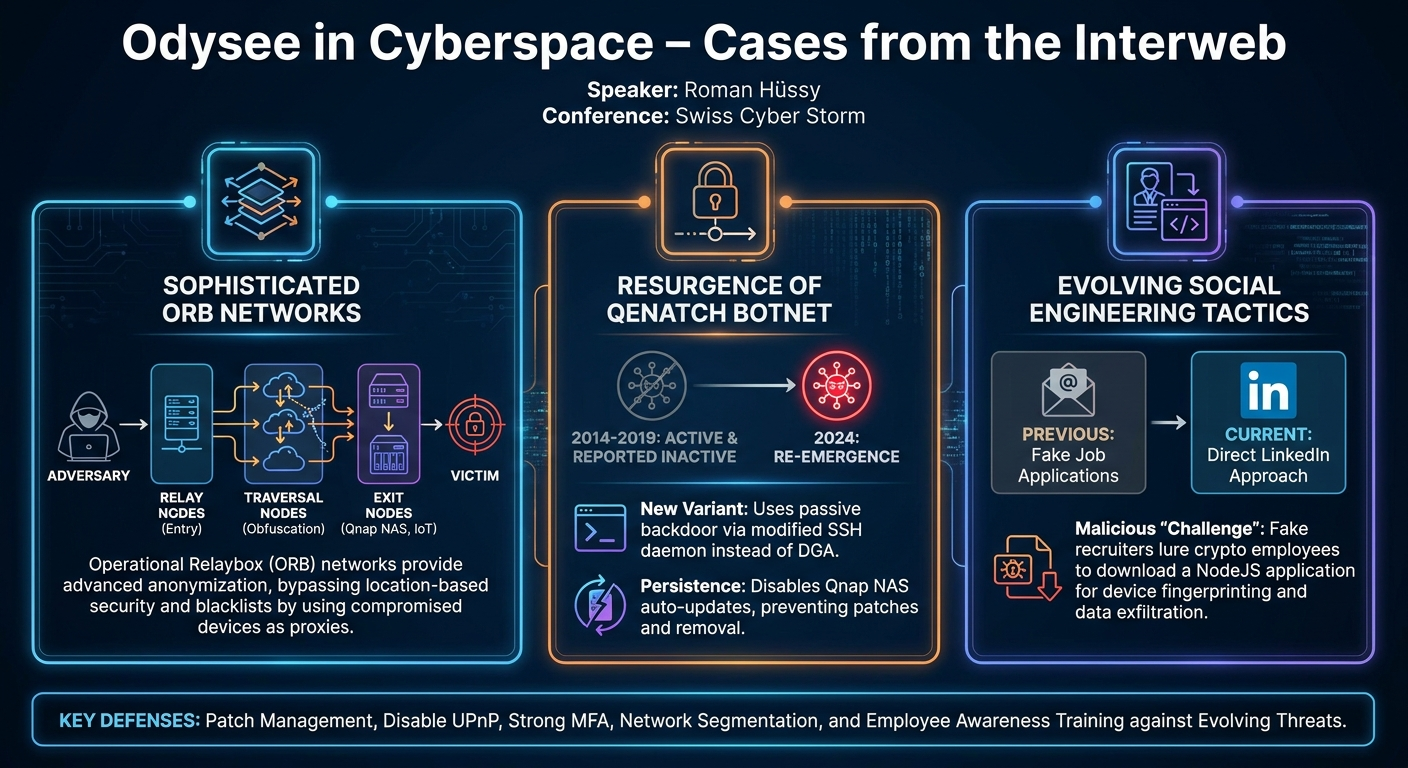
- Discovery of ORB Network Infrastructure: On-site forensics revealed that the Swiss IP addresses belonged to compromised residential devices, primarily Qnap Network Attached Storage (NAS) devices, but also other equipment like Asus routers. These devices were part of an Operational Relaybox (ORB) network, a sophisticated proxy infrastructure used by threat actors for anonymization.
- Qenatch Botnet Resurgence: The Qnap NAS devices were infected with a variant of Qenatch, a malware family active since 2014 but widely considered inactive since 2019. This marked a significant re-emergence, with NCSC identifying hundreds of active infections in Switzerland.
- Technical Adaptations: The new Qenatch variant no longer used a Domain Generation Algorithm (DGA) but instead leveraged a passive backdoor via a modified SSH daemon for C2 communication.
Case 2: Evolving Tactics Against Cryptocurrency Firms
- Shift in Social Engineering: NCSC observed a change in the modus operandi of state-sponsored threat actors, specifically matching the tactics of TraderTraitor (identified by the US government as a North Korean APT). Previously, these actors sent fake job applications to breach crypto companies. The new approach involved directly approaching employees via LinkedIn with fake recruiter profiles, luring them to solve a "challenge."
- Malicious Application Distribution: The challenge required downloading a malicious NodeJS application from a GitHub repository. This application was designed to fingerprint the victim's device and exfiltrate information to a C2 server.
- Rapid Public Disclosure: NCSC's findings on this new tactic were quickly corroborated by press reports, highlighting the rapid pace at which these threats evolve and become public knowledge.
Both cases underscore the adaptability of threat actors, whether through reactivating old botnets and updating their malware, or by evolving social engineering techniques to bypass established defenses and target individuals directly.
Technical Deep Dive
▶ Watch: QSnatch malware: Analysis of its re-emergence on QNAP devices (16:00)
The technical core of Hüssy's presentation revolved around the intricate workings of Operational Relaybox (ORB) networks and the specific malware, Qenatch, used to establish them. He also detailed the payload and delivery mechanism in the cryptocurrency scam.
An ORB network functions as a covert proxy network, designed to obscure the true origin of a threat actor's activities. It typically comprises several components:
- Adversary: The threat actor, controlling their own equipment.
- Relay Nodes (Entry Point): The initial compromised devices or rented VPS servers that the adversary connects to.
- Traversal Nodes (Traffic Obfuscation): A series of interconnected compromised devices or servers, often spanning multiple countries, that further anonymize traffic, similar to the Onion Router (Tor) network.
- Exit Nodes (Victim-Facing): The final compromised devices, such as Qnap NAS units, Tor routers, or various IoT devices, through which the adversary launches their attack against the victim. These are critical for bypassing location-based security measures and exploiting national surveillance laws, as intelligence services in certain countries (like Switzerland) may be restricted from monitoring traffic between two domestic IP addresses.
ORB networks can be acquired in different ways: ORB as a Service (rented from a contractor) or in-house production (where the threat actor compromises devices themselves). Their primary advantage over public anonymity networks like Tor is that their exit nodes are typically unknown to security vendors, thus bypassing blacklists and location-awareness alerts.
The Qenatch malware, found on the compromised Qnap NAS devices, presented a fascinating case of botnet re-activation. While infections were initially detected as far back as 2017, and the botnet was widely reported as inactive in 2019, NCSC observed a re-emergence of traffic through these nodes in 2024. Technically, this variant exhibited key differences:
- Persistence and C2: Instead of a Domain Generation Algorithm (DGA), the malware now relies on a passive backdoor implemented as a modified SSH daemon. This daemon listens for incoming connections, allowing the threat actor to establish control.
- Initial Access: Historical traces suggest initial compromise via vulnerability exploitation and credential brute-forcing.
- Firewall Bypass and Redundancy: A Qenatch bash script was responsible for initiating the malicious SSH daemon. Critically, it leveraged UPnP (Universal Plug and Play) to open a port on the local firewall, making the compromised device accessible from the internet. It also planted a CTI backdoor, likely for redundancy in C2 communication.
- Defense Evasion: The malware actively disabled the auto-update mechanism of the Qnap NAS device. This not only prevented the device from receiving security patches but also rendered Qnap's own Qenatch removal tool (published in 2019) ineffective, ensuring long-term persistence.
- Rogue Accounts: Numerous rogue user accounts were found, featuring unusual usernames in various languages (Mandarin, Korean, Cyrillic) and notably using brackets, which (according to Hüssy) prevented their display in the Qnap web UI, effectively hiding them from the legitimate administrator. These could serve as a false flag to mislead attribution efforts.
In the second case, targeting cryptocurrency companies, the technical payload was a NodeJS application. This application, distributed via a GitHub repository, performed device fingerprinting to gather detailed information about the victim's system. This data was then exfiltrated to a C2 server, likely to aid in further targeted attacks or to assess the value of the compromised environment. The use of a seemingly legitimate development framework like NodeJS for malicious purposes highlights the trend of threat actors blending into common development workflows.
Demo / Proof of Concept
▶ Watch: Second Case: Fake crypto recruiting campaigns by state actors (22:00)
The talk did not feature a live demonstration or a specific proof of concept. Instead, Roman Hüssy presented the findings from NCSC Goffs' real-world incident response and forensic investigations. The technical details shared were derived from the analysis of compromised systems, malware samples, and network traffic observed during these operations.
Defensive Implications
▶ Watch: Q&A: Differentiating ORB networks from residential proxy services (28:30)
The insights gleaned from NCSC Goffs' investigations provide crucial guidance for defenders across various sectors:
For Protecting Against ORB Networks and Botnet Infections (e.g., Qenatch):
- Aggressive Patch Management: The re-emergence of Qenatch on devices compromised years ago underscores the critical importance of keeping all network-attached devices, especially NAS units, routers, and IoT devices, fully patched and up-to-date. Malware that disables auto-updates makes this even more challenging, requiring manual verification.
- Disable UPnP: Universal Plug and Play (UPnP) is a significant security risk. It allows devices on a local network to automatically open ports on the router, creating direct internet access for potentially malicious services. Disabling UPnP on routers and endpoint devices is a fundamental step to prevent unauthorized external access.
- Strong Authentication: Implement strong, unique passwords for all accounts, especially on network devices. Where possible, enable Multi-Factor Authentication (MFA), even for administrative interfaces of NAS devices or routers, to significantly reduce the risk of credential brute-forcing.
- Network Segmentation and Monitoring: Segment networks to isolate critical assets and monitor outbound traffic for unusual connections. While ORB exit nodes might not be on traditional blacklists, anomalous traffic patterns or connections to unknown external IPs should trigger alerts. NCSC Goffs shares technical indicators from these ORB networks, which should be integrated into threat intelligence platforms.
- Regular Security Audits: Periodically audit NAS devices and other IoT equipment for rogue user accounts, unexpected open ports, or modified system files. The use of bracketed usernames to hide accounts in the web UI highlights the need for deeper inspection beyond graphical interfaces.
For Countering Advanced Social Engineering and Targeted Campaigns (e.g., Crypto Scams):
- Enhanced Employee Awareness Training: Organizations, particularly those in high-value sectors like cryptocurrency, must conduct frequent and realistic security awareness training. Employees need to be educated about the evolving tactics of threat actors, including sophisticated LinkedIn phishing, fake recruiter profiles, and the risks associated with downloading and executing code from unverified sources (even GitHub).
- Strict Code Execution Policies: Implement and enforce policies that prohibit employees from downloading and executing third-party code, especially from social media or unverified links, on corporate machines. For legitimate development or testing, advocate for the use of dedicated, isolated environments (e.g., virtual machines, sandboxes) that are segmented from the main corporate network.
- Verify Recruitment Attempts: Employees should be trained to independently verify any recruitment offers, especially those received via social media, by contacting the company through official channels (e.g., corporate website, HR department).
- Incident Reporting: Foster a culture where employees feel empowered and encouraged to report any suspicious activity, no matter how minor, to the internal security team or national cybersecurity agencies like NCSC Goffs. Early reporting can be crucial in containing and mitigating threats.
- Collaborative Intelligence Sharing: Participate in industry-specific working groups and collaborate with national authorities and financial market regulators to share threat intelligence and best practices, as demonstrated by NCSC's workshop with Swiss crypto firms.
Key Takeaways
- Creative Incident Response is Essential: National cybersecurity agencies like NCSC Goffs must employ innovative, legally compliant methods (e.g., relaying letters via ISPs) to overcome investigative limitations and gather crucial on-site intelligence.
- ORB Networks are a Sophisticated Threat: Operational Relaybox (ORB) networks provide advanced anonymization for threat actors, enabling them to bypass traditional threat intelligence and exploit national surveillance legal frameworks, making attribution and tracking exceptionally difficult.
- Legacy Malware Can Resurface with Adaptations: Malware thought to be inactive, such as Qenatch, can be reactivated and updated with new functionalities (e.g., modified SSH daemon, disabling auto-updates) to serve new campaigns, highlighting the long tail of cyber threats.
- Social Engineering Tactics Continuously Evolve: Threat actors, including state-sponsored groups like TraderTraitor, constantly refine their social engineering approaches, shifting from broad phishing to highly targeted LinkedIn recruitment using malicious applications to compromise high-value targets.
- Fundamental Cyber Hygiene Remains Paramount: Basic security practices—patching devices promptly, disabling UPnP, using strong passwords, and enabling MFA—are critical defenses against even sophisticated threats and the underlying infrastructure of botnets.
- Security Awareness and Collaboration are Key: Continuous security awareness training for employees, especially in high-risk sectors, combined with proactive intelligence sharing and collaboration between government agencies and the private sector, is vital for collective defense.
About the Speaker(s)
Roman Hüssy is the co-team lead at NCSC Goffs Switzerland. In his role, he is deeply involved in national cybersecurity incident response, focusing on assisting Swiss companies and critical infrastructure. His work includes investigating complex cyber incidents, analyzing threat actor methodologies, and distilling this knowledge into actionable insights to enhance Switzerland's overall cybersecurity posture. Hüssy's presentation reflects his practical, hands-on experience in dealing with real-world cyber threats and the creative problem-solving required in national cybersecurity defense.
Reviews
Dr. Zero (Offensive Security Researcher) — SOLID
Hüssy's war story about hunting ORB networks in Switzerland is exactly what a good national CERT talk should look like. The first half is a great lesson in operational persistence, even if the second half is just a rehash of North Korean crypto scams we've all seen before. Solid, practical, and honest about the legal friction of real IR.
Heather Calloway (CISO) — STRONG ACCEPT
An unvarnished look at how a national CERT actually operates under legal constraints, highlighting the shift toward domestic ORB networks and targeted social engineering. Worth your time if your SOC still relies heavily on geofencing or if you have a high-target employee base.