Cyber Peace in a Mad World
Panos Vlachos (Mastercard, Cyber Peace Institute)
Swiss Cyber Storm 2025 · Day 1 · Scenario
Overview
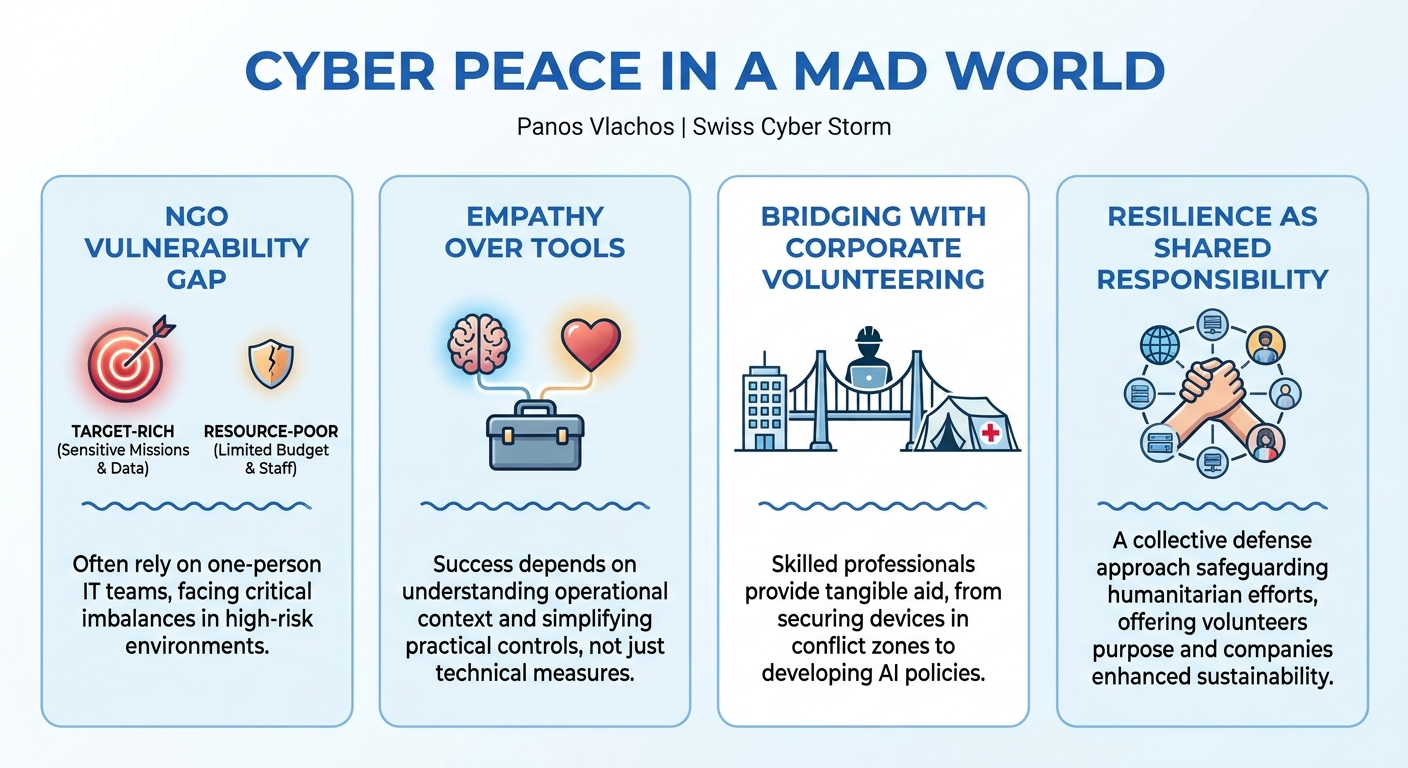
In "Cyber Peace in a Mad World," Panos Vlachos, a dedicated volunteer with the CyberPeace Institute's CyberPeace Builders program and an employee at Mastercard, sheds light on the critical and often overlooked cybersecurity challenges faced by Non-Governmental Organizations (NGOs). The talk delves into the stark reality of these organizations, which are frequently "target-rich" due to their sensitive missions and data, yet "resource-poor" with limited budgets, personnel, and technical expertise. Vlachos, drawing from over 15 missions and his "Cyber Ranger badge," presents a compelling argument for why corporate volunteering in cybersecurity is not just beneficial, but essential, in safeguarding humanitarian efforts globally.
Key moments
- 0:00 Introduction to the CyberPeace Builders program
- 4:00 Challenges NGOs face: target rich, resource poor
- 6:00 Practical advice: Securing devices for war zone border crossing
- 13:00 Supporting one-person IT teams in NGOs
- 16:00 AI security policy for a peacekeeping organization
- 18:50 Key learnings: Context, empathy, and building trust
- 21:00 Benefits for volunteers and their employers
- 26:00 Q&A: Funding model of the CyberPeace Institute
Cyber Peace in a Mad World
Speakers: Panos Vlachos, Mastercard, Cyber Peace Institute
Conference: Swiss Cyber Storm
YouTube: https://www.youtube.com/watch?v=0rVXfSxGMJM
Overview
In "Cyber Peace in a Mad World," Panos Vlachos, a dedicated volunteer with the CyberPeace Institute's CyberPeace Builders program and an employee at Mastercard, sheds light on the critical and often overlooked cybersecurity challenges faced by Non-Governmental Organizations (NGOs). The talk delves into the stark reality of these organizations, which are frequently "target-rich" due to their sensitive missions and data, yet "resource-poor" with limited budgets, personnel, and technical expertise. Vlachos, drawing from over 15 missions and his "Cyber Ranger badge," presents a compelling argument for why corporate volunteering in cybersecurity is not just beneficial, but essential, in safeguarding humanitarian efforts globally.
The core of Vlachos’s presentation revolves around the concept of rethinking resilience as a shared responsibility. He demonstrates how dedicated cybersecurity professionals, volunteering their time and expertise, can bridge the crucial gap between sophisticated cyber threats and the vulnerable digital infrastructures of NGOs. Through a series of poignant real-world stories, Vlachos illustrates the tangible impact of tailored, empathetic cybersecurity advice, from securing aid workers in war zones to protecting environmental educators with one-person IT teams. This talk is a powerful call to action, urging both individuals and corporations to contribute to a collective defense that transcends traditional business continuity, ultimately safeguarding lives and vital humanitarian missions.
Background
▶ Watch: Introduction to the CyberPeace Builders program (0:00)
The CyberPeace Institute’s CyberPeace Builders program is a global corporate volunteering initiative designed to address a fundamental imbalance in the cybersecurity landscape: the vulnerability of NGOs. These organizations, by their very nature and mission, often operate in high-risk environments, handling sensitive information about vulnerable populations, or engaging in public discourse that makes them targets for defamation, espionage, or disruption. Vlachos characterizes them as "target-rich" due to three primary factors: their mission (where they operate, such as war zones), what they possess (intellectual property, financial assets), and what they know (sensitive data on beneficiaries).
Simultaneously, these NGOs are profoundly "resource-poor." They typically lack the necessary equipment, personnel, time, and financial investment to establish robust cybersecurity defenses. Many operate with lean, often single-person IT teams who are simultaneously responsible for a myriad of tasks, from hardware maintenance to basic user training, leaving little capacity for specialized security functions. For these organizations, cybersecurity is frequently perceived as an additional administrative burden and an unaffordable expense, rather than a foundational necessity. This dichotomy creates a critical vulnerability that malicious actors are eager to exploit.
The CyberPeace Builders program seeks to bridge this gap by connecting cybersecurity professionals from corporate partners with NGOs in need. The process for volunteers involves several steps: first, ensuring their employer is onboarded as a corporate partner. Once confirmed, volunteers undergo basic humanitarian training, set up a profile detailing their languages, time zone, skill set (e.g., vulnerability scanning, dark web monitoring, awareness training), and areas of interest aligned with the United Nations' 17 Sustainable Development Goals. This profile then informs a Kanban board where volunteers can select missions tailored to their expertise and availability, with a typical limit of two ongoing missions at a time. This structured approach ensures that the expertise provided is relevant, efficient, and impactful, directly addressing the critical resource deficit faced by NGOs.
Key Findings
▶ Watch: Practical advice: Securing devices for war zone border crossing (6:00)
Panos Vlachos's extensive experience with the CyberPeace Builders program underscores several fundamental insights into effective cybersecurity in humanitarian contexts. The most salient finding is that technical measures, while important, are merely tools; the true determinant of success lies in understanding context and practicing empathy. In environments where resources are scarce and stakes are high, a "cutting-edge" solution might be impractical or even counterproductive. Instead, simplification, adaptability, and a deep understanding of an organization's operational realities are paramount.
Another key finding is the immense impact of a networked community of trust. The CyberPeace Builders program fosters a tightly-knit community where volunteers can seek support from peers and the CyberPeace Institute team when facing complex or sensitive challenges. This collective expertise enhances the resilience of both the volunteers and the NGOs they assist, demonstrating that cybersecurity is truly a shared responsibility.
For the individual cybersecurity professional, volunteering offers significant benefits beyond altruism: it provides real impact by protecting vulnerable organizations and, indirectly, saving lives; it instills a higher sense of purpose beyond commercial objectives; and it serves as an invaluable platform for skill building, allowing volunteers to keep existing skills sharp or develop new ones in unique, high-pressure scenarios.
From an organizational perspective, companies that support corporate volunteering initiatives like CyberPeace Builders also reap considerable rewards. These include improved employee retention (as passionate professionals value employer support for such activities), hybrid upskilling of their workforce at no additional cost, enhanced visibility within the global cybersecurity community alongside other major international companies, and a boost to their corporate sustainability score, a factor Vlachos predicts will become increasingly important. Ultimately, the program highlights that resilience is not just about business uptime but about enabling organizations to continue their vital work, often under extreme conditions, by fostering a collaborative and supportive cyber ecosystem.
Technical Deep Dive
▶ Watch: AI security policy for a peacekeeping organization (16:00)
The technical depth of Panos Vlachos’s talk is not in presenting new exploits or complex architectures, but rather in the practical, context-specific application of cybersecurity principles to real-world humanitarian challenges. Each of the four stories shared by Vlachos serves as a case study in adapting standard security practices to highly constrained and dangerous environments.
Story 1: Securing Aid Workers in a War Zone (MFA Advice)
This mission involved an NGO facilitating aid to civilians in an active war zone, where volunteers and beneficiaries frequently crossed borders. The critical technical challenge was physical device security during border checks, where devices were often confiscated and inspected.
Vlachos’s advice focused on minimizing the attack surface and protecting sensitive data:
- Minimalist Travel: Only carry essential equipment, primarily a mobile phone. Suggesting a burner device used for a short period to avoid suspicion, but without significant sensitive data.
- Application Logout: Crucially, log out of all sensitive applications, especially encrypted messaging apps. This ensures that even if the device is accessed, no data is immediately visible.
- Device Shutdown: Travel with devices fully shut down. This changes the cryptographic state of the device, effectively clearing its memory and ensuring that data at rest is fully encrypted, making forensic recovery significantly harder upon startup.
- Multi-Factor Authentication (MFA): Implement MFA for all accounts.
- Cross-Border MFA: A highly practical suggestion involved having a different person or device on the other side of the border to provide the second factor for authentication, particularly leveraging cloud-based MFA apps for ease of access.
- Strong Passwords & Biometric Disable: Use robust, unique passwords and, critically, disable biometric controls (fingerprint, facial recognition). This prevents border guards from coercing individuals into unlocking devices using physical biometrics.
Story 2: Protecting a Public Dialogue NGO from Defamation (Dark Web Monitoring)
This NGO's founder faced intense public pressure, including defamation, threats, and phishing attacks. The initial mission was dark web monitoring to scan for indicators of compromise (IoCs) and stolen credentials associated with the organization's domain name.
- Scope Expansion: A key technical adaptation was the need to expand the monitoring scope beyond the organizational domain to include the individual founder's personal identifiers, requiring special permission due to service limitations.
- Threat Intelligence: Although no specific IoCs were found, the monitoring provided reassurance and actionable intelligence, enabling the NGO to focus on proactive measures like security awareness training and anti-phishing campaigns.
Story 3: Supporting a Climate Education NGO with a One-Person IT Team (Password Management)
This organization, reliant on its equipment for educational programs, operated with a single IT person responsible for all hardware, software, licenses, and basic security. The technical advice focused on foundational cyber hygiene.
- Password Management: Providing guidance on password management solutions and strategies for securing online accounts.
- Backup Security: Addressing specific questions about backup security, a critical component often overlooked by small teams. This highlights the importance of comprehensive, yet simplified, security strategies.
Story 4: AI Security for a Peacekeeping Organization (Policy Development)
A peacekeeping organization was developing an AI-based service for high-ranking officials, presenting a high-risk, high-stakes environment.
- Mission Transformation: The initial request for basic cybersecurity awareness training evolved into a specialized AI security-based mission.
- Policy & Guidance: The output included drafting an internal policy for AI security and a detailed annex addressing specific technical questions. These questions spanned various layers of the AI service: high-level AI security principles, underlying infrastructure, backend security, user interface (UI) considerations, and even model security (e.g., robustness, bias, data integrity).
- External Referrals: Vlachos acknowledged the limitations of volunteer scope, guiding the NGO to seek external professional advice for deeper, specialized AI security assessments where necessary.
Across these missions, a recurring technical theme is the simplification of "best-in-class" cybersecurity standards to practical, implementable controls for resource-constrained environments. This includes foundational practices like MFA, strong passwords, data backup, and security awareness, adapted to unique operational realities, and extended to emerging areas like AI security policy development.
Demo / Proof of Concept
▶ Watch: Key learnings: Context, empathy, and building trust (18:50)
While Panos Vlachos’s presentation did not include a live software demonstration or a technical exploit, the four detailed stories served as powerful proofs of concept for the effectiveness of the CyberPeace Builders model and the practical application of cybersecurity principles in highly challenging contexts. Each narrative functioned as a "demonstration of practical application," illustrating how tailored advice and flexible volunteer engagement can yield tangible security improvements for vulnerable NGOs.
For instance, the advice given to the NGO operating in a war zone — regarding the use of burner phones, logging out of encrypted messaging apps, traveling with devices shut down to ensure cryptographic integrity, and disabling biometric controls — was a direct demonstration of how to mitigate physical device compromise risks. This wasn't theoretical; it was actionable guidance designed for immediate real-world impact. Similarly, the extension of the dark web monitoring scope to protect a specific individual, and the evolution of a basic awareness training into a comprehensive AI security policy and annex, showcased the program's adaptability and the volunteers' ability to deliver sophisticated, context-aware solutions.
These stories collectively prove that the CyberPeace Builders program successfully bridges the gap between the technical expertise of cybersecurity professionals and the urgent security needs of NGOs. They demonstrate that strategic, empathetic, and pragmatic cybersecurity assistance, even when delivered by volunteers, can significantly enhance an organization's resilience and capacity to continue its vital work.
Defensive Implications
▶ Watch: Q&A: Funding model of the CyberPeace Institute (26:00)
The insights from Panos Vlachos’s talk carry significant defensive implications for both NGOs and the broader cybersecurity community.
For Non-Governmental Organizations (NGOs):
- Acknowledge Vulnerability: NGOs must recognize their "target-rich, resource-poor" status and proactively seek external assistance. Programs like CyberPeace Builders offer a vital lifeline for organizations unable to afford commercial cybersecurity services.
- Prioritize Foundational Security: Even with limited resources, implementing core security measures is paramount. This includes adopting Multi-Factor Authentication (MFA), enforcing strong password policies, establishing robust backup security, and conducting regular security awareness training.
- Develop Basic Cyber Strategy: Even a one-person IT team needs a rudimentary cybersecurity strategy and clear procedures to manage daily operations and respond to incidents. This reduces the burden when "firefighting" is required.
- Contextual Security: Security measures must be adapted to operational realities. For instance, NGOs operating in high-risk physical environments (e.g., border crossings) need specific protocols for physical device security, data minimization, and secure communication.
- Embrace Emerging Threat Guidance: As demonstrated by the AI security mission, NGOs should be open to guidance on emerging threats and technologies, understanding that proactive policy development is more effective than reactive incident response.
- Leverage Community Support: Understand that they are not alone. The CyberPeace Builders community provides a network for ongoing support and advice beyond initial missions.
For Cybersecurity Professionals and Companies:
- Volunteer Engagement: Professionals are encouraged to volunteer their expertise. This not only makes a real-world impact but also provides opportunities for skill building, gaining unique experience in diverse, high-stakes environments, and fostering a higher sense of purpose.
- Empathy and Simplification: When advising resource-poor organizations, professionals must exercise empathy and focus on simplifying complex security concepts into actionable, implementable advice. The goal is progress, not perfection.
- Corporate Social Responsibility (CSR): Companies should consider onboarding to corporate volunteering programs. This demonstrably improves employee retention, facilitates hybrid upskilling of staff, enhances corporate visibility, and boosts corporate sustainability scores.
- Rethink Resilience: The talk challenges the traditional corporate definition of resilience (uptime, business continuity) by expanding it to include the ability of humanitarian organizations to continue their life-saving work amidst active threats. This calls for a broader, shared responsibility in global cyber defense.
- Build Networks of Trust: Fostering collaborative communities among cybersecurity professionals is crucial for sharing knowledge and supporting each other when tackling complex or novel challenges.
Key Takeaways
- NGOs are uniquely vulnerable: They are "target-rich" due to sensitive missions and data, yet "resource-poor" with limited cybersecurity budgets and personnel, often relying on single-person IT teams.
- Context and Empathy are paramount: Effective cybersecurity for NGOs prioritizes understanding their operational context and adapting simplified, practical solutions over implementing cutting-edge, complex technologies.
- Corporate volunteering bridges critical gaps: Programs like CyberPeace Builders connect skilled cybersecurity professionals with NGOs, providing crucial, often life-saving, technical advice and support.
- Practical advice makes tangible impact: Specific guidance on physical device security (e.g., burner phones, device shutdown, biometric disablement), MFA implementation, dark web monitoring, and AI security policy development directly enhances NGO resilience.
- Mutual benefits for all stakeholders: Volunteering offers professionals skill development and purpose, while companies gain improved employee retention, upskilling, visibility, and enhanced corporate sustainability.
- Cyber resilience is a shared responsibility: Protecting humanitarian efforts requires a collective, collaborative approach, extending beyond traditional business continuity to safeguard vital global missions.
About the Speaker(s)
Panos Vlachos is a dedicated cybersecurity professional with a diverse background. He currently works for Mastercard and is also pursuing a PhD, demonstrating his commitment to both industry practice and academic research. Vlachos possesses over 10 years of experience in the Information and Communication Technology (ICT) industry. Most notably, he is a highly active volunteer with the CyberPeace Institute's CyberPeace Builders program, where he has completed more than 15 missions, earning him the prestigious "Cyber Ranger badge." His involvement with the CyberPeace Institute began after joining Mastercard, and he remains a passionate and committed member of the volunteering community, driven by the real-world impact of his work.
Reviews
Dr. Zero (Offensive Security Researcher) — SOLID
Panos Vlachos gives a grounded, non-technical look at OpSec for NGOs that actually face kinetic threats. It's not a research talk, but the physical security advice for border crossings proves he understands the threat model. Solid defensive war story, even if half of it is just basic IT hygiene wrapped in a volunteering pitch.
Heather Calloway (CISO) — SOLID
This is a corporate social responsibility pitch wrapped in an operational briefing, but it holds surprising value for enterprise travel security. The NGO threat model mirrors our high-risk executive travel profiles almost perfectly. I would route this to the leaders managing your executive protection fleet and your corporate sustainability reporting.