From Buzzword to Battlefield: The Cybersecurity Challenges of Smart Cities
Marina Bochenkova (Digital Forensics and Incident Response · zsert)
Swiss Cyber Storm 2025 · Day 1 · Scenario
Overview
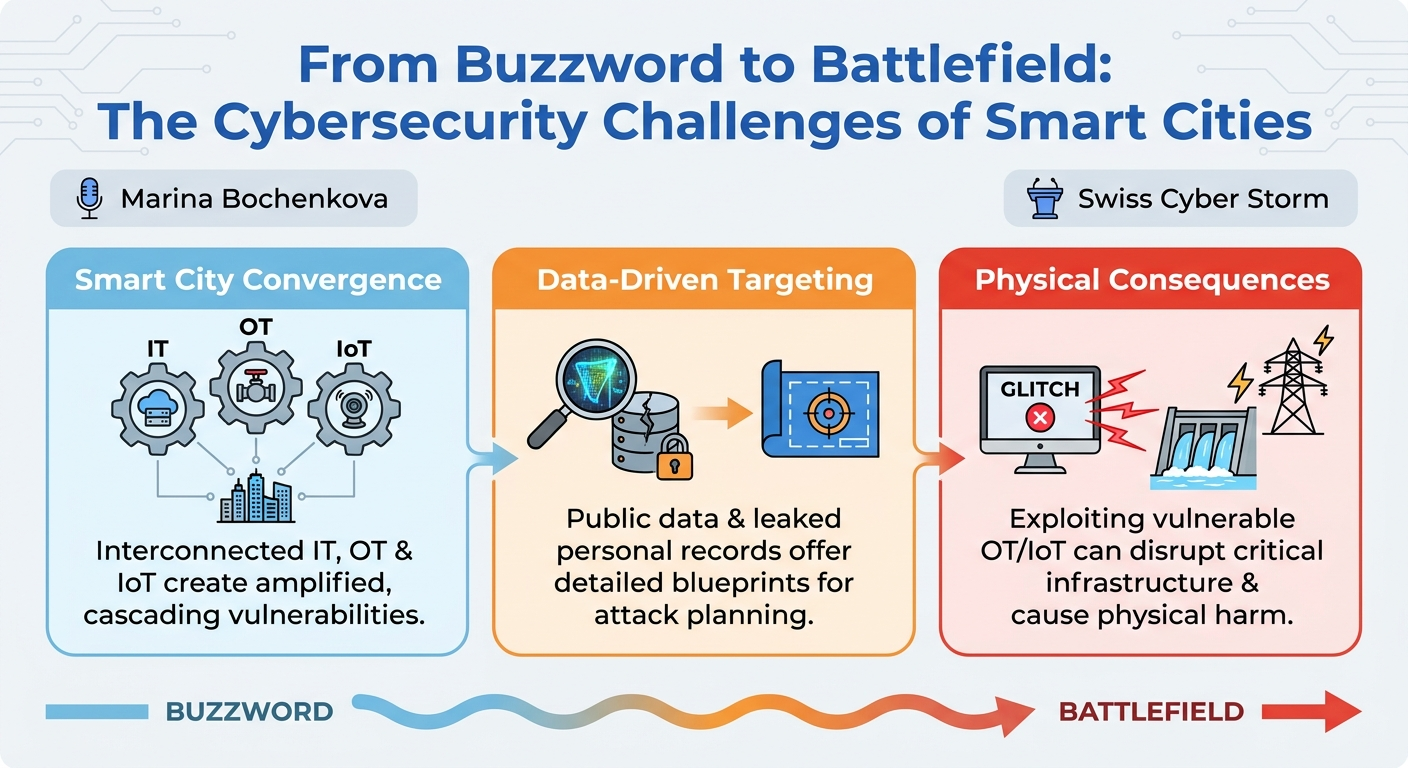
In her compelling talk "From Buzzword to Battlefield: The Cybersecurity Challenges of Smart Cities" at Swiss Cyber Storm, Marina Bochenkova, a Digital Forensics and Incident Response specialist at zsert, dissects the multifaceted security landscape of modern urban environments. Bochenkova argues that the concept of a "smart city," while promising enhanced living through technology, inherently introduces a complex web of interconnected vulnerabilities that adversaries can readily exploit. Her presentation moves beyond the marketing hype to expose the tangible risks, illustrating how the convergence of Information Technology (IT), Operational Technology (OT), and the physical world creates fertile ground for cyberattacks with real-world, often devastating, consequences.
Key moments
- 0:00 Introduction and defining a smart city
- 2:10 Pete the terrorist: leveraging open smart city data
- 6:00 Personal data breaches in smart city projects
- 9:00 Operational Technology (OT) and IoT security challenges
- 12:45 Real-world impact: Dutch floodgates failure during a hurricane
- 19:00 From buzzword to battlefield: interconnected risks summary
- 21:00 Solutions: security testing, frameworks, and secure development
- 28:00 Q&A: Can convenience and cybersecurity coexist in smart cities?
From Buzzword to Battlefield: The Cybersecurity Challenges of Smart Cities
Speakers: Marina Bochenkova, Digital Forensics and Incident Response, zsert
Conference: Swiss Cyber Storm
YouTube: https://www.youtube.com/watch?v=zDi1axhjGNg
Overview
In her compelling talk "From Buzzword to Battlefield: The Cybersecurity Challenges of Smart Cities" at Swiss Cyber Storm, Marina Bochenkova, a Digital Forensics and Incident Response specialist at zsert, dissects the multifaceted security landscape of modern urban environments. Bochenkova argues that the concept of a "smart city," while promising enhanced living through technology, inherently introduces a complex web of interconnected vulnerabilities that adversaries can readily exploit. Her presentation moves beyond the marketing hype to expose the tangible risks, illustrating how the convergence of Information Technology (IT), Operational Technology (OT), and the physical world creates fertile ground for cyberattacks with real-world, often devastating, consequences.
Bochenkova's core message is a stark warning: the convenience and efficiency offered by smart city initiatives come at a steep security cost if not addressed proactively and comprehensively. She highlights that the lack of standardized definitions and security frameworks, coupled with a pervasive "convenience over security" mindset, has led to the deployment of critical infrastructure and personal data systems with significant exploitable weaknesses. The talk underscores the urgent need for a paradigm shift, moving from viewing smart cities as mere technological buzzwords to recognizing them as potential battlefields where cyber conflicts directly impact citizens' safety, privacy, and trust in governmental institutions.
This article delves into Bochenkova's analysis, exploring the specific examples and technical details she presented to illustrate the escalating threat. It examines how readily available public data, pervasive data leaks, and the inherent fragilities of OT and IoT devices create a rich attack surface. Furthermore, it outlines the defensive strategies and proactive measures proposed by Bochenkova, emphasizing that securing smart cities is a shared responsibility requiring collaboration across developers, governments, and individual citizens to prevent future cyber catastrophes.
Background
▶ Watch: Introduction and defining a smart city (0:00)
The concept of a smart city is notoriously elusive, with no single, universally accepted definition. As Marina Bochenkova aptly points out, "Every government, every marketing department makes their own definition because there isn't an official one." To provide clarity for her discussion, Bochenkova offers her own working definition: "an urban territory that uses ubiquitous IT and OT as well as stakeholder partnerships to digitize and improve its functioning." This comprehensive definition is crucial because it immediately highlights the inherent complexity and the core challenge: smart cities represent a convergence of highly variable software and hardware assets, intertwined with the people who use them, thereby consolidating and amplifying their individual risks and vulnerabilities.
This convergence is particularly problematic when considering the distinct characteristics of Information Technology (IT) and Operational Technology (OT), alongside the rapidly expanding realm of the Internet of Things (IoT). Traditional OT systems, prevalent in critical infrastructure such as water treatment plants, energy grids, and transportation networks, are designed for extreme physical resilience and long lifespans, often 30 years or more. This emphasis on physical robustness and uninterrupted operation, however, comes at the expense of software agility and security. Modern, more secure software is frequently incompatible with these legacy devices, leaving them vulnerable to exploits that would be quickly patched in an IT environment. Their physical hardiness paradoxically makes their software incredibly fragile and susceptible to attack.
In contrast, IoT devices are characterized by their ease of development, low cost, and ubiquitous connectivity. While this enables rapid deployment and innovation, Bochenkova stresses that they are "very frequently released without any kind of security testing or any kind of privacy checks." Their inherent ease of connection makes them an "attractive initial access point" for adversaries, allowing them to bridge the gap between less secure consumer-grade devices and more sensitive networks. When vulnerable IoT hardware is combined with software that has access to critical resources, the potential for widespread damage becomes immense. The fundamental problem, therefore, lies in the integration of these disparate technologies, each with its own security profile and lifecycle, into a single, interconnected urban fabric, often without a holistic security-by-design approach. This creates a fertile ground for the kinds of incidents Bochenkova describes, where a single vulnerability can cascade across entire urban systems.
Key Findings
▶ Watch: Personal data breaches in smart city projects (6:00)
Marina Bochenkova's talk reveals several critical findings regarding the cybersecurity posture of smart cities, illustrating how their design and implementation inadvertently create a "battlefield" for adversaries.
Firstly, smart cities, by their very nature, generate and centralize a wealth of information that is ripe for exploitation. Bochenkova demonstrates how publicly accessible open data repositories, such as those in Bern, Switzerland, provide adversaries with detailed intelligence on critical infrastructure (e.g., locations of geothermal pumps, mobile antennas, heat supply maps), public transportation routes, and even building construction plans. This public data, combined with frequently leaked or misconfigured personal data, offers a comprehensive blueprint for planning destructive or chaotic attacks.
Secondly, the overlaps and interconnections between IT, OT, and the physical sphere do not merely cause isolated risks but actively exacerbate them. Bochenkova emphasizes that without proper air gaps and segmentation, a vulnerability in one environment can swiftly propagate to others. She highlights the increasing trend of attacks on OT environments resulting in physical damage, noting a significant jump from 412 attacks in 2021 to over 1,000 in 2022. This alarming statistic underscores that digital intrusions are now directly translating into tangible harm, affecting production lines, critical services, and public safety.
Thirdly, the talk exposes the widespread presence of publicly accessible and vulnerable smart city components. From unauthenticated smart meter applications revealing real-time energy consumption patterns to unprotected login panels for solar farms and industrial control systems, Bochenkova shows how easily adversaries can identify and potentially interact with critical infrastructure. The analogy of the fish tank thermometer used to shut down an American casino serves as a potent reminder that even seemingly innocuous devices can become a pivot point for significant attacks.
Finally, Bochenkova identifies a pervasive issue of desensitization to data breaches and a lack of accountability. While the initial reaction to a data breach might be "it wasn't that bad," she argues that the constant erosion of personal data privacy has profound societal implications. Such incidents undermine faith in government institutions to protect citizens, which she identifies as a "fundamental pillar of democracy." The repeated occurrence of these events without significant repercussions for the responsible parties fosters an environment where security remains an afterthought, allowing adversaries like "Pete the terrorist" to leverage both intentional and unintentional issues for cyber warfare.
Technical Deep Dive
▶ Watch: Real-world impact: Dutch floodgates failure during a hurricane (12:45)
Bochenkova's technical deep dive into smart city vulnerabilities is illuminated through concrete examples across various domains, showcasing the interconnectedness and severity of the risks.
She begins by illustrating the intelligence-gathering potential of open data repositories. Using an interactive map of Bern, Switzerland, Bochenkova demonstrates how a hypothetical "Pete the terrorist" could access detailed information. This includes not only public transportation lines, building sites, and government offices but also more sensitive data such as heat supply maps indicating geothermal and renewable gas sources, specific locations of geothermal pumps, and every mobile antenna in the city. This data, often available via APIs or unstructured formats, provides a comprehensive overview of a city's critical infrastructure, making target identification and attack planning significantly easier.
The discussion then pivots to personal data leaks and privacy issues within smart city contexts. A prominent example is the 2022 hack of the Dutch police by an undisclosed nation-state actor, which resulted in the exfiltration of Outlook data for 63,000 police officers, including undercover personnel, and cooperating government employees. This highlights the inherent risks of stakeholder partnerships in smart cities, where data collected for public safety can become a high-value target. Bochenkova also details several incidents during the COVID-19 pandemic in the Netherlands:
- An insider threat where employees purposefully leaked and stole citizens' test results.
- A database misconfiguration allowing every employee to access every record in the Corona system, including personal health data and device information used for tracking movement.
- A private security researcher discovering an open, unauthenticated database of a testing company containing over a million records of Dutch citizens and international tourists.
These examples underscore how easily sensitive personal data, collected for public health or smart city initiatives, can be compromised through misconfigurations, insider threats, or direct cyberattacks, providing adversaries with extensive personal intelligence.
Bochenkova then transitions to Operational Technology (OT) and Internet of Things (IoT), emphasizing their unique vulnerabilities. She outlines the common architecture: sensors convert physical input into digital values, which are processed and analyzed, often then sent to an actuator that causes a physical reaction. This cycle is fundamental to critical infrastructure, from clean water supply to energy grids.
A compelling illustration of OT vulnerability is the Amsterdam floodgate incident during Hurricane Kieran. Due to a "computer glitch," the control of floodgates to the North Sea switched from automatic to manual. While sensors monitored water levels in 75 kilometers of canals, the system failed to automatically close the gates as intended. This went unnoticed for several hours, leading to water levels rising by over 30 centimeters – billions of liters of extra water – before a single individual noticed the anomaly. This incident, which nearly resulted in widespread flooding and critical infrastructure damage, serves as a stark example of how a digital malfunction can have immediate and severe physical consequences.
Finally, Bochenkova presents evidence of publicly accessible vulnerable systems that could be exploited. She shows screenshots of:
- A login panel for a solar farm in Switzerland that, despite having an identified vulnerability, was ironically protected by a "bug that breaks the website," creating a form of "security by obscurity."
- A smart building panel displaying industrial process information, potentially accessible to an advanced persistent threat (APT).
- A personal home automation system interface, which she found to have unauthenticated access, allowing potential physical changes (e.g., temperature adjustments) in someone's house without authorization.
These examples demonstrate that the attack surface in smart cities extends from national critical infrastructure down to individual homes, with many systems exposed to the internet and lacking fundamental security controls. The prevalence of such easily discoverable vulnerabilities makes the "buzzword" of smart cities a very real "battlefield."
Demo / Proof of Concept
▶ Watch: From buzzword to battlefield: interconnected risks summary (19:00)
While Marina Bochenkova's talk did not feature a live exploitation demonstration in the traditional "red team" sense, it effectively served as a proof of concept through illustrative examples and real-world incidents. Her presentation focused on demonstrating the existence and accessibility of vulnerabilities rather than actively exploiting them, aligning with her self-identification as a "blue teamer" who prioritizes ethical disclosure and defense.
Bochenkova visually demonstrated the wealth of information available to potential adversaries by showcasing an interactive map of Bern, Switzerland. This map, drawing from the city's open data repository, displayed critical infrastructure locations such as geothermal pumps and mobile antennas, alongside public transport routes and construction sites. This segment served as a clear visual "demo" of how intelligence gathering for an attack could commence using publicly available smart city data.
For other technical deep dive points, Bochenkova relied on describing and presenting evidence from real-world incidents and screenshots of publicly exposed systems. The Dutch police hack, the various COVID-related data breaches, and the Amsterdam floodgate incident were presented as concrete examples of how vulnerabilities in smart city components (IT, OT, and data handling) have led to significant compromises and physical risks. She also presented screenshots of actual login panels for a Swiss solar farm, a smart building control system, and a personal home automation interface that she discovered to be publicly accessible. While she explicitly stated she did not test or exploit these, their mere public exposure with apparent lack of strong authentication served as a powerful "proof of concept" for the pervasive insecurity. This approach effectively conveyed the tangible threats without crossing ethical boundaries, emphasizing that the problem is not theoretical but already manifesting in numerous ways.
Defensive Implications
▶ Watch: Q&A: Can convenience and cybersecurity coexist in smart cities? (28:00)
Marina Bochenkova's talk provides a comprehensive roadmap for mitigating the cybersecurity challenges of smart cities, emphasizing a multi-layered approach involving developers, governments, and individual citizens.
For developers, producers, and sellers of OT and IoT devices, the primary implication is the urgent need for security testing. Bochenkova strongly advocates for inviting external researchers and students to "come and break your things" in controlled environments. While acknowledging the associated time and cost, she argues that discovering vulnerabilities proactively is far superior to having a threat actor exploit them in the wild. This includes integrating Secure Software Development Life Cycle (SSDLC) principles and leveraging resources like OWASP for secure coding practices, ensuring security is built-in from design rather than bolted on as an afterthought.
Governments and policymakers have a critical role in establishing a robust regulatory framework. Bochenkova highlights Switzerland as an "excellent example of privacy-forward infrastructure and legislation" and encourages international partnerships to model similar laws. She stresses the importance of legislation written by professionals who understand the technical nuances and consequences, rather than politicians reacting to "scary headlines." The discussion around the EU Cyber Resilience Act is relevant here, with Bochenkova noting its potential positive impact on the grand scheme, provided there's sufficient oversight to ensure principles are actually applied beyond mere compliance metrics. Furthermore, adopting and promoting smart city security frameworks is crucial. She mentions the Five Eyes nations' cybersecurity best practices, principles like cyber-informed engineering, and standards such as IEC 62443 (though acknowledging its US-centricity, its principles are globally applicable). The independent researcher who adapted the NIST Cybersecurity Framework (CSF) for smart cities is cited as a fantastic individual initiative that should be leveraged.
Finally, individuals and the broader community have a significant responsibility. Bochenkova calls for education and awareness, urging everyone to share their knowledge with family, friends, and even teachers about potential monitoring by smart lampposts or the risks of HR data access. She encourages citizens to "vote with our wallets" by refusing to purchase insecure IoT devices and making manufacturers aware of this preference. Long-term, she advocates for IT and cybersecurity education starting from a young age, noting initiatives like the Dutch HackShield video game that teaches cyber hygiene to schoolchildren. This not only steers youth away from cybercrime but also instills an understanding of data's value. Beyond individual actions, Bochenkova stresses the importance of advocacy: using in-person and online voices (e.g., LinkedIn) to spread awareness, speak to lawmakers, and file data protection reports. This collective pressure is essential to motivate manufacturers and businesses to prioritize security, moving beyond a purely "bottoms-up" approach to also encompass a "top-down" legislative push.
Key Takeaways
- Smart cities represent a convergence of IT, OT, and personal data, leading to an exacerbation of interconnected risks. The integration of diverse technologies and human elements creates a complex attack surface where vulnerabilities are amplified across environments.
- Publicly available and leaked data provide adversaries with extensive intelligence for attack planning. Open data repositories, combined with frequent data breaches and misconfigurations, offer detailed blueprints of critical infrastructure and personal habits.
- Vulnerable OT and IoT devices, often deployed without adequate security testing, pose significant threats of physical damage and critical infrastructure disruption. Legacy OT systems with outdated software and rapidly developed IoT devices with poor security hygiene are easily exploited, as demonstrated by the Amsterdam floodgate incident and publicly exposed control panels.
- The human cost of smart city cyber insecurity is profound, eroding public trust in government and impacting daily life. Beyond financial losses, repeated data breaches and infrastructure failures undermine democracy and the very purpose of smart cities to improve citizens' lives.
- Addressing smart city security requires a multi-faceted, collaborative approach across all stakeholders. This includes secure-by-design principles for developers, robust and professionally informed legislation from governments, and active education and advocacy from individuals.
- Proactive security measures and continuous vigilance are critical to prevent smart cities from becoming "battlefields." Security cannot be an afterthought; it must be integrated from the initial concept through deployment and ongoing operation, driven by a commitment to protect citizens and critical services.
About the Speaker(s)
Marina Bochenkova is a distinguished professional in the field of cybersecurity, specializing in Digital Forensics and Incident Response. In her day job, she applies her expertise at zsert, which serves as the sectoral CSIRT (Computer Security Incident Response Team) for the healthcare sector in the Netherlands. Beyond her professional responsibilities, Bochenkova is deeply passionate about IoT and OT security, often pursuing these areas as a personal hobby. Her commitment to the cybersecurity community is further evident through her role as one of the organizers for the Bides Amsterdam conference, which she is actively involved in reviving after a five-year hiatus. Her diverse background in incident response, critical infrastructure security, and community engagement provides a unique and informed perspective on the challenges and solutions for securing smart cities.
Reviews
Dr. Zero (Offensive Security Researcher) — WEAK
This is a classic 'IoT is bad' awareness talk wearing a smart city trenchcoat. Bochenkova tours Shodan screenshots and public news articles without dropping any new research. If you still need to be told that unauthenticated solar farm panels are a bad idea, you probably shouldn't be at a security conference.
Heather Calloway (CISO) — SOLID
The vulnerability of smart city infrastructure is a current procurement failure, not a theoretical future state. This talk competently maps how the collision of legacy OT, cheap IoT, and municipal open-data initiatives creates a highly visible attack surface, though its defensive recommendations rely too heavily on consumer behavior rather than institutional controls.