SCION: A Next-generation Internet for Next-generation Security. IETF Update and Everyday Use Cases
Prof. Dr. Adrian Perrig (Professor)
Swiss Cyber Storm 2025 · Day 1 · Scenario
Overview
In this insightful talk at Swiss Cyber Storm, Professor Dr. Adrian Perrig, widely recognized as "Mr. Scion" and "Mr. Please Fix the Internet," presented a compelling case for SCION (Scalable Control of Internetworking), a novel internet architecture designed to address the fundamental security and resilience shortcomings of today's IPv4/IPv6 internet. Perrig, who spearheaded the SCION project at ETH Zurich after a distinguished career at Carnegie Mellon University, detailed the architecture's core principles, its significant real-world adoption, and the strategic path towards global standardization and widespread implementation.
Key moments
- 0:00 Introduction: Fixing the Internet with SCION
- 2:00 SCION's Path-Based Architecture Explained
- 7:00 Real-world Adoption: Swiss Finance and Healthcare
- 9:50 Enabling Native SCION with Happy Eyeballs & Quick
- 17:00 Global Sierra Network Performance & Path Diversity
- 24:00 SCION's Ambitious Future: Billion Devices Goal
- 27:00 Q&A: SCION's Security and Efficiency Benefits
- 28:30 Q&A: Attacker Perspective and DDoS Mitigation
SCION: A Next-generation Internet for Next-generation Security. IETF Update and Everyday Use Cases
Speakers: Prof. Dr. Adrian Perrig (Professor)
Conference: Swiss Cyber Storm
YouTube: https://www.youtube.com/watch?v=JIPbvlvmAgA
Overview
In this insightful talk at Swiss Cyber Storm, Professor Dr. Adrian Perrig, widely recognized as "Mr. Scion" and "Mr. Please Fix the Internet," presented a compelling case for SCION (Scalable Control of Internetworking), a novel internet architecture designed to address the fundamental security and resilience shortcomings of today's IPv4/IPv6 internet. Perrig, who spearheaded the SCION project at ETH Zurich after a distinguished career at Carnegie Mellon University, detailed the architecture's core principles, its significant real-world adoption, and the strategic path towards global standardization and widespread implementation.
The presentation highlighted SCION's unique path-based routing, which offers unprecedented control, transparency, and inherent security features that are absent in current internet protocols. Unlike the opaque, single-path routing of the existing internet, SCION empowers senders to explicitly choose and cryptographically verify communication paths, dramatically enhancing reliability and mitigating a range of routing attacks. Perrig emphasized that SCION is not intended to replace IP entirely but rather to operate as a complementary, highly secure, and resilient alternative for applications demanding these critical properties.
A decade after its inception, SCION has moved beyond academic research to power critical national infrastructures, including the entire Swiss interbank clearing system. The talk elaborated on the project's progress in the Internet Engineering Task Force (IETF) and its innovative strategy to achieve broad adoption by integrating with widely used internet libraries like Happy Eyeballs and Quick, potentially enabling hundreds of millions of devices to natively leverage SCION's benefits without requiring application rewrites. This ambitious vision aims to deliver a truly secure and resilient global internet for all.
Background
▶ Watch: Introduction: Fixing the Internet with SCION (0:00)
The journey to SCION began with a deep-seated frustration over the inherent vulnerabilities and lack of resilience in the existing internet architecture. Professor Perrig's engagement with internet security dates back to 1991, working with Cisco routers, and his PhD in 1997 focused on securing internet protocols. This extensive experience culminated in a clear mission upon his arrival at ETH Zurich in 2013: to revolutionize the internet. The prevailing internet, based on IPv4 and IPv6, suffers from several critical flaws, primarily its reliance on a trust-based routing system (like BGP) that is susceptible to attacks, its opaque path selection, and its predominantly single-path nature, which severely impacts resilience and reliability.
SCION was conceived as a radical departure from this model. At its core, SCION is a path-based architecture. Unlike traditional IP routing where routers independently determine the next hop, SCION empowers the source to select and specify the entire path a packet will traverse. This fundamental shift provides complete path transparency, meaning the sender explicitly knows and controls the route its data takes. This contrasts sharply with the current internet, where senders have little to no control over path selection, and packets often traverse unpredictable and potentially insecure routes.
The architecture introduces Isolation Domains (ISDs), which are logical groupings of Autonomous Systems (ASes)—entities like ISPs (e.g., Swisscom, Sunrise), universities (e.g., ETH Zurich), or other large organizations. These ISDs define cryptographic trust boundaries, allowing for decentralized trust management. Within this framework, SCION's control plane is responsible for discovering and disseminating path segments between ASes and ISDs. These segments are then cryptographically protected and chained together by the end application to form complete end-to-end paths. The data plane then simply follows these pre-determined, cryptographically verified instructions, enabling stateless forwarding by routers and significantly simplifying their operation. This design directly addresses the foundational issues of the current internet by providing explicit path control, verifiable routing, and inherent support for multipath communication, which are crucial for building a more secure and resilient global network.
Key Findings
▶ Watch: Real-world Adoption: Swiss Finance and Healthcare (7:00)
The talk presented several compelling findings that underscore SCION's technical superiority and growing practical relevance. A major discovery relates to SCION's performance characteristics, particularly over long distances. Extensive measurements, involving 265 million ping measurements comparing IPv4, IPv6, and SCION traffic between nodes in a global native SCION network (the Sierra network), revealed that SCION consistently outperforms IP for intercontinental communication. Specifically, at the 50th percentile, SCION exhibited a median latency that was approximately 7% lower than IP. This performance advantage became even more pronounced at the 90th percentile, where SCION’s multipath capabilities allowed it to leverage the best available path, significantly reducing tail latencies. While IP might have a slight advantage locally due to highly optimized existing internet routers, SCION demonstrates clear benefits for global connectivity.
Another critical finding is the abundance of path diversity offered by SCION. Measurements showed that between a given source and destination, dozens of distinct path options are routinely available—for instance, 80 different paths were observed between ETH Zurich and Korea University. This vast selection of paths is a game-changer for application optimization, allowing applications to dynamically choose routes based on specific requirements such as low latency, high bandwidth, minimal jitter, or low loss. This contrasts sharply with the single-path nature of the current internet, where such granular optimization is largely impossible for the end-user.
Perhaps the most significant finding is the extensive real-world adoption of SCION in critical infrastructure. The Secure Swiss Finance Network (SSFN) was highlighted as a landmark success, where SCION now carries all interbank clearing transactions among 321 banking participants, insurers, and other financial institutions. Notably, the legacy network for this vital service has been completely decommissioned, demonstrating SCION’s robustness and reliability in a highly demanding environment. This success has paved the way for similar deployments, including the Secure Swiss Healthcare Network (SSHFN), connecting 50,000 doctors’ offices, and the Secure Swiss Utility Network (SSU) for critical infrastructure like electricity and water. Most recently, the SEP network (EFT pass network) is also adopting SCION for payment transactions. These deployments collectively involve over 20 network service providers offering SCION connectivity today, signifying a mature and commercially available ecosystem.
Finally, the talk underscored the strategic finding that SCION can achieve widespread adoption by integrating with existing internet libraries and standardization efforts. By becoming a third option alongside IPv4 and IPv6 within libraries like Happy Eyeballs (which manages IP version switching in browsers and programming languages) and Quick Multipath (an IETF effort to make the Quick transport protocol multipath-aware), SCION can leverage existing mechanisms to enable native SCION traffic without requiring applications to be rewritten. This approach significantly lowers the barrier to entry, potentially allowing hundreds of millions, or even over a billion, devices to natively support SCION within the next three to five years, provided the destination servers and network infrastructure are also SCION-enabled.
Technical Deep Dive
▶ Watch: Global Sierra Network Performance & Path Diversity (17:00)
SCION fundamentally re-architects internet routing to deliver security, resilience, and performance that are unattainable with current IP protocols. The core of its technical innovation lies in its path-based architecture. Instead of relying on routers to independently determine the next hop, SCION empowers the source to construct and cryptographically verify the entire end-to-end path.
The network is structured around Autonomous Systems (ASes), which are individual networks like ISPs or large organizations. These ASes are grouped into Isolation Domains (ISDs), represented as colorful ellipsoids in the architectural diagrams. ISDs form trust boundaries, allowing each domain to locally define its cryptographic keys, a concept central to SCION's sovereignty property. This means there's no single global trust anchor, enhancing security and decentralization.
SCION operates with distinct control plane and data plane functions. The control plane is responsible for discovering and disseminating path segments. These segments represent valid routes between ASes within an ISD (core path segments) or between ASes in different ISDs (inter-ISD path segments). These path segments are cryptographically signed and authenticated, ensuring their integrity and preventing unauthorized manipulation. The end application, or a SCION-aware library, then combines these path segments to form a complete end-to-end path to the destination.
Once a path is selected, the data plane takes over. The chosen path information, significantly optimized for size and containing cryptographic data, is embedded directly into the packet header. Routers along the path operate in a largely stateless fashion, simply following the instructions encoded in the packet header. This design simplifies router functionality by eliminating the need for complex inter-domain forwarding tables, contributing to higher forwarding speeds and reduced operational overhead. The cryptographic information in the packet header allows routers to quickly verify the integrity of the path instructions, preventing malicious entities from altering the path mid-transit.
Several key properties emerge from this architecture:
- Path Transparency: Senders have complete visibility and control over the path their packets will take. This is a stark contrast to IP, where paths are opaque and largely determined by intermediate routers.
- Geo-fencing: The explicit path control allows users to restrict data transmission to specific geographic regions or political boundaries, which is crucial for compliance with data residency regulations and other legal requirements.
- Multipath Communication: SCION inherently supports the simultaneous use of multiple available paths. Applications can send different packets on different paths, duplicate packets for maximum reliability, or rapidly failover between paths within milliseconds or even microseconds in the event of an outage. This dramatically enhances resilience compared to the single-path nature of today's internet.
- Built-in Routing Attack Prevention: The cryptographic protection of path segments during creation and dissemination, combined with high-speed cryptographic verification in the packet header during forwarding, provides strong defenses against routing attacks like BGP hijacking, which are a persistent threat in the current internet.
- Sovereignty: Each Isolation Domain manages its own cryptographic keys, enabling sovereign networks to define their local trust policies while still connecting globally. This is a "game-changer" as it allows for both open, global connectivity and strong local control, a capability not found in other existing architectures.
The strategy for widespread adoption hinges on integrating SCION into existing internet ecosystems. Initial SCION deployments, such as the Swiss financial network, utilize IP gateways to translate between SCION and IP, allowing existing applications to benefit without modification. However, the full benefits of SCION are realized when applications are SCION-aware. To achieve this without requiring extensive application rewrites, SCION aims to be integrated into widely adopted libraries:
- Happy Eyeballs: This library, built into modern web browsers (e.g., Apple pushed its adoption) and programming languages like Go, is designed to smoothly transition and optimize connections between IPv4 and IPv6. SCION can be added as a third option, allowing applications to transparently choose the fastest or most suitable path among IPv4, IPv6, and available SCION paths.
- Quick Multipath (IETF): Quick is a modern transport protocol replacing TCP for many web connections. The IETF is standardizing multipath capabilities for Quick. Integrating SCION here would allow applications using Quick to automatically leverage SCION's multipath advantages when available.
- MTP (Multipath Transport Protocol with Deadlines): Another IETF draft that could incorporate SCION for optimized transport with specific performance guarantees.
Standardization is critical for SCION's global interoperability. The SCION Association (scion.org) is driving these efforts, pushing specifications through the IETF's independent stream. The core SCION specifications, encompassing the Public Key Infrastructure (PKI) draft, Control Plane draft, and Data Plane draft, collectively span 224 pages, have undergone 10 revisions, and spent 1.5 years in the IETF process. The goal is to obtain RFCs (Request for Comments) for these documents, which will then facilitate the formation of an official IETF working group to further standardize the SCION system.
From a performance perspective, while cryptography might seem like an overhead, SCION's design can make it more efficient than traditional IP routing. The speaker noted that the computational cost of cryptographic operations in SCION can be less than the expense of large-scale route table lookups in IP routers, potentially leading to a lower ecological footprint in certain scenarios. Further security enhancements include Hidden Paths, which require a cryptographic key to use a specific link, making it harder for attackers to arbitrarily traverse paths. Additionally, the future Hummingbird system (formerly Calibri) aims to provide global quality of service (QoS) guarantees through reservations, offering strong connectivity assurances even over public networks. SCION is also being adapted for resource-constrained environments, with a new open-source C-stack specifically developed for IoT devices.
Demo / Proof of Concept
▶ Watch: SCION's Ambitious Future: Billion Devices Goal (24:00)
While the talk did not feature a live, interactive demonstration, Professor Perrig presented compelling evidence of SCION's real-world functionality and performance through the Sierra network. This global native SCION network, built over the last two years, connects universities across five continents, covering approximately a quarter-million people and rapidly expanding to a million users. This infrastructure serves as a living proof of concept, demonstrating SCION's ability to provide non-overlay native connectivity without reliance on BGP.
The performance of the Sierra network was rigorously measured through 265 million ping measurements comparing IPv4, IPv6, and SCION. The results, visualized in cumulative distribution function (CDF) graphs, clearly showed SCION's superior performance for long-distance communication, with a 7% lower median latency compared to IP and even more significant improvements at the 90th percentile, highlighting the benefits of its multipath capabilities. Furthermore, the measurements revealed the remarkable path diversity, with dozens of unique paths available between various nodes, reinforcing SCION's potential for application-specific optimization. These empirical findings from a live, global network serve as a robust demonstration of SCION's technical viability and practical advantages.
Defensive Implications
▶ Watch: Q&A: Attacker Perspective and DDoS Mitigation (28:30)
SCION introduces a paradigm shift in network security and resilience, offering significant defensive implications for organizations and critical infrastructure.
Firstly, SCION's inherent multipath capabilities dramatically enhance network resilience. By allowing applications to simultaneously use multiple distinct paths, SCION provides rapid failover mechanisms that can switch between paths within milliseconds or even microseconds in the event of a link or node failure. This capability can also be leveraged for packet duplication, sending the same data over multiple paths to guarantee delivery even if one path experiences issues. This is a critical advantage for high-availability systems, where even brief outages can have severe consequences.
Secondly, SCION provides built-in mechanisms to prevent routing attacks. Unlike the current internet's BGP, which is based on a transitive trust model and prone to hijacking, SCION cryptographically protects its path segments and verifies packet headers. Each hop on a SCION path is cryptographically authenticated, making it extremely difficult for attackers to inject malicious routes or alter packet paths without detection. This significantly reduces the attack surface related to routing infrastructure, a persistent vulnerability in today's internet.
Thirdly, the concept of Isolation Domains (ISDs) and sovereign key management offers unprecedented control for network operators. Each ISD can define and manage its own cryptographic keys, allowing entities to maintain local sovereignty over their network segments while still participating in a globally connected internet. This is particularly relevant for national critical infrastructure, where control over data routing and trust anchors is a paramount security and compliance concern.
Fourthly, path transparency and geo-fencing capabilities empower defenders with greater control over data flow. Organizations can explicitly define and verify the geographic routes their data takes, ensuring compliance with data residency regulations and preventing sensitive information from traversing untrusted jurisdictions. This level of granular control is simply not possible with current IP routing.
Finally, while an attacker might theoretically gain access to more paths in a SCION network, the architecture also offers advanced defensive features. Hidden Paths require specific cryptographic keys to utilize certain links, effectively segmenting the network and restricting access only to authorized entities. Furthermore, the upcoming Hummingbird system, designed for global Quality of Service (QoS) with reservations, will provide strong guarantees for connectivity, even in the face of congestion or targeted attacks. This means that even if an attacker attempts a Distributed Denial of Service (DDoS) by leveraging multiple paths, legitimate users with reservations can still maintain connectivity, making SCION a more robust platform against various forms of network disruption.
Key Takeaways
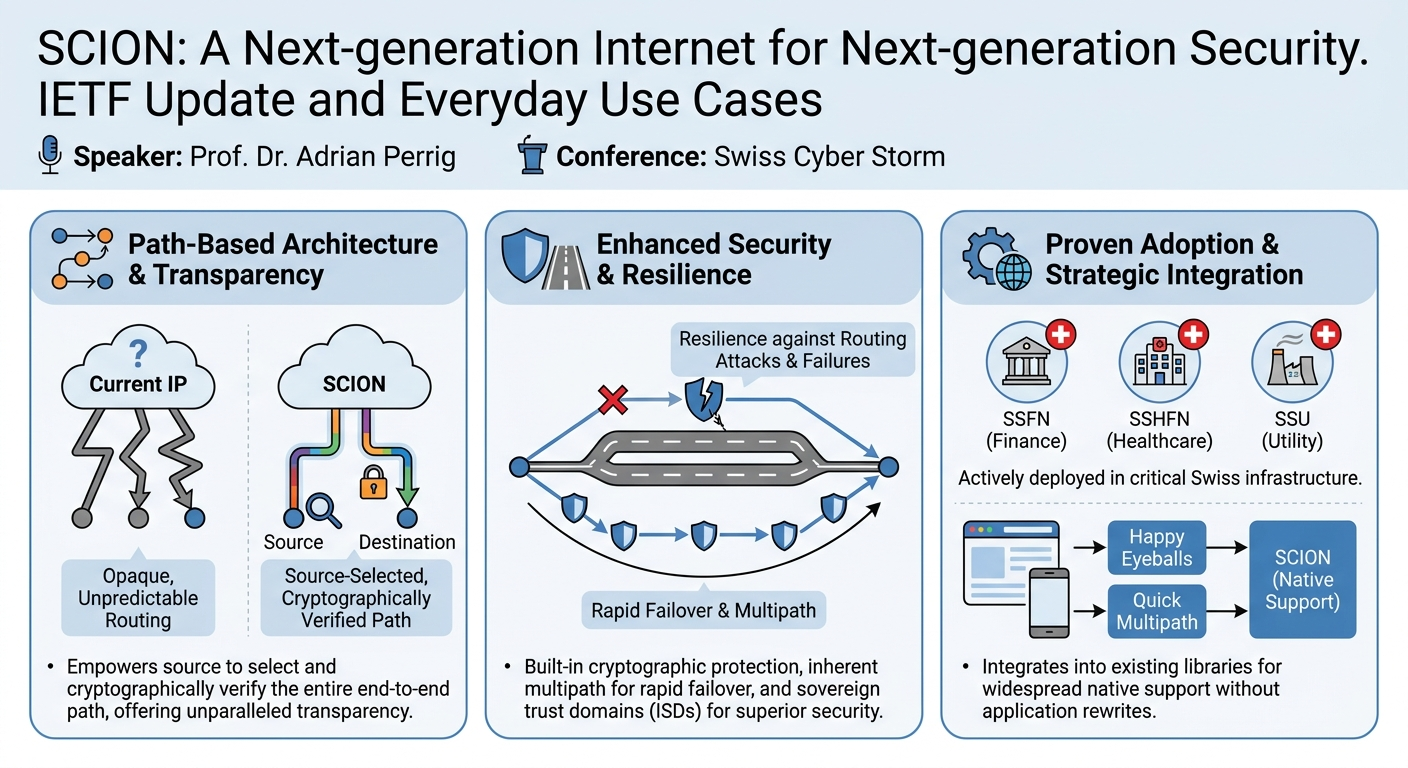
- Path-Based Architecture: SCION fundamentally re-architects internet routing by empowering the source to select and cryptographically verify the entire end-to-end path, offering unparalleled transparency and control.
- Enhanced Security & Resilience: With built-in cryptographic protection against routing attacks, inherent multipath capabilities for rapid failover, and the ability to define sovereign trust domains, SCION offers superior security and resilience compared to current IP.
- Proven Real-World Adoption: SCION is actively deployed in critical infrastructure, including the entire Swiss interbank clearing system (SSFN), Swiss healthcare (SSHFN), and utility networks (SSU), demonstrating its maturity and reliability in demanding environments.
- Strategic Integration for Broad Adoption: SCION aims for widespread native support by integrating as a third option into existing, widely used internet libraries like Happy Eyeballs and Quick Multipath, enabling hundreds of millions of devices to leverage its benefits without application rewrites.
- Superior Long-Distance Performance: Empirical measurements from a global native SCION network (Sierra) show that SCION provides lower latency for long-distance communication compared to IP, with significant advantages at higher percentiles due to effective multipath utilization.
- IETF Standardization Underway: Core SCION specifications are progressing through the IETF's independent stream, with the goal of achieving RFC status and forming an IETF working group to ensure global interoperability and community-driven development.
About the Speaker(s)
Prof. Dr. Adrian Perrig is a distinguished academic and a leading visionary in the field of internet security and architecture. Currently a Professor at ETH Zurich, he joined the institution in 2013, bringing with him a clear mission to revolutionize the internet. Prior to his tenure at ETH Zurich, Professor Perrig held a prominent position at Carnegie Mellon University. His extensive experience in internet security dates back to 1991, when he began working with Cisco routers, and he pursued his PhD in 1997, focusing on securing internet protocols. His unwavering dedication to addressing the fundamental flaws of the current internet has earned him titles such as "Mr. Scion" and "Mr. Please Fix the Internet," reflecting his pivotal role in the development and advancement of the SCION architecture.
Reviews
Dr. Zero (Offensive Security Researcher) — STRONG ACCEPT
SCION has been an academic pipe dream for a decade, but Perrig actually got the Swiss financial sector to adopt it and turn off their legacy BGP networks. It is a rare structural networking update that isn't just IETF vaporware. If you want to know how we might eventually stop relying on transitive trust, watch this.
Heather Calloway (CISO) — STRONG ACCEPT
Perrig outlines SCION, a path-aware routing protocol designed to replace the fragile trust model of BGP. It is already running production traffic for the Swiss financial sector, making this a structural shift that organizations with strict data residency or high-availability transit needs must start tracking.