Detect and Adapt: Building Resilience Through Cloud Detection
Arthur Vuagniaux (Security Engineer Detection Team Leader · Swiss Pass Security)
Swiss Cyber Storm 2025 · Day 1 · Panorama
Overview
In an era of escalating cyber threats and rapid cloud adoption, building robust cyber resilience is paramount for organizations. Arthur Vuagniaux, a Security Engineer Detection Team Leader at Swiss Pass Security, delivered a compelling talk at Swiss Cyber Storm, outlining a comprehensive strategy to achieve this resilience through advanced cloud detection systems and products. His presentation, "Detect and Adapt: Building Resilience Through Cloud Detection," centered on leveraging the extensive Microsoft Azure and Defender security ecosystem to anticipate, withstand, recover from, and adapt to adverse cyber events.
Key moments
- 2:00 Defining cyber resilience and its key pillars
- 5:30 Rationale for choosing Microsoft Azure/Defender
- 8:00 Microsoft Cloud security product families overview
- 14:30 Microsoft Sentinel for detection, investigation, response
- 18:00 Microsoft XDR and Copilot for Security for unified defense
- 22:00 Cost implications of a comprehensive cloud security solution
- 24:00 Practical advice for building tailored cyber resilience
- 26:50 Practical challenges of implementing Microsoft security products
Detect and Adapt: Building Resilience Through Cloud Detection
Speakers: Arthur Vuagniaux, Security Engineer Detection Team Leader, Swiss Pass Security
Conference: Swiss Cyber Storm
YouTube: https://www.youtube.com/watch?v=t-ouEX9sRg0
Overview
In an era of escalating cyber threats and rapid cloud adoption, building robust cyber resilience is paramount for organizations. Arthur Vuagniaux, a Security Engineer Detection Team Leader at Swiss Pass Security, delivered a compelling talk at Swiss Cyber Storm, outlining a comprehensive strategy to achieve this resilience through advanced cloud detection systems and products. His presentation, "Detect and Adapt: Building Resilience Through Cloud Detection," centered on leveraging the extensive Microsoft Azure and Defender security ecosystem to anticipate, withstand, recover from, and adapt to adverse cyber events.
The talk addressed a critical question: how can organizations construct a cyber resilience solution using the powerful capabilities inherent in cloud platforms? Vuagniaux meticulously broke down the concept of cyber resilience into four key pillars—anticipation, withstanding, recovery, and adaptation—and then demonstrated how specific Microsoft cloud security products align with and strengthen each of these areas. While acknowledging the significant investment required, the presentation offered a pragmatic approach to navigating the complex landscape of cloud security.
Vuagniaux's deep technical expertise, particularly in Azure, provided a practical lens through which to explore the integration of various security services, from data loss prevention and identity management to endpoint protection and AI-driven incident response. The overarching message emphasized that cyber resilience is not a one-time fix but an ongoing, iterative process requiring continuous adaptation and strategic investment in integrated security solutions to minimize impact and accelerate recovery during and after incidents.
Background
▶ Watch: Defining cyber resilience and its key pillars (2:00)
The contemporary cybersecurity landscape is characterized by a relentless increase in cyber incidents, a trend acutely observed in Switzerland from 2023 to 2024. This surge in threats has prompted a corresponding rise in cybersecurity budgets among Swiss companies, signaling a growing awareness of the imperative for robust defenses. Concurrently, the global economy is witnessing an exponential increase in spending on cloud services, with reports from Gartner highlighting this shift. Major cloud providers, such as Microsoft, are actively investing in expanding their cloud infrastructure and services within Switzerland, further cementing the region's transition to cloud-based operations.
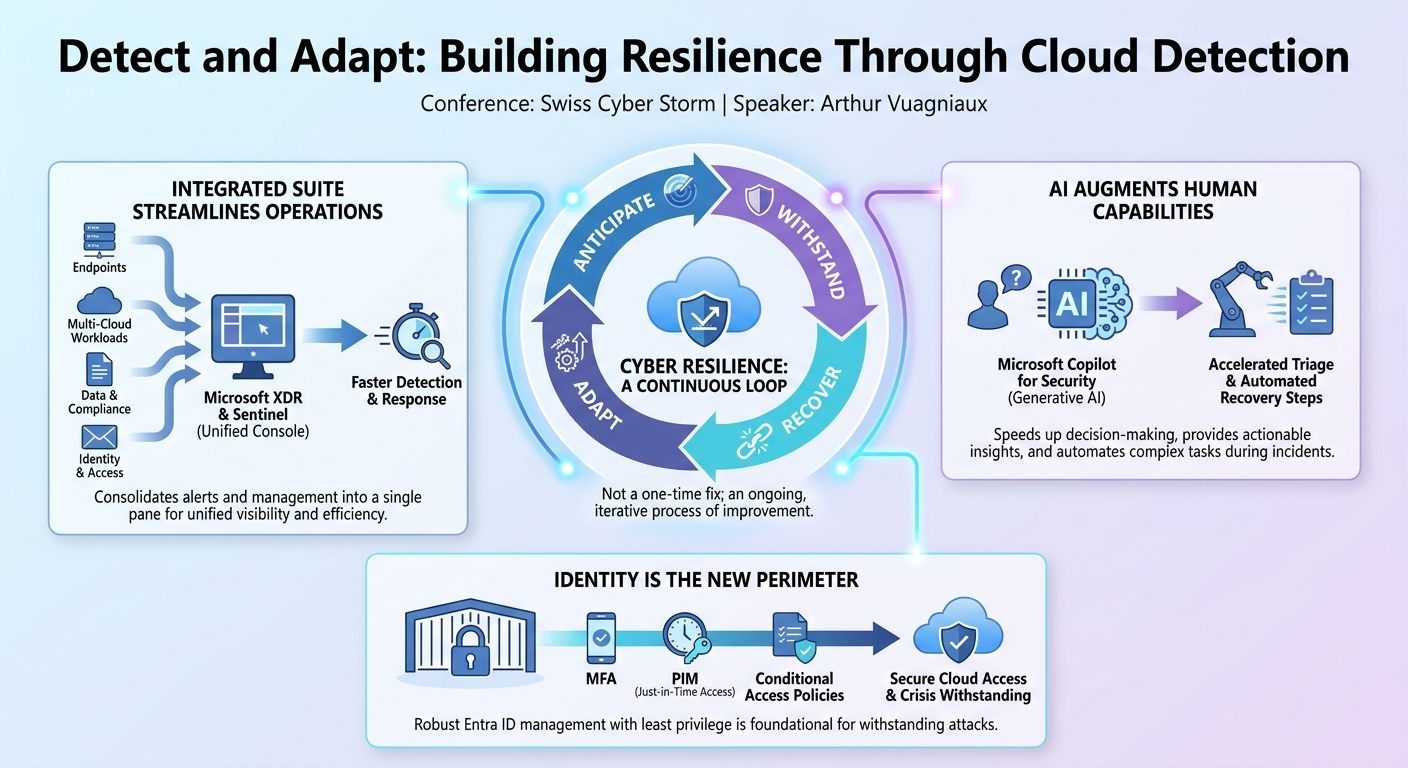
Against this backdrop, the concept of cyber resilience emerges as a critical organizational capability. Vuagniaux defined cyber resilience as an organization's ability to anticipate, withstand, recover from, and adapt to adverse cyber threats and events, including attacks, breaches, and system failures. This definition moves beyond traditional security by emphasizing not just prevention, but also the capacity to maintain core operations during an attack, restore systems quickly, and learn from incidents to improve future defenses.
To address the challenge of building such resilience, Vuagniaux proposed a solution rooted in a specific cloud provider's ecosystem. After evaluating major players like AWS, Azure, GCP, and even Alibaba Cloud, he made a deliberate choice to focus on Microsoft Azure and its Defender suite. This decision was justified by several factors: the perceived greater breadth of integrated security products within Azure for this specific exercise, the platform's unified visibility for logs and incidents through a centralized portal, its capability to protect other cloud assets, and its significant adoption rate within Switzerland. Furthermore, his personal expertise and certifications in Azure allowed for a more in-depth and practical exploration of the chosen architecture. This context set the stage for a deep dive into the specific Microsoft products that can collectively form a resilient cloud security framework.
Key Findings
▶ Watch: Microsoft Cloud security product families overview (8:00)
The central finding of Arthur Vuagniaux’s talk is that a comprehensive, integrated suite of Microsoft cloud security products can effectively establish and maintain cyber resilience across the critical pillars of anticipation, withstanding, recovery, and adaptation. The presentation meticulously demonstrated how disparate services, when strategically combined, create a powerful, multi-layered defense mechanism.
A significant discovery highlighted was the transformative power of Microsoft XDR (formerly Microsoft 365 Defender). This platform acts as a unifying console, bringing together alerts and management capabilities from various Defender products, Microsoft Sentinel, and even Microsoft Purview. This consolidation dramatically simplifies security operations, providing a single pane of glass for security analysts and reducing the complexity often associated with managing multiple security tools. Vuagniaux emphasized that this unified visibility is crucial for accelerating detection, investigation, and response.
Another key finding underscored the emerging role of Artificial Intelligence (AI) in enhancing cyber resilience. The introduction of Microsoft Copilot for Security, a generative AI-powered solution, was presented as a force multiplier for security teams. This tool can accelerate human decision-making, automate complex recovery steps, aid in triage, and provide clear, actionable summaries and step-by-step remediation guides. This points to a future where AI not only assists in detection but also actively contributes to the efficiency and effectiveness of incident response and recovery.
However, a critical finding, and perhaps the most practical, revolved around the cost implications of such a comprehensive solution. Vuagniaux explicitly stated that while the proposed architecture covers all critical security pillars, it represents a "premium investment." He detailed the dual nature of costs: fixed licensing fees for products like Defender XDR and Entra ID suites (P1, P2), alongside variable costs tied to data ingestion in Microsoft Sentinel (gigabytes) and Copilot for Security (SKUs). This highlights that while the technical capabilities are robust, organizations must carefully balance their security needs with budget constraints, emphasizing the importance of strategic scoping and phased implementation rather than an "everything at once" approach.
Finally, the talk underscored that cyber resilience is not a one-time project but a continuous loop. It encompasses ongoing detection, response, recovery, and improvement. This adaptive mindset, supported by the learning capabilities of integrated systems, is essential for organizations to evolve their defenses against an ever-changing threat landscape.
Technical Deep Dive
▶ Watch: Microsoft XDR and Copilot for Security for unified defense (18:00)
Vuagniaux's proposed solution for building cyber resilience is deeply rooted in the Microsoft cloud stack, which he categorized into three main families: Azure, Microsoft 365 (M365), and Defender. The strength of this approach lies in the integration and complementary nature of these services, culminating in a unified security posture.
The backbone of the detection and response capabilities is Microsoft Sentinel, the cloud-native Security Information and Event Management (SIEM) from Microsoft. Sentinel offers four core features:
- Collect: Utilizes native data connectors to ingest logs from various sources, including other cloud providers (e.g., AWS S3 buckets), Microsoft's own services (Azure, M365, Defender), and third-party solutions (e.g., FortiGate, Palo Alto firewalls).
- Detection: Enables the creation of custom analytic rules and leverages built-in templates to identify suspicious activities and threats.
- Investigation: Provides tools like workbooks and Kusto Query Language (KQL) queries for in-depth analysis of incidents, allowing security analysts to understand the scope and impact of alerts.
- Response: Facilitates automated threat containment and remediation through automation rules and playbooks (powered by Azure Logic Apps).
For data loss prevention (DLP) and compliance, Microsoft Purview is central. It allows organizations to monitor and block sensitive data movement. Key features include data classification and labeling, which are foundational for identifying and protecting critical information. Purview also integrates Insider Risk Management to detect risky behaviors like data exfiltration or misuse of AI tools, and Adaptive Protection, which dynamically restricts access for high-risk users.
Identity management and access control are secured by Microsoft Entra ID (formerly Azure Active Directory). Essential features for resilience include:
- Multi-Factor Authentication (MFA) and Conditional Access Policies to reduce unauthorized access risks.
- Privileged Identity Management (PIM), which enforces the least privilege principle through just-in-time (JIT) access for administrative roles.
- Entra ID Protection for detecting risky sign-ins and locations.
- The ability to back up critical configurations like Role-Based Access Control (RBAC) and Conditional Access policies, crucial for recovery plans.
- Support for Zero Trust principles, such as privilege segmentation.
The Defender family provides specific workload and threat protection:
- Microsoft Defender for Cloud: Functions as a Cloud Security Posture Management (CSPM) and Cloud Workload Protection Platform (CWPP), improving the overall cloud security posture and protecting multi-cloud workloads, including those in AWS (e.g., S3 buckets). This is particularly relevant for organizations with hybrid or multi-cloud environments.
- Microsoft Defender for Identity: Protects both on-premises Active Directory (AD) and cloud-based Entra ID, offering comprehensive identity threat detection in hybrid environments.
- Microsoft Defender for Office 365: Shields users from phishing attacks and can be used to run internal phishing campaigns to improve organizational posture.
- Microsoft Defender for Endpoint: Provides Endpoint Detection and Response (EDR) capabilities, allowing for the isolation of compromised devices, blocking suspicious interactions, and comprehensive vulnerability management through scanning.
Regarding response mechanisms, Vuagniaux differentiated between two approaches:
- Defender Automatic Playbooks: These are native to the Defender suite, triggered automatically based on integrated investigation and remediation mechanisms. While effective for local automation within Defender, they are limited to Defender's features and APIs.
- Azure Logic Apps: Offering greater flexibility and extensibility, Logic Apps are workflows in Azure that can orchestrate multiple actions across various providers, not just native Azure services. They can be triggered automatically or manually, serving as a global automation tool, capable of interacting with both cloud and on-premises systems.
The pinnacle of Microsoft's integration strategy is Microsoft XDR (formerly Microsoft 365 Defender). This platform unifies the alerts and management of all Defender products (for Cloud, Identity, O365, Endpoint), Microsoft Sentinel incidents, and even Microsoft Purview alerts into a single console. This simplification streamlines security operations and provides a holistic view of the threat landscape.
Finally, the talk introduced Microsoft Copilot for Security, a generative AI-powered security solution. Distinct from other Copilot offerings, this standalone experience is designed to accelerate human decision-making and automate complex recovery steps. It assists SOC teams with triage, provides clear, actionable summaries, and offers step-by-step remediation guides, thereby enhancing both the efficiency and effectiveness of incident response.
Vuagniaux mapped these tools back to the four pillars of resilience:
- Anticipation: Defender XDR, Sentinel, Copilot for Security.
- Withstanding: Entra ID (including PIM).
- Recovery: Entra ID (for recovery plans), Purview, Azure Backups (though not detailed in the talk).
- Adaptation: Defender products, Sentinel, Copilot for Security.
This layered and integrated approach, while complex, forms a powerful framework for building and maintaining cyber resilience in the cloud.
Demo / Proof of Concept
▶ Watch: Cost implications of a comprehensive cloud security solution (22:00)
Arthur Vuagniaux's presentation focused on a theoretical architectural blueprint and a strategic framework rather than a live demonstration or proof of concept. The talk outlined the capabilities and integration points of various Microsoft cloud security products, illustrating how they collectively contribute to cyber resilience. While no specific tools were actively demonstrated, the comprehensive explanation of each product's functionality and its role within the broader solution served as a detailed conceptual walkthrough.
Defensive Implications
▶ Watch: Practical challenges of implementing Microsoft security products (26:50)
The insights presented by Arthur Vuagniaux offer several critical defensive implications for organizations navigating the complex cloud security landscape. The primary takeaway is the imperative for an integrated and comprehensive cloud security strategy that extends beyond basic perimeter defenses. Defenders must move away from siloed security tools and embrace platforms that offer unified visibility and coordinated response capabilities.
Firstly, the emphasis on Microsoft XDR highlights the value of consolidating security alerts and management into a single console. This unification drastically reduces the operational overhead for security teams, enabling faster threat detection, investigation, and response. Organizations should prioritize solutions that offer this level of integration, as it directly impacts the efficiency of the Security Operations Center (SOC).
Secondly, identity security is presented as a cornerstone of resilience. The robust capabilities of Microsoft Entra ID, including MFA, Conditional Access Policies, and Privileged Identity Management (PIM), are non-negotiable. Defenders must implement these controls to enforce least privilege access and protect against identity-based attacks, which remain a primary vector for breaches. The ability to back up critical identity configurations also underscores the importance of a solid recovery plan for identity infrastructure.
Thirdly, the role of Microsoft Sentinel as the cloud-native SIEM is crucial. Centralized log collection from diverse sources (Microsoft, other clouds, third-party) is fundamental for comprehensive threat detection. Defenders should invest in developing custom analytic rules and leveraging Azure Logic Apps for advanced automation to minimize manual intervention and accelerate remediation.
Fourthly, the adoption of AI-powered tools like Microsoft Copilot for Security represents a significant opportunity. While still evolving, these tools can augment human analysts, accelerating triage, providing actionable insights, and automating complex recovery steps during incidents. Defenders should explore how such AI capabilities can enhance their existing SOC processes and improve decision-making under pressure.
Finally, and perhaps most pragmatically, defenders must critically evaluate their licensing and product needs. Vuagniaux explicitly cautioned against acquiring every product without a clear understanding of its necessity. For example, Defender for Identity is most relevant for hybrid environments with on-premises Active Directory. Organizations should conduct thorough assessments of their specific attack surface, regulatory requirements, and existing infrastructure to make informed decisions about which components of the Microsoft stack are truly essential. Starting small and building capabilities incrementally ("bricks by bricks") is a recommended approach to manage costs and ensure effective implementation, rather than attempting a large, potentially underutilized, deployment. Resilience, as highlighted, is an ongoing journey of adaptation and continuous improvement, requiring strategic investment and a proactive mindset.
Key Takeaways
- Cyber Resilience is a Multi-faceted Loop: True cyber resilience encompasses the abilities to anticipate, withstand, recover from, and adapt to cyber threats, forming a continuous cycle of improvement, not a one-time fix.
- Integrated Cloud Security is Essential: Microsoft's comprehensive suite (Azure, M365, Defender, XDR, Sentinel) offers a powerful, integrated framework for building resilience by addressing various security pillars from identity and data to endpoints and multi-cloud workloads.
- Unified Platforms Streamline Operations: Tools like Microsoft XDR consolidate alerts and management from disparate security products into a single console, significantly simplifying security operations and accelerating incident detection, investigation, and response.
- AI Augments Human Capabilities: Microsoft Copilot for Security leverages generative AI to enhance the efficiency of security teams by accelerating decision-making, automating complex recovery steps, and providing actionable insights during incidents.
- Cost Optimization is Critical: Implementing a full-spectrum cloud security solution is a premium investment. Organizations must carefully scope their needs, understand complex licensing models (e.g., Entra ID P1/P2, Sentinel data ingestion), and build solutions incrementally to optimize costs and avoid underutilized products.
- Identity is the New Perimeter: Robust identity management via Microsoft Entra ID, including MFA, Conditional Access, and PIM for just-in-time access, is foundational for withstanding attacks and ensuring secure access during crises.
About the Speaker(s)
Arthur Vuagniaux is a Security Engineer Detection Team Leader at Swiss Pass Security. With a strong background in cloud technologies, he previously served as a cloud team leader within the same company, which was formed from the fusion of interactive and acknowledge. Arthur is a multi-certified engineer, holding expertise primarily in Azure, with additional certifications in Splunk and AWS. He describes himself as a "technical guy" rather than a "sales guy," emphasizing his hands-on approach and deep understanding of the technologies he discusses. His focus is on building practical, resilient cloud security solutions.
Reviews
Dr. Zero (Offensive Security Researcher) — HARD PASS
I have zero patience for architecture overviews that are just vendor datasheets in a trench coat. This is a theoretical mapping of Microsoft E5 licenses to the concept of resilience, devoid of any novel research, attacks, or real-world incident teardowns.
Heather Calloway (CISO) — SOLID
This is a pragmatic roadmap for mapping the Microsoft E5 and Defender ecosystem to actual resilience pillars. It is not groundbreaking research, but it is exactly the architecture conversation your director of security engineering needs to have before you sign a massive Microsoft renewal. If you are actively consolidating vendors into Azure, have your architects review this to ensure you aren't paying for SKUs you haven't operationalized.