Keeping Pace: How to Integrate Security Requirements into Fast-Moving IT
Moritz Zollinger (cyber security consultant · TMET)
Swiss Cyber Storm 2025 · Day 1 · Panorama
Overview
In the rapidly evolving landscape of modern IT, where new services, software-as-a-service (SaaS) platforms, and cutting-edge technologies like AI agents and chatbots emerge at an unprecedented pace, maintaining robust security and compliance poses a significant challenge. Moritz Zollinger, a cyber security consultant at TMET, addressed this critical issue at Swiss Cyber Storm, presenting a pragmatic management approach designed to seamlessly integrate security and compliance requirements into fast-moving IT environments. His talk, "Keeping Pace: How to Integrate Security Requirements into Fast-Moving IT," outlines a structured methodology that empowers organizations to keep control without stifling innovation.
Key moments
- 0:00 Introduction and the challenge of fast-moving IT
- 1:30 What are Cyber Security & Compliance Requirements (CCRs)?
- 4:30 Phase 1: Tailoring requirements using a security questionnaire
- 8:00 Phase 2: Fulfilling requirements with acceptance criteria and evidence
- 14:00 Implementation prerequisites, artifacts, and key benefits
- 20:00 Q&A: Strategies for driving adoption and cultural change
- 24:00 Q&A: Handling framework application for continuous updates/releases
Keeping Pace: How to Integrate Security Requirements into Fast-Moving IT
Speakers: Moritz Zollinger, cyber security consultant, TMET
Conference: Swiss Cyber Storm
YouTube: https://www.youtube.com/watch?v=1ZMHukh6B3s
Overview
In the rapidly evolving landscape of modern IT, where new services, software-as-a-service (SaaS) platforms, and cutting-edge technologies like AI agents and chatbots emerge at an unprecedented pace, maintaining robust security and compliance poses a significant challenge. Moritz Zollinger, a cyber security consultant at TMET, addressed this critical issue at Swiss Cyber Storm, presenting a pragmatic management approach designed to seamlessly integrate security and compliance requirements into fast-moving IT environments. His talk, "Keeping Pace: How to Integrate Security Requirements into Fast-Moving IT," outlines a structured methodology that empowers organizations to keep control without stifling innovation.
Zollinger's framework introduces the concept of Cyber Security and Compliance Requirements (CCRs), a specialized form of non-functional requirements, and details a three-phase process for their selection, fulfillment, and verification. This methodology aims to distribute security responsibilities across project teams, centralize tracking, and provide clear guidance, thereby reducing the burden on dedicated security teams while enhancing overall organizational security posture. The approach is particularly relevant for organizations struggling to reconcile agile development practices and rapid technological adoption with stringent security and regulatory demands, offering a scalable and adaptable solution.
The core problem Zollinger tackles is the inherent difficulty for security professionals to "keep pace" with the sheer volume and velocity of new technology deployments. By shifting from a reactive, bottleneck-prone security model to a proactive, integrated, and distributed one, his framework offers a pathway to achieving "cyber resiliency." It emphasizes enablement, clear accountability, and continuous improvement, making security an intrinsic part of the development lifecycle rather than an external gate.
Background
▶ Watch: Introduction and the challenge of fast-moving IT (0:00)
The modern IT landscape is characterized by constant innovation and rapid deployment. Organizations are increasingly adopting diverse technologies, from SaaS solutions like MyBoards to emerging fields like AI agents and chatbots. While these technologies drive efficiency and competitive advantage, they also introduce complex security and compliance challenges. Traditional security approaches often struggle to keep up, leading to potential vulnerabilities, compliance gaps, and friction between development and security teams. This struggle to "keep things under control" is the fundamental problem Zollinger's talk addresses.
Zollinger grounds his methodology in established principles of requirement engineering, distinguishing between functional requirements (what a system shall do, e.g., "a system shall send emails") and non-functional requirements (NFRs) (how a system shall be, e.g., "a system shall be secure or fast"). Security and compliance inherently fall under NFRs. To make these more tangible and actionable, Zollinger and his team coined the term Cyber Security and Compliance Requirements (CCRs). These CCRs are essentially NFRs specifically focused on security and compliance aspects.
The sources for these CCRs are diverse, ranging from external acts and regulations (like data protection laws requiring Data Protection Impact Assessments) to internal and external industry standards, and accumulated organizational experience. The framework is designed to integrate seamlessly with various project management methodologies, including agile frameworks like SAFe (Scaled Agile Framework), as well as more traditional waterfall approaches. This adaptability is crucial, as it allows organizations to embed security into their existing operational models rather than requiring a complete overhaul of their project management practices. The underlying premise is that by standardizing and predefining security expectations, organizations can proactively bake security into their products and services from the outset, rather than attempting to bolt it on later.
Key Findings
▶ Watch: Phase 1: Tailoring requirements using a security questionnaire (4:30)
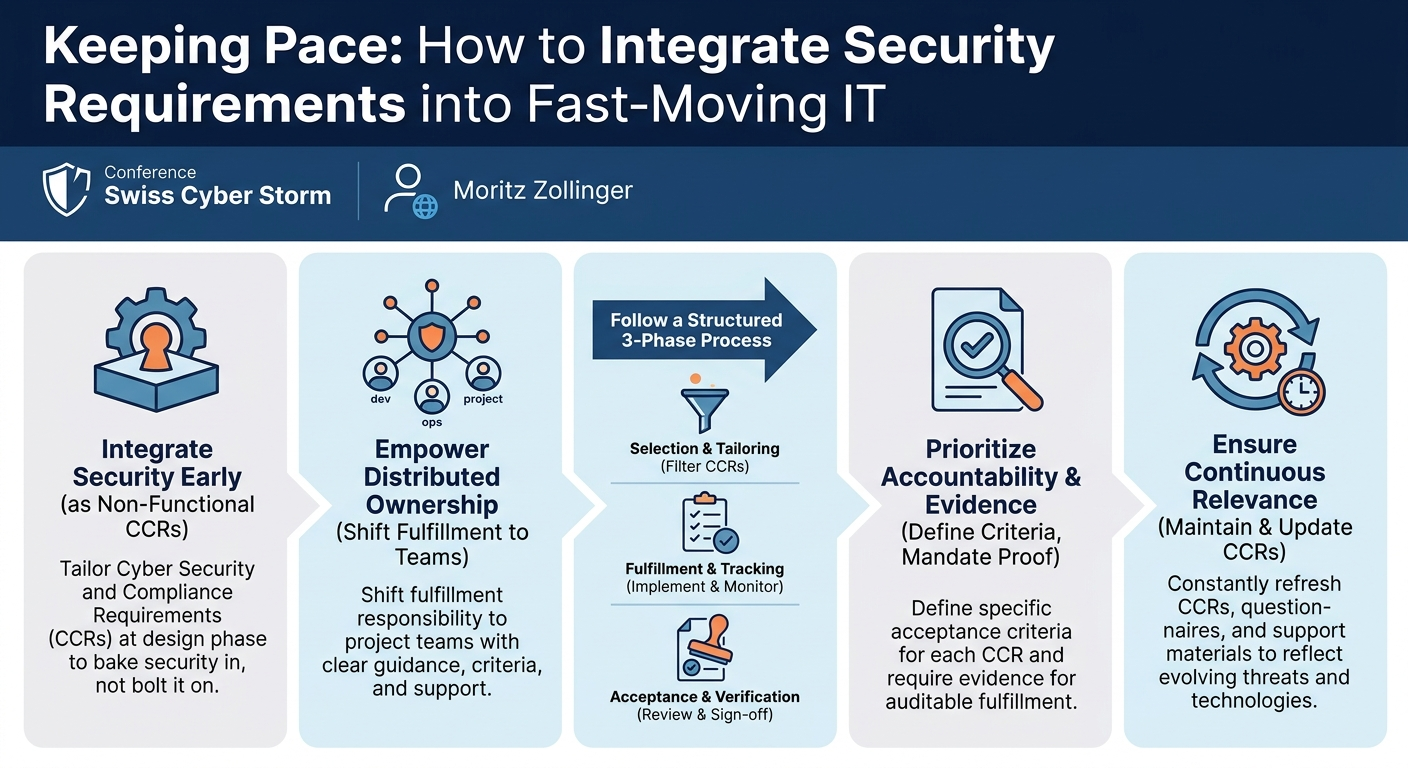
The central contribution of Zollinger's talk is a comprehensive, three-phase management approach for integrating security and compliance requirements into fast-moving IT projects. This methodology, centered around Cyber Security and Compliance Requirements (CCRs), aims to streamline security processes, distribute responsibility, and enhance overall organizational security posture.
The three core phases identified are:
- Selection and Tailoring: This initial phase involves taking a comprehensive CCR catalog and tailoring it to the specific needs of a project. This is achieved through a security questionnaire, which acts as a "shortcut risk analysis." The tailoring process involves two key alignments:
- Business Alignment: Removing requirements that are not applicable to a project's specific context (e.g., if no confidential data is processed, encryption requirements might be removed).
- Infrastructure Alignment: Eliminating requirements already met by the underlying technology stack or platform (e.g., if the server team already provides offline backups or database services are inherently encrypted, the project does not need to re-implement these). The goal is to arrive at a concise, project-relevant CCR list.
- Fulfillment and Tracking: In this phase, the responsibility for fulfilling the tailored CCRs is distributed across the organization's teams, rather than being solely concentrated within the security department. Each team is enabled to implement the requirements, while their progress is tracked centrally. A critical aspect here is the gathering of evidence to demonstrate fulfillment. The guiding principle is "fulfilled, agreed, accepted," emphasizing shared understanding and commitment.
- Acceptance and Verification: The final phase involves key security stakeholders, such as compliance teams or data protection officers, verifying that the fulfilled CCRs meet the defined standards. This involves reviewing the provided evidence and formally signing off on the requirements. Zollinger highlights the principle of "trust sometimes verify," acknowledging that while teams are generally trusted, a verification step is crucial for accountability and assurance.
Beyond these phases, Zollinger emphasizes several key principles for successful implementation:
- Enablement: Providing clear guidance (e.g., wiki pages, detailed instructions), acceptance criteria, and support contacts for project leads and engineers. This ensures that non-security personnel can effectively understand and implement security requirements.
- Lean Exception Management: Establishing a straightforward process for documenting and approving justified deviations from CCRs, preventing unnecessary roadblocks.
- Centralized Tracking and Reporting: Utilizing dashboards (e.g., in Confluence or via SQL reports) to provide a clear overview of project security status, compliance levels, and exceptions for management and auditors.
- Continuous Requirement Engineering and Maintenance: Recognizing that CCRs, questionnaires, and support materials must be constantly updated to reflect evolving threats, technologies, and regulations.
- Cultural Shift: Acknowledging that implementing this framework requires a significant cultural shift, necessitating a security team with influence and a commitment to change management, especially in organizations not accustomed to integrating NFRs early in development.
Technical Deep Dive
▶ Watch: Phase 2: Fulfilling requirements with acceptance criteria and evidence (8:00)
The technical underpinnings of Moritz Zollinger's framework are centered around structured artifacts and processes designed to make security and compliance tangible and manageable for development teams.
At the core is the CCR Catalog, a comprehensive repository of all applicable Cyber Security and Compliance Requirements. Each CCR is not merely a statement but is enriched with several critical components:
- Acceptance Criteria: These are specific, measurable conditions that must be met for a requirement to be considered fulfilled. For instance, for a requirement like "API requests shall be authenticated," acceptance criteria might include "it has to work" and "use SAML or OpenID Connect protocol." These criteria serve as a checklist for the implementing team.
- Support/Guidance: To empower non-security personnel, each CCR is linked to practical guidance. This can take the form of internal wiki pages with detailed step-by-step instructions, code examples, or architectural patterns. Additionally, contact information for relevant internal teams (e.g., the identity team for single sign-on issues) is provided, ensuring engineers are not left without support.
- Evidence: A crucial component for verification and auditability, evidence specifies what artifacts must be provided to prove a CCR has been met. Examples include an "architectural overview" for single sign-on implementation, a "concept" document for role management, or the official "Data Protection Impact Assessment (DPIA)" document for personal data processing.
The Security Questionnaire is a key tool in the "Selection and Tailoring" phase. It functions as a "shortcut risk analysis" that dynamically filters the extensive CCR catalog. By asking targeted questions about a project's characteristics – such as whether it processes confidential data, handles personal data, involves roles and permissions, or runs on a specific internal platform – the questionnaire identifies relevant CCRs. For example, if a project does not process confidential data, requirements for data encryption might be removed. Conversely, if it processes personal data, a DPIA requirement is triggered. The questionnaire also accounts for infrastructure alignment, automatically deselecting CCRs already handled by the underlying platform (e.g., if the server team provides offline backups or all database services are inherently encrypted). This process effectively reduces a large catalog to a manageable, project-specific CCR list.
For the "Fulfillment and Tracking" phase, Zollinger envisions a dynamic tracking mechanism, often presented as a table or list. This could be implemented in existing project management tools like Jira or Confluence, on a Kanban board, or even a shared Excel spreadsheet on SharePoint. This artifact allows project teams to mark acceptance criteria as completed, for the project lead to "agree" to the fulfillment, and for links to the gathered evidence to be recorded. This central record is vital for transparency and accountability.
A critical, yet often overlooked, aspect is Lean Exception Management. In scenarios where a specific CCR cannot be met (e.g., an alternative protocol is required instead of SAML/OIDC), a documented and streamlined process for obtaining an exception is essential. This prevents project delays while maintaining a record of justified deviations.
For "Reporting and Monitoring," the framework leverages a centralized dashboard. This dashboard, potentially built within Confluence, using SQL reports, or integrated into existing project overview tools, provides a high-level view for management and auditors. It displays key metrics such as the criticality of various projects, the number of CCRs assigned to each, the count of exceptions, and overall compliance status. This overview is particularly valuable for revisions and audits, as it consolidates security posture data across multiple initiatives.
Finally, the framework necessitates a continuous Requirement Engineering and Maintenance process. This "gray bar" in Zollinger's model signifies the ongoing effort required to keep the CCR catalog, the security questionnaire, and all support materials up-to-date with evolving threats, technologies, and regulatory changes. This ensures the framework remains relevant and effective over time.
Demo / Proof of Concept
▶ Watch: Q&A: Strategies for driving adoption and cultural change (20:00)
Moritz Zollinger's presentation at Swiss Cyber Storm did not feature a live software demonstration or a deployable tool. Instead, the talk itself served as a conceptual proof of concept, illustrating the framework's mechanics through detailed examples, flowcharts, and hypothetical scenarios. Zollinger explicitly clarified that "it's not a tool, it's more of a methodology," emphasizing that the value lies in the structured process rather than a specific piece of software to be sold.
The "Demo" aspect was effectively conveyed by walking the audience through the framework's three phases using concrete examples. For instance, Zollinger demonstrated the Selection and Tailoring phase by showing how a hypothetical project building an "important service for our customers" would interact with the security questionnaire. He illustrated how questions about processing confidential data, customer data, personal data, and leveraging existing infrastructure (like encrypted databases or offline backup services) would dynamically tailor the initial comprehensive CCR catalog into a shorter, project-specific list.
Similarly, the Fulfillment and Tracking phase was demonstrated through a visual representation of a tracking table. This table showed how specific CCRs, such as "connect to identity provider using single sign-on" or "implement a role concept," would be presented with their associated acceptance criteria, support guidance (e.g., a wiki page for SSO instructions, contact to the identity team), and required evidence (e.g., architectural overview, role concept document). The table visually depicted how an engineer would mark acceptance criteria as fulfilled, how a project lead would agree, and where evidence links would be stored.
The Acceptance and Verification phase was also illustrated using a similar table, highlighting how security stakeholders (e.g., the security team, identity team, data protection office) would review the completed requirements and formally sign off. This visual progression effectively showed how the methodology translates abstract security requirements into actionable tasks with clear accountability and verification steps. While not a runnable demo, these detailed examples clearly articulated the framework's operational flow and its practical application within an organization.
Defensive Implications
▶ Watch: Q&A: Handling framework application for continuous updates/releases (24:00)
The framework presented by Moritz Zollinger offers significant defensive implications for organizations striving to maintain security and compliance in fast-paced IT environments. By implementing this methodology, defenders can achieve a more proactive, integrated, and scalable security posture.
Firstly, the framework promotes shifting left in the security lifecycle. By integrating Cyber Security and Compliance Requirements (CCRs) early in the "Selection and Tailoring" phase, security considerations become an inherent part of project design and planning, rather than an afterthought or a late-stage gate. This proactive approach helps identify and mitigate risks much earlier, reducing the cost and effort of remediation later in the development cycle.
Secondly, it fosters distributed security ownership and capability across the organization. By enabling development teams and project leads to fulfill CCRs themselves, the methodology reduces the security team's bottleneck status. This not only frees up specialized security personnel for more complex tasks but also cultivates a security-aware culture where everyone shares responsibility for security. The provision of clear guidance, acceptance criteria, and support mechanisms (wiki pages, contact persons) is crucial for this enablement, transforming security from an abstract concept into actionable steps for non-security experts.
Thirdly, the structured process provides clear accountability and audit readiness. The requirement for specific evidence for each fulfilled CCR, coupled with centralized tracking and reporting dashboards, significantly simplifies internal and external audits. Organizations can quickly demonstrate due diligence and compliance with regulations by presenting a clear record of security measures taken, verified, and accepted by relevant stakeholders. This transparency is invaluable for demonstrating compliance to auditors and regulatory bodies.
Fourthly, the framework's adaptability to agile and traditional methodologies ensures its broad applicability. Whether an organization uses SAFe, Scrum, or Waterfall, the core principles of tailoring, fulfilling, and verifying CCRs remain consistent. The flexibility to adapt to continuous releases (e.g., reassessing changes every few sprints or annually, focusing only on changed requirements) addresses the challenge of security in highly dynamic CI/CD pipelines, preventing security from becoming an impediment to rapid deployment.
Finally, the methodology offers a strategic advantage in third-party risk management. As Zollinger highlighted, CCRs can be incorporated into contracts with external vendors or outsourced partners. If a third party processes confidential customer data, the contract can explicitly require them to encrypt it, mirroring internal security standards. This extends the organization's security posture beyond its internal boundaries, ensuring that supply chain risks are appropriately managed. The continuous Requirement Engineering and Maintenance aspect ensures that the defensive measures remain current, adapting to new threats, vulnerabilities, and technological advancements over time.
Key Takeaways
- Integrate Security Early and Systematically: Leverage Cyber Security and Compliance Requirements (CCRs) as specialized non-functional requirements, tailoring them to project and infrastructure specifics at the initial design phase to bake security in, not bolt it on.
- Empower Distributed Security Ownership: Shift the responsibility for fulfilling security requirements from a centralized security team to project and development teams, providing clear guidance, acceptance criteria, and support to enable their success.
- Implement a Structured Three-Phase Process: Adopt the framework's phases of Selection and Tailoring, Fulfillment and Tracking, and Acceptance and Verification for a systematic and auditable approach to integrating security into the development lifecycle.
- Prioritize Accountability and Evidence: Define specific acceptance criteria for each CCR and mandate the collection of evidence to prove fulfillment, ensuring clear accountability and simplifying audit processes.
- Foster a Security-Aware Culture with Lean Management: Invest in enablement, training, and stakeholder management to drive a cultural shift towards security ownership, complemented by a lean exception management process to handle justified deviations efficiently.
- Ensure Continuous Relevance and Oversight: Establish ongoing requirement engineering and maintenance to keep CCRs and the security questionnaire updated, and utilize centralized dashboards for continuous monitoring and reporting of the organization's security posture.
About the Speaker(s)
Moritz Zollinger is a cyber security consultant at TMET. He presented the talk "Keeping Pace: How to Integrate Security Requirements into Fast-Moving IT" at Swiss Cyber Storm. Zollinger has a long-standing relationship with Swiss Cyber Storm, having attended the conference as a student before becoming a speaker. He developed the presented framework largely in collaboration with his co-worker Daniel, and also acknowledged contributions from Bruno, "the moi" (specifically their security team and security architecture), and unnamed government organizations in refining the process. His role as a consultant provides him with a broad perspective on the requirements of cyber security and compliance across various organizational contexts.
Reviews
Dr. Zero (Offensive Security Researcher) — WEAK
Moritz Zollinger wants to solve the fast-paced IT problem by rebranding standard security requirements as "CCRs" and putting them in a risk questionnaire. This is textbook, decade-old GRC consulting dressed up as a novel methodology. If you've ever used a Jira checklist for SDLC, you already know the entire talk.
Heather Calloway (CISO) — SOLID
This is a practical, if familiar, framework for embedding security into agile development without making the security team a permanent bottleneck. It's worth handing to your GRC and engineering directors if they're still fighting over Jira workflows, but it won't fundamentally reshape a mature program.