Ethics vs. The Reality of Cybercrime. How Vulnerabilities Are Exploited and Ransomware Strikes
Christian Bernasko
Swiss Cyber Storm 2025 · Day 1 · Panorama
Overview
In this insightful talk from Swiss Cyber Storm, Christian Bernasko, a renowned cybersecurity expert and champion of Germany's best hacker competition, challenges conventional wisdom regarding cybersecurity and the motivations behind cybercrime. Titled "Ethics vs. The Reality of Cybercrime. How Vulnerabilities Are Exploited and Ransomware Strikes," Bernasko offers a provocative perspective derived from his extensive experience in both software engineering and competitive hacking. He argues that the prevailing approaches to IT security often fail because they fundamentally misunderstand the adversary and the powerful economic and intrinsic incentives driving vulnerability exploitation.
Key moments
- 0:00 Introduction and Speaker Background
- 2:40 Hackers' Motivation: Ethics vs. Reality
- 8:40 Legal Zero-Day Market and Payouts
- 12:30 Effective Strategy: Assume Breach, Rapid Response
- 15:00 Beyond the Fence: Zero Trust Security
- 18:00 AI's Impact on Vulnerability Discovery
- 21:15 Q&A: Legality of Selling Vulnerabilities
- 27:00 Q&A: Attacking the Attacker Strategy
Ethics vs. The Reality of Cybercrime. How Vulnerabilities Are Exploited and Ransomware Strikes
Speakers: Christian Bernasko
Conference: Swiss Cyber Storm
YouTube: https://www.youtube.com/watch?v=vSJw3Z5n4NU
Overview
In this insightful talk from Swiss Cyber Storm, Christian Bernasko, a renowned cybersecurity expert and champion of Germany's best hacker competition, challenges conventional wisdom regarding cybersecurity and the motivations behind cybercrime. Titled "Ethics vs. The Reality of Cybercrime. How Vulnerabilities Are Exploited and Ransomware Strikes," Bernasko offers a provocative perspective derived from his extensive experience in both software engineering and competitive hacking. He argues that the prevailing approaches to IT security often fail because they fundamentally misunderstand the adversary and the powerful economic and intrinsic incentives driving vulnerability exploitation.
Bernasko's presentation goes beyond technical details, delving into the ethical dilemmas faced by individuals who discover critical vulnerabilities and the complex ecosystem that monetizes these findings. He illuminates the stark contrast between the intrinsic, relentless motivation of hackers and the more constrained, corporate mindset of defensive security teams. The talk is a critical examination of why, despite massive investments in security, organizations continue to face breaches, proposing a radical shift in defensive strategy from an impossible pursuit of perfect prevention to a resilient model of rapid detection and recovery.
Background
▶ Watch: Introduction and Speaker Background (0:00)
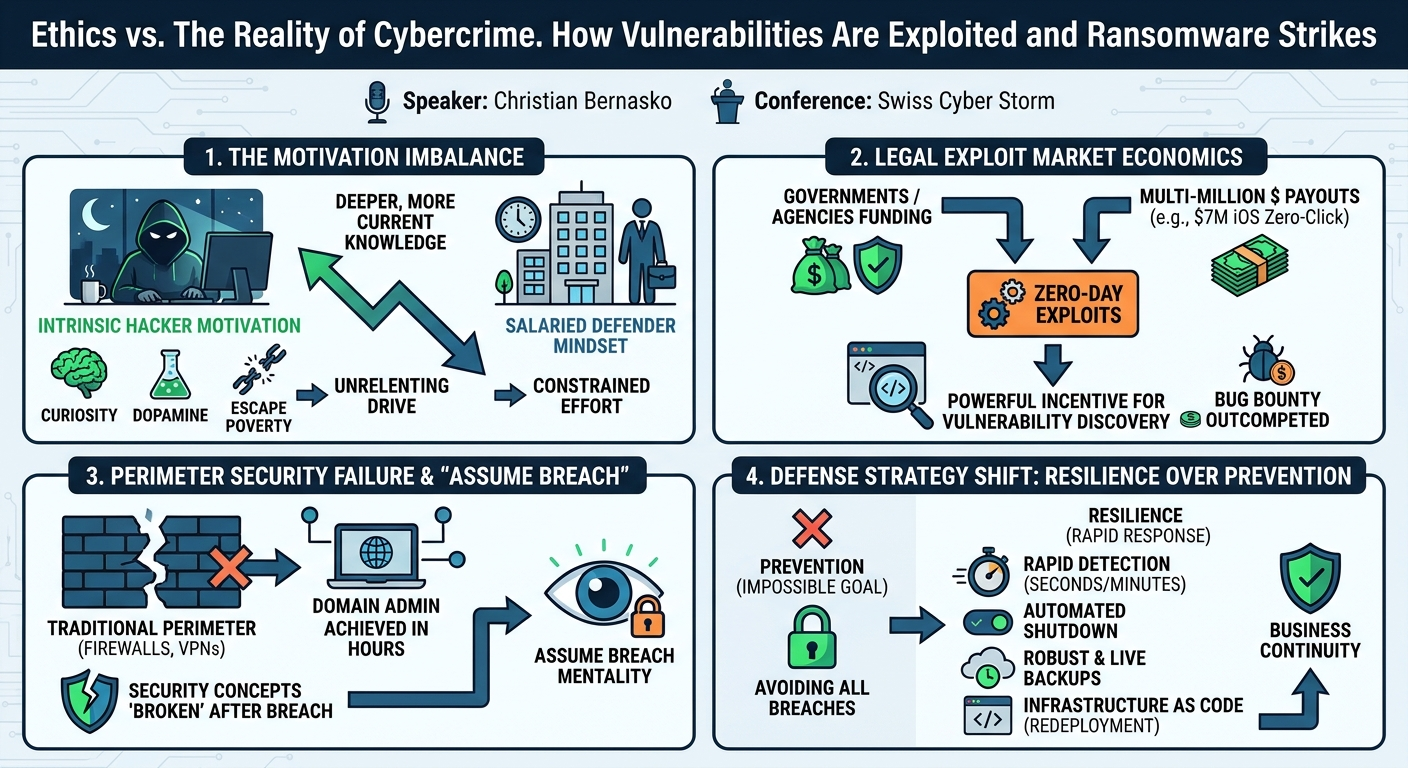
The landscape of cybersecurity is often viewed through a lens of good versus evil, with hackers typically cast as malicious actors. Christian Bernasko, however, argues for a more nuanced understanding, drawing from his decade-plus experience in IT security and a lifetime of programming. He highlights that many individuals who develop advanced hacking skills are driven by intrinsic motivation, curiosity, or even a desire to escape poverty, rather than inherent malice. He cites examples like individuals in developing countries learning through platforms like Hack The Box or YouTube, or well-connected communities like Germany's Chaos Computer Club, where knowledge is freely shared among highly passionate individuals.
This intrinsic drive creates a fundamental imbalance. While corporate security teams operate within structured work hours, often motivated by salary, these highly skilled individuals may dedicate countless late-night hours to discovering vulnerabilities, driven purely by the "dopamine hit" of success. This clash of motivations means attackers often possess deeper, more current knowledge than many defensive organizations, including antivirus companies, who struggle to keep pace with the evolving threat landscape.
Historically, companies attempted to bridge this gap with bug bounty programs, offering financial incentives for reporting vulnerabilities responsibly. However, Bernasko reveals that these programs, often characterized by slow payouts and internal politics, are increasingly outcompeted by a burgeoning, legitimate market for zero-day exploits. This market fundamentally alters the economic calculus for vulnerability researchers, creating a powerful incentive for exploit development that traditional security measures struggle to counter. The problem exists because the demand for these exploits from powerful, well-funded entities far outstrips the supply, driving prices to unprecedented levels and creating a constant stream of advanced threats.
Key Findings
▶ Watch: Legal Zero-Day Market and Payouts (8:40)
Christian Bernasko's talk unveils several critical findings that challenge established cybersecurity paradigms:
- Redefined Attacker Motivation: Hackers are not inherently "bad persons." Their motivations are often intrinsic, ranging from intellectual curiosity and the "dopamine hit" of solving complex problems to socio-economic factors like escaping poverty. This intrinsic drive enables them to dedicate significantly more time and passion to vulnerability research than many salaried security professionals.
- The Lucrative, Legal Exploit Market: A key revelation is the existence of highly profitable and fully legal markets for zero-day exploits. Companies like Crowdfans offer multi-million dollar payouts for unique vulnerabilities, specifically zero-click full chain attacks on platforms like Android (up to $5 million) and iOS (up to $7 million). Even vulnerabilities in enterprise software like Microsoft Windows or antiviruses command substantial sums, with antivirus exploits fetching around $50,000 – a lower figure Bernasko attributes to the ease of finding such vulnerabilities, not lack of interest.
- Government and Agency Funding: These enormous payouts are often funded by governments and security agencies (e.g., NSA, NSO Group), which acquire these exploits for intelligence gathering or offensive capabilities. This creates a powerful, state-backed economic engine for vulnerability discovery, making it incredibly difficult for defensive measures to keep pace.
- Ineffectiveness of Traditional Perimeter Security: The talk strongly argues against the efficacy of relying solely on perimeter defenses like firewalls or VPNs. Bernasko states that penetration testers can often achieve Microsoft domain admin privileges within four hours of starting an engagement, highlighting that once an attacker breaches the perimeter, traditional security concepts are "broken." This necessitates an "assume breach" mindset.
- Critique of Antivirus and "Monitor Everything" Approaches: Antivirus software is presented as largely ineffective and resource-intensive, akin to "trying to prevent cancer in a human" by protecting every cell. Its low payout in the exploit market ($50,000) reflects the relative ease of bypassing it. Broad monitoring strategies that slow down systems are also deemed inefficient and detrimental to productivity.
- The Accelerating Threat of AI/LLMs: Bernasko warns that the advent of Artificial Intelligence (AI) and Large Language Models (LLMs) will dramatically accelerate the discovery of security vulnerabilities. What currently takes human researchers days or months could be achieved by AI in minutes or hours, leading to a surge in sophisticated attacks.
- Implicit Cost of Breaches: A provocative finding is the suggestion that companies might already be implicitly factoring the costs of potential PR damage and data privacy issues from breaches into their overall budgets, rather than investing proactively in robust security. This could lead to a strategic underinvestment in security, operating on the premise that negative publicity is temporary and customers will eventually return.
Technical Deep Dive
▶ Watch: Beyond the Fence: Zero Trust Security (15:00)
Bernasko's talk, while focusing on ethical and economic incentives, provides crucial technical insights into the attacker's mindset and the limitations of current defenses.
A core technical concept explored is the zero-day exploit. These are vulnerabilities unknown to the vendor, making them exceptionally potent. Bernasko highlights the pinnacle of such exploits: zero-click full chain attacks. These allow an attacker to gain complete control over a device (e.g., Android, iOS) simply by sending a message (WhatsApp, SMS) without any user interaction. The high bounties ($5-7 million) for these demonstrate their extreme value and sophistication. Attackers often discover these by reverse engineering widely used software like Microsoft Windows or Microsoft Exchange, which are not open source but are critical targets.
The speaker clarifies the distinction between legal and illegal activities in vulnerability research. Finding a vulnerability is not inherently illegal. Researchers can download the source code for a web server (e.g., from github.com), install it locally in a standard configuration, and test for weaknesses. If a working exploit is developed this way, it can then be legally sold to companies like Crowdfans, provided the researcher has not performed an unauthorized attack on a live system. This process allows researchers to earn significant income without incurring legal repercussions for illegal hacking.
Bernasko identifies several key attack vectors prevalent in enterprise environments:
- Enterprise Software: Beyond operating systems, specific applications used within businesses are prime targets.
- Antiviruses: Paradoxically, software designed to protect systems often presents an easy target. Bernasko notes that antiviruses operate with high privileges and attempt to monitor "every single cell," creating a vast attack surface. The relatively low $50,000 payout for antivirus exploits (compared to mobile OS exploits) reflects the comparative ease of finding vulnerabilities within them.
- Public-facing Web Servers: Companies often expose web panels or services to the internet, running on platforms like Nginx or Microsoft web servers. These are readily identifiable via domain names and represent a constant, accessible attack surface that many traditional security tools, including some antiviruses, do not adequately cover.
From a defensive standpoint, Bernasko critiques the "monitor everything" approach, particularly concerning endpoint security. He argues that trying to monitor every single click or action on a system is inefficient, slows down modern hardware, and creates friction for employees. Instead, he advocates for a shift towards Zero Trust environments. This architectural principle dictates that no device or user should be automatically trusted, even if they are within the network perimeter. Every access request must be authenticated and authorized. He uses the example of a poorly implemented VPN; if a connected device (laptop, phone) is compromised or stolen, the attacker is effectively inside the network, bypassing the VPN "fence" and potentially gaining domain admin rights within hours.
The core technical recommendation for defense revolves around rapid response and resilience. Instead of trying to prevent every breach (which he deems impossible), organizations should focus on:
- Quick Detection: Knowing about an attack within seconds or minutes is crucial to prevent widespread damage, especially from ransomware.
- Automated Shutdown: The ability to quickly isolate or shut down affected systems.
- Robust Backups: Regularly tested, and ideally live backups, are paramount. This ensures business continuity even if data is encrypted.
- Infrastructure as Code (IaC): This practice allows for the automated, rapid redeployment of an entire, clean infrastructure from scratch, minimizing downtime and ensuring no lingering attacker presence.
Bernasko's technical analysis underscores that the battle is not about building impenetrable walls but about designing systems that can withstand and recover from inevitable breaches with minimal impact.
Demo / Proof of Concept
▶ Watch: AI's Impact on Vulnerability Discovery (18:00)
While Christian Bernasko's talk did not feature a traditional live demonstration or a formal proof of concept for vulnerability exploitation, he provided a compelling real-world anecdote that illustrates a practical application of "attacking the attacker" — a concept closely related to defensive innovation.
During the Q&A segment, a question was raised about transforming a zero-day vulnerability into a defensive system, essentially setting up a honeypot or a trap. Bernasko confirmed this is "very well doable" and recounted an incident where one of his customers was under a Distributed Denial of Service (DDoS) attack. The attackers were repeatedly downloading a small 10-kilobyte image from the web server, which was sufficient to overload the site. In response, Bernasko's team replaced the 10KB image with a one-terabyte file at the same URL. As a result, the attackers, continuing their automated script, began downloading the massive file, which quickly overloaded their own systems, causing them to cease the attack within minutes.
This example, while not a zero-day exploit per se, serves as a practical demonstration of how understanding attacker behavior and leveraging system-level responses can turn a defensive challenge into an offensive countermeasure. It highlights that creative, technical solutions can be deployed to disrupt attacker operations, even if such human-intensive interventions are difficult to scale for large organizations.
Defensive Implications
▶ Watch: Q&A: Attacking the Attacker Strategy (27:00)
Christian Bernasko’s talk provides a stark re-evaluation of defensive strategies, urging a fundamental shift in mindset for cybersecurity professionals and organizational leaders. The core implication is that the traditional fortress mentality—building higher walls and trying to prevent every single breach—is a losing battle against intrinsically motivated attackers and a well-funded exploit market.
- Embrace "Assume Breach" and Prioritize Resilience: Defenders must move away from the impossible goal of 100% prevention. Instead, organizations should operate under the assumption that breaches are inevitable. The focus must shift to rapid detection, containment, and recovery. This means investing in capabilities that allow security teams to know about an attack within seconds or minutes, quickly shut down affected systems, and restore operations efficiently.
- Invest in Robust Backup and Recovery Strategies: The importance of comprehensive, regularly tested, and ideally live backups cannot be overstated. In the face of ransomware, a reliable backup strategy negates the need to pay ransoms and ensures business continuity. Paired with Infrastructure as Code (IaC), organizations can achieve the capability to redeploy an entire clean infrastructure with the click of a button, effectively ejecting attackers and restoring services.
- Implement Zero Trust Architectures: Given the ease with which internal networks can be compromised (e.g., via stolen laptops or VPN vulnerabilities), a Zero Trust environment is crucial. No device or user, regardless of location, should be implicitly trusted. Every access attempt must be authenticated, authorized, and continuously verified, limiting an attacker's lateral movement even after an initial breach.
- Rethink the Value of Traditional Antivirus and "Monitor Everything" Solutions: Bernasko's insights suggest that traditional antivirus software and exhaustive monitoring tools are often inefficient, resource-intensive, and easily bypassed. Defenders should critically evaluate the return on investment for such solutions and consider reallocating resources to more effective detection and response mechanisms that focus on core business assets (e.g., monitoring shared network drives or databases for unusual encryption activity).
- Understand Attacker Motivations and Exploit Economics: Security leaders need to grasp the powerful economic incentives driving vulnerability discovery. The existence of legal, multi-million dollar exploit markets, often funded by state actors, means there will always be a strong supply of advanced threats. This understanding should inform risk assessments and budget allocations, acknowledging that the adversary is often more motivated and better resourced than previously thought.
- Advocate for Secure Software Development: While challenging due to market pressures (customers prioritize features over security), security teams should push for integrating security earlier into the software development lifecycle. This requires educating decision-makers about the long-term costs of insecure software and potentially incentivizing developers to prioritize security.
- Prepare for AI-Accelerated Threats: The looming threat of AI and LLMs rapidly discovering vulnerabilities demands proactive preparation. Organizations should consider how to leverage AI for their own defensive purposes, while simultaneously hardening systems against AI-driven attacks. This might involve focusing on architectural resilience and rapid patching mechanisms.
- Challenge Corporate Accountability: Bernasko provocatively suggests linking personal accountability for management to security outcomes. If decision-makers face tangible consequences for security failures, it could drive greater investment and prioritization of robust defensive strategies.
In essence, the defensive implication is a call to action for a more realistic, adaptive, and resilient cybersecurity posture, moving beyond outdated notions of impenetrable perimeters and towards dynamic defense-in-depth coupled with rapid, automated recovery.
Key Takeaways
- Attacker Motivation is Complex and Powerful: Hackers are often driven by intrinsic motivation, intellectual curiosity, or socio-economic factors, not just malice. This deep, relentless drive gives them an edge over corporate security teams.
- Legal Exploit Markets Fund Advanced Threats: The existence of legitimate companies offering multi-million dollar payouts for zero-day exploits (e.g., $7M for iOS zero-click chains) creates an irresistible incentive for vulnerability discovery, often funded by governments and intelligence agencies.
- Perimeter Security is Insufficient: Traditional defenses like firewalls and VPNs are easily bypassed, with attackers often gaining domain admin privileges within hours. Organizations must adopt an "assume breach" mentality.
- Focus on Rapid Response and Recovery: Instead of trying to prevent every breach, prioritize fast detection, automated system shutdown, and robust, tested backup strategies (including live backups and Infrastructure as Code) for swift recovery.
- Antiviruses and "Monitor Everything" are Ineffective: Traditional antivirus software is often easily bypassed and inefficient. Broad, resource-intensive monitoring strategies are less effective than targeted monitoring of core business files for abnormal activity like encryption.
- AI Will Accelerate Vulnerability Discovery: The rise of AI and LLMs will dramatically increase the speed and volume of vulnerability discovery, intensifying the need for resilient, adaptive security architectures.
About the Speaker(s)
Christian Bernasko is a highly accomplished cybersecurity expert with a unique background that spans both competitive hacking and professional IT security. He is recognized as the champion of Germany's best hacker competition from the previous year, demonstrating his exceptional offensive security skills. Bernasko is also an active participant in Capture The Flag (CTF) games, both professionally and privately, which further hones his ability to identify and exploit vulnerabilities. With over 10 years of experience in IT security and a lifelong passion for programming since the age of 10, he brings a rare dual perspective to the field, understanding security not only from a classical IT security standpoint but also from a software engineering perspective. This allows him to gain valuable insights into how attackers operate and how they reverse-engineer and exploit complex software systems. His deep understanding of hacker communities and their motivations provides a rare and critical perspective on the true landscape of cybercrime.
Reviews
Dr. Zero (Offensive Security Researcher) — WEAK
This is an awareness seminar for mid-level managers pretending to be a hacker expose. Everything here—exploit brokers, the AV attack surface, the 'assume breach' mindset—has been standard industry knowledge for a decade.
Heather Calloway (CISO) — SOLID
A useful reality check on attacker economics and the futility of prevention-only architectures. The economic framing is worth excerpting for a board presentation, even if the defensive recommendations are standard fare.