From Cloud-First to Self-Sovereign: E-ID and the Future of Enterprise Identity Infrastructure
Alessandro De Carli (Co-Founder · Papers)
Swiss Cyber Storm 2025 · Day 1 · Scenario
Overview
In an era defined by increasing reliance on cloud infrastructure and mobile technology, the landscape of enterprise identity management is undergoing a profound transformation. Alessandro De Carli, Co-Founder of Papers, delivered a compelling presentation at Swiss Cyber Storm, dissecting this evolution and proposing a shift from traditional cloud-first approaches to a more self-sovereign identity model, exemplified by the Swiss e-ID initiative. This talk not only contextualizes the contentious Swiss e-ID vote but also extrapolates its potential profound impact on corporate environments, offering a blueprint for enhancing security, streamlining operations, and regaining control over critical identity infrastructure.
Key moments
- 0:00 Introduction: Swiss E-ID and Enterprise Identity Challenges
- 5:00 Cloud-First Identity: Convenience vs. Loss of Control
- 9:30 Self-Sovereign Identity: E-ID Leveraging Mobile Secure Elements
- 11:40 E-ID's Privacy Solution: Selective Disclosure of Credentials
- 17:20 E-ID for Enterprises: Streamlining Onboarding and Authentication
- 20:50 Risks of E-ID: User Security, Trust Anchors, and Fallbacks
- 24:20 Q&A: E-ID Resilience, Quantum Computing, and Plan B
- 30:00 Q&A: Addressing E-ID Accessibility and Non-Smartphone Users
From Cloud-First to Self-Sovereign: E-ID and the Future of Enterprise Identity Infrastructure
Speakers: Alessandro De Carli, Co-Founder, Papers
Conference: Swiss Cyber Storm
YouTube: https://www.youtube.com/watch?v=vwO9U6sALzc
Overview
In an era defined by increasing reliance on cloud infrastructure and mobile technology, the landscape of enterprise identity management is undergoing a profound transformation. Alessandro De Carli, Co-Founder of Papers, delivered a compelling presentation at Swiss Cyber Storm, dissecting this evolution and proposing a shift from traditional cloud-first approaches to a more self-sovereign identity model, exemplified by the Swiss e-ID initiative. This talk not only contextualizes the contentious Swiss e-ID vote but also extrapolates its potential profound impact on corporate environments, offering a blueprint for enhancing security, streamlining operations, and regaining control over critical identity infrastructure.
De Carli argues that the current trajectory of centralized cloud identity providers, while convenient, introduces significant risks, including geopolitical weaponization, mass surveillance, and a fundamental loss of resilience and data ownership. His vision posits the human, empowered by their personal mobile devices and a robust digital identity like the e-ID, at the center of a more secure and resilient enterprise authentication ecosystem. The presentation delves into the technical underpinnings of such a system, highlighting privacy-preserving features and the inherent security advantages of modern mobile platforms.
Ultimately, this article explores how the principles behind self-sovereign identity, particularly as embodied by the Swiss e-ID, can empower enterprises to mitigate pervasive cloud risks, combat prevalent threats like phishing, and establish a more trustworthy and efficient identity framework. It provides a critical analysis of both the opportunities and the inherent challenges that come with entrusting digital identity to users and the underlying mobile infrastructure.
Background
▶ Watch: Introduction: Swiss E-ID and Enterprise Identity Challenges (0:00)
Alessandro De Carli began by grounding the discussion in his company's ethos and projects. Papers, co-founded in 2010, focuses on impactful products leveraging expertise in mobile security, confidential computing, and enterprise authentication. Key projects include Acurist, which enables mobile devices to function as confidential compute units for resilience testing, and Hypergate, a tool designed to help enterprises with high security standards regain control over their authentication infrastructure, specifically by reducing exposure to cloud services while offering a user experience comparable to cloud-native solutions. This background sets the stage for De Carli's perspective on the need for decentralized control.
Historically, enterprise identity infrastructure has undergone several significant shifts. Initially, the enterprise was conceptualized as a secure network perimeter, where internal presence conferred an elevated trust state, and security efforts focused on controlling ingress and egress. The advent of mobile workforces led to the extension of this perimeter via Virtual Private Networks (VPNs). The subsequent evolution saw large-scale Active Directory servers leveraging Kerberos authentication for many employees. However, the most recent shift has been towards cloud-first identity-as-a-service models, where organizations increasingly hand over their "crown jewels"—user identities—to providers like Microsoft, gaining convenience, seamless integration with various apps, and a native user experience.
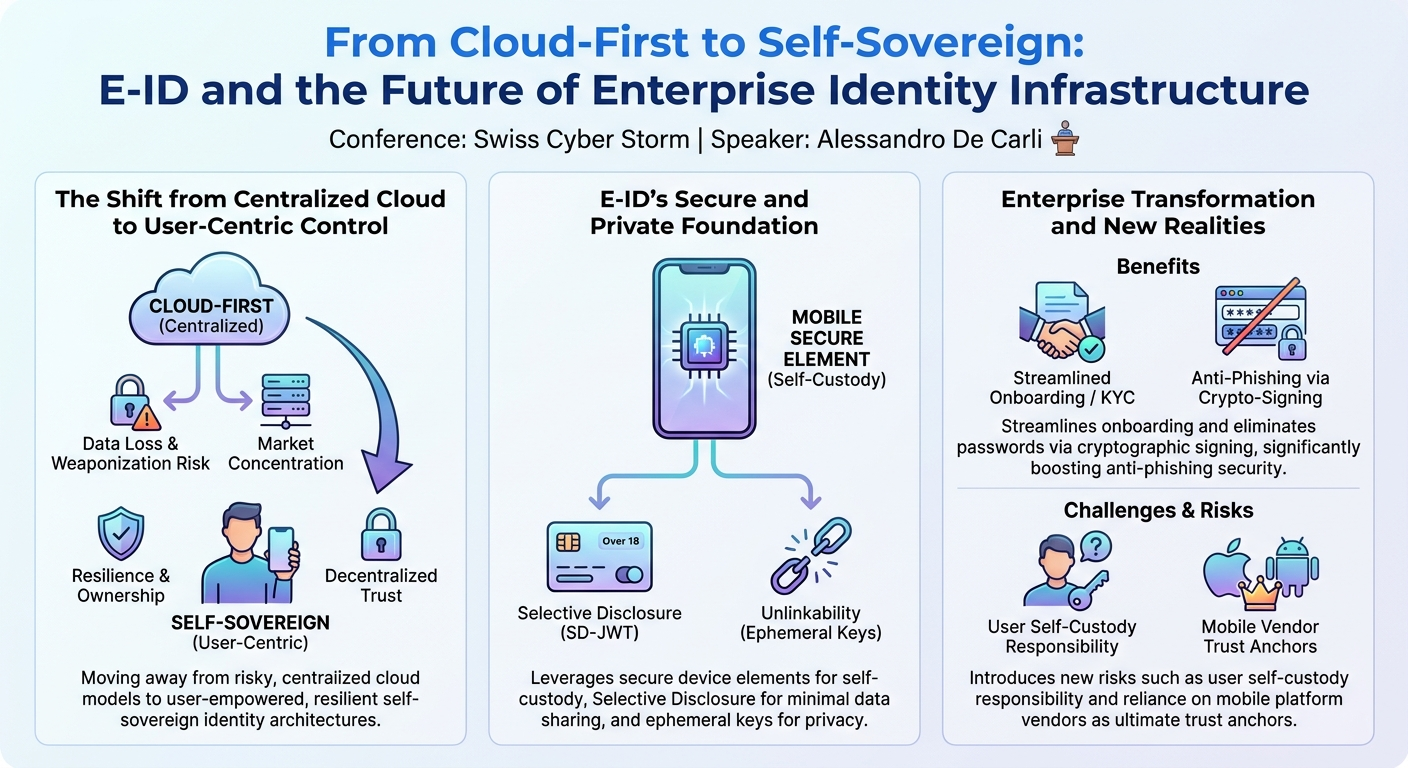
While this cloud-first approach offers undeniable benefits in terms of scalability and user experience, De Carli meticulously outlines the accumulating risks. He notes the alarming market concentration, with just five cloud providers controlling over 60% of the market. This centralization creates attractive targets for mass surveillance and introduces systemic supply chain risks. More critically, these providers have evolved into geopolitical actors, capable of shaping power balances and even being weaponized. De Carli cites two stark examples:
- Weaponization of Services: The case of Microsoft shutting down email services for the International Criminal Court (ICC) prosecutor due to pressure from the Trump administration. This incident highlighted how a cloud provider, even if taking no explicit political stance, can be compelled to act against a client, necessitating intervention from Swiss authorities to re-establish service.
- Loss of Resilience: The widespread disruption caused by an Amazon downtime event, which rendered "half of the internet" unusable, underscored the inherent loss of resilience when critical services are centralized within a single provider.
Beyond geopolitical and resilience concerns, De Carli emphasizes the fundamental loss of data ownership. Data stored in the cloud is accessible not only by the cloud provider but also by an "endless list of suppliers" and, crucially, by the governments of the countries where these providers are headquartered. This complex web of access erodes an organization's control over its most sensitive asset: identity data. The underlying problem, as De Carli frames it, is the tension between consumer demand for convenient, app-like experiences in the workplace and the security team's imperative for full control. Current solutions often force a compromise: either fully embracing the cloud (convenience, no control) or maintaining everything on-premise (control, often at the expense of user experience). This dilemma necessitates a new paradigm, one that places control and resilience back in the hands of the entity whose identity is at stake.
Key Findings
▶ Watch: Self-Sovereign Identity: E-ID Leveraging Mobile Secure Elements (9:30)
De Carli posits that to regain resilience and control, the modern workplace must shift towards a human-centric model, where individuals, equipped with their devices and identities, authenticate independently with services. This is where initiatives like the Swiss e-ID come into play, offering a compelling alternative to centralized cloud identity.
The core finding is that the e-ID system is designed to leverage the secure elements present in modern mobile devices, enabling users to perform self-custody over their digital credentials. This transforms the mobile phone into a personal, confidential compute unit for identity management, storing a full digital representation of the user's Swiss ID. A significant positive aspect highlighted by De Carli is that the e-ID has been built on open standards, fostering transparency and interoperability.
Crucially, the e-ID addresses the paramount concern of privacy through sophisticated mechanisms like Selective Disclosure Web Tokens (SD-JWT). This allows users to reveal only the minimum necessary attributes (e.g., "over 18" instead of their exact birth date) when authenticating, preventing unnecessary data sharing and collusion between different verifiers. Furthermore, the system employs ephemeral keys to ensure unlinkability, meaning a user's interactions with one service cannot be linked to their interactions with another, thereby bolstering privacy.
De Carli argues that the mobile device is ideally suited for this role, being "by far the most secure device that the consumer has and it's the most personal device." This inherent security stems from modern mobile operating system design, which incorporates features like application sandboxing and strict control over signed executables.
For enterprises, the e-ID presents transformative opportunities. It can completely replace traditional Know Your Customer (KYC) flows, leveraging the state-issued identity as the ultimate verification. This is a significant upgrade from current KYC providers that often rely on manual checks in low-wage countries. More broadly, the e-ID can eliminate the need for traditional usernames and passwords, allowing employees to cryptographically sign into services, applicable for both digital and physical access, and across various devices. This streamlines the entire employee onboarding and device provisioning process, significantly enhancing security by combating pervasive threats like phishing and providing robust verification for remote workers, even against sophisticated threats like deepfakes and identity fraud.
Technical Deep Dive
▶ Watch: E-ID for Enterprises: Streamlining Onboarding and Authentication (17:20)
The architectural foundation of the Swiss e-ID system places the user, referred to as the holder, at its core, interacting with a wallet application on their mobile device. This wallet is responsible for storing and managing the user's digital credentials, securely residing within the mobile device's secure element. Credentials are issued by an issuer (e.g., the state), and importantly, everything within the system is cryptographically signed, ensuring authenticity and integrity. Verification can occur both physically, via Bluetooth Low Energy (BLE) channels, and digitally, typically over HTTP, making the system versatile for various use cases.
A cornerstone of the e-ID's privacy model is the implementation of Selective Disclosure Web Tokens (SD-JWT). This mechanism directly addresses the concern of over-sharing personal data. When a user requests credentials from an issuer, they receive two cryptographically signed representations: one containing the full plain text payload of their attributes (e.g., full name, birth date, address) and another containing claims, which are essentially hashes of these individual attributes. When a user needs to prove a specific attribute (e.g., being over 18 for an online purchase), they selectively disclose only the relevant claim. The verifier receives this disclosed claim, which is a "triplet disguised as a base64," and can then verify that the user is in possession of the credential and knows the original content behind the hash, without ever seeing the full plain text. De Carli highlights the pragmatic choice to use "redundant" properties, such as a simple "over 18" flag, instead of relying on more complex and less mature technologies like Zero-Knowledge Proofs (ZKPs), to achieve privacy goals.
To further enhance privacy and prevent tracking, the e-ID system employs ephemeral keys. The risk with traditional digital signatures is that reusing the same key for multiple authentications allows different verifiers to link those interactions back to the same individual. With ephemeral keys, a unique, one-time key is generated for each interaction with a specific verifier. This ensures that even if a verifier colludes or shares data, it cannot be linked to other verifications performed by the user, achieving complete unlinkability across different service providers.
The security of the mobile device itself is a critical enabler for the e-ID. De Carli stresses that mobile phones are arguably the most secure consumer devices due to their fundamental design principles. Unlike desktop operating systems burdened by legacy compatibility, mobile OSes were built from the ground up with security in mind. Key features include:
- Application Sandboxing: Each application operates in an isolated environment, preventing unauthorized access to other apps' data or system resources.
- Signed Executables: Every application installation is verified against a digital signature from the developer, establishing a root of trust. The operating system will block unsigned or tampered executables.
- Unique Identifier (UID) Access Control: This system ensures that only a specific executable with a specific UID can access a particular entry in the secure element. If an app is uninstalled and reinstalled, even by the same developer (if the signature changes or is re-generated), it receives a new UID and loses access to previously stored secure element entries, reinforcing isolation.
However, De Carli points out a significant caveat: the increasing control exerted by mobile platform vendors. While this system relies on the developer's signature as a root of trust, both Google (for Android) and Apple (for iOS) have shifted towards a model where they themselves ultimately sign the executables distributed through their app stores. This means that Apple and Google effectively become the "ultimate root of trust" and the primary distributors of applications, centralizing a critical aspect of the security chain.
The practical implications for enterprise onboarding are profound. Traditionally, this involves manual KYC checks, issuing physical badges, and complex processes for setting up certificates and passwords—often with peer-assisted verification. With the e-ID, this process is dramatically streamlined:
- KYC Replacement: The state-issued e-ID acts as the ultimate KYC, eliminating manual checks and significantly improving the reliability and efficiency of identity verification, especially compared to often unreliable third-party KYC providers.
- Credential Elimination: Employees no longer require usernames and passwords. Their e-ID can be used for cryptographic signing, providing secure access across various devices and for both digital and physical access points.
- Streamlined Provisioning: Device provisioning can be directly linked to the e-ID, simplifying the setup of corporate devices and access.
- Remote Work Verification: The e-ID offers a robust solution for verifying the true identity and location of remote employees, combating issues like fraudulent applications (e.g., individuals falsely claiming Swiss residency) and sophisticated identity attacks like face swaps.
Ultimately, the e-ID's cryptographic foundation offers a powerful defense against phishing attacks, as authentication relies on possession of a secure element-backed credential rather than easily phishable passwords. It also allows enterprises to offload a significant portion of their trust infrastructure to the state, leveraging a scalable system where credential verification can occur without requiring an interactive connection back to the original issuer.
Demo / Proof of Concept
▶ Watch: Risks of E-ID: User Security, Trust Anchors, and Fallbacks (20:50)
While Alessandro De Carli's presentation provided a detailed conceptual and technical overview of the Swiss e-ID system and its applications within enterprise environments, it did not include a live demonstration or a specific proof of concept of the technology in action. The talk focused on explaining the architecture, benefits, and implications of adopting such a self-sovereign identity framework.
Defensive Implications
▶ Watch: Q&A: Addressing E-ID Accessibility and Non-Smartphone Users (30:00)
The shift towards a self-sovereign, mobile-centric identity system like the e-ID carries a dual set of implications for defenders: significant opportunities for enhanced security and efficiency, alongside new risks and challenges that require careful consideration.
Opportunities for Defenders:
- Enhanced Security Against Phishing: By relying on cryptographic signing via a secure element on a personal mobile device, the e-ID system fundamentally eliminates many traditional phishing vectors that target usernames and passwords. An attacker would need physical access to the device and the user's biometrics to compromise an account, a significantly higher bar than simply stealing credentials.
- Streamlined and Robust KYC/Onboarding: Enterprises can leverage the state-provided identity verification capabilities of the e-ID to perform highly reliable and efficient Know Your Customer (KYC) processes. This not only reduces the operational burden of manual checks but also provides a higher assurance level than many third-party KYC services, mitigating risks associated with identity fraud during onboarding, especially for remote employees.
- Offloading Trust Infrastructure: The e-ID framework allows enterprises to potentially offload a portion of their identity trust infrastructure to a state-managed, scalable system. The design, which supports non-interactive verification of credentials, means organizations don't always need to directly communicate with the original issuer for every authentication, simplifying trust chains.
- Improved Resilience: By moving away from a single, centralized cloud identity provider, organizations can regain a degree of resilience by distributing the points of trust and control across individual users and their secure devices.
Risks and Challenges for Defenders:
- User Responsibility and Self-Custody: A primary risk highlighted by De Carli is the complete offloading of security responsibility to the end-user. Similar to managing digital assets in cryptocurrencies, users become the sole custodians of their digital identities. If they lose their credentials (e.g., lose their phone and recovery keys), they lose access. While less dramatic than losing crypto (as a new e-ID can be requested), it still necessitates robust user education, clear recovery processes, and user-friendly interfaces that prioritize security.
- Varying Security Levels of Holder Wallets: The "openness" of the e-ID standard, while positive for innovation, implies that there will likely be different implementations of holder wallets. Users may choose wallets based on convenience rather than optimal security, potentially introducing vulnerabilities. Defenders must be aware of this fragmentation and its implications for overall security posture.
- Mobile Platform Vendors as New Trust Anchors: The reliance on mobile device security means that mobile platform vendors (Apple, Google) effectively become the new "trust anchors." De Carli notes that these vendors control the signing keys for applications, theoretically giving them the power to push signed updates that could extract or decrypt data from devices. While there's no indication they would, this centralizes a new form of trust at a different layer of the stack.
- e-ID as a Central Target: While decentralizing identity from a single cloud provider, the e-ID itself becomes a highly attractive central target for sophisticated attackers. Any systemic vulnerability in the e-ID standard, its core infrastructure, or widely used wallet implementations could have far-reaching consequences.
- Necessity of Fallback Mechanisms: Not everyone will possess an e-ID. This includes demographics like children, the elderly, or individuals who do not own a smartphone or choose not to use one within the Apple/Google ecosystems. Enterprises must design and maintain robust fallback authentication flows to accommodate these users, ensuring inclusivity without compromising security.
- Quantum Computing Threat: During the Q&A, De Carli acknowledged that the current cryptographic algorithms used, such as ECDSA with P256, are not quantum-resistant. This necessitates a "plan B" for cryptographic agility, allowing the standard to evolve and incorporate post-quantum cryptography as it matures. The standard's ability to change algorithms is a positive, but the transition will be a significant defensive challenge.
- Government Database Security: A question from the audience raised concerns about the government's ability to protect the underlying e-ID databases from breaches. De Carli expressed cautious confidence in the design's software architecture, emphasizing the independence of issuers, but acknowledged that ultimately, trust in the implementers' understanding of security is paramount. A breach of a central government identity database would be catastrophic, requiring robust recovery plans.
In conclusion, adopting an e-ID based identity infrastructure requires a strategic approach from defenders. They must capitalize on the inherent security benefits, particularly against phishing and fraud, while proactively addressing the new risks associated with user self-custody, platform vendor trust, and the need for cryptographic resilience against future threats.
Key Takeaways
- Shift to User-Centric Identity: The modern workplace is moving towards a model where individual users, leveraging their mobile devices and digital identities, are at the center of authentication, replacing centralized cloud reliance.
- e-ID as a Secure Foundation: The Swiss e-ID, built on open standards and utilizing mobile device secure elements, offers a robust framework for self-sovereign identity, enabling cryptographic signing and verifiable credentials.
- Enhanced Privacy and Unlinkability: Features like Selective Disclosure Web Tokens (SD-JWT) and ephemeral keys are crucial for allowing minimal data disclosure and preventing the linking of user activities across different services.
- Enterprise Transformation: e-ID can revolutionize enterprise onboarding, eliminate phishing by replacing passwords with cryptographic authentication, and provide superior KYC verification, including for remote workforce identity.
- New Risks and Responsibilities: This paradigm shift introduces challenges such as increased user responsibility for credential self-custody, potential for varying security levels in wallet implementations, and the new role of mobile platform vendors as ultimate trust anchors.
- Future-Proofing and Fallbacks: Organizations must consider the long-term implications of evolving threats like quantum computing and develop comprehensive fallback mechanisms for individuals who may not adopt the e-ID system.
About the Speaker(s)
Alessandro De Carli is a seasoned expert in the field of mobile security and enterprise authentication. He is the Co-Founder of Papers, a company he established in 2010. Papers focuses on creating impactful ventures by leveraging deep knowledge in mobile security, confidential computing, and enterprise authentication. De Carli is heavily involved in projects such as Acurist, which aims to upcycle mobile devices into confidential compute units for purposes like resilience testing. He is also a key figure behind Hypergate, a tool designed to empower enterprises with high security standards to regain control over their authentication infrastructure, moving away from complete reliance on cloud providers while maintaining a high-quality user experience. His extensive experience and insights into the evolving landscape of digital identity make him a prominent voice in discussions about the future of enterprise security.
Reviews
Dr. Zero (Offensive Security Researcher) — SOLID
De Carli pitches the decentralized identity dream, arguing we should rip cloud identity out of the enterprise and replace it with state-issued mobile wallets using the Swiss e-ID. It's a technically sound architecture talk that's surprisingly honest about the mobile threat model, even if the core premise—that enterprises actually want users to have self-custody of their corporate identity—is pure fiction.
Heather Calloway (CISO) — SOLID
A technically sound architectural proposal for adopting self-sovereign, state-issued mobile identities in the enterprise. It fundamentally underestimates the operational realities of corporate identity recovery, but the underlying SD-JWT mechanics offer a highly valuable model for remote employee onboarding. Worth reviewing for the KYC implications alone.