The SBOM and the Software Security Regulation Revolution
Olle E. Johansson
Swiss Cyber Storm 2025 · Day 1 · Scenario
Overview
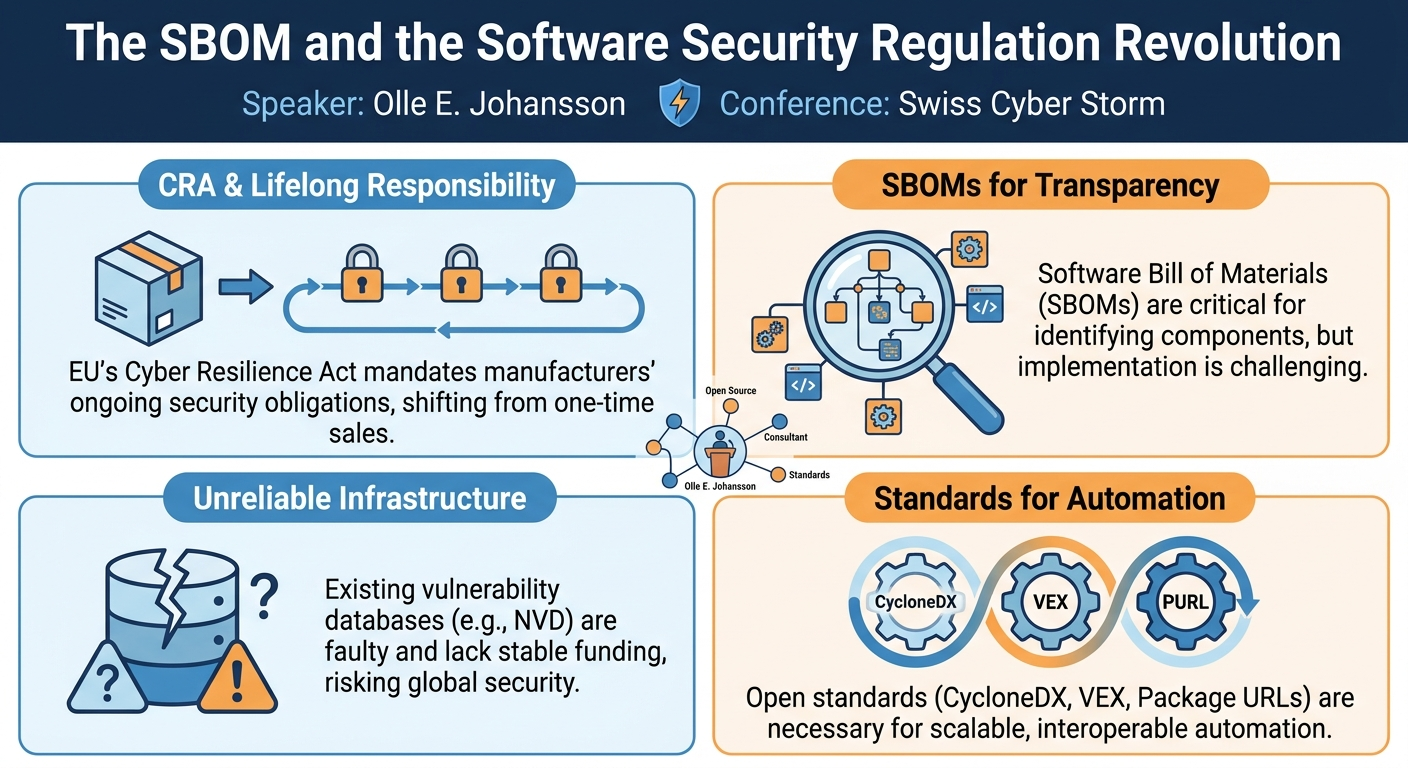
Olle E. Johansson's talk, "The SBOM and the Software Security Regulation Revolution," delivered at Swiss Cyber Storm, addresses the profound shift occurring in the software industry due to new global regulations. Johansson, a veteran open-source developer and consultant, highlights how legislation like the EU's Cyber Resilience Act (CRA) is poised to fundamentally redefine manufacturer responsibility, moving from a "one-time sale" model to a lifelong product relationship that encompasses cybersecurity obligations. Central to this transformation is the Software Bill of Materials (SBOM), a concept that promises transparency but currently faces significant implementation challenges.
Key moments
- 0:00 Speaker Introduction and background
- 2:00 Software industry changing: lifelong product responsibility under CRA
- 6:45 Key compliance dates for Cyber Resilience Act (CRA)
- 9:00 Understanding SBOMs and VEX for vulnerability management
- 16:00 Challenges with the National Vulnerability Database (NVD)
- 22:30 CycloneDX: An open standard for software transparency
- 27:00 Global Vulnerability Intelligence Platform: Addressing funding issues
The SBOM and the Software Security Regulation Revolution
Speakers: Olle E. Johansson, Project Lead, Open Source Developer, Consultant
Conference: Swiss Cyber Storm
YouTube: https://www.youtube.com/watch?v=kLZy2gRXB_c
Overview
Olle E. Johansson's talk, "The SBOM and the Software Security Regulation Revolution," delivered at Swiss Cyber Storm, addresses the profound shift occurring in the software industry due to new global regulations. Johansson, a veteran open-source developer and consultant, highlights how legislation like the EU's Cyber Resilience Act (CRA) is poised to fundamentally redefine manufacturer responsibility, moving from a "one-time sale" model to a lifelong product relationship that encompasses cybersecurity obligations. Central to this transformation is the Software Bill of Materials (SBOM), a concept that promises transparency but currently faces significant implementation challenges.
The core message of the presentation is a stark warning: the software industry is largely unprepared for these impending changes. Johansson draws on his personal experience with the Log4j (Log4Shell) vulnerability, which exposed a critical lack of visibility into software components and the immense manual effort required to assess risk. He argues that while the need for SBOMs is clear, the underlying infrastructure – robust vulnerability databases, standardized identifiers, and automated processes – is severely lacking, leaving both manufacturers and defenders in a precarious position.
This talk is crucial for anyone involved in software development, sales, or security. It not only outlines the regulatory landscape and its strict deadlines but also exposes the systemic weaknesses in current vulnerability management practices. Johansson’s insights underscore the urgent need for collaboration, open standards, and automated solutions to navigate this "regulation revolution" successfully, lest companies face severe penalties and distribution bans.
Background
▶ Watch: Speaker Introduction and background (0:00)
Olle E. Johansson’s extensive career, spanning from developing Sweden's first commercial computer game to spearheading open-source projects like Asterisk and Kamailio, provides a unique perspective on the evolution of software. Historically, software sales operated on a model where manufacturers bore minimal responsibility post-purchase. Contracts often absolved vendors of long-term security obligations, leaving users to manage vulnerabilities themselves. This paradigm, however, is rapidly dissolving under the weight of increasing cyber threats and a growing demand for accountability.
The Log4j (Log4Shell) vulnerability, which surfaced in late 2021, served as a potent catalyst for the current regulatory push. Johansson recounts how this high-profile incident (04:00) disrupted weekends for open-source developers and inundated vendors with urgent, often unpaid, requests from customers desperate to understand their exposure. The inability of organizations to quickly identify whether they were using the vulnerable Log4j library, or where it resided within their complex IT infrastructure, highlighted a critical lack of software transparency. This global scramble to identify and remediate vulnerabilities underscored the urgent need for a structured approach to understanding software components – the Software Bill of Materials (SBOM).
Building on this context, the impending Cyber Resilience Act (CRA) in the EU, alongside similar legislation in the US and UK (02:00), represents the spearhead of this "regulation revolution." The CRA mandates that manufacturers take lifelong responsibility for their products' cybersecurity, including providing free security updates and managing vulnerabilities for the entire product lifecycle. Crucially, this responsibility extends to all components, including third-party and open-source elements (02:00). Johansson emphasizes that most manufacturers are currently ill-equipped for this shift, lacking the basic insight into their products' "ingredients" that an SBOM provides. The clock is ticking, with significant deadlines approaching, and the industry’s current state of unpreparedness is a major concern.
Key Findings
▶ Watch: Key compliance dates for Cyber Resilience Act (CRA) (6:45)
The central finding of Olle Johansson’s talk is the stark reality that the software industry is largely unprepared for the impending wave of security regulations, particularly the Cyber Resilience Act (CRA). Despite critical deadlines looming (September 2026 for vulnerability reporting and management, December 2027 for full compliance), many vendors remain unaware or underestimate the profound implications (06:00).
Johansson identifies several critical challenges hindering readiness:
- Lack of Software Transparency: Most manufacturers have no clear understanding of the components, especially open-source dependencies, within their products. This lack of an SBOM makes it impossible to quickly identify exposure to vulnerabilities like Log4j (04:00).
- Immature SBOM Ecosystem: While the concept of SBOMs is gaining traction, the practical implementation is fraught with difficulties. There are multiple types of SBOMs (source, runtime, binary), and connecting them effectively to vulnerability databases is complex (08:00).
- Unreliable Vulnerability Databases: The foundational tools for vulnerability management are failing. The National Vulnerability Database (NVD), a primary source, effectively stopped working in February 2023, covering only about 50% of CVEs when it did resume partial operation (16:00, 18:00). Furthermore, its inconsistent product naming conventions make automated lookups unreliable. The CVE project itself faces uncertain funding (27:00).
- Signal-to-Noise Problem: Vulnerability databases are generating an ever-increasing volume of reports (50% growth year-on-year), largely due to changes like the Linux kernel team reporting all bugs as vulnerabilities (12:00, 14:00). Johansson estimates that up to 90% of reported vulnerabilities may not affect a specific product or its users (10:00), creating a significant burden for manual triage without effective filtering mechanisms like VEX.
- Lack of Standardization and Interoperability: The absence of universally accepted, reliable identifiers for software components (Package URLs are a proposed solution) and standardized APIs for SBOM exchange (e.g., Transparency Exchange API) prevents automation and seamless integration across the software supply chain (12:00, 24:00).
- Dependency on Single-State Funding: The global cybersecurity infrastructure, particularly the CVE project, is heavily reliant on funding from a single state (the US) (26:00). This creates a critical single point of failure, as demonstrated by past budgetary scares, threatening the stability of global vulnerability intelligence (27:00, 28:00).
These findings collectively paint a picture of an industry ill-prepared for a regulatory environment that demands comprehensive software transparency and continuous security responsibility.
Technical Deep Dive
▶ Watch: Understanding SBOMs and VEX for vulnerability management (9:00)
The core of Johansson's talk delves into the technical intricacies and challenges surrounding Software Bill of Materials (SBOMs) and the regulatory landscape. The Cyber Resilience Act (CRA) is the legislative driver, imposing stringent requirements on software manufacturers selling into the EU. By September 2026, companies must implement vulnerability reporting and management for all products, including their existing installed base (06:00). The full weight of the CRA falls by December 2027, by which point products must be resilient to Denial of Service (DoS) attacks, include an SBOM, and guarantee no known exploitable vulnerabilities (08:00). Non-compliance carries severe consequences, including multi-million Euro fines and bans on product distribution within the EU.
An SBOM is likened to a "family history tree" of software, detailing all components, sub-components, and their dependencies within a product (10:00). Johansson notes the existence of various SBOM types—covering source code, runtime, execution, binary, build systems, and test systems—each providing different levels of detail (08:00). The primary purpose of an SBOM is to enable manufacturers and users to quickly identify if a product contains a vulnerable component, such as the infamous Log4j library. However, merely having an SBOM is insufficient; it must be actionable. This is where Vulnerability Exploitability eXchange (VEX) comes in (10:00). VEX is a standard that allows vendors to communicate whether a reported vulnerability (e.g., from a CVE) actually affects their specific product or is exploitable in its context. This is crucial for filtering the noise, as Johansson states that up to 90% of reported vulnerabilities might not be relevant to a particular product, thus preventing wasted effort (10:00).
A significant technical hurdle lies in the current state of vulnerability databases. The National Vulnerability Database (NVD), long a cornerstone, has proven unreliable. It stopped functioning in February 2023, and when it resumed, it only covered approximately 50% of CVEs (16:00). A major flaw is its reliance on free-text product naming, leading to inconsistent entries (e.g., "Microsoft," "Microsoft, Inc.," "Microsoft.inc") that prevent accurate, automated matching with SBOM entries (18:00). This forces applications generating SBOMs to include multiple potential names for a single component, relying on guesswork. The underlying CVE project also faces precarious funding, highlighting a critical single point of failure for global vulnerability intelligence (27:00). The sheer volume of vulnerabilities is also escalating, with a 50% increase year-on-year, partly due to the Linux kernel team now reporting all bugs as vulnerabilities (12:00, 14:00).
To address these systemic issues, Johansson highlights several ongoing initiatives focused on open standards and interoperability:
- CycloneDX: An open-source, lightweight SBOM standard, now officially an ECMA International standard (TC54) (22:00, 23:00). It's expanding beyond software to include Hardware Bill of Materials (H-BOM) and Cryptographic Bill of Materials (C-BOM), vital for areas like post-quantum migration. The project is actively developing CycloneDX 2.0 for future enhancements (24:00).
- Dependency-Track: An open-source SBOM and vulnerability management platform that leverages CycloneDX, enabling organizations to manage their component inventory and track vulnerabilities (24:00).
- Transparency Exchange API (TEA): Initiated within CycloneDX, TEA aims to create an automated API for exchanging SBOMs and VEX data (24:00). This initiative, with its koala mascot, is also on track to become an ECMA standard, facilitating machine-to-machine communication.
- Package URLs (PURLs): A standard for unique, canonical identifiers for software packages, designed to be set by the original manufacturer or open-source project (24:00, 25:00). This addresses the NVD's naming inconsistency problem and is also becoming an ECMA standard.
- Common Life Cycle Enumeration (CLE): A standard for describing product lifecycle events such as end of life, end of support, and end of sales (26:00). This information is crucial for maintaining accurate asset inventories and understanding long-term risk.
- European Vulnerability Database (EUVD): Recognizing the NVD's shortcomings, the EU has funded its own vulnerability database (26:00). While it imports data from NVD and CVE, it also adds an additional layer for issues related to EU legislation.
- Global Vulnerability Intelligence Platform (GVIP): A more ambitious, long-term project spearheaded by Johansson and other organizations (28:00). GVIP seeks to create a globally funded, multi-stakeholder platform to enhance existing vulnerability intelligence systems, provide a unified API, and ensure resilience against single points of failure.
- Digital Signatures: Proposed for authenticating vulnerability reports, ensuring their provenance and integrity (29:00).
- Real-time Publishing: The goal for vulnerability information, mirroring the immediacy of protocols like SIP (30:00).
These initiatives collectively represent a massive collaborative effort to build the foundational infrastructure necessary for a transparent, secure, and compliant software ecosystem in the face of evolving regulations.
Demo / Proof of Concept
▶ Watch: CycloneDX: An open standard for software transparency (22:30)
While Olle Johansson's talk did not feature a live demonstration or proof of concept of a specific tool or exploit, it implicitly highlighted the need for such practical applications by discussing the critical shortcomings in current software security practices and the solutions being developed. The presentation focused on the theoretical and architectural underpinnings of SBOMs, VEX, and related standards, emphasizing the "how it works" rather than a direct "what was demonstrated."
Johansson referenced several key open-source projects that serve as practical implementations of the discussed concepts. For instance, he spoke about Dependency-Track (24:00) as a "beautiful piece of software" for SBOM and vulnerability management, which leverages the CycloneDX standard. He also introduced the Transparency Exchange API (TEA) (24:00) as an upcoming standard for automated SBOM exchange, designed to solve the manual overhead of downloading and uploading SBOMs. Although these were not demonstrated, their mention underscores the ongoing work to create tangible, open-source tools that align with the vision of a more transparent and secure software supply chain. The implication is that these projects, once mature and widely adopted, will provide the necessary "proof of concept" for the regulatory revolution.
Defensive Implications
▶ Watch: Global Vulnerability Intelligence Platform: Addressing funding issues (27:00)
The "regulation revolution" outlined by Olle Johansson presents both significant challenges and clear directives for defenders. The impending Cyber Resilience Act (CRA) and similar legislation necessitate a fundamental shift in defensive strategies, moving from reactive patching to proactive, continuous security management across the entire software lifecycle.
- Embrace SBOMs and VEX as Foundational: Defenders must prioritize the generation and consumption of Software Bill of Materials (SBOMs) for all software, both developed in-house and acquired from third parties. This provides the essential ingredient list needed for vulnerability assessment (04:00, 10:00). Equally important is the adoption of Vulnerability Exploitability eXchange (VEX). VEX documents allow organizations to filter the overwhelming volume of vulnerability reports, distinguishing between theoretical risks and actual, exploitable threats within their specific product context (10:00). This drastically reduces the "signal-to-noise" problem and allows security teams to focus on critical issues.
- Automate Everything Possible: The scale of vulnerability reporting (50% year-on-year growth) and the complexity of managing software components demand extensive automation (12:00, 14:00). Defenders should invest in tools and processes for automated SBOM generation, continuous vulnerability scanning against these SBOMs, and automated correlation with asset inventories (15:00). Open-source solutions like Dependency-Track can be invaluable for SBOM and vulnerability management (24:00). The goal is to move beyond manual, ad-hoc checks, especially for critical internet-facing systems (16:00).
- Adopt Open Standards and Interoperability: To achieve automation and seamless integration, adherence to open standards is paramount. Defenders should actively promote and utilize standards like CycloneDX for SBOMs, Package URLs (PURLs) for consistent software identification, and the forthcoming Transparency Exchange API (TEA) for automated SBOM exchange (22:00, 24:00, 25:00). This fosters an ecosystem where security data can flow freely and accurately between different tools and organizations.
- Build and Maintain a Robust Asset Inventory: A comprehensive and up-to-date asset inventory, encompassing both hardware and software, is crucial. This inventory must be linked to SBOMs to provide a holistic view of the organization's attack surface (15:00, 20:00). The ability to quickly identify which systems use a vulnerable component and prioritize mitigation based on criticality (e.g., internet-facing e-commerce vs. internal printers) is a key defensive capability (16:00).
- Prepare for Regulatory Compliance: Defenders, especially those operating or selling into the EU, must meticulously understand and prepare for the Cyber Resilience Act (CRA) deadlines (September 2026 for vulnerability reporting, December 2027 for full compliance) (06:00, 08:00). This involves establishing robust Coordinated Vulnerability Disclosure (CVD) processes, ensuring the capability to provide free, lifelong security updates, and demonstrating that products are free from known exploitable vulnerabilities. Failure to comply can result in severe financial penalties and product distribution bans (08:00).
- Diversify Vulnerability Intelligence Sources: The demonstrated unreliability of the National Vulnerability Database (NVD) and the precarious funding of the CVE project underscore the risk of relying on a single source (16:00, 27:00). Defenders should explore commercial vulnerability intelligence services, leverage the new European Vulnerability Database (EUVD), and consider engaging with initiatives like the Global Vulnerability Intelligence Platform (GVIP) to ensure access to comprehensive and reliable threat data (18:00, 26:00, 28:00).
- Engage and Collaborate: The challenges are too vast for any single entity to solve. Defenders should actively participate in relevant open-source communities (e.g., OWASP, CycloneDX, FOSDEM) and industry forums (30:00). By contributing to standards development and sharing expertise, organizations can help shape the solutions that will ultimately benefit everyone.
Key Takeaways
- The software industry is undergoing a "regulation revolution," spearheaded by legislation like the EU's Cyber Resilience Act (CRA), which mandates lifelong cybersecurity responsibility for manufacturers, including free security updates and vulnerability management for all product components.
- Software Bill of Materials (SBOMs) are essential for achieving software transparency and regulatory compliance, but the current ecosystem for generating, consuming, and acting upon them is immature, fragmented, and suffers from a lack of automation.
- The foundational infrastructure for vulnerability management is critically flawed, with the National Vulnerability Database (NVD) being unreliable and the CVE project facing uncertain funding, creating a global single point of failure for vulnerability intelligence.
- Open standards such as CycloneDX for SBOMs, Package URLs (PURLs) for consistent software identification, Vulnerability Exploitability eXchange (VEX) for risk prioritization, and the Transparency Exchange API (TEA) for automated data exchange are crucial for building a scalable and interoperable security ecosystem.
- The reliance on single-state funding for global vulnerability intelligence is unsustainable. There is an urgent need for a multi-stakeholder, globally funded, and community-driven initiative like the proposed Global Vulnerability Intelligence Platform (GVIP) to enhance and stabilize vulnerability data distribution.
- Proactive preparation for CRA deadlines (September 2026 for vulnerability reporting, December 2027 for full compliance), investment in automation, adoption of open-source tools like Dependency-Track, and active participation in industry collaboration are vital for organizations to avoid severe penalties and ensure the security and market viability of their products.
About the Speaker(s)
Olle E. Johansson is a highly experienced and prominent figure in the open-source software and cybersecurity communities. With a career spanning decades, he describes himself as an "application-aholic," having written Sweden's first commercial computer game in BASIC early in his career. He is a prolific open-source developer, notably involved in projects like Asterisk (the open-source PBX) and Kamailio (an open-source SIP proxy), where he contributed significantly to coding, training, conferences, and certification programs.
Beyond development, Johansson has worked extensively as a consultant for carriers, embedded systems, and large-scale emergency software systems. He currently leads the "robust internet project" and is deeply engaged in shaping the future of software security. He is an active participant and leader in several key initiatives, including the OWASP ESBOM forum, the CycloneDX project (which he helped establish as an ECMA International standard under TC54), and the development of related standards like the Transparency Exchange API (TEA), Package URLs (PURLs), and the Common Life Cycle Enumeration (CLE). Furthermore, he is a driving force behind the proposed Global Vulnerability Intelligence Platform (GVIP), advocating for a more resilient global vulnerability intelligence infrastructure. Johansson also co-runs Esbomb Europe, offering training and consulting in this critical domain. His extensive background in open standards, interoperability, and practical software development makes him a leading voice in the software security regulation revolution.
Reviews
Dr. Zero (Offensive Security Researcher) — STRONG ACCEPT
Johansson delivers a sobering, necessary look at the collision course between the EU's Cyber Resilience Act and the failing infrastructure we use to track vulnerabilities. It's a strong policy talk because it skips the usual SBOM evangelism to focus on the actual mechanics of compliance, specifically the collapse of the NVD and the lack of standard component naming. If you ship software to Europe, you need to understand the 2026 deadlines he's mapping out here.
Heather Calloway (CISO) — STRONG ACCEPT
The EU Cyber Resilience Act is about to turn software liability from a one-time transaction into a lifelong vendor obligation, and this talk makes it brutally clear that our tooling isn't ready. Johansson nails the core problem: regulators are mandating SBOMs and vulnerability management while the underlying infrastructure, like NVD, is actively collapsing. It is mandatory viewing for your general counsel and your product security leads.