Resilience When U.S. Laws Turn Cloud Providers Into a Threat
Tomas Kokolevsky (Information Security Officer · Beyond Gravity)
Swiss Cyber Storm 2025 · Day 1 · Arena
Overview
In an era of accelerating digital transformation and increasing reliance on cloud infrastructure, Tomas Kokolevsky, Information Security Officer at Beyond Gravity, delivered a critical talk at Swiss Cyber Storm addressing a profound geopolitical and cybersecurity challenge: the weaponization of US laws that can transform cloud service providers into potential threats to their non-US customers. Titled "Resilience When U.S. Laws Turn Cloud Providers Into a Threat," the presentation dissected the complex interplay between national sovereignty, strategic data, and the dominant US-centric cloud ecosystem.
Key moments
- 1:00 US laws turn cloud providers into a threat
- 4:50 Understanding FISA, Executive Order, and the Cloud Act
- 10:00 US government doesn't trust its own public clouds
- 18:00 Confidential Compute: trusting the chip, not the cloud
- 22:40 Q&A: Why Europe became so dependent on US clouds
- 26:30 Q&A: Real-world example of the Cloud Act in France
Resilience When U.S. Laws Turn Cloud Providers Into a Threat
Speakers: Tomas Kokolevsky, Information Security Officer, Beyond Gravity
Conference: Swiss Cyber Storm
YouTube: https://www.youtube.com/watch?v=b5i_6HAyFKU
Overview
In an era of accelerating digital transformation and increasing reliance on cloud infrastructure, Tomas Kokolevsky, Information Security Officer at Beyond Gravity, delivered a critical talk at Swiss Cyber Storm addressing a profound geopolitical and cybersecurity challenge: the weaponization of US laws that can transform cloud service providers into potential threats to their non-US customers. Titled "Resilience When U.S. Laws Turn Cloud Providers Into a Threat," the presentation dissected the complex interplay between national sovereignty, strategic data, and the dominant US-centric cloud ecosystem.
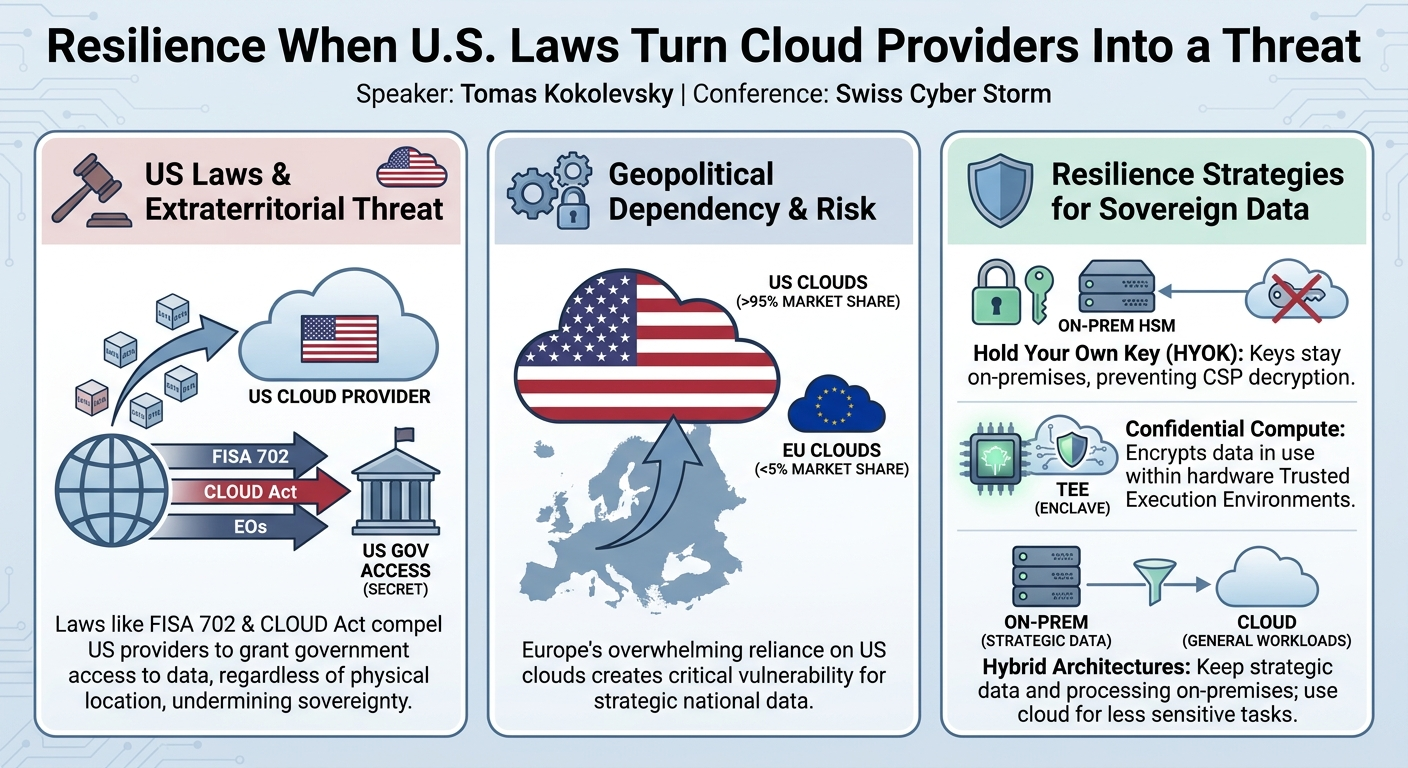
Kokolevsky highlighted the paradox where organizations, driven by operational pressures and resource constraints, are increasingly "locked in" to cloud services, yet face significant risks when dealing with sensitive, strategic data. The core of his argument revolved around specific US laws—such as FISA Section 702, Executive Orders, and the CLOUD Act—that grant the US government expansive powers to access data stored by US-based cloud providers, regardless of the data's physical location. This situation creates a critical dilemma for European nations and organizations, particularly those in strategic sectors like aerospace, defense, critical infrastructure, and government, who find themselves dependent on a cloud landscape largely controlled by US entities with less than 5% market share held by European providers.
The talk underscored the urgent need for robust resilience strategies to protect sovereign data in this challenging environment. Kokolevsky presented and analyzed three primary approaches: Hold Your Own Key (HYOK), Confidential Compute, and Hybrid Architectures. His insights are particularly vital for risk professionals, policymakers, and security practitioners grappling with the implications of extraterritorial legal frameworks on data governance and national security in the digital age.
Background
▶ Watch: US laws turn cloud providers into a threat (1:00)
The pervasive adoption of cloud computing has fundamentally reshaped the IT landscape. Organizations, facing escalating demands for operational capacity, rapid cyber threat remediation, and limited internal IT resources, have increasingly turned to cloud service providers (CSPs) as indispensable partners. This shift, however, has led to a significant dependency, creating a scenario where, as Kokolevsky noted, "we're almost locked in. Almost everybody is using some form of cloud service provider." The critical question then becomes: are these the right partners for handling strategic data?
Strategic data encompasses information vital to a nation's core capabilities and societal functions. This includes data related to airspace defense, government operations (e.g., criminal files, police records), critical infrastructure (e.g., nuclear power plants), financial services, telecommunications, and healthcare. The disruption or compromise of such data would have profound consequences, affecting economic stability, national security, and public welfare. With the advent of Industry 4.0, data and digital systems now drive critical decisions across these sectors, making the protection of this data—often termed "sovereign data"—paramount for nations to sustain their capabilities.
Beyond conventional cybersecurity concerns like antivirus and multi-factor authentication, strategic data introduces a complex dimension of geopolitics and jurisdiction. Governments across the globe understand these risks and respond with regulations, laws, and policies that dictate how such information can be processed, stored, and shared. While organizations remain data owners, their freedom to act unilaterally is curtailed by these legal frameworks, especially when the data's sensitivity impacts national interests.
A stark reality highlighted by Kokolevsky is the severe imbalance in the global cloud market. Europe possesses "less than 5% market share of European clouds," leading to an "absolute dependency on United States clouds." This dependency forms the crux of the problem: can these dominant US providers be fully trusted with Europe's strategic data, given the legal frameworks they operate under? This question sets the stage for a deeper examination of US laws that, in effect, turn CSPs into potential conduits for government access to data, creating a significant compliance and geopolitical layer over digital sovereignty.
Key Findings
▶ Watch: US government doesn't trust its own public clouds (10:00)
Kokolevsky's presentation revealed several critical findings that underscore the challenges of digital sovereignty in a US cloud-dominated world:
- Extraterritorial Reach of US Laws: The core finding is that specific US laws enable the US government to compel US-based cloud providers to grant access to data, irrespective of where that data is physically stored.
- Foreign Intelligence Surveillance Act (FISA) Section 702: This "evergreen" law, in force since the 1970s and repeatedly expanded, now explicitly includes "all cloud service providers, ISPs and data centers." It is a secret law, used by intelligence agencies like the NSA, with a reported 97-99% approval rate from the Federal Intelligence Surveillance Court (FISC), making it an almost unchecked mechanism for surveillance.
- Executive Orders (EOs): Presidential laws in the US can issue gag orders, prohibiting CSPs from informing their customers if the government demands data access. This directly contravenes transparency principles.
- Clarifying Lawful Overseas Use of Data (CLOUD) Act (2018): This law emerged from Microsoft's legal challenge against the US government, asserting that US law should "follow the provider, not the territory." Unlike FISA, the CLOUD Act is used for "normal police legal investigations," and CSPs are generally allowed to inform customers about subpoenas. However, it still mandates data disclosure irrespective of physical location.
- Geopolitical Risk and Lack of Trust: These laws create a tangible geopolitical risk. EU processes, policies, and laws (like Schrems I and Schrems II which broke down Safe Harbor for GDPR) indicate that European governments view these US legal frameworks as "unnecessary and disproportionate." This leads to a constant "chatter about Cloud Act" and a push for rethinking cloud strategies. Former CIA director Mike Pompeo's statement that the US is "the best friend to Europe and the fiercest competitor" succinctly captures this dual relationship.
- US Government's Own Cloud Strategy: Crucially, the US government itself does not trust public clouds for its own Controlled Unclassified Information (CUI). It mandates the use of FedRAMP certified government clouds, such as Amazon GovCloud and Azure GCC High. These specialized clouds adhere to stringent requirements, like NIST 853, which include background checks for every person working in the data center. This demonstrates a clear dichotomy: while US public clouds are promoted globally, the US government isolates its strategic data, setting a precedent that other nations should heed.
- Inadequacy of CSP Claims and Audits: Cloud providers' claims of "no operator access" (e.g., Microsoft's multi-step HSM access, Amazon's AWS Nitro) are insufficient. Kokolevsky argued that while these technologies are "cool," they lack independent, formal verification at the hardware level. More importantly, these claims are overridden by US law, which compels providers to cooperate. For data subject to ITAR (export control data), a US requirement, operators cannot store it in public clouds, regardless of "no operator access" claims, unless it's a FedRAMP-certified environment.
- Europe's Regulatory Progress vs. Market Reality: While Europe has made strides with GDPR (data jurisdiction), and is progressing with NIS2 and DORA (risk assessments for strategic third-party cloud providers), it still lacks a "FedRAMP equivalent" or large-scale sovereign cloud providers. This creates a regulatory challenge, as strict regulations could inadvertently hinder 80% of companies from day one due to the lack of viable European alternatives.
- Varying Sectoral Impact: The impact of these laws is not uniform. Kokolevsky presented a subjective ordering of vulnerability, placing "airspace defense" at 100% risk, followed by "government," "critical infrastructure," "financial services," "telco," and "healthcare." Any sector dealing with data that could be considered strategic by the US government is "on the radar of danger danger zone."
These findings collectively paint a picture of a global digital landscape where geopolitical realities significantly influence cybersecurity strategies, demanding a proactive and informed approach to data governance, especially for strategic national assets.
Technical Deep Dive
▶ Watch: Confidential Compute: trusting the chip, not the cloud (18:00)
To address the challenges posed by US laws turning cloud providers into potential threats, Kokolevsky outlined three resilience strategies, each offering a different balance of trust with the cloud service provider.
Hold Your Own Key (HYOK)
Hold Your Own Key (HYOK) is a cryptographic approach designed to ensure that the cloud provider never possesses the keys required to decrypt an organization's sensitive data. This stands in contrast to the more common Bring Your Own Key (BYOK) model, where an organization generates its cryptographic key but then transfers it to the CSP, who stores it in their Hardware Security Module (HSM). With BYOK, while the organization "owns" the key, the CSP controls its use, meaning they can instruct their HSM to decrypt data as needed, or they might use a wrapper key that, if compromised, would grant access.
In an HYOK setup, the organization maintains physical and logical control of its cryptographic keys within its own on-premises HSM. All data is encrypted before it leaves the organization's premises and is sent to the cloud. This typically involves a proxy or gateway that intercepts all requests, encrypts outbound data, and decrypts inbound data. The cloud provider only ever stores encrypted data and never has access to the master decryption key.
Pros: HYOK offers the highest level of confidentiality control, effectively removing the cloud provider's ability to access the plaintext data, even under legal compulsion. It provides a robust defense against secret government access.
Cons: This approach is described as a "nightmare" due to its complexity, high cost, and operational overhead. It introduces significant latency and can be slow due to the on-premises encryption/decryption process. Furthermore, any availability issue with the on-premises HSM immediately "bricks your cloud," making it a single point of failure. Consequently, HYOK is not suitable for all use cases, but rather for "super secret" files or specific data within larger systems (e.g., an ERP system) where absolute confidentiality is paramount.
Confidential Compute
Confidential Compute represents a newer, "sexy technology on the block" that aims to protect data while it is in use. Unlike traditional encryption at rest or in transit, confidential compute encrypts data even during processing within the CPU. The source of trust in this model is not the cloud provider or the operating system, but the Trusted Execution Environment (TEE) built into the hardware chip itself (e.g., AMD SEV or Intel SGX).
The mechanism involves creating an encrypted memory region (an "enclave") that is only decrypted by the CPU when the authorized code is actively running within that enclave. When control passes back to the kernel, hypervisor, or another user, the memory region is re-encrypted. This design ensures that even if the cloud provider's operators, the operating system, or the hypervisor were compromised, they would not be able to read the data within the enclave. The cloud provider "will never know what happened inside."
Different approaches exist: AMD's technology can create a confidential virtual machine, while Intel's focuses on securing a single application in a high-security enclave. Both aim to prevent the cloud service provider from inspecting the application's internal operations or sensitive data.
Use Cases: Confidential compute is particularly valuable for scenarios requiring high data confidentiality during processing. Examples include:
- Banking: Two banks exchanging and processing sensitive data in a public cloud without revealing it to the CSP.
- Confidential AI: Running machine learning inferences on proprietary or secret data (e.g., a "Coca-Cola recipe") without exposing the data or the model to the cloud provider.
Cons: While powerful, confidential compute is still evolving technology. It is based on both software and hardware, and vulnerabilities can exist (e.g., a recently published vulnerability in the AMD version that bypassed paging encryption). Organizations must be aware of these risks and carefully assess them based on their specific sector and threat model.
Hybrid Architectures
Hybrid Architectures represent the most traditional and widely adopted resilience strategy. This approach involves strategically dividing an organization's IT infrastructure, keeping highly sensitive data and processing on-premises while leveraging the cloud for less sensitive data and general workloads.
The fundamental principle is to "control what stays where and how does the routing go." This requires meticulous design to ensure that any truly critical or sensitive data "cannot go to the cloud." Organizations must carefully choose which components of their systems reside in the cloud and which remain within their controlled premises.
Key Considerations:
- Data Flow Control: Strict controls must be in place to prevent accidental or unintended exfiltration of sensitive data. For example, Kokolevsky cited the risk of an antivirus solution, while securing on-premises systems, inadvertently pulling a "secret instruction for the nuclear reactor" file up to the cloud during a forensic event.
- Component Placement: Critical components that handle strategic data must be isolated and managed on-premises. The cloud is then used for scalable, less sensitive functions, or for data that has been sufficiently anonymized or encrypted with on-premises keys.
Pros: Hybrid architectures offer a practical and often cost-effective way to balance the benefits of cloud scalability and flexibility with the need for stringent control over strategic data. It allows organizations to gradually adapt to cloud adoption while mitigating the most severe risks.
Cons: This approach requires significant architectural planning, ongoing management, and a deep understanding of data classification and flow. The complexity of integrating on-premises and cloud environments can be challenging, and overlooked details can create critical vulnerabilities.
In summary, these three strategies offer a spectrum of control, from the absolute key ownership of HYOK, to the in-execution protection of Confidential Compute, and the architectural segregation of Hybrid Architectures. The choice depends heavily on the specific nature of the strategic data, the organization's risk tolerance, and its operational capabilities.
Demo / Proof of Concept
▶ Watch: Q&A: Why Europe became so dependent on US clouds (22:40)
The conference talk focused on theoretical frameworks, legal analysis, and strategic solutions, and as such, it did not include a live demonstration or a proof of concept of the discussed resilience strategies. The presentation was primarily an analytical and educational exposition of the geopolitical challenges and technical approaches to data sovereignty.
Defensive Implications
▶ Watch: Q&A: Real-world example of the Cloud Act in France (26:30)
The insights from Tomas Kokolevsky's talk provide a clear mandate for defenders to re-evaluate their cloud strategies, especially for organizations handling strategic data. The extraterritorial reach of US laws fundamentally alters the threat model for non-US entities utilizing US cloud providers.
Here are the key defensive implications:
- Conduct Comprehensive Risk Assessments: Organizations must go beyond standard cybersecurity risk assessments to include geopolitical and jurisdictional risks. This involves identifying what constitutes "strategic data" within their operations, understanding its sensitivity, and assessing its exposure to US laws. Factors like the sector (aerospace, government, critical infrastructure are highest risk), data classification, and regulatory obligations (e.g., ITAR with its half-million dollar penalties for mishandling data) must be thoroughly analyzed.
- Challenge Cloud Provider Claims: Do not blindly trust "no operator access" claims from CSPs. Understand that legal frameworks can override technical assurances. Demand independent audits and formal verification for hardware-level security claims, especially for highly sensitive data. Be aware that the US government itself does not trust public clouds for its CUI, setting a precedent for rigorous scrutiny.
- Implement Hold Your Own Key (HYOK) for Extreme Confidentiality: For the absolute most sensitive data where even metadata access by the cloud provider is unacceptable, HYOK should be considered. This strategy, while costly and complex, ensures that cryptographic keys remain entirely within the organization's control, preventing the CSP (and by extension, foreign governments) from decrypting data. It's a niche solution for very specific, critical data assets.
- Explore Confidential Compute for Data-in-Use Protection: For workloads that require processing of sensitive data in the cloud, Confidential Compute offers a powerful layer of defense. Defenders should investigate its applicability for scenarios like secure multi-party computation, confidential AI inference, or processing highly regulated financial or health data. While not a silver bullet (vulnerabilities can exist), it significantly raises the bar for unauthorized access to data during its active processing.
- Prioritize Hybrid Architectures with Strict Data Governance: For most organizations, a hybrid architecture will be the most pragmatic and immediate defensive posture. This involves:
- Clear Data Classification: Rigorously classify all data to determine its sensitivity and strategic importance.
- On-Premises for Strategic Data: Design systems to ensure that strategic data and its core processing components remain entirely within the organization's controlled premises.
- Secure Data Flows: Meticulously design and audit all data flows between on-premises and cloud environments. Ensure that no sensitive data inadvertently moves to the cloud. This includes scrutinizing third-party tools (e.g., antivirus, forensic agents) that might exfiltrate data.
- Control Routing: Maintain explicit control over where data resides and how it is routed.
- Advocate for and Invest in Sovereign Cloud Alternatives: While challenging given the current market, organizations should advocate for stronger European cloud alternatives and, where feasible, prioritize providers that are demonstrably outside the jurisdictional reach of adverse foreign laws. This fosters a more resilient and balanced cloud ecosystem.
By adopting these defensive strategies, organizations can build greater resilience against the geopolitical risks inherent in today's cloud landscape, safeguarding their strategic data and maintaining national digital sovereignty.
Key Takeaways
- US Laws Create a Threat: US laws like FISA Section 702, Executive Orders, and the CLOUD Act compel US cloud providers to grant data access to the US government, often secretly, posing a significant threat to non-US entities storing strategic data in these clouds.
- Geopolitical Dependency: Europe's overwhelming reliance on US cloud providers (less than 5% market share for European clouds) creates a critical geopolitical vulnerability for strategic national data.
- US Government's Own Precaution: The US government itself does not trust public clouds for its Controlled Unclassified Information (CUI), instead relying on highly controlled FedRAMP certified government clouds (e.g., Amazon GovCloud, Azure GCC High).
- Hold Your Own Key (HYOK) for Ultimate Control: HYOK allows organizations to retain full control over their cryptographic keys on-premises, preventing cloud providers from decrypting data, though it comes with high cost and complexity.
- Confidential Compute Protects Data in Use: This emerging technology uses hardware-based Trusted Execution Environments (TEEs) to encrypt data during processing, preventing the cloud provider, OS, or hypervisor from accessing sensitive application data.
- Hybrid Architectures are Pragmatic: A well-designed hybrid architecture, keeping strategic data and processing on-premises while leveraging the cloud for less sensitive workloads, offers a practical approach to managing geopolitical data risks.
- Proactive Risk Assessment is Crucial: Defenders must conduct thorough risk assessments that incorporate geopolitical dimensions, specific regulatory obligations (like ITAR), and careful scrutiny of all data flows to identify and mitigate exposure.
About the Speaker(s)
Tomas Kokolevsky is an Information Security Officer at Beyond Gravity, a prominent Swiss airspace defense organization. With over five years of dedicated experience, Tomas has been actively involved in critical topics surrounding sovereign data, airspace data, cloud services, and government cloud initiatives. Known for his adventurous spirit, he is drawn to challenging environments, including heavily regulated industries, where his expertise in information security is paramount. His work at Beyond Gravity places him at the forefront of protecting highly sensitive national security data, providing him with unique insights into the geopolitical and technical challenges of cloud adoption for strategic sectors.
Reviews
Dr. Zero (Offensive Security Researcher) — SOLID
This is a competent but completely standard European CISO talk about why you can't trust US cloud providers. Kokolevsky rightly points out that FISA 702 and the CLOUD Act make AWS and Azure legally hostile to European sovereign data, but his mitigations are just the textbook trio of HYOK, Confidential Compute, and hybrid architectures. Solid framing for risk managers, but nothing a practitioner hasn't heard at every EU privacy con since Schrems II.
Heather Calloway (CISO) — STRONG ACCEPT
Kokolevsky maps the exact gap between European data sovereignty ambitions and the reality of US legal extraterritoriality via FISA 702 and the CLOUD Act. It is a clear-eyed look at third-party risk that doesn't pretend technical controls can solve geopolitical realities. Required viewing for your general counsel and enterprise architecture teams.