The Scale of Russian Sabotage Operations Against Europe’s Critical Infrastructure
Charlie Edwards (Researcher · Institute of Security Studies in London)
Swiss Cyber Storm 2025 · Day 1 · Arena
Overview
In a stark address at Swiss Cyber Storm, Charlie Edwards, a researcher from the Institute of Security Studies in London, unveiled a sobering assessment of the escalating threat posed by Russian sabotage operations against Europe’s critical national infrastructure (CNI). Edwards challenged the conventional separation of cyber and physical attacks, arguing that Russia now orchestrates these as a unified campaign, marking the most intense era of sabotage in Europe since the Cold War. His research, presented at the conference, highlights a significant increase in such incidents post-2022, directly correlating with the conflict in Ukraine.
Key moments
- 2:00 Physical sabotage blurs with cyber warfare
- 4:00 Russian sabotage of French railways and attribution challenge
- 6:00 Mapping sabotage: The challenge of scale and attribution
- 8:00 Aging infrastructure: Europe's critical vulnerability
- 14:00 Russia's motivation and surge in sabotage post-2022
- 17:00 GRU's 'gig economy' playbook for remote sabotage
- 24:00 Five key recommendations for countering sabotage
- 27:00 Government response: Tools and challenges for deterrence
The Scale of Russian Sabotage Operations Against Europe’s Critical Infrastructure
Speakers: Charlie Edwards, Researcher, Institute of Security Studies in London
Conference: Swiss Cyber Storm
YouTube: https://www.youtube.com/watch?v=ZApV2FfY6Z8
Overview
In a stark address at Swiss Cyber Storm, Charlie Edwards, a researcher from the Institute of Security Studies in London, unveiled a sobering assessment of the escalating threat posed by Russian sabotage operations against Europe’s critical national infrastructure (CNI). Edwards challenged the conventional separation of cyber and physical attacks, arguing that Russia now orchestrates these as a unified campaign, marking the most intense era of sabotage in Europe since the Cold War. His research, presented at the conference, highlights a significant increase in such incidents post-2022, directly correlating with the conflict in Ukraine.
The talk provides a critical examination of Europe's vulnerabilities, from aging infrastructure and fragmented regulatory frameworks to the challenges of attribution and a lack of coordinated response. Edwards's work maps these incidents, categorizing them by modus operandi and likelihood, revealing a pattern of deliberate, low-tech, and deniable attacks executed through a "gig economy" model of proxies. This comprehensive analysis underscores the urgent need for European governments and the private sector to recalibrate their understanding of contemporary threats and bolster their collective resilience against a sophisticated and adaptable adversary.
Edwards’s presentation is particularly pertinent in a cybersecurity conference setting, as it forces a broader perspective on national security, urging the audience to consider the physical manifestations and consequences that often accompany or are enabled by cyber activities. By broadening the aperture beyond purely digital threats, he emphasizes that the integrity of physical infrastructure is inextricably linked to cybersecurity, and that Russia’s strategy leverages this interconnectedness to impose costs, disrupt resilience, and erode public support across the continent.
Background
▶ Watch: Physical sabotage blurs with cyber warfare (2:00)
The premise of Charlie Edwards’s talk is rooted in the alarming observation that Europe is currently experiencing an unprecedented surge in sabotage activities, reminiscent of the Cold War era. This escalation, he posits, can no longer be viewed in isolation from cyber warfare, as Russia increasingly integrates physical and digital tactics into a cohesive campaign. A significant challenge in addressing this threat lies in the lack of a standardized European definition for sabotage or critical national infrastructure (CNI). For instance, Switzerland identifies nine CNI sectors, the UK 13, France 12, and Germany nine, leading to a fragmented understanding and inconsistent protective measures across the continent.
Edwards notes that existing public and academic maps of Russian hostile activities – such as those by ACLED, The Economist, Leiden University, and AP News – suffer from inconsistencies. Some include cyber attacks, others only physical sabotage, and some focus solely on confirmed convictions versus suspected incidents. This variability makes it "very difficult for governments, the public, private sector organizations to understand what the scale of sabotage is." To address this, his research developed a proprietary map focusing specifically on CNI, categorizing attacks by modus operandi (MO) like arson, explosives, anti-dragon (e.g., anchor dragging), vandalism, and electronic attacks with physical effects, then ranking them by likelihood from "realistic possibility" to "almost certain."
A core vulnerability highlighted is Europe's aging infrastructure and a pervasive lack of investment in its maintenance and upgrades. Edwards points out that much of Europe's telecommunications and energy infrastructure relies on legacy systems, making them inherently susceptible to attack. The privatization of many CNI sectors further exacerbates this issue, as the incentives for maintenance and upgrades often conflict with the profitability motives of private companies. This tension, he argues, leads to deferred maintenance, leaving critical systems vulnerable until an incident forces action. A striking example cited is the Dutch hydraulic water management system, which relies on an old computer system, capable of rendering Rotterdam airport useless if its sluice gates were compromised.
Furthermore, uneven regulation and fragmented governance across borders compound the problem. Edwards references the NIST 2 directive (likely referring to NIS2, the EU's updated Directive on the security of network and information systems), acknowledging its merits as an information security framework. However, he reveals that 13 EU countries have yet to transpose this directive into national law, and eight of those haven't even defined their key cyber rules. This regulatory patchwork creates significant vulnerabilities, especially given the tightly coupled nature of European infrastructure, where one country's robust protection might be undermined by a neighbor's lax standards, as illustrated by the hypothetical reliance of Switzerland on German or Italian energy systems. These systemic weaknesses create fertile ground for Russia's strategic objectives.
Key Findings
▶ Watch: Mapping sabotage: The challenge of scale and attribution (6:00)
Charlie Edwards's research reveals several critical findings regarding the nature and scale of Russian sabotage operations in Europe. Foremost among these is the dramatic surge in sabotage activity post-2022, directly coinciding with Russia's full-scale invasion of Ukraine. This escalation is not coincidental but a deliberate strategy by the Kremlin to impose costs, create friction, disrupt resilience, and erode public support in Europe, thereby preventing the continent from converting its "latent potential" into "usable superiority." This strategy is executed through a combination of disinformation, cyber attacks, and physical sabotage.
A pivotal finding is Russia's reliance on proxies and a low-tech, deniable modus operandi. Following the expulsion of hundreds of Russian intelligence officers from European countries in 2018 and 2022, Russia adapted its operational model. The GRU, Russia's military intelligence organization, specifically unit 29155 (now known as the 161 center in Moscow), has pioneered a "gig economy" approach. This involves remotely tasking individuals, often recruited via social media platforms like Telegram using tools such as the "previet bot." These recruits, described as "professional amateurs," are paid in cryptocurrency to carry out acts ranging from defacing property with pro-Russian stickers to more serious sabotage like slaughtering pigs or tampering with water treatment plants. Despite their lack of professional training, their recklessness and sloppiness are effective against vulnerable and poorly maintained targets.
Edwards highlights that Russia targets the "seams, not the silos" of European critical infrastructure. Instead of focusing on isolated components, attacks aim at the interfaces and interdependencies between different sectors, such as energy and Information and Communications Technology (ICT), to maximize disruption. The water treatment plant sector has seen a significant increase in incidents, quadrupling from 2023 to 2024, particularly in Finland, Estonia, Sweden, and Germany. This pattern suggests a coordinated campaign rather than isolated incidents, yet law enforcement often investigates these in isolation.
The talk underscores the challenge of attribution and the normalization of sabotage. Governments frequently struggle to definitively attribute attacks, or choose not to, allowing "plausible deniability" to reign supreme. This normalization risks societies viewing such incidents as part of everyday life, diminishing the impetus for a robust response. The case of the Polish shopping center fire, initially deemed "likely" Russian involvement by Donald Tusk, took 12 months for definitive attribution, a timeline Edwards considers "probably too slow" in a "just in time economy."
Finally, Edwards argues that success in defense should be measured in terms of recovery, not compliance. He notes that Mean Time To Recovery (MTTR) is getting longer in some critical sectors, like repairing undersea cables, due to factors such as a shortage of specialized repair ships and increasing technical complexity. This highlights a shift from preventative measures and regulatory adherence to the urgent need for robust recovery capabilities.
Technical Deep Dive
▶ Watch: Russia's motivation and surge in sabotage post-2022 (14:00)
The technical deep dive into Russian sabotage operations, as presented by Charlie Edwards, reveals a sophisticated, albeit often low-tech, approach to exploiting systemic vulnerabilities across Europe. The core of Russia's methodology revolves around leveraging a "gig economy" model for its Modus Operandi (MO), which includes arson, explosives, anti-dragon (e.g., anchor dragging), vandalism, and electronic attacks that produce physical effects.
The GRU unit 29155, now known as the 161 center in Moscow, is identified as the primary orchestrator of these physical operations. Following the expulsion of numerous Russian intelligence officers from Europe, the GRU adapted by recruiting individuals remotely, primarily through social media platforms like Telegram. The "previet bot" is specifically mentioned as a tool used in this recruitment process. These recruits, often referred to as "professional amateurs," are given tasks that initially might seem trivial, like placing "NATO all over Brussels" stickers. However, as trust builds, the tasks escalate to more destructive actions such as slaughtering pigs or tampering with CNI. Crucially, in at least one investigation, detailed water schematic diagrams with clear instructions were provided to operatives to facilitate sabotage of water treatment plants. Payments are made via cryptocurrency, ensuring anonymity for both the handlers and the operatives. This model is highly effective despite the operatives' lack of formal training, as their recklessness and sloppiness are often sufficient to exploit the inherent vulnerabilities of aging and under-maintained infrastructure.
Several specific incidents illustrate the technical execution and impact:
- French Railway Sabotage: Approximately 150 km southwest of Paris, the day before the Paris Olympics, a railway was sabotaged. While not formally attributed by the French government due to a historical "culture of attribution," law enforcement and intelligence agencies consider Russian involvement "highly likely." This incident demonstrates the strategic timing and potential for significant disruption of high-profile events.
- Merka 44 Shopping Center Fire (Poland): In May 2024, a large shopping center fire was initially suspected to be Russian-linked. Twelve months later, Polish authorities confirmed Russia's involvement. This case exemplifies the time lag in attribution and the challenge it poses for a "just in time economy."
- Water Treatment Plants: Edwards noted a quadrupling of attacks on water treatment plants between 2023 and 2024, particularly in Finland, Estonia, Sweden, and Germany. These low-tech physical attacks, potentially guided by provided schematics, highlight a systematic targeting of a critical, often overlooked, sector. The intent is to disrupt essential services and create widespread friction.
- DHL Explosives: This incident, deemed an "outlier" due to its scale, involved four packages containing phosphorus-based explosives sent to DHL logistics hubs in Birmingham (UK), the US, and Germany. A photo from Minworth in Birmingham showed the resulting fire. The intent of these packages remains unclear – whether to burn down warehouses or cause aircraft to fall from the sky. This operation, attributed to GRU unit 29155, was identified quickly, leading to a direct "red line" warning from President Biden to Russia, indicating the extreme escalation potential and the international community's classification of such acts as potential terrorism if they targeted passenger aircraft.
- Baltic Sea Cables (Anchor Dragging): The deliberate dragging of an anchor for 100 kilometers by a vessel, damaging Baltic cables, was definitively identified by the Finnish government as a deliberate attack. Despite clear evidence that this was not an accidental occurrence (70% of cables are damaged annually, but not typically by 100km anchor drags), the prosecution collapsed because the incident occurred in international waters, outside Finnish jurisdiction. This highlights a significant legal and jurisdictional challenge in responding to such "anti-dragon" operations.
Edwards emphasizes that these physical operations are often intertwined with cyber activities, creating a complex threat landscape where "digital commons, pre-positioned access, DOS and infooops create noise," while proxies carry out physical actions. The strategic focus is on single points of failure and exploiting the "seams, not the silos" – the interfaces between different critical infrastructure sectors – to maximize disruptive effect and create friction across Europe.
Demo / Proof of Concept
▶ Watch: GRU's 'gig economy' playbook for remote sabotage (17:00)
While Charlie Edwards's talk did not feature a live technical demonstration or a software-based proof of concept in the traditional sense, the presentation itself served as a compelling evidence-based exposition of real-world Russian sabotage operations. Instead of a direct "demo," Edwards meticulously presented case studies, photographic evidence, and statistical data from his research to illustrate the methods, targets, and scale of these attacks.
The detailed descriptions of incidents, such as the French railway sabotage, the Merka 44 shopping center fire in Poland, the surge in attacks on water treatment plants across several European nations, and the DHL explosives packages, functioned as concrete examples of the capabilities and intent of Russian actors. The inclusion of a photo of the phosphorus-based explosives from the DHL incident, alongside the explanation of the GRU's "gig economy" model and the use of the "previet bot" on Telegram, provided a clear and vivid picture of how these operations are conceived and executed.
In essence, the talk presented a "proof of concept" in the form of documented, real-world events, demonstrating the efficacy of Russia's hybrid warfare tactics. This approach, grounded in empirical research and intelligence analysis, aimed to prove the existence, scale, and specific characteristics of the threat rather than showcasing a simulated exploit. By presenting this evidence, Edwards effectively demonstrated the practical implications and success of Russia's strategy in disrupting European critical infrastructure through a blend of physical and deniable operations.
Defensive Implications
▶ Watch: Government response: Tools and challenges for deterrence (27:00)
The insights from Charlie Edwards's talk carry profound defensive implications for European governments, CNI operators, and the private sector. A fundamental shift in perspective is required: to treat cyber and sabotage as a unified campaign, rather than distinct threats. Defenders must recognize that digital pre-positioning, denial-of-service attacks, and information operations often serve as a smokescreen or enabler for physical actions carried out by proxies. This necessitates a holistic intelligence gathering and response strategy that connects seemingly disparate incidents.
One of the most critical areas for immediate action is addressing aging infrastructure and the lack of investment. Governments must confront the tension between private sector profitability and the imperative for CNI maintenance and upgrades. Edwards highlighted that deferred maintenance makes infrastructure inherently vulnerable, as seen in the Dutch hydraulic water management system or the UK substation incident. Proactive, government-mandated investment and oversight are essential, potentially through direct funding or regulatory incentives that prioritize resilience over short-term cost savings.
Furthermore, there is an urgent need for harmonized regulation and governance across Europe. The slow transposition of directives like NIS2 into national law creates dangerous vulnerabilities, especially given the interconnected nature of European CNI. Countries cannot afford to wait for NATO to dictate their resilience spending priorities; they must undertake proprietary risk assessments and investment strategies. Cross-border collaboration, intelligence sharing, and the development of shared incident response playbooks are crucial to present a united front against an adversary that exploits jurisdictional seams.
To counter Russia's strategy of deniability, governments must develop predictable consequences for sabotage acts. This involves establishing clear thresholds for response, improving attribution capabilities, and being prepared to publicly attribute attacks when evidence allows. The UK's playbook for rapid attribution, which quickly ruled out Russian involvement in a substation fire due to poor maintenance, serves as an example of an organized approach. Lithuania and Poland's swift legislative changes to allow the shooting down of drones in peacetime demonstrate a proactive posture that other nations could emulate.
Finally, defenders must shift their focus from merely achieving compliance to genuinely improving resilience and recovery capabilities. Edwards emphasizes that success should be measured by Mean Time To Recovery (MTTR), which is currently increasing in some sectors. This requires investing in redundant systems, maintaining adequate stocks of spare parts, and ensuring access to specialized repair capabilities (e.g., more undersea cable repair ships). Crucially, defenders need to look for patterns, not just individual incidents. By analyzing commonalities across attacks on similar targets, such as water treatment plants in different countries, law enforcement and intelligence agencies can uncover coordinated campaigns and develop more effective, collective countermeasures. This holistic, proactive, and collaborative approach is vital to disrupt Russia's sabotage efforts and secure Europe's critical infrastructure.
Key Takeaways
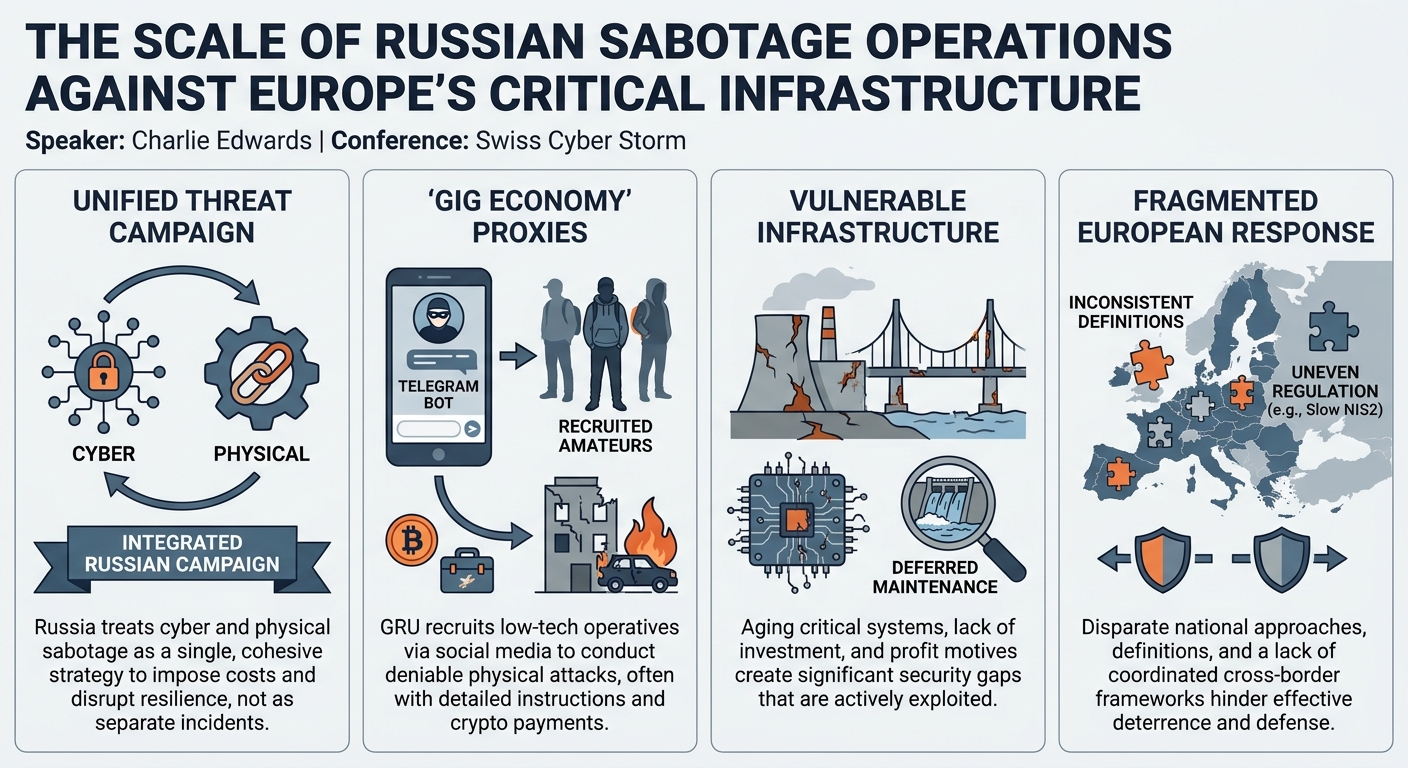
- Unified Threat Campaign: Russia treats cyber and physical sabotage as an integrated campaign, not separate incidents, targeting critical national infrastructure to impose costs and disrupt European resilience.
- "Gig Economy" Proxies: Russian intelligence (GRU unit 29155) leverages a "gig economy" model, recruiting "professional amateurs" via social media (e.g., Telegram's "previet bot") to conduct low-tech, deniable physical attacks, often providing detailed instructions and paying in cryptocurrency.
- Vulnerable Infrastructure: Europe's aging critical national infrastructure, coupled with a lack of investment and the profit motives of private operators leading to deferred maintenance, creates significant vulnerabilities that Russia actively exploits.
- Fragmented European Response: Inconsistent definitions of CNI and sabotage, uneven regulation (e.g., slow NIS2 transposition), and a lack of coordinated, cross-border response frameworks hinder Europe's ability to effectively deter and respond to these threats.
- Focus on Recovery and Patterns: Defensive strategies must prioritize resilience and reduce Mean Time To Recovery (MTTR) rather than solely focusing on compliance. Additionally, analyzing patterns across incidents (e.g., water treatment plant attacks) is crucial to uncover coordinated campaigns and develop effective countermeasures.
- Urgent Need for Attribution and Deterrence: Governments need clearer thresholds for response, improved capabilities for rapid attribution, and predictable consequences to counter plausible deniability and establish a more assertive deterrent effect against Russian sabotage.
About the Speaker(s)
Charlie Edwards is a distinguished Researcher at the Institute of Security Studies in London. He is recognized for his expertise in contemporary security challenges, particularly those related to hybrid warfare and critical infrastructure protection. Edwards's work, including the research presented at Swiss Cyber Storm, focuses on analyzing the evolving tactics of state actors and their implications for European security. His caliber and status as a researcher were highlighted by the conference host, underscoring the significance and timeliness of his contributions to understanding and addressing complex geopolitical threats.
Reviews
Dr. Zero (Offensive Security Researcher) — STRONG ACCEPT
A substantive threat intelligence briefing that strips the buzzwords out of 'hybrid warfare' to show exactly how Russian intelligence is currently operating in Europe. Edwards maps out GRU Unit 29155's pivot to a Telegram-driven gig economy for physical sabotage, providing rare actionable signal for defenders.
Heather Calloway (CISO) — STRONG ACCEPT
This is required viewing for any CISO with a physical footprint in Europe. Edwards perfectly captures the convergence of cyber operations and kinetic sabotage, moving past theory into actual incident data that changes how we must calculate business continuity.