Motivate and Prepare for Cyber Crises
Gregor Wegberg (Head of the Digital Forensics and Response Team · Oneconsult)
Swiss Cyber Storm 2025 · Day 1 · Panorama
Overview
In an increasingly volatile digital landscape, the question for organizations is not if they will face a cyber crisis, but when. Gregor Wegberg, Head of the Digital Forensics and Response Team at Oneconsult, delivered a compelling talk at Swiss Cyber Storm, addressing one of the most persistent challenges in cybersecurity: motivating executive boards to actively prepare for and lead during such crises. His presentation delved into a real-world case study, offering practical strategies to shift leadership from passive delegation to active participation and ownership in cyber resilience.
Key moments
- 2:17 Board's lack of commitment despite security investments
- 4:45 Defining board's crisis roles and responsibilities
- 9:00 Understanding executive priorities: share prices over IP
- 12:00 Using 'killer story' of logistics and share price impact
- 14:40 Engaging executives through realistic tabletop exercises
- 17:40 Realistic tabletop execution: real alerts and fake media
- 24:20 Q&A: Securing crisis management cheat sheet
- 28:50 Q&A: Motivating proactive action before a crisis
Motivate and Prepare for Cyber Crises
Speakers: Gregor Wegberg, Head of the Digital Forensics and Response Team, Oneconsult
Conference: Swiss Cyber Storm
YouTube: https://www.youtube.com/watch?v=ntGmjEB8XIA
Overview
In an increasingly volatile digital landscape, the question for organizations is not if they will face a cyber crisis, but when. Gregor Wegberg, Head of the Digital Forensics and Response Team at Oneconsult, delivered a compelling talk at Swiss Cyber Storm, addressing one of the most persistent challenges in cybersecurity: motivating executive boards to actively prepare for and lead during such crises. His presentation delved into a real-world case study, offering practical strategies to shift leadership from passive delegation to active participation and ownership in cyber resilience.
Wegberg highlighted the critical disconnect often observed between well-funded security teams and executive boards that, despite approving budgets, remain disengaged from the practicalities of crisis response. This talk is crucial for cybersecurity professionals seeking to bridge this gap, demonstrating how to translate technical risks into business-centric impacts that resonate with decision-makers. It emphasizes that while technology is essential, the human and organizational elements, particularly executive leadership, are often the weakest links in an effective crisis response.
The core of Wegberg's message revolves around the necessity of preparedness in a "mad bad world" where attackers cannot be entirely prevented. He argues that true resilience comes from proactive engagement and realistic training for all levels of an organization, especially the executive board that often constitutes the designated crisis team. By sharing a successful methodology, Wegberg provides a blueprint for security leaders to inspire genuine commitment and leadership from the top, ensuring that when a cyber crisis hits, the organization is not only technically capable but also strategically led.
Background
▶ Watch: Board's lack of commitment despite security investments (2:17)
The problem Wegberg addressed is a pervasive one across industries: executive boards often understand the necessity of cybersecurity but struggle with commitment and leadership when it comes to crisis preparedness. He illustrated this with a case study of a large, publicly traded international manufacturer operating in over 50 countries. This organization was highly hierarchical, with a security team that had ample resources, including an XDR (Extended Detection and Response) service and multiple Incident Response (IR) teams. Budgets were consistently approved, and the CISO (Chief Information Security Officer) regularly reported metrics.
However, the board of directors, which had self-appointed itself as the organization's crisis team, remained detached. They would sign off on reports and approve requests but never engaged in real discussions or demonstrated genuine commitment. This lack of leadership was compounded by a common organizational flaw: security consultants, including Wegberg's own firm, would conduct extensive gap analyses based on frameworks like NIST CSF or ISO 27001. These analyses consistently identified technical and organizational weaknesses.
The critical issue arose when the identified tasks and gaps were invariably delegated to the security team. This meant the CISO and their team were made responsible for areas far beyond their remit, such as Business Continuity Management (BCM), public relations, and legal compliance. As Wegberg pointed out, BCM is about business continuity, not just IT security continuity. Similarly, managing public statements during a crisis or navigating mandatory notification laws in multiple jurisdictions falls squarely within the domains of communications and legal departments, not IT security. Yet, these responsibilities were continually offloaded onto the security team, creating an impossible burden.
This dysfunctional dynamic persisted because "nothing big" had happened yet. Even internal auditing, serving as a "third line of defense," would merely reiterate the same known gaps, leading to a cycle of reports without resolution. Wegberg emphasized that in their experience, when incidents take a long time to resolve, it's rarely due to technical failures but almost always due to shortcomings in the "people" and "process" aspects, particularly the lack of an integrated, whole-of-organization response led by an engaged executive crisis team. The fundamental challenge was to make the executive board truly care and take ownership of their designated role.
Key Findings
▶ Watch: Understanding executive priorities: share prices over IP (9:00)
Wegberg's team, in collaboration with their customer, developed a multifaceted approach to overcome executive disengagement, culminating in several key findings that proved successful:
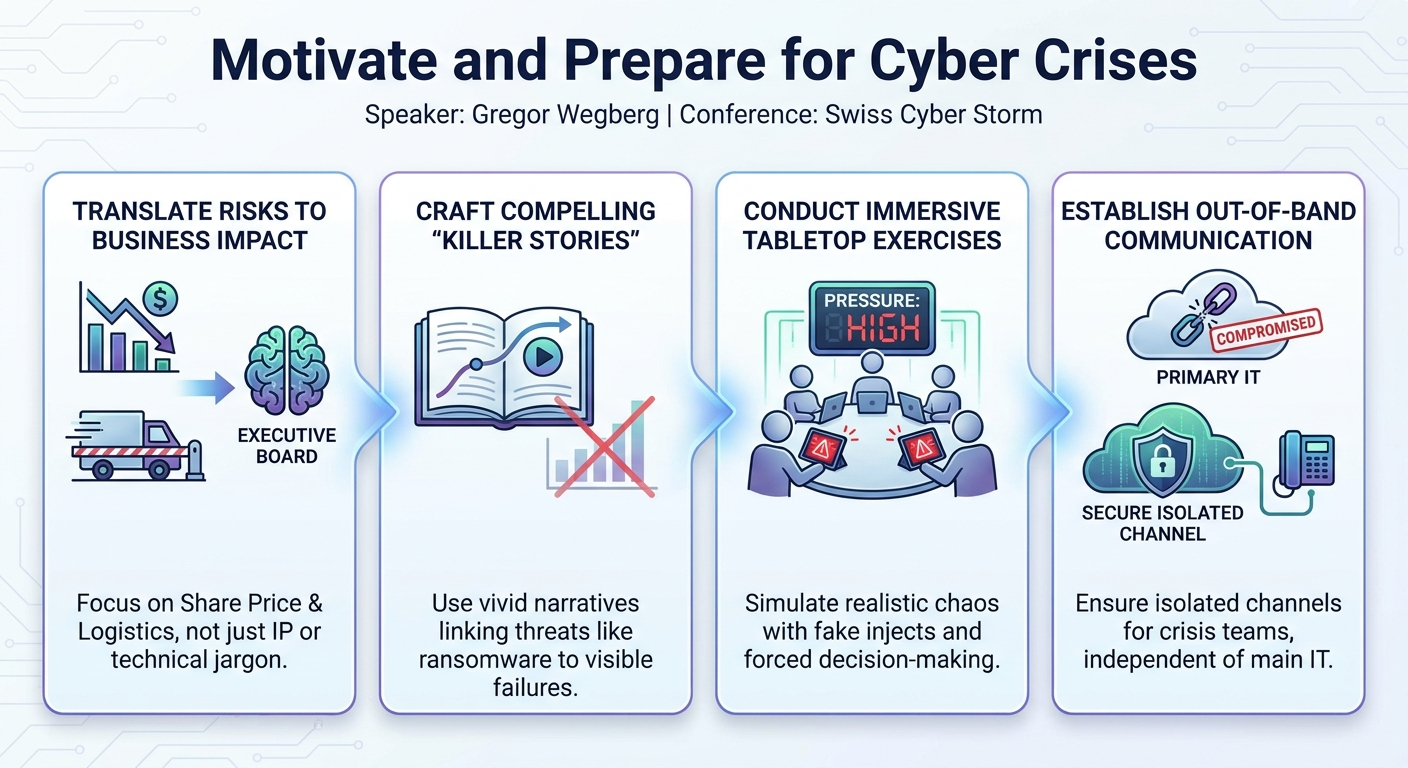
- Understand Executive Priorities, Not Just Security Concerns: The most crucial discovery was the need to speak the board's language. Security professionals often focus on intellectual property (IP), but for this particular board, IP was a secondary concern. Their primary drivers were share prices and logistics. The board members, many of whom held significant company shares, were deeply invested in the company's financial performance and operational stability. Understanding this allowed the security team to reframe cybersecurity risks in terms of direct financial and operational impact.
- Craft a "Killer Story," Not Just a "Killer Chart": While the initial aim was to create a single, impactful "killer chart" that would instantly convey the severity of the problem, this proved difficult. Instead, a compelling narrative, a "killer story," was developed. This story linked common cyber threats, specifically ransomware, to the board's identified priorities:
- Logistical breakdown: Visualizing how a ransomware attack could halt automated logistics, leading to hundreds of trucks queuing up in a small city, creating highly visible operational chaos.
- Share price plummet: Demonstrating how public disclosure of a breach (e.g., via fake news articles) would directly impact the company's stock value, hitting them where it mattered most.
- Leverage Experiential Learning Through Immersive Tabletop Exercises: The most impactful finding was the power of "letting them experience it." Instead of presenting more numbers or processes, the team designed highly realistic tabletop exercises specifically for the board of directors. These exercises were not passive discussions but dynamic simulations designed to put executives under pressure, forcing them to make real-time decisions and confront their unpreparedness. The goal was to mimic the chaos and uncertainty of a real crisis, compelling them to understand their roles and responsibilities firsthand.
- Develop a Comprehensive, Business-Centric Crisis Management "Cheat Sheet": The direct outcome of the successful tabletop exercises was the board's commitment to creating a detailed, 130-slide crisis management cheat sheet. This living document defined roles, responsibilities, expected recovery times (e.g., 6 weeks for a specific location hit by ransomware), and decision-making frameworks for all crisis team members, bridging the gap between technical response and business leadership. It became a practical guide, shifting discussions from technical minutiae to strategic business impact during subsequent exercises.
These findings collectively represent a strategic pivot from traditional, technical-centric security reporting to a more empathetic, business-aligned approach that prioritizes executive engagement and practical preparedness.
Technical Deep Dive
▶ Watch: Engaging executives through realistic tabletop exercises (14:40)
While not a deep dive into code or network architecture, the talk provided a significant technical and methodological deep dive into the design and execution of effective executive-level cyber crisis preparedness. Wegberg detailed the specific techniques and "tools" used to shift the executive board's mindset.
The initial analytical step involved creating an "ugly graph" that mapped potential cyber impacts to the board's actual priorities. This wasn't about security metrics but about understanding what truly motivated them. For this manufacturer, it wasn't intellectual property but rather share prices and the integrity of their logistics operations. This insight was foundational, guiding all subsequent communication.
The "killer story" was constructed with specific, impactful elements:
- Data-driven context: Referencing a publication that showed the manufacturing industry experiences a high rate of cyberattacks, specifically 26%, served as a relevant starting point.
- Ransomware as the primary threat: This was chosen for its widespread recognition and devastating impact. The narrative directly linked ransomware to the breakdown of their highly digitalized and automated logistics.
- Visual impact: A modified Google Maps image was used to visually represent the chaos of 200-300 trucks queuing up outside their facilities due to a logistics system failure. This tangible, localized impact immediately resonated with the operations personnel and the board.
- Reputational and financial damage: Fake news articles, specifically one from "Watson" (a Swiss news outlet), were generated. These articles detailed the company being hit by a specific ransomware variant (e.g., Akira), directly correlating the attack with a hypothetical drop in share price. Wegberg candidly admitted that while share prices often recover, the initial story focused on the immediate, negative impact to drive home the point.
The tabletop exercises themselves were a masterclass in immersive simulation:
- Scenario Design: While initially considering a complex insider threat scenario involving SAP logistics changes, the team opted for ransomware as a more immediately understandable and impactful threat for the initial exercise. Later exercises evolved to include more modern threats like AI insider threats.
- Orchestration Philosophy: The key was minimal guidance. The orchestrator's role was to "shut up," present injects, and let the board grapple with decisions, echoing the uncertainty of a real crisis. Questions from the board, such as "who was it?", were met with realistic responses like "ask me in three days," reinforcing that immediate answers are rarely available.
- Realistic Injects:
- Live Alert Simulation: The exercise began with a simulated crisis alert sent to the board's mobile devices. Phones in the room started "beeping very annoyingly, very loud," startling participants and immediately immersing them. This replicated the chaos of a real alert, even causing some alerts to propagate to external individuals due to participants' unfamiliarity with the system.
- Fake Evidence: Highly customized and realistic "fake material" was created. This included screenshots of internal applications (e.g., a "proof published by Play ransomware" notice placed on a screenshot of their actual internal application). This level of detail made the scenario incredibly real; participants even recognized specific applications and, in one instance, nearly identified the account used to create the fake screenshot, forcing the exercise to adapt.
- LLM-generated News: Fake news articles were easily generated using Large Language Models (LLMs), specified for "training purposes" to avoid content filters.
The culmination of these exercises was the development of a 130-slide crisis management cheat sheet. This was not a static document but a dynamic, hyperlinked slide deck that served as the board's primary guide during a crisis. It included:
- Expected Recovery Times: Specific, pre-defined recovery estimates, such as "at least six weeks" for a critical location hit by ransomware, to manage expectations and highlight the severity of impact.
- Role-Specific Guidance: For technical teams (like the CERT), it outlined what the board should expect from them (e.g., "ask them those questions to understand it really"), rather than instructing technical actions. For non-technical board members (e.g., Head of Legal, Head of Communications), it detailed their specific responsibilities and tasks during a crisis. This exposed gaps in preparedness in these non-technical domains, prompting them to develop their own sections.
- Secure Deployment: Crucially, this sensitive document was stored within a separate, isolated SaaS tenant specifically for board communication and file sharing, completely disconnected from the internal IT infrastructure. Hard copies were also distributed to key individuals (CISO, CFO, CIO) and stored in secure locations (e.g., home, IT safes with "breaking glass" account passwords). This out-of-band storage strategy aimed to protect the crisis plan from being compromised during an actual cyberattack that might cripple internal systems.
This methodological deep dive showcases a strategic, experience-driven approach to executive preparedness, leveraging realistic simulations and tailored communication to build genuine resilience.
Demo / Proof of Concept
▶ Watch: Realistic tabletop execution: real alerts and fake media (17:40)
The entire methodology presented by Gregor Wegberg served as a powerful proof of concept, demonstrating how to effectively engage and prepare an executive board for cyber crises. The centerpiece of this demonstration was the tabletop exercise itself, which was meticulously designed to be an immersive and impactful experience rather than a theoretical discussion.
The "demo" began with an immediate, real-world sensation: a simulated crisis alert. As Wegberg explained the upcoming exercise, his colleagues simultaneously triggered the alerts on the board members' mobile devices. This resulted in all phones in the room "beeping very annoyingly, very loud," immediately startling and engaging the participants. This unexpected, disruptive start was crucial for creating a sense of urgency and realism. Some board members were so caught off guard that they struggled to acknowledge or disable the alerts, leading to alerts propagating to other individuals outside the room—a powerful, albeit unintended, demonstration of initial unpreparedness.
Once engaged, the participants were presented with highly realistic "injects." These included:
- Screenshots of Internal Applications: Fake but convincing screenshots of the company's own internal applications, showing a message like "proof published by Play ransomware." This made the threat incredibly tangible, as participants immediately recognized their own systems. Wegberg noted that some participants even deduced the specific account or person responsible for creating the fake screenshot, underscoring the high fidelity of the simulation.
- Fake News Articles: Fabricated news articles from reputable outlets (e.g., a Swiss news site like "Watson") reporting the company's breach and subsequent share price drop. These were generated using Large Language Models (LLMs), ensuring they looked authentic.
The orchestrator's role during this "demo" was critical: to facilitate, not to provide answers. When the board members, under pressure, asked questions like "who was it?" or "what do we do?", Wegberg's instruction was to "shut up" and let them "cook." This forced the board to confront the reality of limited information and the need to make decisions based on available data, rather than relying on immediate technical solutions from the security team.
The impact of this immersive demonstration was profound. The board, initially disengaged, became "really hooked." The CEO, realizing the depth of their unpreparedness, eventually had to ask for help to move forward. This pivotal moment validated the approach, leading to a commitment for regular exercises (initially twice a year, settling at 1.5 times annually) and, most importantly, the development of the 130-slide crisis management cheat sheet. This comprehensive guide, which emerged directly from the "demo," became the tangible proof of concept for the entire strategy, showcasing how experiential learning could transform passive awareness into active, structured preparedness.
Defensive Implications
▶ Watch: Q&A: Motivating proactive action before a crisis (28:50)
The strategies presented by Gregor Wegberg offer critical defensive implications for organizations aiming to enhance their cyber resilience, moving beyond purely technical controls to address the crucial human and organizational factors.
- Reframe Security in Business Terms: Defenders must shift their communication from technical jargon and vulnerability counts to tangible business impacts. Understand what truly motivates the executive board – often share prices, logistics, revenue, or reputation – and translate cyber risks into these terms. This involves creating compelling narratives, or "killer stories," that vividly illustrate how a cyberattack directly affects the organization's core operations and financial health.
- Actively Engage Executive Leadership: It is insufficient for executive boards to merely approve budgets or receive reports. Defenders should push for active participation in defining crisis processes and measures. This means involving board members in discussions, decision-making, and, critically, in tabletop exercises. The goal is to cultivate a sense of ownership, ensuring that the crisis team understands its responsibilities and leadership role, rather than delegating all crisis management to IT.
- Implement Immersive and Realistic Tabletop Exercises: Move beyond theoretical discussions. Design and conduct tabletop exercises that are highly realistic, dynamic, and challenging. Incorporate elements that mimic the chaos and stress of a real crisis, such as simulated alerts, fake but authentic-looking evidence (e.g., screenshots of internal applications, AI-generated news articles), and a facilitator who encourages independent decision-making rather than providing immediate answers. These exercises should involve all relevant stakeholders, including legal, communications, HR, and operations, not just IT.
- Develop Comprehensive, Accessible Crisis Playbooks: Create a detailed crisis management cheat sheet or playbook that clearly outlines roles, responsibilities, communication protocols, and expected timelines for all crisis team members. This document should be business-centric, providing guidance on what to expect from technical teams and what non-technical departments must do. Include critical information like estimated recovery times for key systems and locations.
- Establish Secure, Out-of-Band Crisis Communication Channels: During a major cyberattack, internal IT systems (email, collaboration platforms) may be compromised or unavailable. Defenders should advocate for and implement isolated, secure communication channels for the crisis team. This could involve a separate SaaS tenant for board-level communication and file sharing, completely disconnected from the primary IT infrastructure, as well as maintaining encrypted hard copies of essential documents.
- Prioritize Continuous Improvement and Repetition: Cyber crisis preparedness is not a one-time activity. Regular, scheduled tabletop exercises (e.g., 1-2 times per year) are essential to keep the crisis team's skills sharp, update playbooks, and adapt to evolving threats. Consistent communication and repetition of key messages are necessary to maintain executive engagement over time, especially by leveraging real-world incidents affecting peer organizations.
By adopting these defensive implications, organizations can move from a reactive stance to a proactive, integrated approach to cyber crisis management, ensuring that leadership is not only aware but also prepared and empowered to act decisively when a significant incident occurs.
Key Takeaways
- Executive Buy-in Requires Business Context: To motivate leadership, translate cybersecurity risks into tangible business impacts like share price fluctuations and logistics disruptions, rather than focusing solely on technical vulnerabilities or intellectual property.
- Craft a Compelling "Killer Story": A well-constructed narrative, linking common threats like ransomware to specific, visible business failures (e.g., trucks queuing, fake news reports of breaches), is more effective than abstract data or a single "killer chart."
- Experiential Learning is Paramount: Highly realistic and immersive tabletop exercises that simulate the chaos and pressure of a real cyber crisis are crucial for engaging executive boards and making them confront their preparedness gaps firsthand.
- Force Decision-Making, Withhold Easy Answers: During simulations, facilitators should avoid immediately answering executive questions, forcing the crisis team to make decisions with incomplete information, mirroring real-world conditions.
- Develop a Comprehensive Crisis Playbook: Create an accessible, business-centric "cheat sheet" (e.g., a 130-slide deck) that clearly defines roles, responsibilities, and expected recovery timelines for all crisis team members, separating technical actions from leadership expectations.
- Secure Out-of-Band Communication: Ensure critical crisis management documents and communication channels are isolated from the primary IT infrastructure (e.g., separate SaaS tenants, hard copies) to maintain accessibility during a system-wide compromise.
About the Speaker(s)
Gregor Wegberg is the Head of the Digital Forensics and Response Team at Oneconsult. His team specializes in handling significant and complex cybersecurity incidents that typically exceed the capabilities of standard Security Operations Centers (SOCs). Oneconsult, under Wegberg's leadership, has served as the incident response team for high-profile events, including the Eurovision Song Contest. With a background as a software developer, Wegberg brings a structured and practical approach to defining success and achieving preparedness, applying principles like "definition of done" to complex crisis management challenges. He is dedicated to helping organizations build resilience by bridging the gap between technical security and executive leadership.
Reviews
Dr. Zero (Offensive Security Researcher) — SOLID
This is a consulting war story about getting a disengaged board to actually do their jobs during a breach. Wegberg's team used simulated alerts, fake news articles, and Play ransomware injects to scare executives into caring about incident response. It's solid, practical advice for CISOs tired of holding the bag for business continuity.
Heather Calloway (CISO) — STRONG ACCEPT
This is a blueprint for forcing executive boards to own their crisis roles instead of delegating the operational fallout to the CISO. It’s highly actionable viewing for any security leader struggling to get their board to take a tabletop exercise seriously.